
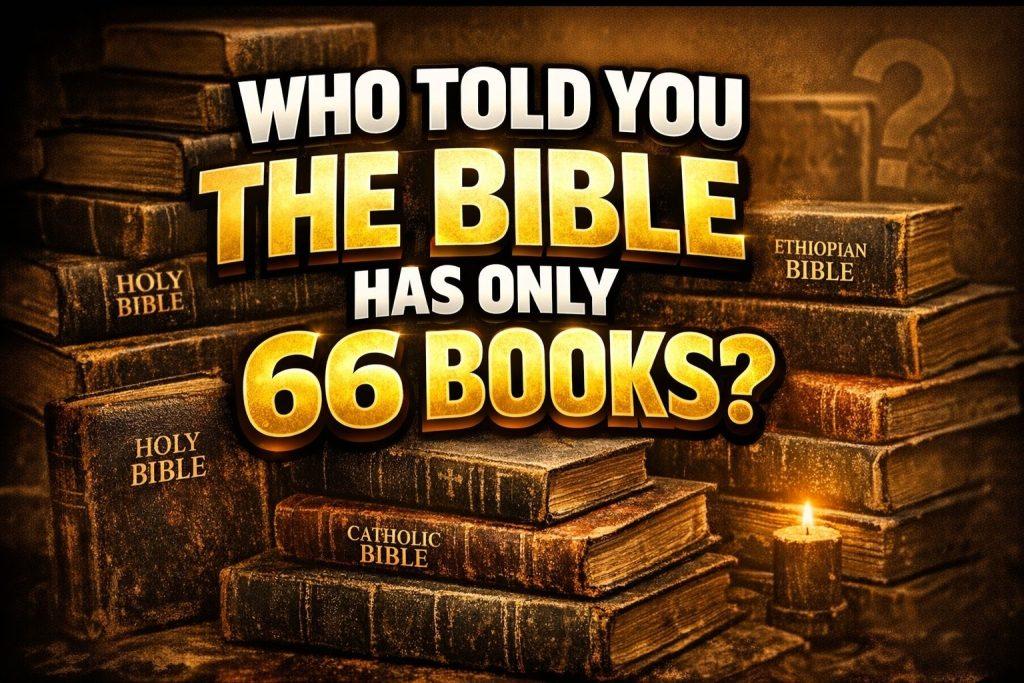
Who Told You the Bible Has Only 66 Books?
Brief Overview
- The question of who determined the biblical canon is the single most effective challenge a Catholic can pose to any Protestant who holds to Scripture alone as the final authority.
- Every possible Protestant answer to this question eventually collapses into either circular reasoning or an unintentional admission that an authority outside Scripture defined Scripture.
- This canonical question has played a direct role in the conversion of numerous Protestant pastors, scholars, and laypeople to the Catholic faith over the past several decades.
- Catholics who learn to ask this question clearly and charitably gain an apologetics tool that cuts through centuries of denominational debate in a single conversation.
The Question That Changes Everything
Ask a Protestant friend a simple question: “Who told you the Bible has 66 books?” Then wait. The silence that follows is usually more instructive than any argument you could make. Most Protestants have never considered the question because they have never had to. The 66 book Bible is simply the Bible they were handed, and they assumed it had always been that way. The discovery that their canon was assembled by a specific group of people at a specific point in history, and that other Christians use larger Bibles, opens a crack in the foundation of Sola Scriptura that is very difficult to seal.
The question is not a trick and it is not hostile. It is a genuine historical inquiry. Somebody decided that Matthew belongs in the Bible but the Didache does not. Somebody decided that Jude belongs but the Shepherd of Hermas does not. Somebody decided that Esther stays but Tobit goes. That somebody was not God reaching down from heaven with a table of contents. It was a community of believers exercising judgment, and the identity of that community matters enormously.
The “Self-Authenticating” Answer and Why It Fails
The most common sophisticated Protestant response is that the canonical books are “self-authenticating.” This position, developed by theologians like Michael Kruger, argues that the inspired books of Scripture bear internal qualities, divine authorship, corporate reception by the Church, and the testimony of the Holy Spirit, that allow believers to recognize them as God’s Word. The books authenticate themselves, and the Church merely acknowledged what was already evident.
This argument sounds elegant until you press on it. If the books truly authenticate themselves, why did the early Church spend four centuries debating which books belonged? Why did respected Church Fathers like Origen list different canons than Athanasius? Why does the Ethiopian Church recognize 81 books while Protestants recognize 66? If self-authentication were as clear as this theory suggests, every Christian community guided by the Holy Spirit should have arrived at the same list. They did not. The self-authentication argument attempts to remove the need for Church authority, but the historical record demonstrates that Christians could not agree on the canon without precisely that authority.
Catholic Share is a one-person ministry. If this content helps you, consider supporting it.
Catholic Share is a one-person ministry, and articles like this stay free because of readers who choose supporting this work.
The “Early Church Consensus” Answer and Its Problem
Some Protestants take a different approach and argue that the canon was settled by broad consensus among early Christians rather than by any single authoritative body. On this view, the Church gradually recognized the canonical books through widespread use, and no council actually “decided” anything. The councils merely ratified what everyone already knew.
This answer has a grain of truth but a fatal flaw. Consensus did develop over time, but it was not universal and it was not spontaneous. The Book of Revelation was rejected by many Eastern churches well into the fourth century. The letter to the Hebrews was disputed in the West. Second Peter faced serious questions about its authenticity. James was questioned by multiple early authorities long before Luther expressed his doubts. If consensus alone determined the canon, these disputed books should have been excluded, because consensus about them did not exist. What did exist was an institutional Church with the authority to settle disputes, and that Church exercised its authority at the councils of Rome, Hippo, and Carthage by formally defining which books belonged. Consensus contributed to the process. Authority completed it.
The “Holy Spirit Guided Us” Answer and the Obvious Follow-Up
The most pious Protestant answer is simply that the Holy Spirit guided believers to recognize the correct books. Catholics actually agree with this claim. The Church teaches that the Holy Spirit guided the process of canonical discernment (CCC 120). The disagreement is not about whether the Spirit was involved but about how the Spirit worked. Catholics hold that the Holy Spirit guided the Church through her bishops, councils, and teaching authority. Protestants who invoke the Spirit’s guidance without any institutional mechanism have to explain why the Spirit guided different communities to different canons.
The Ethiopian Church claims the Spirit’s guidance for 81 books. The Orthodox churches claim it for 78. Catholics claim it for 73. Protestants claim it for 66. If the Holy Spirit is the sole explanation and no authoritative Church is needed, then the Spirit apparently gave contradictory guidance to sincere believers across multiple centuries. The Catholic position avoids this problem. The Spirit guided one Church with one teaching authority to define one canon. That canon has 73 books, and it has remained unchanged since the fourth century.
The Conversion Stories This Question Produces
The canon question is not merely theoretical. It has changed lives. Scott Hahn, one of the most prominent Catholic converts of the twentieth century, has described the canon question as a key factor in his conversion from Presbyterianism. Marcus Grodi, founder of the Coming Home Network, has documented hundreds of conversion stories in which the question of biblical authority and the canon played a central role. When Protestants who love the Bible begin to investigate where their Bible came from, the trail leads inevitably to the Catholic Church.
This pattern repeats because the logic is genuinely difficult to escape. A Protestant who takes Sola Scriptura seriously must explain how Scripture can be the sole authority when Scripture itself does not define its own contents. The moment you need something outside Scripture to tell you what Scripture is, you have admitted that Scripture alone is not sufficient. That admission does not automatically make someone Catholic, but it removes the single biggest barrier to considering Catholic claims about the Church’s teaching authority.
How to Ask This Question Without Starting a Fight
Delivery matters as much as content. Posing this question with a smug or combative tone will produce defensiveness, not reflection. The goal is not to win a debate point but to plant a seed of genuine inquiry. Ask with curiosity rather than accusation. Say something like, “I have always wondered about this, and I am curious what you think. How do we know the Bible has exactly 66 books? Where does that number come from?” Let the other person work through their own answer. Resist the urge to pounce on every weakness immediately. Give them space to sit with the difficulty.
The strongest version of this conversation happens when you can share positive content alongside the question. Mention the councils of Hippo and Carthage. Talk about what the deuterocanonical books actually contain. Share the story of the Ethiopian Bible. When people see that the Catholic position is historically grounded rather than merely polemical, they engage with it far more openly. Truth delivered in charity is always more effective than truth delivered as a weapon (CCC 2489).
So, Will You Ask the Question?
The canon question remains the most direct path from Protestant assumptions to Catholic truth. It does not require advanced theology or obscure historical knowledge. It requires one simple, honest question that any person can ask and that no Protestant theology has ever adequately answered: who told you the Bible has 66 books? The answer, whether the Protestant admits it or not, is the Catholic Church. Catholic bishops at Catholic councils, guided by the Holy Spirit, examined the available writings and defined the canon that every Christian tradition has used as its starting point ever since. Protestants then subtracted from that canon in the sixteenth century without any comparable authority to justify the decision.
If you are a Catholic who has never asked this question in conversation, you are leaving your strongest card on the table. Learn the history. Know the councils. Read the deuterocanonical books. And when the moment is right, ask the question with genuine charity and let the historical record do the heavy lifting. The truth about the canon does not need embellishment. It only needs a voice willing to speak it clearly.
Catholic Share is a one-person, reader-supported ministry that publishes everything for free. If this article served you, you can subscribe to the free newsletter for weekly writing, or help keep articles like this freely available by choosing to support this ministry.
Keep reading. Keep sharing.
Follow Catholic Share wherever you spend your time — and share this article with someone who needs it.