
From Carthage to Ethiopia: The Bible’s African Roots
Brief Overview
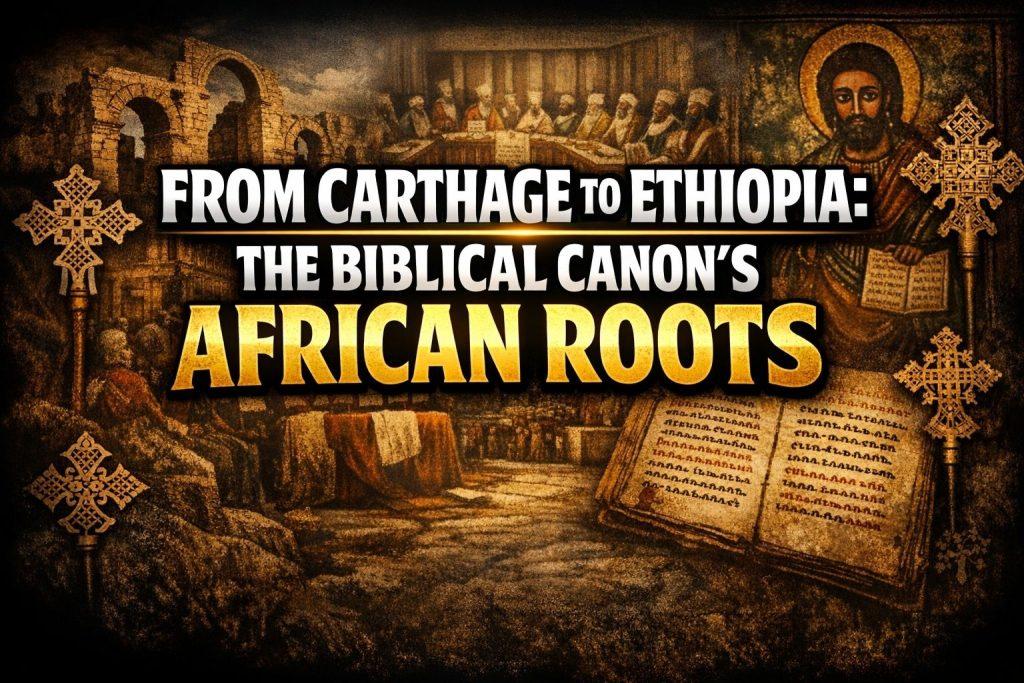
- The biblical canon was formally defined at councils held in North Africa, making the continent central to the history of how Christians received their Bible.
- The Ethiopian Orthodox Church independently preserved the largest biblical canon in Christianity, with manuscripts predating the King James Version by nearly 800 years.
- The 66 book Protestant Bible has no precedent in any ancient African, European, or Middle Eastern Christian community and represents a sixteenth century innovation.
- Connecting the North African councils to the Ethiopian tradition reveals a powerful and largely untold story about Africa’s role in shaping the Word of God.
The African Councils That Defined Your Bible
The story of the biblical canon runs directly through North Africa. In 393 AD, bishops gathered at the Synod of Hippo in modern-day Algeria and produced a formal list of the books of Sacred Scripture. That list contained 73 books. Four years later, the Council of Carthage in modern-day Tunisia ratified the same canon and sent it to Rome for confirmation. A subsequent Council of Carthage in 419 reaffirmed the list once more. St. Augustine, the Bishop of Hippo and arguably the most influential theologian in Western Christianity, played a direct role in these proceedings and championed the inclusion of the deuterocanonical books.
These were not obscure regional meetings. Their canonical decisions shaped the entire Western Church and remained unchallenged for over a thousand years. Every medieval Bible, every monastic lectionary, every cathedral pulpit in Europe read from the 73 book canon that African bishops defined. When modern Catholics defend the deuterocanonical books, they stand on ground that was first staked out by African churchmen in African cities under the African sun. The irony that many Western Christians today have never heard of Hippo or Carthage in this context speaks to how thoroughly this history has been forgotten.
Across the Continent: Ethiopia’s Independent Witness
While North African bishops were defining the canon for the Western Church, Ethiopian Christians were already reading a Bible that exceeded it. The Ethiopian Orthodox Tewahedo Church traces its roots to the apostolic era, and its canon of 81 books developed independently from both Rome and Constantinople. Ethiopian manuscripts of Scripture, written in the ancient Ge’ez language, include not only every book in the Catholic Bible but also 1 Enoch, Jubilees, 4 Baruch, and additional texts in the New Testament such as the Sinodos and the Book of the Covenant.
The Garima Gospels, discovered in an Ethiopian monastery, are among the oldest illustrated Christian manuscripts in existence, dating to roughly the fifth or sixth century. Ethiopia’s monastic tradition preserved these texts through centuries of isolation, war, and political change. The Ethiopian Church did not borrow its canon from Rome. It did not respond to the Council of Trent. It received its Scriptures from the earliest Christian missionaries who carried the faith into the Horn of Africa and simply kept everything it was given. That independent preservation makes Ethiopia an extraordinarily valuable witness in any debate about which books belong in the Bible.
Catholic Share is a one-person ministry. If this content helps you, consider supporting it.
Catholic Share is a one-person ministry, and articles like this stay free because of readers who choose supporting this work.
Two Streams, One Confirmation
Here is what makes the connection between Carthage and Ethiopia so significant for the canon debate. These two African Christian traditions developed their canons with minimal direct influence on each other, yet both arrived at collections that include every deuterocanonical book Protestants removed. Carthage defined a 73 book canon through formal conciliar authority. Ethiopia preserved an 81 book canon through continuous liturgical use and monastic transmission. Neither tradition ever entertained the idea that Tobit, Wisdom, Sirach, or Maccabees were anything less than sacred Scripture.
When a Protestant claims that the deuterocanonical books were “added” by the Catholic Church at Trent in 1546, two separate African traditions stand as witnesses against that claim. The books were already in the canon defined at Carthage eleven centuries before Trent. They were already in the Ethiopian Bible centuries before any European reformer was born. Two independent streams of African Christianity, flowing from different sources and through different channels, confirm the same truth. The broader canon is the original canon. The smaller Protestant Bible is the novelty.
The Manuscripts Europe Forgot
Africa preserved biblical manuscripts that Europe either lost or never possessed. The complete text of 1 Enoch survives only in Ge’ez, the Ethiopian liturgical language. Without Ethiopian monks copying and preserving this text generation after generation, the Book of Enoch, quoted directly in Jude 1:14-15, would have vanished from human knowledge entirely. Jubilees, an ancient retelling of Genesis through Exodus that was influential among Second Temple Jews, likewise survives in full only in Ethiopian manuscripts.
Catholic and Protestant scholars have recognized the significance of these Ethiopian texts for biblical studies. The Dead Sea Scrolls, discovered in the twentieth century, confirmed that Aramaic fragments of 1 Enoch circulated widely in ancient Judaism, validating what Ethiopian Christians had preserved all along. Africa did not merely receive the Bible passively from European missionaries, as colonial narratives sometimes suggest. Africa actively shaped, defined, and preserved the Christian Scriptures from the very beginning, and the manuscript evidence proves it.
Why This History Gets Ignored
The reasons this story remains largely untold are uncomfortable. Western Christianity, both Catholic and Protestant, has often centered its narrative of biblical history around European figures and European events. The standard Protestant telling jumps from the apostles to the Reformation with almost nothing in between. The standard Catholic telling emphasizes Rome, the Latin Vulgate, and the Council of Trent. Both versions underplay Africa’s role. Hippo and Carthage get mentioned in footnotes. Ethiopia gets treated as an exotic curiosity rather than a serious canonical witness.
This neglect does a disservice to the truth. The Bible that Western Christians carry to church on Sunday was defined on African soil by African bishops. The most complete ancient biblical tradition in Christianity was preserved in African monasteries by African monks. Correcting this blind spot does not require rewriting Church history. It requires reading the history that already exists and giving Africa the credit it has always deserved.
What This Means for the Canon Debate Today
The African roots of the biblical canon give Catholics a powerful historical argument that extends well beyond the usual apologetic talking points. When a Protestant challenges you on the deuterocanonical books, you can point not only to the councils of Hippo and Carthage but also to the Ethiopian tradition as an independent confirmation. Two witnesses from the same continent, separated by geography and ecclesiastical structure, both preserved a canon larger than 66 books. The Protestant position requires you to believe that both of these ancient traditions got it wrong and that a sixteenth century German reformer got it right. That is a difficult case to make with a straight face.
The Catholic Church teaches that the Holy Spirit guided the process of canonical discernment (CCC 120). The African evidence supports this teaching from an angle that European-centered arguments cannot provide. God did not entrust His Word to a single culture or a single continent. He scattered the seeds of Scripture across the ancient world and raised up communities in North Africa and East Africa to define it, preserve it, and hand it on to every generation that followed.
So, Will You Follow the Canon Back to Africa?
The biblical canon was born in Africa. That statement is not a metaphor or an exaggeration. It is a description of where the Church’s bishops first gathered to formally define which books constitute Sacred Scripture, and where the most extensive biblical tradition in Christianity still lives today. From the council halls of Carthage to the rock-hewn churches of Lalibela, African Christianity has guarded the Word of God with a faithfulness that puts many Western Christians to shame. The 66 book Bible that dominates the Protestant world has no roots in this soil. It was assembled in sixteenth century Europe by men who broke with the very Church that defined the canon on African ground.
Catholics who know this history carry an argument that is both historically airtight and refreshingly different from the usual back-and-forth of denominational debate. The next time someone questions why your Bible has more books, do not start in Rome. Start in Carthage. Start in Ethiopia. Start where the story actually began, and let Africa’s witness speak for itself.
Catholic Share is a one-person, reader-supported ministry that publishes everything for free. If this article served you, you can subscribe to the free newsletter for weekly writing, or help keep articles like this freely available by choosing to support this ministry.
Keep reading. Keep sharing.
Follow Catholic Share wherever you spend your time — and share this article with someone who needs it.