
Does the Number of Books in Your Bible Really Matter?
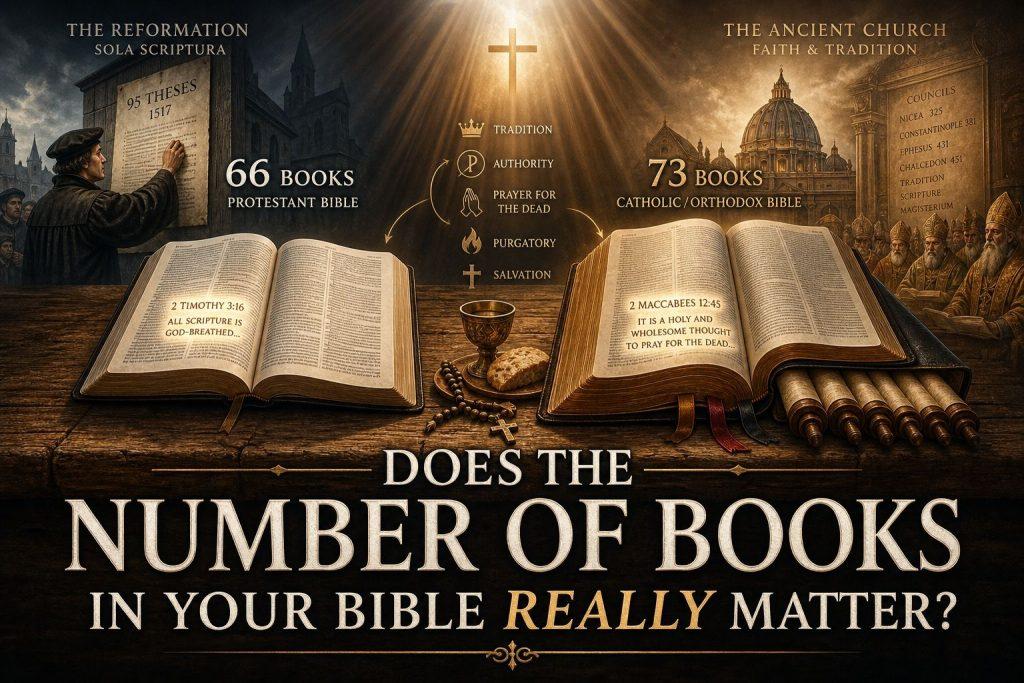
Brief Overview
- The number of books in a Christian’s Bible directly shapes the doctrines that Christian believes, a pattern that holds consistently across three thousand years of biblical history.
- The Sadducees with five books lost the resurrection, the Pharisees with thirty-nine books kept it but missed the Messiah, and the apostles with forty-six Old Testament books handed down the full sacramental life of the Church.
- The Reformation removed seven books from the Old Testament and watched seven sacraments collapse to two within a single generation, which is the clearest modern proof of the pattern.
- Every Christian must eventually answer one question. Are you reading the Bible the apostles handed down, or a shorter version a later editor handed you?
The Pattern Across Three Thousand Years
Start with the Sadducees. Five books. No resurrection, no angels, no afterlife, no spirits. Move to the Pharisees. Thirty-nine books. Resurrection, angels, judgment, and a developed theology of the soul, but a tragic blindness to the Messiah standing in front of them. Move to the apostles. Forty-six Old Testament books plus the twenty-seven of the New Testament. The full Gospel, the seven sacraments, prayer for the dead, the communion of saints, the priesthood, and Sacred Tradition.
Move to the Catholic Church. The same seventy-three book canon, defended at Rome, Hippo, Carthage, and Trent. Move to the Eastern churches. The same canon or even wider, with the same seven sacraments. Move to the Reformation. Sixty-six books. The disputed seven gone, and within a generation prayer for the dead, purgatory, the priesthood, confession, anointing of the sick, and the intercession of saints all faded from practice.
The pattern is not subtle. It is the central historical fact of Christian theology, and most believers have never been shown it.
Why This Is Not a Coincidence
Doctrines do not float in midair. They rest on revelation, and revelation comes to us through Scripture and Sacred Tradition. 2 Timothy 3:16-17 says, “All scripture is inspired by God and is useful for teaching, for reproof, for correction, and for training in righteousness, so that everyone who belongs to God may be proficient, equipped for every good work.” All Scripture. Not most. Not the parts a particular tradition prefers. All of it.
When a portion of Scripture is removed, the doctrines that rest most heavily on that portion lose their foundation. Prayer for the dead loses its clearest scriptural witness when Second Maccabees is removed. The intercession of angels loses its sharpest example when Tobit is removed. The destiny of the just souls loses its most direct articulation when Wisdom is removed. The pattern is mechanical, not mystical.
The Catechism teaches that the Church received the canon of Scripture under the guidance of apostolic Tradition, and the result is forty-six books in the Old Testament and twenty-seven in the New (CCC 120). That number is not arbitrary. It is the measure of the deposit of faith handed down.
The Reformation Is the Cleanest Test Case in History
If anyone doubts that the number of books shapes doctrine, the Reformation is the experiment that settles the question. Take a Christian community that held the seven disputed books, remove those books, and observe what happens over the next two centuries.
The data is unambiguous. Within a generation, purgatory was rejected. Prayer for the dead was rejected. The intercession of saints was rejected. The seven sacraments collapsed to two in most Protestant traditions. The priesthood became a metaphor rather than a sacramental reality. The Real Presence in the Eucharist was reduced to a memorial in most communions.
None of this is hostile commentary. It is the actual history of post-Reformation theology, traceable through the confessions and catechisms of every major Protestant body. Remove the books, lose the doctrines. Every time.
What Scripture Itself Says About Editing the Bible
Scripture treats the editing of revelation with the gravest seriousness. Revelation 22:19 warns, “If anyone takes away from the words of the book of this prophecy, God will take away that person’s share in the tree of life and in the holy city, which are described in this book.” That warning specifically addresses the Book of Revelation, but the principle it expresses is older. Deuteronomy 4:2 commands, “You shall not add to the word that I command you, nor take from it.”
These verses do not settle the canon question by themselves. They do, however, set the moral stakes. Anyone who removes books from the Bible carries an enormous burden of proof, because the act itself is one that Scripture treats with severity. The Reformation removed seven books. The burden of proof for that action has never been adequately met by appealing to history or to the apostolic witness.
The Question Every Christian Has to Face Eventually
Most Christians inherit their Bible without asking how it got that way. That is understandable. But at some point, an honest believer has to ask whether the Bible on the shelf is the Bible the apostles preached. The answer for hundreds of millions of Christians is no, by seven entire books, and almost none of them have ever been told.
The Sadducees inherited a defective canon and lost four doctrines. The post-Reformation Christian inherits a defective canon and has lost roughly the same number. The mechanism is identical. The lesson is identical. The fix is identical.
What the Catholic and Orthodox Witness Offers
The Catholic Church preserved the canon the apostles handed down. The Orthodox churches preserved the same canon or even wider. Between them, every ancient apostolic community on earth holds the seven books and the seven sacraments. That is not a Catholic argument against Protestants. That is the simple convergence of all apostolic Christianity outside the Reformation traditions.
A Christian who studies this honestly is not being recruited. He is being given the same information the early Church had. What he does with it is his own decision, but the information itself is non-negotiable.
So, Does the Number of Books Really Matter?
The Sadducees prove it does. The Pharisees prove it does. The apostles prove it does. The early councils prove it does. The Eastern churches prove it does. The Reformation proves it does, in reverse. Across three thousand years and every continent where the faith has reached, the same iron law holds. The size of the canon shapes the size of the faith. Add a book, gain a doctrine. Remove a book, lose a doctrine. The pattern does not bend for theological preference or denominational loyalty.
That leaves the honest reader with one question. Are you holding the Bible the apostles actually handed down, or a shorter version that someone edited later? The answer matters more than almost anything else a Christian will study in this life, because every other doctrine he holds depends on which books he allows to speak.
This Article Was Made Possible By Supporters Like You
Catholic Share survives on reader generosity, not corporate sponsors. If this article deepened your faith or helped you share it with someone, consider joining our Patreon. For as little as $5 per month, you sustain this ministry, and we pray for every patron by name. You can also support us with a one time gift via PayPal at catholicshare@outlook.com.