
The Bible Jesus and the Apostles Actually Used Daily
Brief Overview
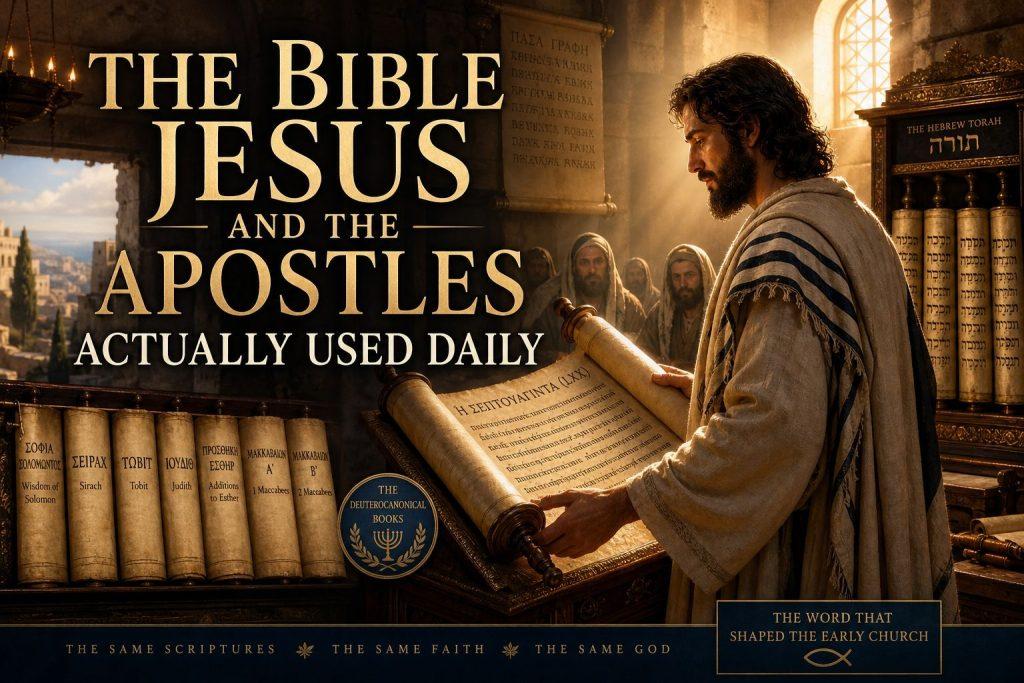
- The apostles preached the Gospel using the Greek Septuagint, the Old Testament translation that already contained the seven books Protestants would later remove.
- The New Testament quotes the Septuagint far more often than the Hebrew text, which means the apostolic Bible was visibly larger than most modern Christian Bibles.
- Several New Testament passages directly cite or echo the disputed books, including Hebrews, the Gospel of John, and the writings of Saint Paul.
- Most Christians have never been told this history, and the discovery is unsettling because it changes who owes whom an explanation about the canon.
The Bible the Apostles Carried
The apostles did not walk through the Mediterranean world quoting Hebrew scrolls to Greek-speaking pagans. They preached in Greek, and they preached from a Greek Bible. That Bible was the Septuagint, translated roughly two centuries before Christ by Jewish scholars in Alexandria.
The Septuagint was not a private edition. It was the standard Old Testament of the synagogues of the diaspora, the Bible of Greek-speaking Jews from Egypt to Asia Minor. It included the Hebrew books and several more. Tobit, Judith, Wisdom, Sirach, Baruch, First Maccabees, Second Maccabees, plus longer versions of Daniel and Esther. The early Church inherited it intact.
What the Numbers Actually Show
Scholars who count Old Testament citations in the New Testament generally agree that the apostolic authors quote the Septuagint far more often than the Hebrew text. Some place the ratio above two-thirds. Others go higher. Either way, the Bible on the apostles’ lips matches the Greek tradition, not the rabbinic Hebrew text that would not be finalized until decades after the resurrection.
That single fact reframes the entire canon debate. The question is no longer whether the Catholic Church added books to the Bible. The question is whether anyone later had the authority to subtract books from the Bible the apostles already used.
The New Testament Quotes the Disputed Books
The clearest example sits in Hebrews 11:35, which reads, “Others were tortured, refusing to accept release, in order to obtain a better resurrection.” There is no story like that anywhere in the Hebrew Bible. The reference is unmistakably to 2 Maccabees 7, where a mother and her seven sons are tortured to death rather than violate God’s law. The author of Hebrews assumes his readers know the story, treats it as Scripture-grade history, and uses it to teach the doctrine of the resurrection.
Saint John records Jesus walking in the Temple during the Feast of the Dedication in John 10:22. That feast, Hanukkah, has no origin story anywhere in the Hebrew canon. Its only scriptural account sits in 1 Maccabees 4. Jesus kept a feast whose biblical foundation lives in a book later removed from millions of Bibles.
The Book of Wisdom is even more striking. Wisdom 2:19-20 reads, “Let us test him with insult and torture, so that we may find out how gentle he is, and let us make trial of his forbearance. Let us condemn him to a shameful death.” The early Church Fathers read that passage as a direct prophecy of the Passion, and the parallels with the Gospel narratives are difficult to dismiss as coincidence.
What the Early Church Did About It
The early Christians did not stumble onto these books by accident. They read them because the apostles handed them down as part of Israel’s Scripture, fulfilled in Christ. The Councils of Rome in three hundred eighty-two, Hippo in three hundred ninety-three, and Carthage in three hundred ninety-seven all confirmed the same seventy-three book canon, including the seven disputed books, that the Catholic Church still holds today.
The Catechism teaches that the apostolic Tradition guided the Church in recognizing which writings belonged to Scripture, and the resulting list contains forty-six books in the Old Testament and twenty-seven in the New (CCC 120). That number is not a Roman invention. It is the simple inheritance of what the early Christians actually read.
For more than a thousand years, no serious Christian community in the world held a different Old Testament.
The Objection That Sounds Convincing Until You Check It
The standard Protestant reply is that the Jews of Jesus’ time already rejected the seven books, so the apostles must have rejected them too. That claim falls apart on contact with the evidence. The Jews of Jesus’ time were divided. The Sadducees accepted only the Torah. The Pharisees accepted the wider Hebrew canon. The diaspora Jews read the Septuagint with its extra books. There was no settled Jewish canon in the first century, because the rabbinic canon was only finalized near the end of the first century, decades after Pentecost.
The early Christians had no obligation to follow a rabbinic decision made after the resurrection, especially when that decision excluded books the apostles had already preached from. They followed the Bible they had received. That Bible was the Septuagint.
Why This Discovery Hits Hard
Most Christians grow up assuming their Bible is identical to the one Jesus used. Discovering that the apostolic Bible was larger than the modern Protestant Bible is uncomfortable for obvious reasons. It is much more comfortable to assume that someone added the disputed books than to face the historical reality that someone removed them.
The honest reader has to follow the evidence wherever it leads. The evidence leads to a Septuagint-shaped Old Testament in the hands of Saint Paul, Saint Peter, and Saint John. That is the starting point. Anything that contradicts that starting point requires an explanation, not the other way around.
So, Whose Bible Are You Actually Reading?
The Bible the apostles preached from contained the seven disputed books. The Bible the early Church confirmed at Rome, Hippo, and Carthage contained the seven disputed books. The Bible every Christian community in the world used for over a thousand years contained the seven disputed books. None of that is a Catholic talking point. It is documentable history, available to anyone willing to look at the citations and the council records.
The hard question is whether the Bible currently on your shelf matches the Bible Jesus and the apostles actually used. If it does not, the next question is who took the books out, why they did it, and what doctrines they expected to lose along with the pages. That is not a small question. It is one of the most consequential questions a Christian can ask.
This Article Was Made Possible By Supporters Like You
Catholic Share survives on reader generosity, not corporate sponsors. If this article deepened your faith or helped you share it with someone, consider joining our Patreon. For as little as $5 per month, you sustain this ministry, and we pray for every patron by name. You can also support us with a one time gift via PayPal at catholicshare@outlook.com.