
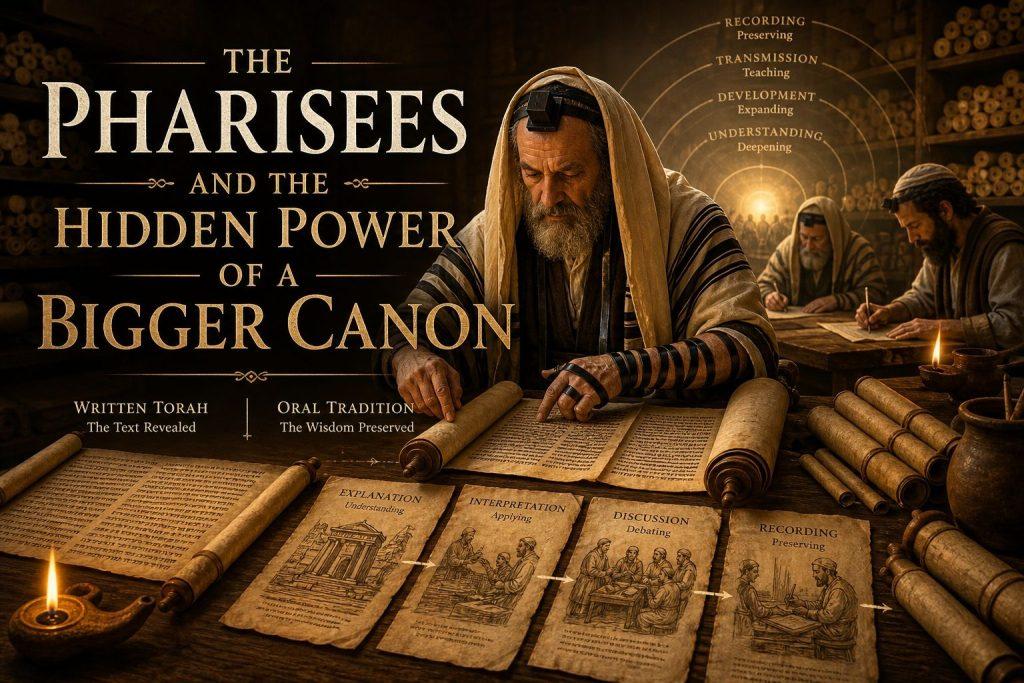
The Pharisees and the Hidden Power of a Bigger Canon
Brief Overview
- The Pharisees accepted the full Hebrew Bible of thirty-nine books, and that wider canon directly produced their belief in the resurrection, angels, spirits, and final judgment.
- Saint Paul was trained as a Pharisee, and his entire defense of the Gospel in Acts rests on doctrines preserved in books that the Sadducees had rejected.
- Jesus rebuked the Pharisees often for hypocrisy and legalism, but never for their canon, a silence that carries real theological weight for any honest reader.
- A wider Bible is no guarantee of a holy life, because the Pharisees prove that correct doctrine without humility still ends in spiritual ruin.
A Party Divided by Books, Not Just Beliefs
Pharisees and Sadducees lived in the same Jerusalem, prayed in the same Temple, kept the same Sabbath, and read the same Torah. From the outside they looked like rival wings of one religion. From the inside they were two different faiths, because they read two different Bibles.
The Sadducees stopped at Deuteronomy. The Pharisees kept reading. The Prophets, the Psalms, the Writings, all the way to Daniel, were Scripture in the Pharisee household. That fuller canon did not just give them more pages. It gave them more doctrines, and those doctrines reshaped how they viewed God, the soul, and eternity.
What a Bigger Canon Actually Produced
Daniel speaks plainly about the dead rising. Daniel 12:2 reads, “Many of those who sleep in the dust of the earth shall awake, some to everlasting life, and some to shame and everlasting contempt.” That single verse alone is enough to settle the resurrection question. The Pharisees had it in their Bible. The Sadducees had cut the book that contained it.
The same pattern holds for angels. Daniel names Gabriel and Michael as personal messengers of God. Ezekiel describes the living creatures of the throne. Zechariah records angelic dialogue in vivid detail. The Sadducees rejected all of these books, so they rejected the angels who walked through them. The Pharisees kept the books, so they kept the angels.
Final judgment, the immortality of the soul, and the moral accountability of every life after death also come into clear focus in the later prophets and writings. The Pharisees taught all of it. The Sadducees, with their truncated Bible, could not.
Saint Paul, the Pharisee Who Stayed a Pharisee on Resurrection
Saint Paul never apologized for his Pharisee training on this point. Even after his conversion, he proudly identified with their stand. Acts 23:6 records him crying out before the Sanhedrin, “I am a Pharisee, a son of Pharisees. I am on trial concerning the hope and the resurrection of the dead.”
That confession was strategic, but it was also sincere. The Pharisee canon had taught him the resurrection long before the road to Damascus, and the risen Christ confirmed everything the Prophets and the Writings had already prepared him to believe. Grace built on a foundation that a fuller Bible had laid.
Paul’s testimony tells us something important about how God works through Israel’s history. The Holy Spirit did not wait until the Gospels were written to teach the resurrection. He had been teaching it for centuries through books the Sadducees refused to read.
What Jesus Corrected and What He Left Alone
Jesus rebuked the Pharisees publicly and frequently. He called them whitewashed tombs. He called them blind guides. He called them hypocrites who tithed mint and dill while ignoring justice and mercy. The Gospels do not soften any of this.
But Jesus never told the Pharisees they had too many books in their Bible. He never reduced their canon. He never told them that Daniel was uninspired or that the Prophets had been added by tradition. He corrected their hearts and their interpretive abuses. He left their canon intact.
That silence is its own teaching. The Sadducee error had to be confronted because it stripped revelation. The Pharisee error had to be confronted because it weaponized revelation. But the Pharisee canon, the wider canon, was the one Jesus operated within, quoted from, and fulfilled.
The Hard Truth a Wider Bible Cannot Fix
Here is where honesty cuts the other way. The Pharisees believed in the resurrection. They believed in angels. They believed in judgment. And many of them still missed the Messiah when he stood in front of them.
A complete canon is necessary, but it is not sufficient. Correct doctrine and a hard heart can coexist for a long time, and the Pharisees prove it. Jesus saved his harshest words for men whose theology was largely right, because correctness without conversion is a kind of damnation in slow motion.
This is the warning every Catholic who loves the fullness of Scripture and Tradition needs to hear. Holding the right books matters enormously. Reading them with a humble heart matters even more. The Catechism is firm that Sacred Scripture and Sacred Tradition together form one sacred deposit of the Word of God entrusted to the Church (CCC 81-82). That deposit must be received in faith, not merely possessed in pride.
What This Means for the Modern Reader
If the Sadducees prove that a smaller Bible shrinks faith, the Pharisees prove that a fuller Bible expands the field of belief without automatically expanding the soul. Both lessons matter. Anyone who simplifies the canon question into a slogan misses half of what the first century is trying to teach the twenty-first.
The Pharisees were closer to apostolic truth than the Sadducees because they read more of God’s word. They were still far from the kingdom because they read it without love. The same risk haunts every Christian who collects doctrines like trophies.
So, What Should a Catholic Take From the Pharisee Witness?
The Pharisee story has two edges, and a serious reader must hold both. The wider canon they preserved is the canon that prepared Israel to recognize the Messiah, and the doctrines that came with that canon, resurrection, angels, judgment, and the soul’s destiny after death, became the framework into which the Gospel was preached. Without the Pharisee canon there is no Saint Paul, no recognizable proclamation of the resurrection, and arguably no New Testament as we know it. That is no small inheritance.
The other edge is sharper. Books in the Bible do not save a soul. They feed a faith, but only a humble faith. The Pharisee tragedy is the warning every catechized Catholic needs to keep close at hand.
This Article Was Made Possible By Supporters Like You
Catholic Share survives on reader generosity, not corporate sponsors. If this article deepened your faith or helped you share it with someone, consider joining our Patreon. For as little as $5 per month, you sustain this ministry, and we pray for every patron by name. You can also support us with a one time gift via PayPal at catholicshare@outlook.com.