
Brief Overview
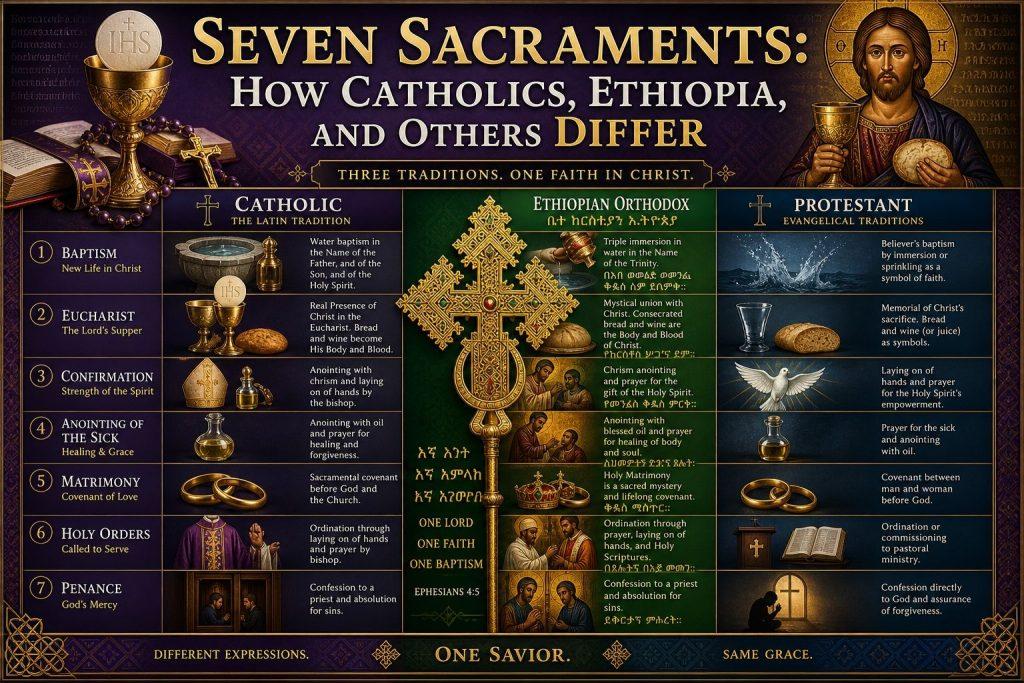
- The Catholic Church, the Eastern Orthodox, and the Ethiopian Orthodox Tewahedo Church all hold to the same seven Sacraments, while most Protestant traditions reduced the count to two or three.
- Each Sacrament rests on direct scriptural warrant and unbroken practice from the early Church, which is why the Catholic Church teaches that Christ himself instituted all seven (CCC 1210).
- The differences between Catholic and Ethiopian sacramental life are real but mostly liturgical, while the gap between Catholic and most Protestant practice is doctrinal and substantial.
- A Catholic who has only ever known a vague, low-church version of the Sacraments is missing the very thing that united Christians East and West for fifteen hundred years.
The Number Itself Is the First Argument
Before any single Sacrament gets examined, the count matters. The Catholic Church teaches seven Sacraments instituted by Christ: Baptism, Confirmation, the Eucharist, Penance, Anointing of the Sick, Holy Orders, and Matrimony (CCC 1210). The Eastern Orthodox Churches confess the same seven, though they sometimes resist the medieval Latin precision of the term “sacrament” and prefer “mystery.” The Ethiopian Orthodox Tewahedo Church confesses the same seven and grounds each one in the Fathers and the apostolic writings.
Most Protestants kept only two, Baptism and the Lord’s Supper, on the grounds that only those two carry an explicit dominical command in the Gospels. Lutherans and some Anglicans hover between two and three, often retaining a higher view of confession or confirmation without calling them Sacraments in the full sense. Baptists, evangelicals, and most non-denominational congregations recognize two and treat both as ordinances rather than Sacraments, meaning they obey them as commands without believing grace flows through them.
That gap is not a footnote. It is the difference between a sacramental Christianity and a memorial Christianity.
Baptism: Where Almost Everyone Still Agrees, Almost
Catholics, Eastern Orthodox, and Ethiopian Orthodox all baptize infants and teach that Baptism actually does something, namely the forgiveness of original sin and incorporation into Christ (CCC 1213). Ethiopia baptizes boys on the fortieth day after birth and girls on the eightieth, a practice rooted in Levitical purification and continued from the early centuries. The Catholic Church does not specify a day count but teaches that infants should be baptized within the first few weeks of life.
Protestant practice splits sharply. Mainline Protestants, including most Lutherans, Anglicans, Methodists, and Presbyterians, still baptize infants and recognize the Sacrament as effective. Baptists and most evangelicals reject infant Baptism entirely and require a believer’s profession of faith, which means a Baptist child raised in church is typically not baptized until adolescence. The scriptural anchor for the older view is John 3:5, where Jesus tells Nicodemus that no one enters the kingdom of God without being born of water and the Spirit.
This is where Ethiopia and Catholic teaching agree without daylight. Baptism saves. It is not a symbol you graduate into. It is the door.
Confirmation, or Why Most Protestants Have Nothing Like It
In the Catholic Church, Confirmation completes Baptism by sealing the recipient with the Holy Spirit through the bishop’s anointing with sacred chrism (CCC 1285). In the Eastern Orthodox and Ethiopian traditions, the priest administers the parallel rite, called Chrismation, immediately after Baptism, which means an Ethiopian infant is fully initiated within minutes. Catholic Latin practice separates Confirmation by years, which has theological costs nobody likes to discuss openly.
Most Protestant traditions have nothing equivalent. Many Lutherans and Anglicans hold a confirmation ceremony, but the rite has no sacramental weight in their theology. Baptists and evangelicals do not confirm at all. The Ethiopian Church anoints with holy oil called Myron, drawn from a recipe handed down for centuries, and treats the sealing as essential to receiving the Holy Spirit in the way the Apostles did in Acts 8:14-17.
If your church has no rite that gives the Holy Spirit beyond Baptism itself, you are not practicing what the early Church practiced.
The Eucharist: Real Presence or Memorial Meal
This is the largest single doctrinal fault line in Christianity. The Catholic Church teaches that the bread and wine, by the words of consecration, become the actual Body, Blood, Soul, and Divinity of Jesus Christ, a change called transubstantiation (CCC 1376). The Eastern Orthodox affirm the same reality without locking in the Aristotelian vocabulary, preferring to call it a holy mystery. The Ethiopian Orthodox teach that the bread and wine are genuinely transformed into the Body and Blood of Christ and are received as such, with the elements consecrated upon the Tabot, the replica of the Ark.
Lutherans hold a real but differently described presence, often called sacramental union, where Christ is truly present in, with, and under the bread and wine without the substances changing. Anglicans range from near-Catholic to nearly memorialist depending on the parish. Most evangelical and Baptist congregations teach a purely symbolic memorial, following Ulrich Zwingli’s sixteenth-century reading of Luke 22:19, where “Do this in remembrance of me” is taken to mean nothing more than recall.
Ethiopia and the Catholic Church stand on the same side of that line. So does the early Church, unanimously, for the first thousand years.
Confession: The Sacrament Most Catholics Quietly Skip
The Catholic Church teaches that grave sins committed after Baptism must be confessed to a priest, who absolves them in the person of Christ (CCC 1456). The authority comes from John 20:23, where the risen Jesus breathes on the Apostles and gives them power to forgive or retain sins. The Eastern Orthodox and Ethiopian Orthodox practice the same auricular confession, with regional variations in how often and how formally the rite is celebrated.
Most Protestants reject sacramental confession entirely, teaching that the believer goes straight to God in private prayer. Some Lutherans retain a private confession option that few actually use. The honest Catholic admission here is that auricular confession has collapsed in much of the West, with most Catholics confessing once a year at most, and many never. That is not a sign that the Sacrament is optional. It is a sign of how thoroughly Protestant assumptions have seeped into Catholic practice.
If you want to know what an unreformed sacramental life looks like, look at how Ethiopian Orthodox Christians prepare for Communion. They confess first.
Holy Orders and Marriage: The Two Sacraments Aimed Outward
Holy Orders ordains deacons, priests, and bishops in apostolic succession, an unbroken chain of laying on of hands traced from the Apostles (CCC 1555). Catholic, Eastern Orthodox, and Ethiopian Orthodox bishops all stand in that chain, with Ethiopia receiving its line through Alexandria from the consecration of Saint Frumentius by Saint Athanasius in the fourth century. Most Protestant communities do not claim apostolic succession at all and ordain ministers through congregational vote or denominational appointment, which means their ministry, in Catholic eyes, lacks sacramental ordination.
Matrimony, in the Catholic understanding, is a Sacrament between a baptized man and a baptized woman, indissoluble until death (CCC 1601). The Eastern Orthodox agree that marriage is a sacred mystery while permitting limited remarriage after divorce through a penitential rite. The Ethiopian Orthodox treat marriage as sacramental and indissoluble, with practice closer to the Catholic position than to the Eastern allowance. Most Protestants treat marriage as a covenant blessed by God but not a Sacrament, which is why divorce and remarriage are permitted across nearly every Protestant denomination.
Two Sacraments, two callings, both meant to build the Church through bodies, not just feelings.
Anointing of the Sick: The Last Sacrament Almost Nobody Asks For
The seventh Sacrament anoints the seriously ill or dying with blessed oil, for the healing of soul and body (CCC 1499). The scriptural foundation is direct, in James 5:14-15, where the elders of the Church are commanded to anoint the sick. Catholic, Eastern Orthodox, and Ethiopian Orthodox priests all administer this rite. Most Protestants have no equivalent Sacrament. Some Pentecostal and charismatic congregations anoint with oil for healing, but treat the act as a prayer practice rather than a Sacrament conveying grace.
The hard truth for Catholics is that this Sacrament is dramatically underused. Many Catholics call a priest only when a relative is hours from death, missing the months when the Anointing could have strengthened them through serious illness. The Sacrament is not last rites in the sense of a ticket out. It is a real channel of grace for the suffering.
So, Which Sacraments Is Your Church Actually Living?
The seven Sacraments are not a Catholic accessory bolted onto the Gospel. They are the ordinary way Christ chose to give grace to his Church, and the witness of Ethiopia matters here precisely because Ethiopia never went through a Reformation and never had a reason to drop any of them. Catholic, Eastern Orthodox, and Ethiopian Orthodox practice all seven, with regional liturgical differences that do not touch the substance. Protestant traditions vary from keeping a high view of two Sacraments to reducing both to symbols, and most Protestants are simply unaware that the count was ever seven. A Catholic who treats the Sacraments as optional, who skips confession for years, who never asks for Anointing in serious illness, and who receives the Eucharist out of habit, is functionally living a Protestant life inside a Catholic parish.
The question is not whether the Catholic Church has the right number. The historical, scriptural, and global witness all confirm that it does. The question is whether you are actually receiving what the Church offers. Seven Sacraments are sitting on the table. Take what is yours.
This Article Was Made Possible By Supporters Like You
Catholic Share survives on reader generosity, not corporate sponsors. If this article deepened your faith or helped you share it with someone, consider joining our Patreon. For as little as $5 per month, you sustain this ministry, and we pray for every patron by name. You can also support us with a one time gift via PayPal at catholicshare@outlook.com.