
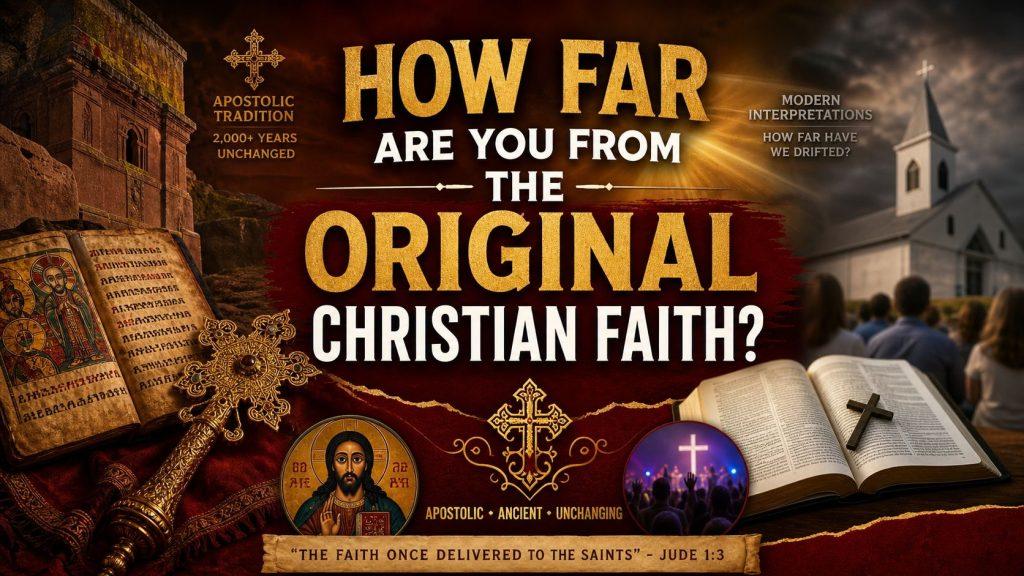
Brief Overview
- The Ethiopian Orthodox Tewahedo Church has practiced the same faith, in the same language, with the same eighty-one book Bible, and the same seven Sacraments for over sixteen hundred years without a single Reformation.
- Every one of the five ancient apostolic centers of Christianity, Rome, Constantinople, Alexandria, Antioch, and Jerusalem, fell under foreign political or colonial rule; Ethiopia never did.
- Most Protestant traditions today have removed five of the seven Sacraments, cut the biblical canon to sixty-six books, and reduced the Eucharist to a symbolic memorial, none of which Ethiopia ever accepted.
- Comparing your current beliefs to what Ethiopia has preserved untouched is one of the most direct ways to measure how far modern Christianity has drifted from its original form.
The Five Sees That Fell and the One That Did Not
The early Christian world organized itself around five great patriarchal cities, Rome, Constantinople, Alexandria, Antioch, and Jerusalem. Every one of them eventually fell. Constantinople fell to the Ottoman Turks in fourteen fifty-three. Alexandria, Antioch, and Jerusalem fell to Arab Muslim armies in the seventh century. Rome survived as a Christian city but produced a papacy whose political entanglements directly provoked the Protestant Reformation. Every ancient apostolic center was touched, bent, or broken by outside forces.
Then look to Africa. The Ethiopian Orthodox Tewahedo Church received the faith in the fourth century through Frumentius, consecrated by Athanasius of Alexandria, and it was never colonized, never absorbed into a caliphate, never subjected to foreign theological reform. When Jesuit missionaries tried to Latinize the Ethiopian Church in the sixteenth century, Ethiopia expelled them. It did not need to become more Western to be genuinely Christian.
What Ethiopia Kept That Others Removed
The Protestant Bible has sixty-six books. The Catholic Bible has seventy-three. The Ethiopian Orthodox Bible has eighty-one. The seven books Protestant reformers removed in the sixteenth century were part of the Septuagint, the Greek Old Testament that Jesus and the Apostles used. Ethiopia never removed them because Ethiopia had no Reformation demanding it.
Second Maccabees, chapter twelve, verse forty-six, the primary scriptural foundation for praying for the dead, is one of the removed books. After removing it, those same traditions rejected prayer for the dead on the grounds that Scripture does not support it. Ethiopia kept the book and kept the practice. The Catholic Church teaches the same (CCC 1032). The Ethiopian canon also includes First Enoch, quoted in Jude at verses fourteen and fifteen with explicit attribution to Enoch as a prophet. Ethiopia never lost it.
Seven Sacraments, Confirmed From Africa
The Ethiopian Orthodox Church holds exactly seven Sacraments, in full agreement with the Catholic and Eastern Orthodox tradition. Most Protestant traditions reduced the Sacraments to two. The Ethiopian Church notes that even Protestant communities that reject five Sacraments as Sacraments still practice them in some form, an unconscious acknowledgment of their necessity.
On the Eucharist, the Ethiopian Church is unambiguous. The priest consecrates the bread and wine, and the faithful receive the actual Body and Blood of Christ, consistent with John 6:53-55 and Catholic teaching (CCC 1374). Most evangelical and Baptist traditions hold a purely symbolic view that no Ethiopian believer would recognize as the faith they inherited.
The Liturgy Nobody in a Modern Church Has Seen
Walk into an Ethiopian Orthodox liturgy and you enter something that looks, sounds, and smells nothing like a modern Protestant service. Incense rises before every scripture reading, grounded in Revelation 5:8, where the prayers of the saints rise before God as incense. Beeswax candles burn on altars and in processions. The liturgy is sung in Ge’ez, an ancient Semitic language preserved as a sacred tongue for sixteen hundred years. Most Protestant traditions eliminated incense and candles during the Reformation.
Every Ethiopian Orthodox church must possess a Tabot, a consecrated replica of the Ark of the Covenant, placed on the altar. Without it, the building is not yet a church. On feast days, the Tabot is carried on the head of a priest in procession while the community sings and drums, exactly as David danced before the Ark in 2 Samuel 6. No other Christian tradition in the world maintains this practice.
What Mary and the Saints Have Always Looked Like
The Ethiopian Orthodox Church venerates Mary above all saints, calls her the Mother of God, celebrates thirty-three feast days dedicated to her throughout the year, and invokes her intercession. The Church teaches her perpetual virginity. This is not a medieval European addition; it is the consistent teaching of the Ethiopian Church since the fourth century, grounded in Luke 1:28, where the Angel calls her full of grace, and Luke 1:48, where Mary prophesies that all generations will call her blessed.
The intercession of the saints is central to Ethiopian liturgical life. Saints and angelic messengers carry the prayers of the faithful to God, consistent with Revelation 5:8 and the Communion of Saints the Catholic Church affirms (CCC 956). Most Protestant traditions reject both. Ethiopia never accepted that rejection.
So, How Far Have You Actually Drifted?
The Ethiopian Orthodox Church is not perfect in every member. Its theological position on the nature of Christ, called Miaphysitism, the belief in one united divine and human nature in Christ, differs from the Catholic and Eastern Orthodox definition at Chalcedon, and that difference is real and deserves honest acknowledgment. But on the canon of Scripture, the seven Sacraments, the Real Presence, the veneration of Mary, the intercession of saints, auricular confession, Apostolic Succession, liturgical incense and candles, and prayer for the dead, Ethiopia agrees with the ancient undivided Church against the Reformation on every single point. Ethiopia never needed a Reformation because nothing in its core practice needed to be changed.
If your church uses incense, recognizes seven Sacraments, believes in the Real Presence, confesses to a priest, venerates Mary as Mother of God, invokes the saints, and reads a Bible with more than sixty-six books, you are close to what Ethiopia preserved. If your church does none of those things, the distance between your current practice and the original Christian faith is not a small gap. It is the full width of a Reformation that Ethiopia never had to survive.
This Article Was Made Possible By Supporters Like You
Catholic Share survives on reader generosity, not corporate sponsors. If this article deepened your faith or helped you share it with someone, consider joining our Patreon. For as little as $5 per month, you sustain this ministry, and we pray for every patron by name. You can also support us with a one time gift via PayPal at catholicshare@outlook.com.