
Brief Overview
- The Catholic Mass and the Ethiopian Orthodox Divine Liturgy share more than most Catholics realize, including incense, beeswax candles, ancient liturgical languages, fixed prayer hours, and serious fasting.
- Ethiopia preserves elements no other Christian tradition has, most strikingly the Tabot, a consecrated replica of the Ark of the Covenant placed on every altar.
- The Ethiopian fasting discipline reaches roughly two hundred and ten days a year for the devout, which is more demanding than anything most modern Catholics have lived through.
- A Catholic who walks into an Ethiopian liturgy will recognize almost everything, which says more about what the Reformation stripped out of Western worship than about Ethiopian peculiarity.
What Walking Into an Ethiopian Liturgy Actually Looks Like
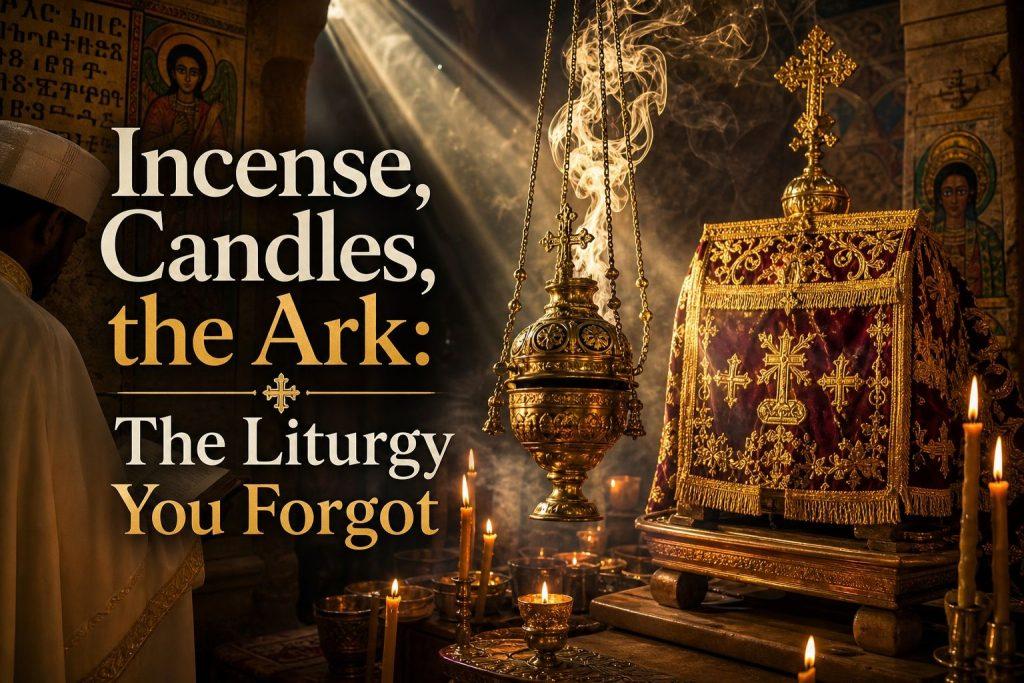
The smell hits first. Frankincense fills the church before a single word is sung. Beeswax candles burn on the altar and in the hands of deacons. Priests chant in a language nobody speaks at home. A consecrated wooden tablet, wrapped in rich cloth, sits at the center of the sanctuary and represents the Ark of the Covenant itself. The faithful stand for hours, having eaten nothing since the night before. None of this is exotic by ancient standards. It is what Christian worship looked like everywhere before the printing press and the Reformation rearranged the West.
A Catholic who has only attended a low-key parish Mass with two unlit candles, no incense, a guitar, and a homily in casual English has been formed by a particular post-conciliar style, not by the full Catholic tradition. The Roman Rite at its most reverent, especially the traditional Latin Mass, looks remarkably similar to what Ethiopia has been doing since the fourth century.
The Ethiopian liturgy is not a museum piece. It is a mirror.
Incense: Why the Smoke Was Never Optional
Incense is commanded in the Old Testament temple worship and reappears in the New Testament heavenly vision. In Revelation 5:8, the prayers of the saints rise before God as incense from golden bowls. Catholic teaching treats incense as a sign of reverence, prayer ascending to God, and the consecration of persons and things to him. The Catechism describes the use of physical signs and symbols as integral to liturgical celebration (CCC 1145).
Ethiopian liturgy uses incense throughout the service. Before the readings, the priest blesses the censer and the deacon walks around the Tabot, swinging the smoke through the church. The Catholic Mass, when celebrated solemnly, censes the altar, the Gospel book, the gifts, the clergy, and the people, in that order, for the same reason Ethiopia does. Most Protestant traditions eliminated incense during the Reformation as a Romish practice, which is to say, they removed something the Apostle John saw in heaven.
If smoke offends your worship instincts, the problem is not the smoke.
Beeswax Candles and Why the Material Matters
Catholic liturgy traditionally requires candles made primarily of beeswax, a rule preserved in older liturgical legislation and still followed in serious parish practice. The reasoning is not arbitrary. Beeswax was understood as a symbol of the pure flesh of Christ, taken from the labor of virgin bees, and the flame as a sign of his divinity. Three candles or six, depending on the form of the Mass, sit on the altar, and a sanctuary lamp burns continuously before the tabernacle to mark the Real Presence.
Ethiopian Orthodox practice is identical in substance. Beeswax candles burn on the altar, deacons carry them in procession, and the Tabot is honored with light at every step of the liturgy. Candles also accompany the administration of the Sacraments, funerals, and major feasts. Most Protestant churches use candles only as decoration, and a substantial number use no candles at all, treating them as a holdover from Catholic ritualism.
A candle on the altar is not aesthetic. It is theology in wax.
The Tabot: Where Ethiopia Stands Alone
This is the part of the Ethiopian liturgy that has no parallel anywhere else in Christianity, and the part Catholics most need to understand carefully. Every Ethiopian Orthodox church must contain a Tabot, a consecrated wooden or stone tablet that represents the Ark of the Covenant. The local bishop blesses it, only priests may touch it, and without it the building is not yet a church. The Eucharist is celebrated with the bread and wine placed upon the Tabot, marking the continuity between the Old Covenant Ark and the New Covenant presence of Christ.
On major feasts, especially Timkat, which celebrates the Baptism of Jesus, the Tabot is wrapped in rich cloth, lifted onto the head of a priest, and carried in procession around the church and to a body of water. Drums beat. Priests dance. The people sing through the night. The reference is 2 Samuel 6, where King David danced before the Ark with all his might. Ethiopia has not stopped dancing.
The Catholic Church does not have a Tabot, and Catholic teaching does not require one. The Catholic understanding is that the Ark prefigured the Blessed Virgin Mary, who carried Christ in her womb the way the Ark carried the presence of God, and that the tabernacle in every Catholic church houses something even greater than the Ark, namely Christ himself in the Eucharist (CCC 1379). A Catholic does not need to envy the Tabot. The Catholic altar holds the reality the Ark only foreshadowed.
That said, watching Ethiopia process the Tabot through a city at dawn is watching the Old Testament still walking around.
Ge’ez and the Case for an Old Liturgical Language
Ethiopia celebrates its liturgy in Ge’ez, an ancient Semitic language related to Hebrew and Aramaic, the languages Jesus spoke. Ge’ez ceased to be a daily tongue centuries ago and survives only as the sacred language of the Church. Every generation of Ethiopian worshipers prays the same words their fourth-century ancestors prayed.
The Catholic parallel is Latin. For roughly fifteen hundred years, the Roman Rite was celebrated in Latin across the entire Western Church, which gave Catholics in Ireland, Mexico, Poland, and the Philippines a single liturgical language. The Second Vatican Council permitted vernacular celebration, and the result, intended or not, has been that most Catholics under fifty have never attended a Mass primarily in Latin. Sacrosanctum Concilium, the Council’s liturgy document, actually mandated that Latin be preserved in the Latin rites, a directive that quietly disappeared in most parishes.
Ethiopia did not face that pressure. Ge’ez stayed. Most Protestant traditions translated everything into contemporary speech and lost the ancient cadence entirely. A Catholic who has never prayed the Confiteor or the Pater Noster in Latin has been cut off from a continuity Ethiopia takes for granted. The case for an old liturgical language is not nostalgia. It is that worship spoken in the same words for sixteen centuries forms a different soul than worship rewritten every generation.
Seven Times a Day: The Rhythm Most Catholics Have Lost
Devout Ethiopian Orthodox Christians pray seven times daily, following a fixed cycle drawn from Psalm 119:164, “Seven times a day I praise you for your righteous laws.” The hours mark dawn, the third, sixth, and ninth hours of the day, evening, the start of night, and midnight. Monks and serious laity actually keep this schedule.
The Catholic Church has the same structure, called the Liturgy of the Hours or the Divine Office, and every priest, deacon, and consecrated religious is bound to pray it daily (CCC 1174). The lay faithful are warmly encouraged to pray at least Morning and Evening Prayer. In practice, almost no Catholic layperson prays the full Office, and many priests rush through it. The Eastern Orthodox keep the same hours through monastic offices that lay faithful sometimes attend.
Most Protestants have no fixed prayer hours at all. Personal devotion is encouraged, but the structure is gone. A Catholic who picks up a breviary or a smaller volume like the Christian Prayer book and starts praying at fixed times is recovering something Ethiopia never lost.
Two Hundred and Ten Days of Fasting
This is where Ethiopian discipline humbles every Western Christian, including Catholics. The Ethiopian Orthodox Church requires fasting on roughly two hundred and ten days per year for the devout, which is more than half the calendar. Wednesdays and Fridays are fast days throughout the year, in addition to a fifty-five day Lent, an Advent fast, and several other major fasting seasons. On fast days, food is taken only after a certain hour, and animal products are excluded entirely. Children above the age of seven are expected to keep the major fasts.
Catholic fasting law has shrunk dramatically. Current Western practice requires only two days of full fasting per year, Ash Wednesday and Good Friday, plus abstinence from meat on Fridays of Lent (CCC 1438). Older Catholic discipline included weekly Friday abstinence, the Ember Days, vigils, and a much longer Eucharistic fast. Eastern Catholic and Eastern Orthodox practice still demand significant fasting throughout the year, closer to Ethiopia than to the modern Latin minimum. Most Protestants have no church-mandated fasting at all.
The honest Catholic admission is this. Two days of fasting per year is the floor, not the ceiling. A serious Catholic life looks far closer to Ethiopia than to the modern parish norm.
So, What Should a Catholic Actually Do With This?
A Catholic does not need to become Ethiopian Orthodox to recover what the Ethiopian liturgy displays. The Catholic Church already has incense, beeswax candles, an ancient liturgical language, fixed prayer hours, and serious fasting embedded in its own tradition. Most of these elements have been allowed to fade in ordinary parish life, which is why an Ethiopian liturgy feels foreign to Catholics whose great-grandparents would have recognized it instantly. The Tabot is the one element Catholics do not share, and the Catholic answer to the Tabot is the tabernacle holding the Real Presence, which the Ark only prefigured. Everything else on this list belongs to the Catholic patrimony, and any Catholic can begin recovering it through a more reverent parish, a Latin Mass, the Liturgy of the Hours, and a fasting discipline that takes the calendar seriously.
The Ethiopian witness is not a rebuke to Catholicism. It is a reminder of what Catholic worship looks like when nothing forces it to apologize for itself. Light a candle. Burn the incense. Fast on Wednesday. Pray the hours. The tradition is still there, waiting.
This Article Was Made Possible By Supporters Like You
Catholic Share survives on reader generosity, not corporate sponsors. If this article deepened your faith or helped you share it with someone, consider joining our Patreon. For as little as $5 per month, you sustain this ministry, and we pray for every patron by name. You can also support us with a one time gift via PayPal at catholicshare@outlook.com.