
Why the Sadducees Got Nearly Everything About God Wrong
Brief Overview
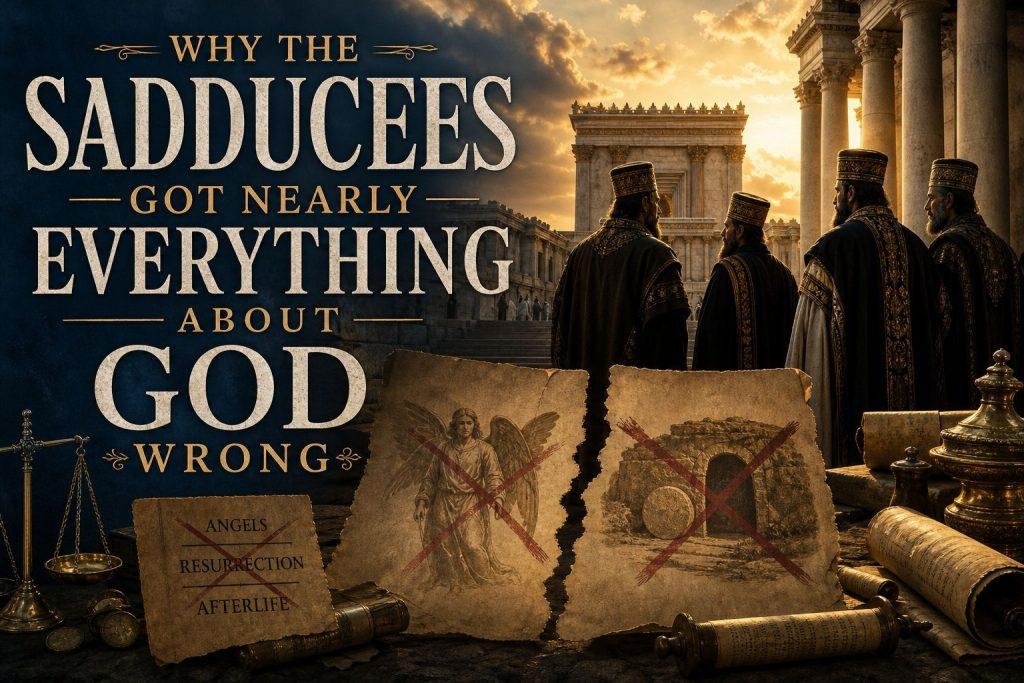
- The Sadducees rejected the resurrection, angels, spirits, and the afterlife because they accepted only the first five books of the Old Testament as authoritative Scripture.
- A shrunken canon produces a shrunken faith, and the Sadducees stand as the clearest historical proof of that principle in the entire Bible.
- Jesus refuted the Sadducees by quoting Exodus chapter three, the only ground they would accept, and pulled the resurrection straight out of their own truncated Bible.
- The Sadducee error did not stay buried in the first century, because anyone who shrinks the canon today will find the same doctrines starting to fade from belief and practice.
The Party That Cut Their Own Bible Short
The Sadducees were the priestly aristocracy of first-century Judaism. They controlled the Temple, the high priesthood, and most of the wealth that flowed through Jerusalem. By any worldly measure they were the religious establishment. By any spiritual measure they were a wreckage of half-faith.
Their problem was simple. They accepted only the Torah, the five books of Moses, as authoritative Scripture. The Prophets and the Writings, the books that Pharisees and ordinary Jews read every Sabbath, the Sadducees treated as secondary at best. That decision was not a footnote in their history. It became the explanation for every strange doctrine they held, and the reason their entire theological system stood on a foundation too small to carry it.
What the Sadducees Refused to Believe
Luke records their rejection of supernatural reality in a single tight sentence. Acts 23:8 says, “For the Sadducees say that there is neither a resurrection, nor an angel, nor a spirit.” Four doctrines, gone in one verse. The resurrection of the dead. The existence of angels. The reality of spirits. The afterlife of the soul.
These are not minor disagreements. These are load-bearing walls of biblical religion. Yet the Sadducees rejected every one of them, and they did so by appealing to Scripture. Their Scripture. Their five books. They were not godless men in their own eyes. They were rigorous men with a defective canon.
The pattern matters. Where the resurrection is taught most clearly, in Daniel chapter twelve, they had cut the book. Where the angels speak by name, Gabriel and Michael in Daniel and the cherubim of Ezekiel, they had cut the books. Where the afterlife is described in vivid detail, in Wisdom and Second Maccabees, they had cut the books. Their faith collapsed because their canon collapsed.
How Jesus Demolished Them From Their Own Bible
The Sadducees brought Jesus a riddle about a woman married to seven brothers, hoping to make the resurrection look absurd. Jesus refused their riddle and went straight to their own Torah. He quoted Exodus chapter three. Matthew 22:31-32 records his answer. “And as for the resurrection of the dead, have you not read what was said to you by God, ‘I am the God of Abraham, the God of Isaac, and the God of Jacob’? He is God not of the dead, but of the living.”
The argument is surgical. God speaks of the patriarchs in the present tense, centuries after their burial. Either they are still alive in some real sense, or God misspoke at the burning bush. The Sadducees were silenced. Their own Bible had been hiding the doctrine they rejected.
Jesus could have quoted Daniel. He could have quoted Wisdom. He chose to meet them where they stood and to expose the truth still embedded in the smallest canon they would accept. That choice is itself a teaching. The fullness of revelation is always richer than the editor wants it to be.
The Iron Law of Canon and Doctrine
Saint Paul understood the principle perfectly. He stood on trial in front of a divided Sanhedrin and shouted, in Acts 23:6, “I am on trial concerning the hope of the resurrection of the dead.” The Pharisees defended him. The Sadducees raged. Same courtroom. Same Jewish faith on paper. Two opposite verdicts, separated only by which books each side carried in its Bible.
Here is the law every Christian needs to grasp. Add a book to your Bible, and a doctrine walks in with it. Remove a book, and a doctrine walks out. The Church recognized this from the beginning, which is why the early Councils of Rome, Hippo, and Carthage took such care to define the canon. The Catechism teaches that the apostolic Tradition itself guided the Church in recognizing which writings belonged to Scripture (CCC 120).
That recognition was not a power grab. It was a rescue mission against future Sadducee-style errors.
Why This Still Matters in the Twenty-First Century
Most Christians today never ask why their Bible contains the books it contains. They inherited a table of contents and assumed someone competent settled it long ago. But the Sadducees inherited a canon too. They assumed their fathers had settled the question correctly. They were wrong, and four doctrines fell out of their faith because of it.
The honest question for any reader is whether the Bible on the shelf actually contains everything God inspired. If even one book is missing, the doctrines uniquely taught in that book will start to fade from belief, from preaching, and eventually from practice. That is not a Catholic talking point. That is the Sadducee story told forward.
So, Is the Sadducee Warning Still Worth Hearing?
The canon question is not antiquarian trivia and it is not denominational point-scoring. It is the most practical doctrinal question a Christian can ask, because every other doctrine depends on it. The Sadducees prove that a shrunken Bible produces a shrunken faith. They prove it with their denial of the resurrection, with their denial of angels, with their denial of the soul, and with their stunned silence when Jesus turned their own five books against them. The same logic runs in reverse. A complete Bible, faithfully received, produces a complete faith. Anything less leaves the believer guessing about heaven, hell, angels, and the dead.
The honest path forward is to read the Bible the apostles actually handed to the Church and to find out what doctrines come with the books most modern readers no longer hold. That is the work of a lifetime, and it begins by taking the Sadducee warning seriously.
This Article Was Made Possible By Supporters Like You
Catholic Share survives on reader generosity, not corporate sponsors. If this article deepened your faith or helped you share it with someone, consider joining our Patreon. For as little as $5 per month, you sustain this ministry, and we pray for every patron by name. You can also support us with a one time gift via PayPal at catholicshare@outlook.com.