
Brief Overview
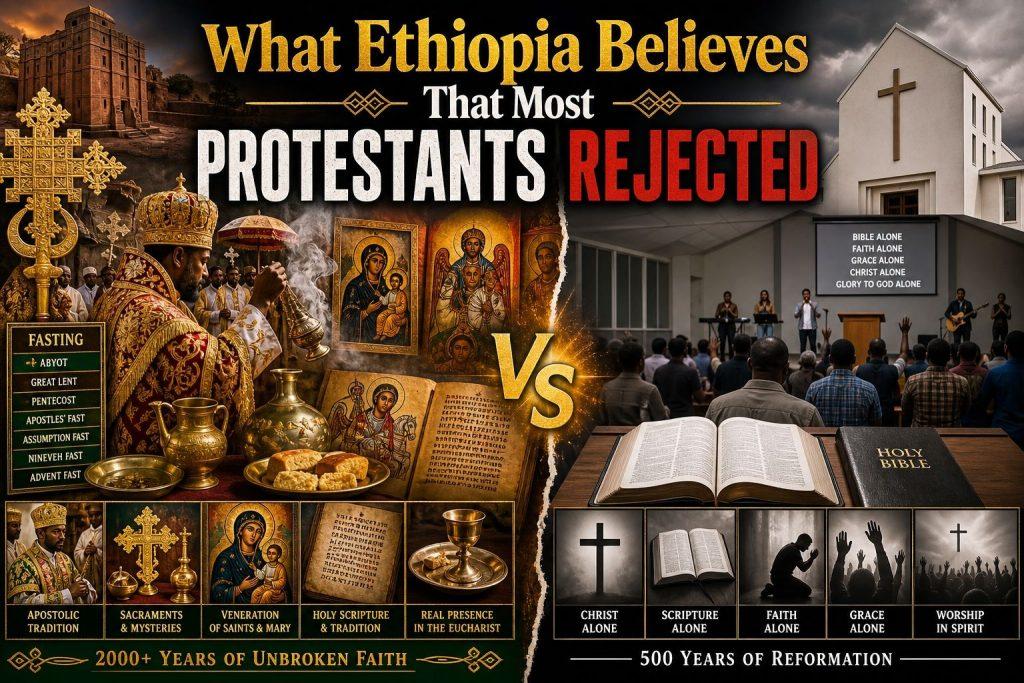
- The Ethiopian Orthodox Tewahedo Church holds nearly every major doctrine the Catholic Church holds, including the Trinity, the Real Presence, Marian veneration, the intercession of saints, and apostolic succession.
- Ethiopia and the Catholic Church part ways on one significant point of Christology, the Miaphysite formula on the nature of Christ, though modern dialogue has shown the difference is largely terminological.
- Most Protestant traditions reject not just one of these doctrines but the entire architecture, which is why an Ethiopian Christian and a Catholic recognize each other as kin while a Baptist and a Catholic often do not.
- A Catholic who treats Marian devotion, prayer for the dead, or the saints as embarrassing leftovers has absorbed Protestant assumptions without realizing it.
The Trinity: Where Almost Everyone Still Stands Together
The Ethiopian Church confesses the Father, the Son, and the Holy Spirit as one God in three Persons, co-equal and co-eternal, exactly as the Council of Nicaea defined in 325. The Nicene Creed is recited at every Ethiopian Divine Liturgy. The Catholic Church teaches the same, with the Catechism calling the Trinity the central mystery of Christian faith and life (CCC 234). The Eastern Orthodox confess the same Creed, with the well-known dispute over the filioque clause, the Latin addition that the Spirit proceeds from the Father “and the Son.”
Most mainstream Protestant traditions hold the Trinity. The fractures appear at the edges of Protestantism, where Oneness Pentecostals reject the three Persons, and Jehovah’s Witnesses, who descend from a Protestant lineage, deny the divinity of Christ outright. Mormonism, which rose from a Protestant context in nineteenth-century America, teaches a polytheistic framework that no Christian council ever recognized.
The Trinity is the doorway. Anything that calls itself Christian but denies it has stepped outside.
Miaphysitism: The One Real Disagreement
This is the harder conversation. The Council of Chalcedon in 451 defined that Jesus Christ is one Person in two natures, fully divine and fully human, united without confusion, without change, without division, without separation. The Catholic and Eastern Orthodox Churches hold this formula. The Ethiopian, Coptic, Armenian, and Syriac Orthodox Churches rejected Chalcedon and confess Miaphysitism, meaning that Christ has one united nature, both divine and human, inseparably joined. Tewahedo, the word in the Ethiopian Church’s own name, means “being made one.”
This is not Monophysitism, the ancient heresy that taught Christ’s humanity was swallowed up by his divinity. The Ethiopian position holds the full humanity and full divinity of Christ in one composite nature, which is closer to Chalcedon than the historical labels suggest. Twentieth-century dialogue between Rome and the Oriental Orthodox produced a joint Christological declaration in 1990 acknowledging that both sides confess the same faith in Christ using different formulas (CCC 467). The Catholic position remains Chalcedonian. Ethiopia remains Miaphysite. Both confess Jesus as true God and true man.
A Catholic should not pretend the difference is nothing. It is something. It is just much smaller than five hundred years of name-calling implied.
Mary, Mother of God
The Council of Ephesus in 431 defined that Mary is Theotokos, the Mother of God, because the One she bore is God. The Ethiopian Church holds this title fiercely, dedicates thirty-three feast days a year to her, and refers to Ethiopia as “Mary’s country.” The Catholic Church confesses the same title and adds the dogmas of the Immaculate Conception and the Assumption, which Ethiopia honors liturgically without identical formal definition (CCC 491, 966). The Eastern Orthodox venerate the Theotokos as the highest of all creatures and observe similar feasts.
Most Protestants kept Mary as a respected historical woman and stripped away nearly everything else. Marian intercession, perpetual virginity, and titles such as Mother of God either disappeared or became theologically suspect. The original Reformers, including Luther himself, retained more Marian devotion than their heirs did, but the trajectory across five centuries of Protestantism has been steadily downward. By the time you reach modern evangelicalism, Mary appears in a manger scene at Christmas and vanishes for the rest of the year.
The scriptural anchor is Luke 1:48, where Mary herself prophesies that all generations will call her blessed. Ethiopia and the Catholic Church do. Most Protestants do not. One of the two is reading that verse honestly.
The Intercession of the Saints
The Ethiopian liturgy is filled with appeals to the saints and the angels. Ethiopian Christians ask Saint Michael, Saint Gabriel, Saint George, and a long list of local martyrs to pray for them. The Catholic Church teaches the same practice and grounds it in the Communion of Saints, the bond between the Church on earth, the Church in purgatory, and the Church in heaven (CCC 956). The Eastern Orthodox invoke the saints in nearly every liturgical service.
The scriptural foundation is Revelation 5:8, where the elders in heaven hold golden bowls full of the prayers of the saints. The dead in Christ are alive in Christ. They pray. They intercede. The Catholic position has never been that the saints replace Christ as mediator. The Catholic position is that the saints, members of the same Body, pray for fellow members the way any Christian asks a friend to pray for him.
Most Protestants reject this entirely, calling it unbiblical and dangerously close to idolatry. The honest response is that Protestant rejection of saintly intercession is itself a sixteenth-century innovation, not a recovery of anything the early Church practiced. Ethiopia, in a part of the world the Reformation never touched, kept asking the saints for prayer the whole time.
If your dead grandmother loved you on earth, she has not forgotten you in glory.
Apostolic Succession
The Ethiopian Orthodox Church traces its ordained ministry through Alexandria back to the Apostles. Frumentius, the first bishop of Ethiopia, was consecrated in the fourth century by Saint Athanasius, the same Athanasius who fought the Arians and helped fix the New Testament canon. Every Ethiopian bishop, priest, and deacon stands in that chain. The Catholic Church teaches the same principle through Rome and the other ancient sees, and the Catechism states that the bishops are successors of the Apostles by divine institution (CCC 861). The Eastern Orthodox hold succession through Constantinople, Antioch, Jerusalem, and Alexandria.
Most Protestant communities do not claim apostolic succession at all. Anglicans claim it, though Catholic teaching, since Apostolicae Curae in 1896, holds Anglican orders to be invalid. Lutherans in Scandinavia retained a form of episcopal succession, while German Lutherans and most other Protestants ordain through congregational or denominational processes that make no historical claim to a chain of laying on of hands.
This is not a procedural detail. If apostolic succession is real, then a Eucharist celebrated without a validly ordained priest is not the Eucharist the Apostles celebrated. That is the Catholic position, and it is also the Ethiopian and Eastern Orthodox position. It is the reason these three Churches recognize valid Sacraments in each other in ways they cannot recognize in most Protestant communities.
Prayer for the Dead and the Souls in Purgatory
The Ethiopian Church prays for the departed at every liturgy. Names are remembered. Masses are offered. The faithful give alms for the souls of those who have died. The Catholic Church teaches the same practice and teaches a final purification, called purgatory, for those who die in God’s friendship but still imperfectly purified (CCC 1030). The Eastern Orthodox pray for the dead and accept a process of purification after death without using the Latin term purgatory.
The clearest scriptural witness is 2 Maccabees 12:46, where Judas Maccabeus offers sacrifices for fallen soldiers so that they might be loosed from their sins. Most Protestants removed Maccabees from their Bibles in the sixteenth century and rejected prayer for the dead in the same move. The two decisions are connected. Take the book out, and the practice loses its proof text.
Ethiopia kept the book and kept the practice. The Catholic Church kept both as well. If you carry a sixty-six book Bible and have never prayed for a deceased relative, that is the Reformation’s footprint on your soul.
The Real Presence and the Saturday Sabbath
The Ethiopian Church teaches that the bread and wine at the Divine Liturgy become the actual Body and Blood of Christ, received as such by the faithful. The Catholic Church confesses transubstantiation, the term defined at the Fourth Lateran Council and the Council of Trent (CCC 1376). Eastern Orthodoxy affirms the same reality without the Aristotelian vocabulary. Most Protestant traditions teach a memorial or symbolic presence, with Lutherans holding a real but differently described presence.
Ethiopia is unusual among Christian Churches in observing Saturday as a Sabbath alongside Sunday, a practice rooted in its Jewish heritage and the conviction that both the Old Covenant day of rest and the New Covenant day of resurrection deserve honor. The Catholic Church transitioned to Sunday observance in the apostolic era, recognized in Acts 20:7 and Revelation 1:10, and the Catechism teaches that Sunday fulfills and replaces the Sabbath in the new economy of grace (CCC 2175). This is one place where the Catholic and Ethiopian practices genuinely differ.
A Catholic does not need to keep Saturday to honor God. A Catholic does need to actually keep Sunday, which most modern Catholics treat as one more shopping day with an hour of Mass squeezed in.
So, How Catholic Is Ethiopia, Really?
On nearly every major doctrine that separates historic Christianity from modern Protestantism, Ethiopia stands with the Catholic Church. The Real Presence, the seven Sacraments, Marian veneration, the intercession of the saints, prayer for the dead, apostolic succession, the Trinity, and the deuterocanonical books all sit on the Ethiopian side of the line, the same side the Catholic Church has always occupied. The single major theological gap is Chalcedon, and the Catholic Church’s own dialogue with the Oriental Orthodox over the past century has shown that the Christological substance is closer than the historical formulas suggested. A Catholic looking at Ethiopia is looking at a Church that confesses what the Catholic Church confesses, with regional differences in liturgy and one technical disagreement on Christ’s nature.
The harder question is what an honest Catholic does with this recognition. Ethiopia is not a Catholic Church and full sacramental communion does not yet exist between Rome and Addis Ababa. What does exist is a witness. When a Catholic prays for the dead, asks Saint Michael for protection, kneels before the tabernacle, or honors the Mother of God, an Ethiopian Christian on the other side of the world is doing the same thing, in a language neither of them speaks at home, for the same reasons their ancestors did sixteen centuries ago. That is not a coincidence. That is the Church.
This Article Was Made Possible By Supporters Like You
Catholic Share survives on reader generosity, not corporate sponsors. If this article deepened your faith or helped you share it with someone, consider joining our Patreon. For as little as $5 per month, you sustain this ministry, and we pray for every patron by name. You can also support us with a one time gift via PayPal at catholicshare@outlook.com.