
The Ancient Churches That Never Lost the Seven Books
Brief Overview
- Every ancient Christian community on earth, from Ethiopia and Egypt to India and Russia, kept the seven books that the Reformation removed and kept all seven sacraments with them.
- These churches separated from Rome long before Luther was born, which means their agreement with the Catholic canon and sacramental life cannot be dismissed as Roman influence.
- The link between the wider canon and the seven sacraments is not coincidence, because each sacrament has its scriptural seed in books that the Reformation either removed or marginalized.
- A Christian who studies the ancient churches honestly will face a hard question about which communities actually preserved the apostolic deposit and which ones edited it down.
A Pattern Hidden in Plain Sight
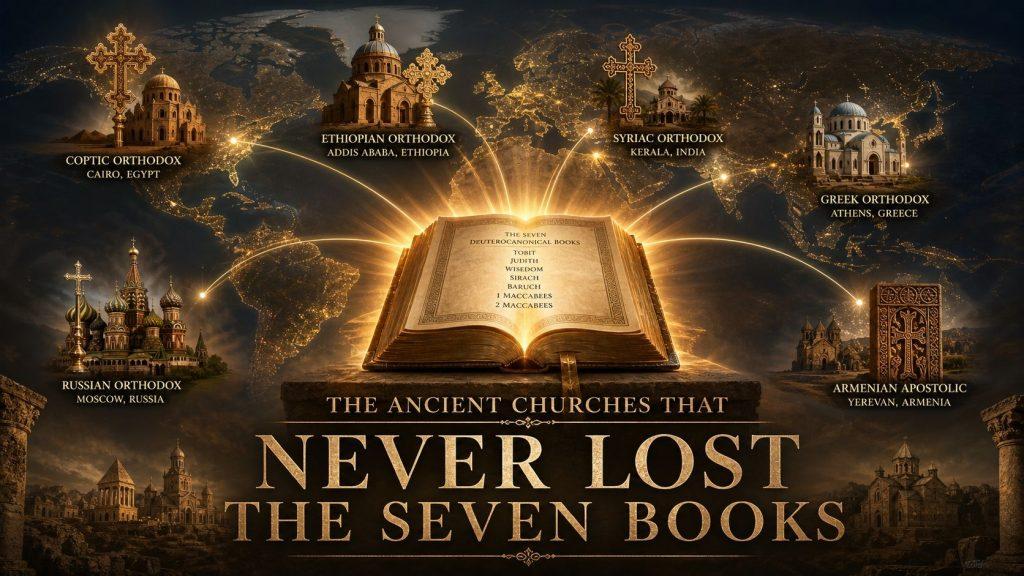
Walk into a Coptic church in Cairo, an Ethiopian Tewahedo church in Addis Ababa, a Syriac church in Kerala, a Greek Orthodox parish in Athens, a Russian Orthodox cathedral in Moscow, or an Armenian Apostolic church in Yerevan, and you will find the same thing. Seven sacraments. Prayer for the dead. Intercession of saints. A real priesthood. A real Eucharist. Sacred Tradition received from the apostles. And in their Old Testament, the same seven books the Reformation removed.
These communities did not get this list from Rome. Most of them parted ways with Rome a thousand years before Luther was born. They argue with Rome about the papacy, the Filioque, jurisdiction, councils, and language. They do not argue with Rome about the canon of the Old Testament or the number of sacraments. That convergence is one of the most underreported facts in church history.
Where These Churches Actually Came From
The Coptic Orthodox Church traces its founding to Saint Mark in Alexandria. The Ethiopian Orthodox Tewahedo Church preserves a Christian tradition older than most European nations and actually holds an even larger biblical canon, with eighty-one books in total. The Syriac Christians of the Saint Thomas tradition in India root their faith in the apostle Thomas himself.
The Greek Orthodox and Russian Orthodox churches inherit the patristic and liturgical life of the Eastern Roman Empire. The Armenian Apostolic Church was the first nation to embrace Christianity as a state religion in three hundred one. The Assyrian Church of the East carried the Gospel as far as China during the Tang dynasty.
These are not small, recent, or marginal communities. They are ancient apostolic churches with continuous histories, continuous liturgies, and continuous Scriptures. Their witness matters.
The Books and the Sacraments Travel Together
Look at the link between the disputed books and the sacraments, and the pattern is clear. Sirach 38:9-12 speaks of the sick praying, of physicians as instruments of God, and of the proper response to illness with religious seriousness. That is the seed of the Anointing of the Sick.
Tobit 6 and 8 describe the marriage of Tobiah and Sarah as a sacred event, blessed with prayer and angelic protection. Generations of Christian theologians drew on Tobit to ground the sacramentality of marriage.
2 Maccabees 12:43-46 records prayer and atonement offered for the dead, which the Church reads as a witness to the doctrine of purgatory and the sacramental life of intercession surrounding death. Wisdom 3 describes the state of the just souls in God’s hand, supporting the same framework.
The Catechism teaches that there are seven sacraments instituted by Christ and entrusted to the Church, with each one rooted in the apostolic deposit (CCC 1113). The ancient churches preserved both the books and the sacraments because both were handed down together. They never had a reason to choose between them, because nobody told them they were supposed to.
The Communion of Saints in Daily Life
The intercession of saints is not a Catholic invention. Tobit 12:12 records the archangel Raphael bringing the prayers of the righteous before God, a clear scriptural picture of heavenly intercession. The Catechism teaches that the saints in heaven contribute to the Church on earth through their intercession with the Father in Christ (CCC 956).
Walk into any Orthodox liturgy on earth and you will hear the saints invoked by name. Walk into any Coptic or Ethiopian liturgy and the same pattern holds. The communion of saints is not a Western devotional flourish. It is the universal practice of every Christian community that received the apostolic deposit and held it intact.
The Argument From Geography
Here is the part that should stop any honest reader. These ancient churches developed across continents, in different languages, under different empires, with different liturgical families and different theological emphases. Some of them did not exchange theological letters with Rome for a thousand years. Some of them were cut off entirely by Islamic conquests or Mongol invasions.
And yet they all kept the same seven sacraments. They all kept the wider Old Testament canon. They all kept prayer for the dead, the intercession of saints, the priesthood, the Real Presence, and Sacred Tradition. The simplest explanation is also the most uncomfortable for Reformation theology. These doctrines and books were universally received from the apostles, which is why they show up everywhere apostolic Christianity reached.
The alternative explanation requires the Reformation to be a recovery of something every apostolic community on earth had somehow lost in lockstep. That is an enormous historical claim, and the evidence for it is thin.
The Hard Question Modern Christians Often Avoid
If the seven sacraments and the seven disputed books are not Roman inventions, then the burden of proof shifts. The question is no longer why Catholics believe what they believe. The question is how an entire branch of Christianity came to hold a shorter Bible and a shorter sacramental life than every other apostolic community in the world.
This is uncomfortable territory. Many Protestants have never been told that the Eastern churches even exist in any serious way, much less that they hold the same canon and the same sacraments as Rome. Once that information lands, the standard Reformation narrative starts to look harder to defend, not because Rome wins by default, but because the witness of the global apostolic Church becomes impossible to ignore.
What the Ancient Churches Are Quietly Saying
The ancient churches are not trying to prove anything to anyone. They are simply living the faith they received. Their liturgies, their Scriptures, and their sacraments speak for themselves to anyone willing to look.
Their witness is not a Catholic argument. It is a Christian one, and it has been standing in plain sight for fifteen hundred years.
So, What Should a Thoughtful Christian Do With This?
The convergence of the ancient apostolic churches on a seventy-three book Old Testament and seven sacraments is not a coincidence that can be waved away. It is the strongest historical signal available about what the apostles actually handed down. When Coptic, Ethiopian, Indian, Greek, Russian, Armenian, Syriac, and Catholic Christians all read the same disputed books as Scripture and all celebrate the same seven sacraments, the burden of proof rests on whoever holds a smaller list. The Reformation has every right to make its case, but it cannot make that case by pretending the ancient churches do not exist or do not matter.
The honest path is to study the ancient churches with the same seriousness given to the Reformers. Read their liturgies. Read their canons. Read their saints. The unity of the apostolic witness across continents and centuries is the closest thing to a fingerprint of the original deposit of faith that history offers, and it points consistently in one direction.
This Article Was Made Possible By Supporters Like You
Catholic Share survives on reader generosity, not corporate sponsors. If this article deepened your faith or helped you share it with someone, consider joining our Patreon. For as little as $5 per month, you sustain this ministry, and we pray for every patron by name. You can also support us with a one time gift via PayPal at catholicshare@outlook.com.