
The Seven Books That Were Removed From Christian Bibles
Brief Overview
- Martin Luther removed seven books from the Old Testament in the early sixteenth century, books that every major Christian community had treated as Scripture for over a thousand years.
- Each removed book contained passages that directly contradicted core Reformation doctrines, including prayer for the dead, purgatory, intercession of saints, and meritorious good works.
- Luther’s edits were not limited to the Old Testament, because he also tried to demote James, Hebrews, Jude, and Revelation when they conflicted with his teaching on faith alone.
- The Council of Trent did not invent the Catholic canon, because the same seventy-three books had already been listed by the Councils of Rome, Hippo, and Carthage more than a thousand years earlier.
What Luther Actually Did
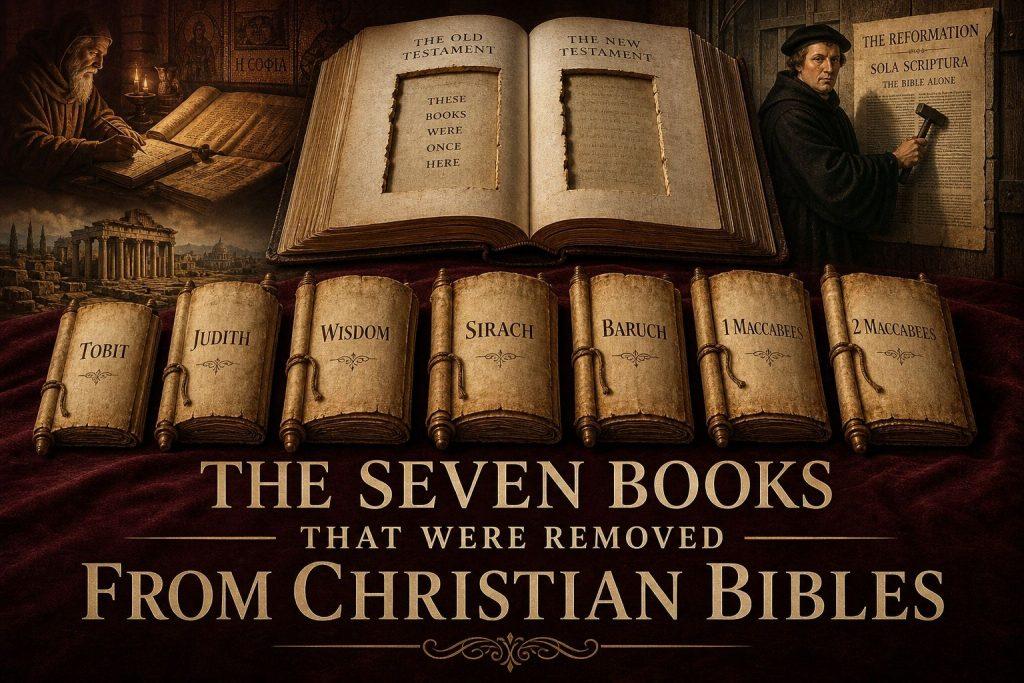
In fifteen twenty-two, Martin Luther published his German New Testament. A few years later he completed the Old Testament. When he did, he separated seven books into a section he called the Apocrypha, marked them as inferior, and over time most Protestant Bibles dropped them entirely.
The seven books were Tobit, Judith, Wisdom, Sirach, Baruch, First Maccabees, and Second Maccabees. He also relegated the longer Greek portions of Daniel and Esther to the same secondary status. These were not obscure texts that nobody had read. They had been bound into every Christian Bible in the Latin West for over a millennium, and they remained Scripture for every Eastern Christian community on earth.
The Real Reason the Books Had to Go
Luther had a theological problem. The seven books contradicted doctrines he was preaching. Prayer for the dead, intercession of the saints, purgatory, and meritorious good works all appear in those pages with uncomfortable clarity.
2 Maccabees 12:46 reads, in the older Catholic rendering still common in Reformation-era Bibles, “It is therefore a holy and wholesome thought to pray for the dead, that they may be loosed from sins.” That single verse is enough to ground the doctrine of purgatory. The Catechism cites exactly this passage when explaining the Church’s teaching that the souls of the faithful departed can be helped by the prayers of the living (CCC 1032). For a man preaching that purgatory was a Roman fabrication, this verse was unacceptable. The book had to be marked as inferior.
Tobit 12:12 records the archangel Raphael saying, “When you and Sarah prayed, it was I who brought the record of your prayer before the glory of the Lord.” That is angelic intercession written into Scripture. For a movement rejecting the intercession of angels and saints, this was a structural threat. The book had to go.
Wisdom 3:1 reads, “The souls of the righteous are in the hand of God, and no torment will ever touch them.” That verse implies a state of the soul between death and final judgment, a state that the Reformation collapsed into an immediate binary. The book had to go.
Sirach 3:3 teaches that those who honor their father atone for sins. Atonement tied to a meritorious action stands directly against faith alone. The book had to go.
The Pattern Is the Sadducee Pattern
This is the Sadducee playbook in a new century. Identify the books that teach doctrines you reject. Strip those books out of the canon. Then quote what remains as proof that the doctrines were never biblical in the first place. The argument becomes circular by design.
The same logic explains why Luther also targeted parts of the New Testament. He called the Letter of James “an epistle of straw” because James 2:24 says, “You see that a person is justified by works and not by faith alone.” He wanted to remove Hebrews, Jude, and Revelation as well. His criterion was consistent throughout. Books that contradicted his theology were demoted, marked, or removed.
Other reformers stopped him from going further with the New Testament, partly because the New Testament canon had been stable for far too long to attack openly. The Old Testament felt easier, because the seven disputed books had always been a quieter part of the Christian Bible. They were easier to lose.
What the Catholic Church Actually Did at Trent
A common claim says that Rome added the seven books at the Council of Trent in fifteen forty-six as a reaction against Luther. The documentary record says the opposite. The Council of Rome in three hundred eighty-two, the Synod of Hippo in three hundred ninety-three, and the Council of Carthage in three hundred ninety-seven all listed the same seventy-three book canon that Trent later defined.
Trent did not invent a canon. Trent defended a canon that had already been received, read, and preached for more than eleven hundred years before Luther was born. The Catechism reflects this continuity when it teaches that the Church, guided by apostolic Tradition, recognized the list of inspired writings under the Holy Spirit’s protection (CCC 120).
The historical question is not why Catholics still hold these books. The historical question is why Protestants do not.
What Was Lost Along With the Pages
Within a generation of the Reformation, several doctrines that had been universal Christian teaching for fifteen centuries quietly vanished from Protestant practice. Prayer for the dead, purgatory, intercession of saints, and the formal anointing of the sick all faded from the new tradition almost in lockstep with the removal of the books that taught them.
This is exactly what happened to the Sadducees. They cut Daniel, Wisdom, and the rest of the Prophets and Writings, and they lost the resurrection, the angels, and the afterlife. Luther cut the seven books, and Protestantism lost the doctrines those books contained. The principle holds across every century. Remove a book, and a doctrine walks out.
The Honest Conversation Most Christians Never Have
Most Protestant Christians have never been told this history in any serious form. They have been told that Catholics added books, that the seven books are spurious, and that the Reformation simply returned to the original Bible. The actual sequence of events is harder to defend, which is probably why it rarely gets taught.
A Catholic who knows this history is not winning a debate. A Catholic who knows this history is offering a fellow believer a piece of information that was kept from him. The right response to that information is not embarrassment on either side. It is honest study.
So, Did Catholics Add Books or Did Protestants Remove Them?
The evidence is one-directional. The Bible the apostles used contained the seven disputed books. The early Christian councils confirmed those books. Every Christian community in the world held those books for over a thousand years. Then, in the sixteenth century, one reformer removed them and others followed. The Council of Trent did not add anything. It defended what had always been there. Anyone willing to read the council documents and the patristic record can verify this in an afternoon.
That leaves only one serious question for the honest Christian to settle. If the seven books were always part of the Bible, and if their removal was driven by doctrinal preference rather than by historical evidence, then the Bible most Western Christians inherit today is shorter than the one the apostles preached. The Sadducee warning applies again. A shrunken canon eventually produces a shrunken faith, and the parts that fade first are the parts the missing books taught most clearly.
This Article Was Made Possible By Supporters Like You
Catholic Share survives on reader generosity, not corporate sponsors. If this article deepened your faith or helped you share it with someone, consider joining our Patreon. For as little as $5 per month, you sustain this ministry, and we pray for every patron by name. You can also support us with a one time gift via PayPal at catholicshare@outlook.com.