
The Canon Problem That Breaks Sola Scriptura Cold
Brief Overview
- The Bible never provides its own table of contents, which means every Christian who opens a New Testament is already trusting a decision made by the early Catholic Church.
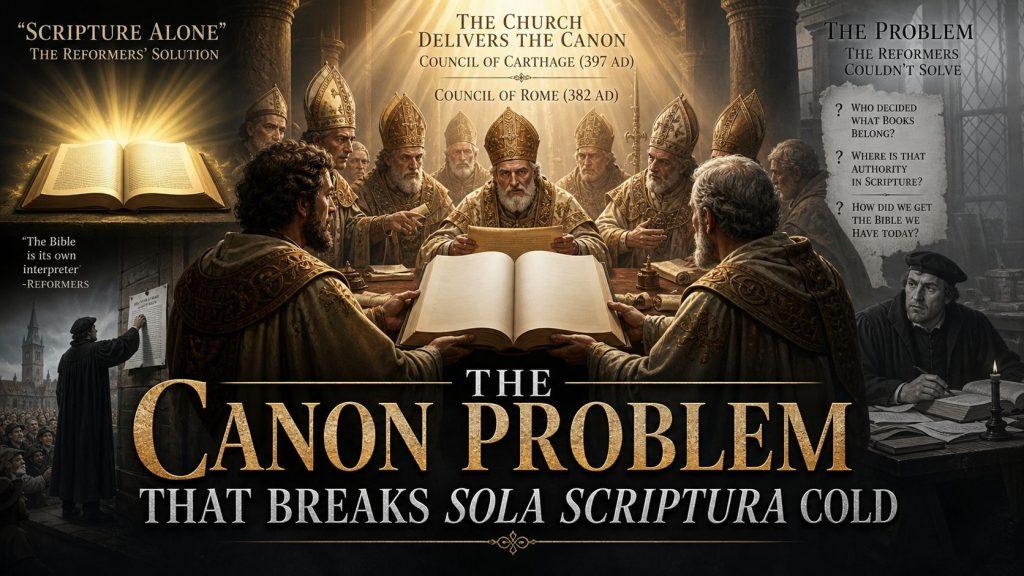
- Protestantism claims Scripture alone as the final authority, yet the canon of Scripture was discerned by Catholic bishops in council, not delivered from heaven on a list.
- Catholics rest honestly on the authority of the Church Christ founded, while many sincere Protestants have never been told how their own canon was actually decided.
- Facing the canon question seriously forces a choice between trusting the Church that handed down the Bible or trusting a private judgment the Bible itself never authorizes.
The Question Almost No One Asks
Open any Protestant Bible and turn to the table of contents. Sixty-six books, give or take the seven Deuterocanonical writings that Luther removed in the sixteenth century. Now ask the question almost no one asks in Sunday school. Where did that list come from? Not the inspired words inside the books, but the list itself.
Scripture never provides its own index. No verse in Matthew tells you that Hebrews belongs in the canon. No line in Romans certifies Revelation. The early Church wrestled for roughly four centuries with which writings were truly apostolic and which were forgeries or pious imitations. Councils at Hippo in 393 and Carthage in 397 settled the matter for the Latin West, and the canon they ratified included the seven Deuterocanonical books that Protestants would later remove more than a thousand years after the fact.
How the Church Actually Decided
The discernment was not random or hasty. Bishops weighed apostolic origin, doctrinal soundness, and continuous use in the worship of the great sees. Athanasius, Augustine, Jerome, and Pope Damasus all played roles, and the same Church that defined the Trinity at Nicaea defined the canon of Scripture in the decades that followed. The two acts came from the same authority and the same Spirit.
This matters because Catholics have always taught that Scripture, Tradition, and the living teaching office work together as one organic whole. The Catechism teaches that Scripture and Tradition flow from the same divine wellspring and must be received with equal devotion (CCC 82), and that the complete list of sacred books is itself called the canon of Scripture (CCC 120). The canon is not an accident. It is the fruit of the Spirit guiding the Church Christ promised would never be overcome (Matthew 16:18).
Catholic Share is a one-person ministry. If this content helps you, consider supporting it.
The Bind Sola Scriptura Cannot Escape
Here is where the logic gets uncomfortable for a serious Protestant. If Scripture alone is the rule of faith, then the list of books in Scripture must itself be drawn from Scripture. It cannot be. The list comes from outside the books, from the very ecclesial tradition the Reformers tried to subordinate.
If this kind of writing helps you, you can keep it free for others by supporting this work.
So the Protestant believer is left with a quiet problem. He trusts the canon, but he trusts it on the authority of the Catholic Church that discerned it. He has accepted a Catholic decision while rejecting the Catholic principle that made the decision possible. Some Protestant theologians, like R.C. Sproul, admitted this openly and called the canon a fallible collection of infallible books. That is a striking concession from a serious Reformed thinker.
What Luther Actually Did to the Bible
Most Protestants do not know the full story. Luther did not merely remove the seven Deuterocanonical books that Christians had read and quoted since before the Resurrection. He also wanted to remove James, Hebrews, Jude, and Revelation from the New Testament because they did not fit his theology of justification by faith alone. He famously called James an epistle of straw.
He failed to remove them in the end, but the precedent he set is sobering. Once the principle becomes individual judgment, the canon itself is open for renegotiation. The Ethiopian Orthodox use a wider canon. The Eastern Orthodox use the Septuagint. The Assyrian Church of the East has its own tradition. Protestants quietly inherited a shortened Old Testament from Luther and a complete New Testament from the Catholic Church, and then declared the result the only rule of faith.
The Honest Catholic Answer
The Catholic position is not embarrassed by any of this. The Church openly says that Christ founded a visible community, gave it apostolic authority, and entrusted to it the Word of God in both written and unwritten form (2 Thessalonians 2:15). The Spirit guided that community to recognize which writings were truly Sacred Scripture and to set aside the many gospels and epistles that were not authentic.
This is internally consistent. The same authority that recognized the New Testament under the guidance of the Spirit also discerned its limits. The same Church that gave us the creed gave us the canon. A Catholic does not need to invent a self-authenticating Bible because he already trusts the Body that produced and preserved it.
So Where Does This Leave You?
The canon question will not go away by ignoring it. Every Christian who reads a New Testament is already standing inside a decision made by Catholic bishops centuries before the Reformation. To pretend otherwise is to live on borrowed credit without acknowledging the lender. Honest Protestants admit this much, and some, like John Henry Newman in the nineteenth century, followed the question all the way home to Rome. Others remain Protestant but stop claiming Scripture alone in any strict sense. What the question rules out is the easy assumption that the Bible simply fell from the sky in its present form.
None of this is meant to humiliate anyone or score a point. It is an invitation to think carefully about authority, history, and the promises Christ made about His Church. The canon you trust is older than your tradition, and the hands that gathered it were Catholic hands.
Catholic Share is a one-person ministry that publishes everything for free. If this article served you, you can subscribe to the free newsletter for weekly writing, or help keep articles like this freely available by choosing to support this ministry.
This Article Was Made Possible By Supporters Like You
Catholic Share survives on reader generosity, not corporate sponsors. If this article deepened your faith or helped you share it with someone, consider joining our Patreon. For as little as $5 per month, you sustain this ministry, and we pray for every patron by name. You can also support us with a one time gift via PayPal at catholicshare@outlook.com.