
Sola Scriptura’s Hidden Flaw No One Talks About
Brief Overview
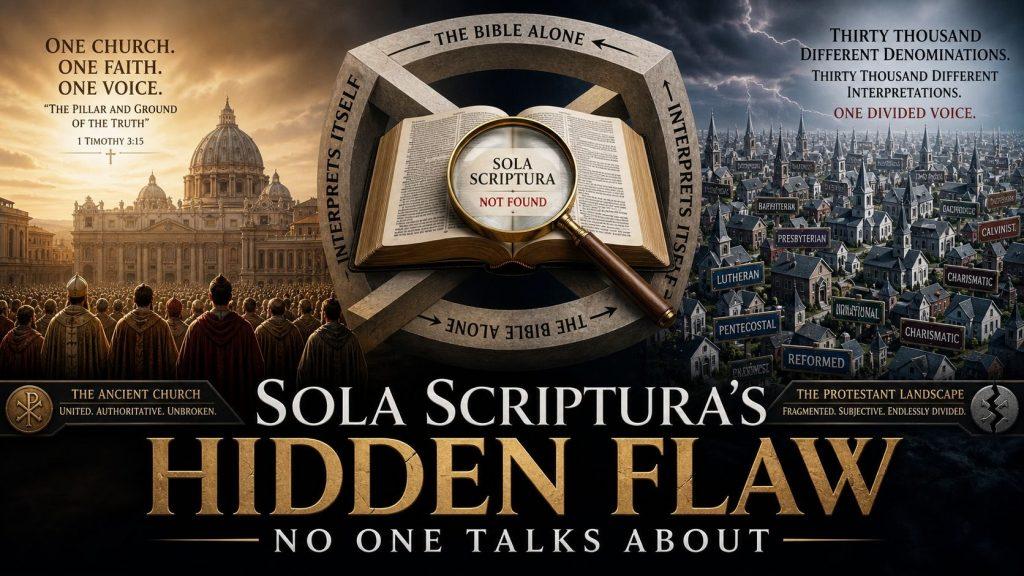
- Sola Scriptura claims the Bible alone is the final rule of faith, yet that very claim cannot be found anywhere inside the Bible itself.
- The doctrine produced thirty thousand denominations in five hundred years, which is hard to square with a Savior who prayed that His followers would be one.
- Catholics hold Scripture in the highest reverence while recognizing that Christ entrusted its interpretation to the living teaching office of the Church.
- Anyone willing to test the principle by its own fruit will find a record of fragmentation, contradiction, and continual revision rather than the clarity it promised.
The Slogan That Built the Reformation
Sola Scriptura is the engine of Protestantism. Strip it out, and the whole project loses its footing. The slogan insists that the Bible alone is the supreme and final authority for Christian faith and practice, and that anything not found in Scripture cannot bind the conscience of a believer.
It sounds clean. It sounds biblical. It sounds like a return to the source. But the moment you press on it, the principle starts to wobble in ways most Protestants never hear discussed from a pulpit. The wobble is not a Catholic invention. It is built into the doctrine itself.
The Self-Reference Problem
Here is the first crack. Sola Scriptura is a claim about Scripture. If Scripture alone is the rule of faith, then Sola Scriptura must be taught inside Scripture. It is not. No verse in the Bible says that the Bible alone is the rule of faith. 2 Timothy 3:16 says all Scripture is inspired and useful for teaching, but inspired and useful is not the same as alone and sufficient apart from the Church.
In fact, the New Testament repeatedly assumes the opposite. Paul tells the Thessalonians to hold fast to the traditions they were taught, whether by word of mouth or by letter (2 Thessalonians 2:15). He tells Timothy that the Church, not a book, is the pillar and bulwark of the truth (1 Timothy 3:15). The earliest Christians had no New Testament canon for centuries, and yet the faith was preached, the sacraments were celebrated, and the gospel spread across the Roman world.
Catholic Share is a one-person ministry. If this content helps you, consider supporting it.
What the Fruit Actually Looks Like
Jesus said you would know a tree by its fruit. So look at the fruit of Sola Scriptura honestly. In five centuries, the principle has produced an estimated thirty thousand or more distinct Protestant denominations and independent communities, each appealing to the same Bible and reaching contradictory conclusions on baptism, the Eucharist, salvation, church government, sexuality, and the moral law.
Lutherans baptize infants. Baptists insist that is unbiblical. Reformed Christians teach predestination in a strong sense. Methodists reject that reading entirely. Pentecostals say tongues are normative. Cessationists call modern tongues a counterfeit. Each side opens the same text, prays for the same Spirit, and walks out with an incompatible conclusion.
Catholic Share is a one-person ministry, and readers who choose supporting this work are remembered by name in prayer.
A principle that consistently produces irreconcilable conclusions among sincere, prayerful, intelligent believers is not a reliable principle of unity. It is a recipe for endless division dressed up in biblical language.
The Interpretive Authority Question
The deeper problem is interpretive authority. A book, even an inspired book, does not interpret itself. Someone has to read it, weigh it, and apply it. The Catholic answer is that Christ entrusted authentic interpretation to the living teaching office of the Church, the Magisterium, which serves the Word of God rather than standing above it (CCC 85).
The Protestant answer collapses authority down to the individual conscience guided by the Spirit. That sounds humble until you notice that every heretic in Church history made the same claim. Arius read his Bible. So did the Gnostics, the Donatists, and the Marcionites. The early Church did not settle disputes by handing out scrolls and wishing everyone luck. It settled them in council, with bishops in apostolic succession, under the protection promised by Christ to His Church.
The Early Church Did Not Operate This Way
Read the Fathers and the picture becomes clearer. Ignatius of Antioch in the year 107 was already writing about the bishop as the center of Christian unity. Irenaeus around 180 was appealing to apostolic succession against the heretics, not to a private reading of the Scriptures. Augustine in the fourth century famously said he would not believe the gospel itself except on the authority of the Catholic Church.
These were not medieval popes inventing power grabs. These were the men closest in time to the apostles, and they recognized no such thing as Sola Scriptura. The doctrine simply did not exist in the early Church. It was a sixteenth century innovation designed to justify a break from Rome, and it has produced exactly the kind of confusion you would expect from a principle the apostles never taught.
What Catholics Actually Believe About the Bible
It is worth saying clearly that Catholics love Scripture. The Church calls the faithful to read it, pray it, and let it shape every part of life. The Catechism is saturated with biblical quotation. The Mass is woven through with Scripture in every part. Catholic mystics and doctors, from Jerome to Therese of Lisieux, have lived inside the Word of God in a way that puts much of modern Christianity to shame.
The Catholic difference is not less Bible. The Catholic difference is that the Bible is read inside the Church that produced it, under the guidance of the Spirit who inspired it, with the help of the Tradition that interpreted it from the beginning. Scripture, Tradition, and the Magisterium are not three rival authorities. They are one organic source of revelation.
So Where Does This Leave a Sincere Believer?
If you take Sola Scriptura seriously, you should be willing to test it by its own results. Has it delivered the clarity it promised? Has it produced the unity Christ prayed for in John 17? Has it preserved the apostolic faith intact for five hundred years, or has it splintered Christianity into thousands of competing voices, each certain that the others are reading the same book incorrectly? The honest answer is hard to dodge once you stop reciting the slogan and start looking at the evidence.
The Catholic alternative is not anti-Bible. It is pro-Church, pro-Tradition, and pro-Scripture all at once, exactly as the apostles left things. The Reformation tried to cut one strand of a single cord, and the cord unraveled. That unraveling is what the principle’s hidden flaw looks like in the real world.
Catholic Share is a one-person ministry that publishes everything for free. If this article served you, you can subscribe to the free newsletter for weekly writing, or help keep articles like this freely available by choosing to support this ministry.
This Article Was Made Possible By Supporters Like You
Catholic Share survives on reader generosity, not corporate sponsors. If this article deepened your faith or helped you share it with someone, consider joining our Patreon. For as little as $5 per month, you sustain this ministry, and we pray for every patron by name. You can also support us with a one time gift via PayPal at catholicshare@outlook.com.