
Why Protestants Still Can’t Agree On What Saves You
Brief Overview
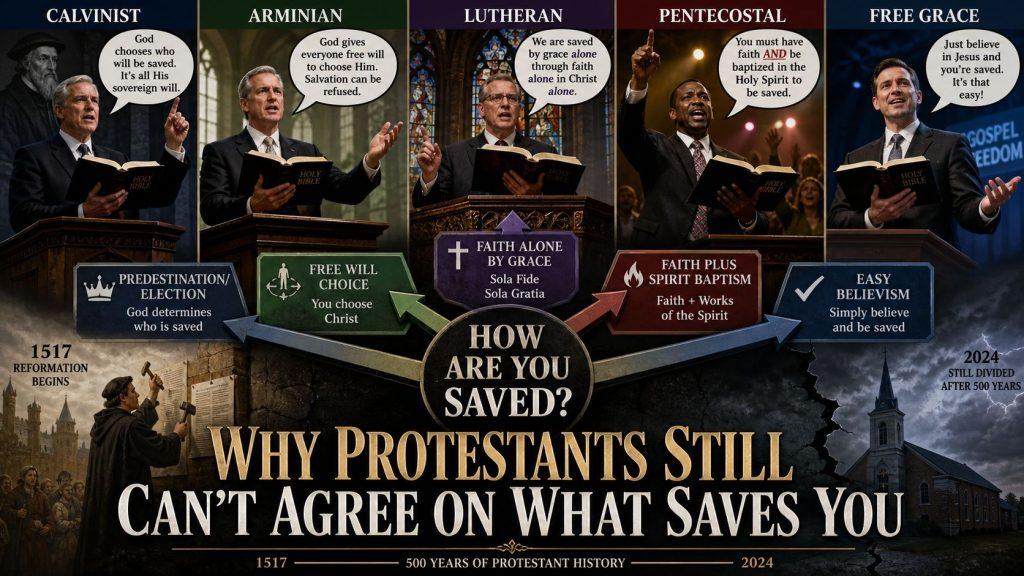
- Five centuries after the Reformation, Protestants cannot agree among themselves on the most basic question a Christian can ask, which is how a person is actually saved.
- Calvinists, Arminians, Lutherans, Pentecostals, and Free Grace teachers all claim biblical support while reaching incompatible conclusions about election, faith, works, and assurance.
- The Catholic Church teaches a unified position on grace, faith, and works that has remained stable for two thousand years and is grounded in Scripture and the Fathers.
- The cost of getting this question wrong is not academic, which is why the confusion inside Protestantism on salvation is one of the gravest problems the Reformation produced.
The Question Every Soul Has to Answer
What must I do to be saved? The jailer asked it in Acts 16. The rich young man asked it in Mark 10. Every honest seeker eventually asks it too. It is the question the gospel exists to answer.
You would expect that any Christian tradition serious about the gospel would give one clear answer to that question. Catholics do. The Eastern Orthodox do. The Reformation, however, produced a hall of mirrors in which sincere Protestants give answers that contradict each other directly. The disagreement is not over secondary matters. It is over the very thing Christ died to accomplish.
The Calvinist Answer
For the strict Calvinist, salvation is the unconditional act of God toward a chosen elect. Before the foundation of the world, God decreed which individuals would be saved and which would be passed over. Christ died only for the elect, grace cannot be resisted, and the saved cannot finally fall away. Faith itself is a gift given only to those already chosen.
This is the famous TULIP scheme, hammered out at the Synod of Dort in 1618 against the Arminians. It claims to be the only consistent reading of Paul, especially Romans 9. If it is correct, then most of the rest of Protestantism, and certainly all of Catholicism, is preaching a defective gospel that flatters human freedom and dishonors divine sovereignty.
Catholic Share is a one-person ministry. If this content helps you, consider supporting it.
The Arminian and Wesleyan Answer
For the Arminian and the Wesleyan Methodist, the Calvinist scheme makes God the author of damnation. Christ died for all, grace is offered to all, and the human will, freed by prevenient grace, can either accept or resist that offer. A true believer can fall away through persistent unbelief or grave sin. Sanctification matters, and Wesley even taught a doctrine of Christian perfection in this life.
This is a different gospel from the Calvinist one. It is not a matter of emphasis. The two systems give incompatible answers to whether God wills the salvation of every person, whether Christ died for every person, and whether a believer can ever be lost. Both sides cite Scripture with confidence. Both sides have produced saints and martyrs. Both cannot be right.
The Lutheran, Baptist, and Free Grace Answers
It gets worse. Confessional Lutherans hold a position that does not fit neatly into either camp, affirming baptismal regeneration and the real possibility of falling away while also rejecting Calvinist election. Most Baptists hold once saved always saved without the rest of Calvinist theology, producing what scholars call eternal security without unconditional election.
The Free Grace movement, associated with Zane Hodges and parts of Dallas Theological Seminary, teaches that a person is saved by a single moment of intellectual assent to the gospel, with no necessity of repentance, obedience, or perseverance. Lordship Salvation advocates, like John MacArthur, insist that view empties the gospel of its content. Pentecostals add the further claim that Spirit baptism, often evidenced by tongues, is a distinct work necessary for the full Christian life.
Articles like this stay free because of the readers who choose supporting this work.
Add in the Churches of Christ, who teach that baptism by immersion is necessary for salvation, and the New Perspective on Paul, which reframes justification entirely, and the picture becomes a maze. These are not minor disputes. They are direct contradictions about how a sinner is reconciled to God.
What the Bible Actually Says
Scripture itself refuses the tidy slogans. Ephesians 2:8 to 9 says salvation is by grace through faith and not by works. James 2:24 says a person is justified by works and not by faith alone. Philippians 2:12 tells Christians to work out their salvation with fear and trembling. Romans 8:30 speaks of predestination, while 1 Timothy 2:4 says God wills all to be saved.
A theological system that takes one strand and severs it from the others will always read parts of the Bible while ignoring others. The Catholic position is the only one that holds every strand together without contradiction. Salvation is entirely the work of grace, freely received through faith, lived out in works of love, sustained through the sacraments, and finally completed when the soul perseveres to the end. The Catechism teaches that grace is the free gift of God which precedes, prepares, and accompanies every good act, and that no one can merit the initial grace of conversion.
The Catholic Synthesis
Catholic teaching on salvation can be stated in a single arc. God offers grace to every person through the merits of Christ. That grace, received in baptism, makes the soul a new creation. Faith working through love (Galatians 5:6) animates the Christian life. The sacraments nourish and restore grace when it is wounded or lost. Final salvation depends on perseverance, which is itself a gift, asked for daily in prayer.
This is the gospel that produced Augustine and Aquinas, Therese and Mother Teresa, the martyrs of every century, and the missionaries who brought the faith to every continent. It does not pit grace against freedom, faith against works, or justification against sanctification. It holds them together as Scripture itself does.
So What Should You Make of the Confusion?
If five hundred years of Protestant scholarship, prayer, and biblical study have failed to produce a unified answer to the most basic question a Christian can ask, something has gone wrong at the level of the principle, not the people. Sincere believers in every camp are doing their honest best with the Bible they have. The trouble is that the Bible was never meant to be read without the Church Christ founded, the Tradition the apostles left, and the teaching office that guards both. Cut Scripture loose from its native home, and the gospel itself begins to fray at the edges.
The Catholic Church does not claim to have invented a clever answer. She claims to have preserved the original one. The unity she offers on this question is not the unity of a slogan but the unity of two millennia of consistent teaching, tested in council, refined under persecution, and held by every generation of saints.
Catholic Share is a one-person ministry that publishes everything for free. If this article served you, you can subscribe to the free newsletter for weekly writing, or help keep articles like this freely available by choosing to support this ministry.
This Article Was Made Possible By Supporters Like You
Catholic Share survives on reader generosity, not corporate sponsors. If this article deepened your faith or helped you share it with someone, consider joining our Patreon. For as little as $5 per month, you sustain this ministry, and we pray for every patron by name. You can also support us with a one time gift via PayPal at catholicshare@outlook.com.