
The 1,500 Year Gap Protestantism Still Cannot Explain
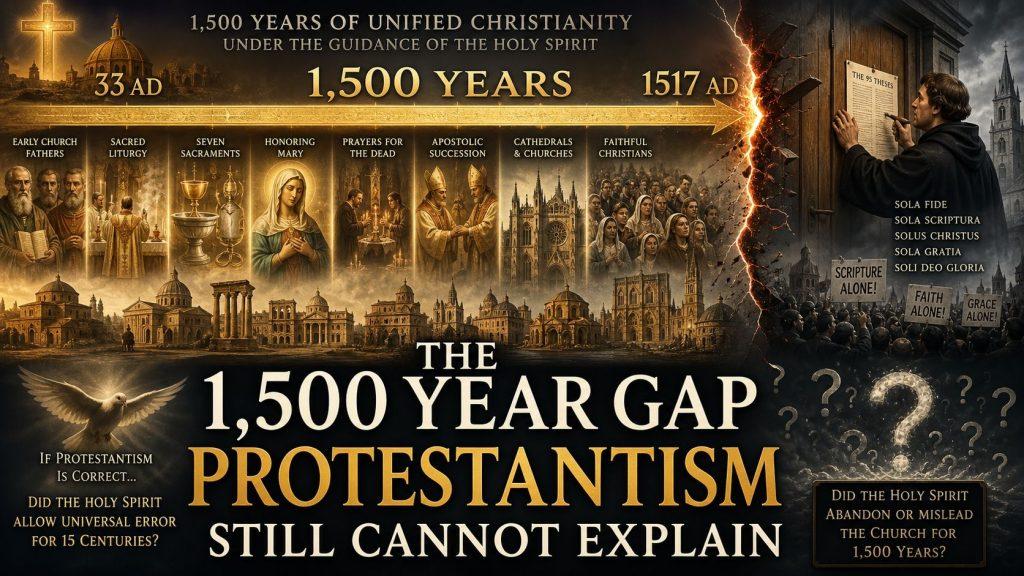
Brief Overview
- For roughly fifteen centuries before the Reformation, the entire visible Church practiced the seven sacraments, honored Mary, prayed for the dead, and recognized the authority of bishops in apostolic succession.
- If the Reformers were right, then the Holy Spirit allowed every Christian on earth to fall into serious error for fifteen hundred years until a German monk corrected the record.
- That claim is hard to reconcile with Christ’s promise that the gates of hell would not prevail against His Church and that the Spirit would guide her into all truth.
- Honest engagement with the Fathers, the early liturgies, and the historical record forces a conclusion most Protestants are never invited to face.
The Quiet Assumption Behind the Reformation
Every Protestant tradition rests on a single quiet assumption that almost no one states out loud. The assumption is that the Christian Church, the visible Body of Christ on earth, went badly wrong somewhere between the death of the last apostle and the year 1517. Otherwise, there would be nothing to reform. Luther, Calvin, and Zwingli were not building from scratch. They were claiming that fifteen hundred years of Christian practice and belief had drifted into serious error, and that they alone were restoring the original.
That is a staggering claim when you put it plainly. It means the Holy Spirit allowed every Christian community on the planet, including the martyrs, doctors, mystics, missionaries, and councils that defined the Trinity and the Incarnation, to teach and practice falsehood on central matters of faith for a millennium and a half.
What the Early Church Actually Believed
The historical record is not vague. We have the writings of the Church Fathers, the liturgies of the East and West, the canons of the ecumenical councils, and the archaeological evidence of early Christian worship. These sources speak with a strikingly unified voice on the very doctrines Protestantism rejected.
Ignatius of Antioch around the year 107 called the Eucharist the flesh of our Savior Jesus Christ. Justin Martyr around 150 described the Mass in terms any Catholic would recognize today. Irenaeus around 180 defended apostolic succession through bishops as the guarantee of true doctrine. Cyprian in the third century taught that outside the Church there is no salvation. Augustine in the fourth and fifth centuries preached infant baptism for the remission of original sin, the real presence in the Eucharist, the authority of the Roman see, and the intercession of the saints.
Catholic Share is a one-person ministry. If this content helps you, consider supporting it.
These were not late medieval corruptions. They were the universal faith of the early Church, taught by men who knew the apostles or knew those who knew the apostles. To call them wrong is to call the whole foundation wrong.
The Sacraments Were Always There
Take the seven sacraments specifically. Baptism is everywhere in the New Testament. The Eucharist is celebrated in 1 Corinthians 11. Confession of sins is commanded in James 5:16 and connected to the apostolic power to forgive in John 20:23. The anointing of the sick is described in James 5:14. Marriage is called a great mystery in Ephesians 5:32, where the Greek word is the same root the Latin Church renders as sacrament. Holy Orders is conferred by the laying on of hands throughout Acts and the pastoral epistles. Confirmation appears as the laying on of hands for the gift of the Spirit in Acts 8.
If this kind of writing helps you, you can keep it freely available for others by supporting this work.
The early Church practiced all seven without controversy. The Eastern Orthodox, the Coptic, the Ethiopian, the Syriac, the Armenian, and the Assyrian Churches, none of which were in communion with Rome at the time of the Reformation, all preserved the same seven sacraments independently. The unanimity is the point. Communities separated by language, geography, politics, and theological dispute for over a thousand years still held the sacramental system in common, because they all received it from the apostles.
The Promise Christ Made About His Church
Now place that historical record against the words of Christ Himself. He told Peter that the gates of hell would not prevail against the Church He was building (Matthew 16:18). He promised that the Spirit of truth would guide His followers into all truth (John 16:13). He committed Himself to be with His Church always, to the end of the age (Matthew 28:20). The Catechism draws out the implication when it teaches that the unity of the pilgrim Church is assured by visible bonds of communion which include the profession of one faith and the celebration of the sacraments (CCC 815).
If the Reformers were right, then those promises failed. The gates of hell did prevail. The Spirit did not guide the Church into truth on the Eucharist, on baptism, on the priesthood, on confession, on Mary, on the saints, on the structure of worship, or on the means of grace. For fifteen hundred years, every Christian on earth was wrong on these points, and the Spirit said nothing until a sixteenth century friar broke ranks.
This is the conclusion the Protestant position requires. Most Protestants never state it that plainly because, stated plainly, it is hard to believe.
The Alternative Reformers Sometimes Offer
Some Protestants try to soften the gap by appealing to an invisible remnant. The argument runs that throughout the medieval centuries there were always secret believers who held the true Protestant faith underground while the visible Catholic Church taught error. The trouble is that there is no historical evidence for such a remnant. The groups sometimes nominated, the Waldensians, the Hussites, the Lollards, do not actually share Protestant theology when their writings are examined honestly. They were medieval reform movements within or near Catholicism, not crypto-Lutherans waiting for daylight.
The invisible remnant theory is what historians call special pleading. It is invented to fill a gap the evidence cannot fill on its own.
So What Does the Honest Believer Do With This?
The fifteen hundred year gap is not a Catholic talking point. It is the actual historical situation any serious Christian has to account for. If you believe Christ kept His promise about His Church, then you have to identify where that Church was during those fifteen centuries, and the only honest answer is that it was the visible Catholic and Orthodox Church teaching the very doctrines the Reformers rejected. If you believe the Reformers were right, then you have to explain why Christ’s promises appear to have failed and what kind of Savior makes promises He does not keep.
The Catholic answer is simpler and more historically grounded. Christ founded one visible Church, gave it the apostolic ministry, and preserved its essential teaching across every century. Reform is necessary at times, and the Church has reformed herself many times, in monasticism, at Trent, at Vatican II. What she has never done is begin again from scratch, because the original is still standing.
Catholic Share is a one-person ministry that publishes everything for free. If this article served you, you can subscribe to the free newsletter for weekly writing, or help keep articles like this freely available by choosing to support this ministry.
This Article Was Made Possible By Supporters Like You
Catholic Share survives on reader generosity, not corporate sponsors. If this article deepened your faith or helped you share it with someone, consider joining our Patreon. For as little as $5 per month, you sustain this ministry, and we pray for every patron by name. You can also support us with a one time gift via PayPal at catholicshare@outlook.com.