
Which Protestant Church Is Actually the Right One?
Brief Overview
- If the ancient apostolic Churches got the canon and the sacraments wrong, the burden falls entirely on Protestantism to identify which of its competing voices carries the truth.
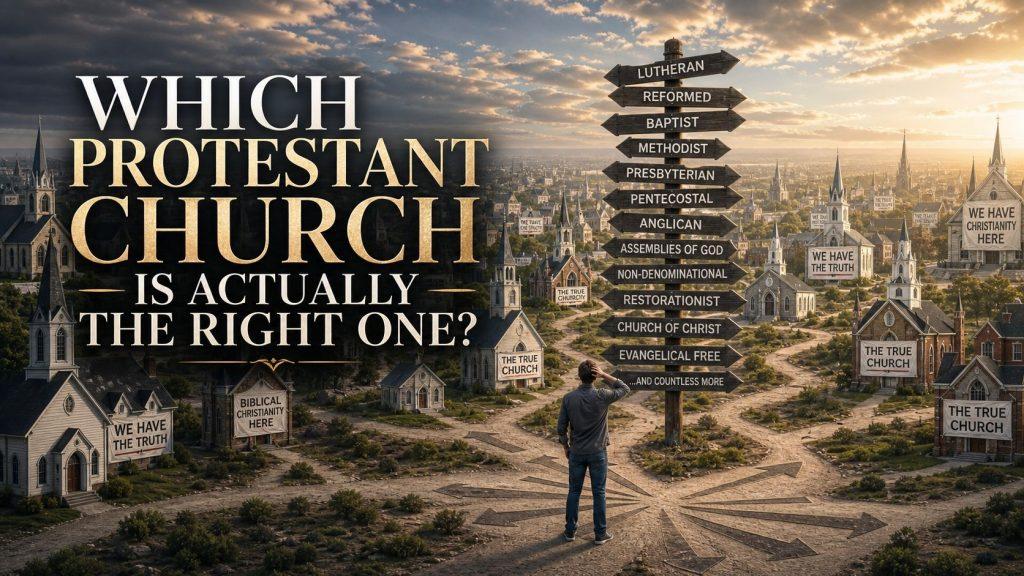
- Lutherans, Reformed, Anglicans, Baptists, Methodists, Pentecostals, and Restorationists each claim to have recovered something the others missed, and their claims directly contradict each other.
- There is no Protestant tribunal to adjudicate these disputes because Sola Scriptura hands authority to every interpreter and therefore to none.
- Following the question honestly leads back toward the Catholic claim that Christ founded one visible Church with the authority to settle these disputes.
Setting Up the Question Fairly
Grant the Protestant premise for a moment. Suppose the Catholic, Orthodox, Coptic, Ethiopian, Armenian, and Assyrian Churches all got the canon wrong, the seven sacraments wrong, and the major doctrines of grace, ecclesiology, and worship wrong. Suppose the entire pre-Reformation Christian world drifted into error and needed correction in the sixteenth century.
A serious question follows. Which Protestant church, of the thousands now in existence, has actually recovered the truth? Because if any one of them is right, the rest are by necessity wrong, and the believer needs to know which one to follow. Let us walk through the field honestly and see whether any answer survives scrutiny.
The Major Claimants
Lutheranism claims that Luther recovered the gospel of justification by faith alone, retains a high view of baptism and the real presence in the Eucharist, and treats the Book of Concord as a faithful exposition of Scripture. Lutherans accuse Reformed Christians and Baptists of stripping the sacraments of their power. Yet Lutherans themselves are split between confessional bodies like the LCMS and liberal bodies like the ELCA, which disagree on Scripture, sexuality, and even basic Christology.
The Reformed tradition follows Calvin and the Westminster Standards. It claims to have systematized biblical theology most rigorously through covenant theology, divine sovereignty, predestination, and a spiritual presence in the Supper. Reformed Christians argue Lutherans were inconsistent and Arminians were under-reformed. The Reformed world itself fractures into Presbyterian denominations, Reformed Baptists, theonomists, Federal Vision, and dozens of smaller bodies that excommunicate one another over baptism, polity, and worship.
Catholic Share is a one-person ministry. If this content helps you, consider supporting it.
Anglicans claim a middle way with apostolic succession, the Book of Common Prayer, and the 39 Articles. The Communion is now openly fracturing between GAFCON and Canterbury over sexuality, women’s orders, and basic doctrine. Anabaptists, Baptists, Methodists, and Pentecostals each add their own claims, each rejecting parts of every other tradition above.
The Contradictions That Cannot Be Reconciled
These are not minor differences of style. They are direct contradictions about the gospel, the Church, and the means of salvation. Lutherans baptize infants and teach baptismal regeneration. Baptists call infant baptism unbiblical and refuse to recognize it as baptism at all. Churches of Christ teach that baptism by immersion is necessary for salvation. Quakers and the Salvation Army reject water baptism entirely.
Catholic Share is a one-person ministry, and readers who choose supporting this work are remembered by name in prayer.
On the Lord’s Supper, Lutherans affirm Christ’s bodily presence in, with, and under the elements. Reformed Christians teach a spiritual presence received by faith. Most Baptists hold a purely memorial view. These positions cannot all be right. At most one is. On salvation, Calvinists and Arminians give incompatible answers about election, atonement, and the security of the believer. On church government, episcopal, presbyterian, and congregational structures each claim biblical warrant while functioning in completely different ways.
The Restorationist and Sectarian Claimants
The picture gets stranger at the edges. The Stone-Campbell movement, which produced the Churches of Christ and the Christian Churches, taught that all of historic Christianity went wrong and that they alone restored the New Testament pattern. Seventh-day Adventists added a prophetess in Ellen White, a Saturday Sabbath, and distinctive teachings on the state of the dead. Jehovah’s Witnesses rejected the Trinity and produced their own Bible translation. Latter-day Saints added new scriptures and a restored priesthood. Oneness Pentecostals collapsed the Trinity into modalism.
Each of these groups arose from Protestant soil and used the same principles, the Bible alone and private interpretation, to arrive at conclusions most other Protestants now consider heretical. There is no internal Protestant principle that can rule them out without smuggling in extra-biblical tradition.
The Tribunal That Does Not Exist
Here is the heart of the problem. When Lutherans and Baptists disagree on baptism, who decides? When Calvinists and Arminians disagree on election, who decides? When charismatics and cessationists disagree on the gifts of the Spirit, who decides? There is no Protestant council, no Protestant magisterium, no Protestant pope. Every appeal to Scripture is met with a counter-appeal to Scripture, and the dispute goes nowhere except into further fragmentation.
Sola Scriptura hands the gavel to every interpreter and then to none. The result is exactly what we see on the ground, tens of thousands of denominations and independent communities, each certain it has the Bible on its side. A principle that produces this much contradiction is not the principle Christ left to His Church.
The Standard Protestant Responses
Protestants are aware of the problem, and they offer four main responses. The first is the mere Christianity approach, which says the divisions are real but the core gospel unites all true believers and secondary issues do not unchurch anyone. The trouble is that baptism and the Eucharist are not secondary in Scripture, and the so-called core is itself a Protestant construct chosen after the fact.
The second is the invisible Church theory, which says the true Church is known only to God and scattered across denominations. But Christ prayed for visible unity in John 17, and the New Testament knows nothing of an invisible Church divorced from visible communion. The third is providential pluralism, which celebrates diversity. That position collapses into relativism, because contradictories cannot both be true. The fourth is the honest one, which is to say that my denomination has actually recovered the truth and the others are in varying degrees of error. It is the most logically consistent answer and the least credible, because every group says it about itself.
So Where Does the Argument Land?
Followed honestly, the question rules out the easy assumption that rejecting the ancient Churches leads to a clear Protestant alternative. It does not. It leads into a maze where every claimant has equal formal credentials, a Bible and the Spirit, and arrives at incompatible conclusions. The fragmentation is not a bug to be fixed later. It is the predictable fruit of the principle itself.
The Catholic claim, by contrast, is the boring one and the historically grounded one. Christ founded one visible Church, gave her bishops in apostolic succession, promised her the Spirit, and entrusted to her the Scriptures and the sacraments. That Church has stumbled in many ways across the centuries, but she has never lost the deposit of faith. Her unity is not perfect, but it is real, visible, and traceable to the apostles. No Protestant body can make the same claim, and most do not even try.
Catholic Share is a one-person ministry that publishes everything for free. If this article served you, you can subscribe to the free newsletter for weekly writing, or help keep articles like this freely available by choosing to support this ministry.
This Article Was Made Possible By Supporters Like You
Catholic Share survives on reader generosity, not corporate sponsors. If this article deepened your faith or helped you share it with someone, consider joining our Patreon. For as little as $5 per month, you sustain this ministry, and we pray for every patron by name. You can also support us with a one time gift via PayPal at catholicshare@outlook.com.