
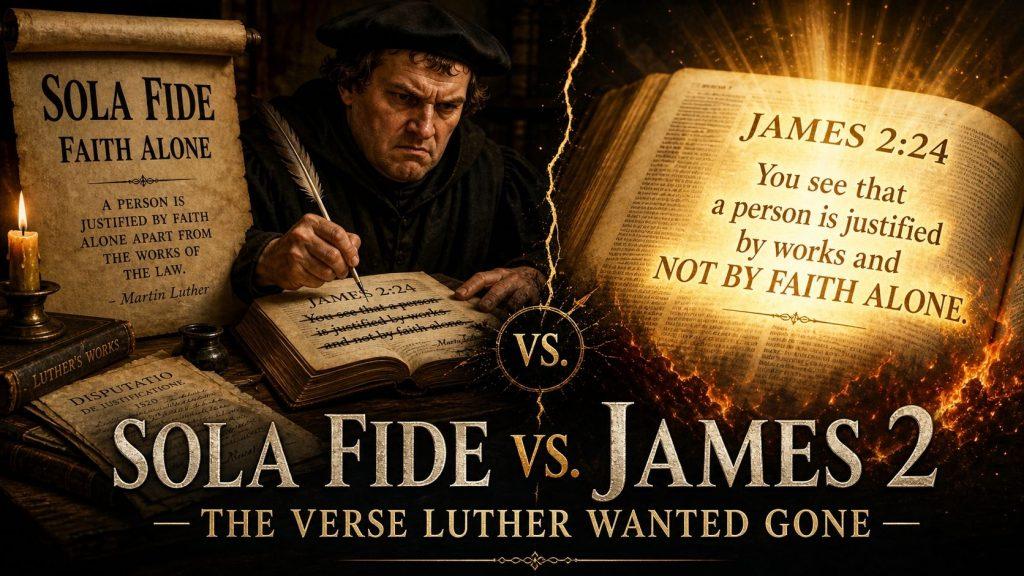
Sola Fide vs. James 2 — The Verse Luther Wanted Gone
Brief Overview
- Sola Fide teaches that a person is justified by faith alone, yet the only place in the entire Bible where the phrase faith alone appears is in James 2:24, and the verse explicitly denies it.
- Luther recognized the conflict so sharply that he tried to remove the Letter of James from the New Testament and called it an epistle of straw.
- The Catholic position holds faith and works together as Scripture itself does, teaching that saving faith is always a faith that works through love.
- This is not a small dispute, because it shapes how a Christian understands salvation, sanctification, the sacraments, and the moral life from start to finish.
The Slogan and the Problem
Sola Fide, justification by faith alone, is one of the load-bearing walls of the Reformation. Luther called it the article on which the Church stands or falls. According to this teaching, a sinner is declared righteous by God on the basis of faith alone, with the merits of Christ imputed to the believer’s account, while works contribute nothing to justification itself.
The trouble shows up immediately when you open the New Testament and read James 2:24. The verse says plainly that a person is justified by works and not by faith alone. This is not a Catholic translation trick. The Greek is direct. It is the only verse in the entire Bible that uses the phrase faith alone, and it denies the Reformation slogan word for word.
What Luther Did With James
Luther saw the problem clearly, and his response is one of the most candid moments in Reformation history. He concluded that the Letter of James must be defective. In his preface to the New Testament, he ranked James as a lesser book, called it an epistle of straw compared to the gospel of John and the letters of Paul, and argued it should not stand on the same level as the rest of Scripture.
He did not succeed in removing James from the canon, but his judgment reveals the underlying logic. When Scripture contradicts the system, the system bends Scripture rather than reconsidering itself. That is a striking move for a man who claimed Scripture alone as the rule of faith.
Catholic Share is a one-person ministry. If this content helps you, consider supporting it.
What James Actually Says
Read the whole passage and the force becomes clearer. James is writing against a false confidence, against believers who claim faith while ignoring the moral demands of the gospel. He asks what good it does to say one has faith while doing nothing to feed the hungry or clothe the poor (James 2:14 to 17). He says even the demons believe and tremble (James 2:19). He concludes that faith without works is dead.
His example is Abraham, whom Paul also discusses in Romans 4. James says Abraham was justified by works when he offered Isaac on the altar (James 2:21), and that his faith was completed by his works (James 2:22). He then states the contested verse directly. You see that a person is justified by works and not by faith alone.
Articles like this stay free because of the readers who choose supporting this work.
The Protestant response usually distinguishes between the works Paul rejects, namely works of the Mosaic Law performed to earn salvation, and the works James commends, namely the visible evidence of an already justified faith. The distinction is not without merit, but it does not save the slogan. It only proves that the relationship between faith and works is more textured than Sola Fide allows.
The Catholic Synthesis
The Catholic Church has never pitted faith against works because Scripture does not pit them against each other. Paul writes that what counts is faith working through love (Galatians 5:6). He tells the Philippians to work out their salvation with fear and trembling (Philippians 2:12). He warns the Corinthians that not even he can presume on his own salvation but must discipline his body lest he be disqualified (1 Corinthians 9:27). These are not the words of a man who believed in a one-time forensic imputation followed by guaranteed safety.
Catholic teaching holds that justification is the free gift of God, received initially through faith and the grace of baptism, lived out in works of love, sustained through the sacraments, and finally completed when the soul perseveres in grace to the end. Works do not earn the initial grace of conversion, which is purely a gift, but works done in grace are themselves the fruit of that gift and have real merit before God because they are the actions of Christ living in the baptized soul (Galatians 2:20).
What the Early Church Believed
This is not a medieval innovation. Read the Fathers and the picture is consistent. Clement of Rome around the year 96 wrote that we are justified by faith and by works in the same breath. Polycarp, John Chrysostom, Augustine, and the entire patristic tradition treated faith and works as inseparable elements of the one Christian life. Augustine taught that God crowns His own gifts when He rewards our merits, capturing the Catholic balance precisely.
There is no early Christian writer who teaches Sola Fide in the Lutheran sense. The doctrine simply does not appear in the first fifteen centuries of Christianity. It was a sixteenth century innovation, and Luther himself recognized that his reading required adding the word alone to Romans 3:28, where it does not exist in the Greek. He defended the addition openly, saying it was demanded by the meaning of the text. That is the language of an interpreter imposing a system on Scripture, not of a man simply receiving what the Bible says.
Why This Matters for the Christian Life
The dispute is not merely academic. Sola Fide shapes how a believer relates to sin, sanctification, and the sacraments. If justification is a one-time imputation, then the sacramental life of confession, Eucharist, and anointing becomes optional or even confused. If serious sin cannot truly endanger salvation, then the moral demands of the gospel lose their urgency. If works contribute nothing, then the calls of Matthew 25 to feed the hungry and clothe the naked become evidence of a salvation already secured rather than the actual conditions Christ names at the final judgment.
The Catholic view restores the seriousness of the Christian life. Faith is the beginning, not the end. Baptism is the gateway, not the finish line. Perseverance is required, daily conversion is necessary, and the sacraments are real channels of the grace that completes the work begun.
So How Should You Read These Verses Honestly?
If you take Scripture seriously, you cannot read Paul without James, or James without Paul. The two are not enemies. They are addressing different errors with different emphases, and the Spirit who inspired both did not contradict Himself. The Reformation slogan reads one half of the New Testament and quietly sets aside the other. The Catholic synthesis reads both halves together, exactly as the Church has done from the beginning, and finds them in harmony.
This does not make salvation a matter of climbing a ladder by your own strength. It never was. Catholic teaching is clear that every good work the Christian performs is itself a gift of grace, an action of Christ in the soul that He purchased with His blood. The slogan Sola Fide tries to protect a real truth, that we cannot save ourselves, but it does so by amputating half of the biblical witness. The fuller truth is the older one, and it is still standing where it always was.
Catholic Share is a one-person ministry that publishes everything for free. If this article served you, you can subscribe to the free newsletter for weekly writing, or help keep articles like this freely available by choosing to support this ministry.
This Article Was Made Possible By Supporters Like You
Catholic Share survives on reader generosity, not corporate sponsors. If this article deepened your faith or helped you share it with someone, consider joining our Patreon. For as little as $5 per month, you sustain this ministry, and we pray for every patron by name. You can also support us with a one time gift via PayPal at catholicshare@outlook.com.