
Did Jesus Keep Jewish Tradition? Hanukkah Says Yes
Brief Overview
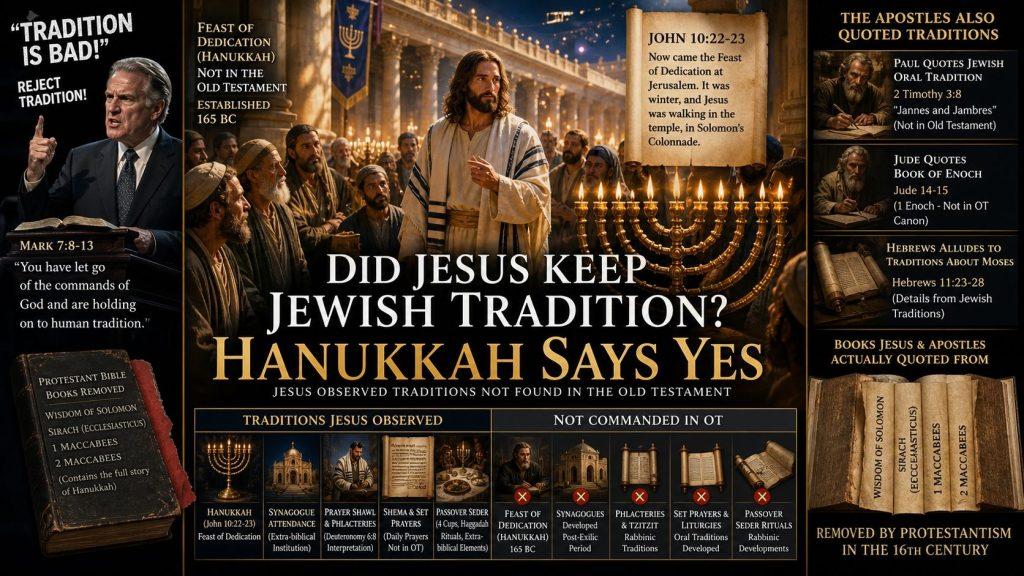
- Protestants who quote Mark 7 against tradition rarely notice that Jesus Himself observed Jewish customs found nowhere in the Old Testament.
- Hanukkah, the Passover seder, the synagogue service, and the standard forms of Jewish prayer are all extra-biblical traditions Jesus practiced without rebuke.
- Paul, Jude, and the writer of Hebrews quote or allude to Jewish oral tradition as authoritative, including works the Reformers later cut from the canon.
- The Mark 7 reading that bans all tradition cannot survive contact with how Jesus and the apostles actually lived their faith.
The Verse Everyone Quotes and the Verses Nobody Cites
You have heard Mark 7 quoted a hundred times. Jesus accuses the Pharisees of nullifying God’s word through their tradition, and the Protestant case against Catholic Tradition treats that passage as a knockout blow. The reasoning runs like this. Jesus rejected tradition. Catholics teach tradition. Therefore Catholics are wrong.
The problem is that nobody quotes the rest of the Gospels alongside Mark 7. Jesus did not reject Jewish tradition as a category. He rejected one specific tradition, Corban, that voided the fourth commandment. The rest of His life, He observed Jewish customs found nowhere in the books of Moses, and He did so without apology. If the Mark 7 reading were correct, Jesus contradicted Himself constantly.
The truth is simpler. Jesus drew the same distinction Catholics draw. Some traditions corrupt the faith. Other traditions transmit it. He affirmed the second kind by living it.
Hanukkah in the Gospel of John
Start with the clearest example. John 10:22 says, “It was the feast of the Dedication at Jerusalem; it was winter, and Jesus walked in the temple, in the portico of Solomon.” The feast of the Dedication is Hanukkah, the eight-day commemoration of the rededication of the Temple after the Maccabean revolt. It is not commanded anywhere in the Torah. It was instituted by Judas Maccabeus and his brothers in 164 BC, and the institution is recorded in 1 Maccabees 4:59.
Catholic Share is a one-person ministry. If this content helps you, consider supporting it.
Hanukkah is a tradition. A purely human tradition, by Protestant standards. It comes from a book the Reformers removed from their Bibles. Jesus walked into the Temple during this feast, did not denounce it, and used it as the setting for one of His most public claims to divinity.
If Jesus rejected all tradition not commanded in the Hebrew Scriptures, He should have rebuked Hanukkah on sight. He did the opposite.
The Seder, the Synagogue, and the Standard Prayers
The Passover Jesus celebrated at the Last Supper was not the bare ceremony of Exodus 12. It was the Second Temple seder, structured by rabbinic tradition with four cups of wine, the singing of specific Psalms, the dipping of bitter herbs, and the breaking of the afikoman. None of this structure appears in the Torah. All of it appears in Matthew 26, Mark 14, and Luke 22 as the framework Jesus used to institute the Eucharist.
The synagogue itself is a traditional institution. No verse in the Old Testament commands the building of synagogues or the order of synagogue worship. Luke 4:16 nevertheless tells us that Jesus “went to the synagogue, as his custom was, on the sabbath day.” His custom. He was observing a Second Temple Jewish tradition built up over centuries.
If this kind of writing helps you, you can keep it freely available for others by supporting this work.
The forms of prayer Jesus used, including the Shema, the eighteen benedictions known as the Amidah, and the standard blessings over bread and wine, are rabbinic tradition. Every blessing Jesus pronounced at a meal followed a fixed traditional formula that no Old Testament verse spells out.
What the Apostles Did With Jewish Tradition
The pattern continues in the writings of the apostles. 2 Timothy 3:8 names Jannes and Jambres as the Egyptian magicians who opposed Moses. Those names are not in Exodus. They come from Jewish oral tradition recorded in extra-biblical sources. Paul cites them as authoritative.
Jude 9 describes a dispute between the Archangel Michael and the devil over the body of Moses. That story is nowhere in the Old Testament. It comes from an extra-biblical work called the Assumption of Moses. Jude 14 to 15 then directly quotes 1 Enoch as a prophecy. Hebrews 11:35 refers to those who “were tortured, refusing to accept release, that they might rise again to a better life,” which is a clear allusion to the martyrdom of the Maccabean mother and her seven sons in 2 Maccabees 7.
The New Testament writers, under the inspiration of the Holy Spirit, use Jewish tradition as authoritative material. They quote it, they assume it, they build on it. A doctrine that bans the use of extra-biblical tradition makes the New Testament itself unbiblical.
What Jesus Actually Condemned
So what was Jesus condemning in Mark 7? Read the chapter carefully. He attacks one specific Pharisaic ruling called Corban. The ruling allowed a person to declare assets dedicated to the Temple in a way that voided the obligation to support aging parents. This was a manmade workaround that directly contradicted the fourth commandment.
Jesus is not condemning tradition as such. He is condemning a tradition that nullifies the moral law revealed by God. The principle He uses is exactly the principle Catholic theology uses. Authentic tradition serves God’s word. False tradition contradicts it. Sort the two correctly and you can tell which is which.
The Catechism teaches that Sacred Tradition transmits in its entirety the Word of God entrusted to the apostles by Christ the Lord and the Holy Spirit (CCC 81). That is the kind of tradition Paul commands in 2 Thessalonians 2:15. The Corban-style tradition Jesus condemns is the corruption of that gift, not the gift itself.
So, Does Mark 7 Actually Refute Catholic Tradition?
The honest answer is no, and you cannot make it answer yes without ignoring half the Gospels. The same Jesus who rejected Corban also kept Hanukkah, celebrated the rabbinic seder, attended synagogue as His custom, and used traditional Jewish prayer forms throughout His ministry. The same apostles who warned against the doctrines of men also commanded the holding of apostolic traditions and quoted Jewish oral tradition as authoritative.
The Mark 7 case against Catholic Tradition cannot survive a careful reading of the rest of the New Testament. What it can do, when used carefully, is help every Christian distinguish life-giving tradition from corrupting tradition. That is exactly the distinction Catholics have always made.
Catholic Share is a one-person ministry that publishes everything for free. If this article served you, you can subscribe to the free newsletter for weekly writing, or help keep articles like this freely available by choosing to support this ministry.
This Article Was Made Possible By Supporters Like You
Catholic Share survives on reader generosity, not corporate sponsors. If this article deepened your faith or helped you share it with someone, consider joining our Patreon. For as little as $5 per month, you sustain this ministry, and we pray for every patron by name. You can also support us with a one time gift via PayPal at catholicshare@outlook.com.