
Tradition vs tradition: The Equivocation No Pastor Names
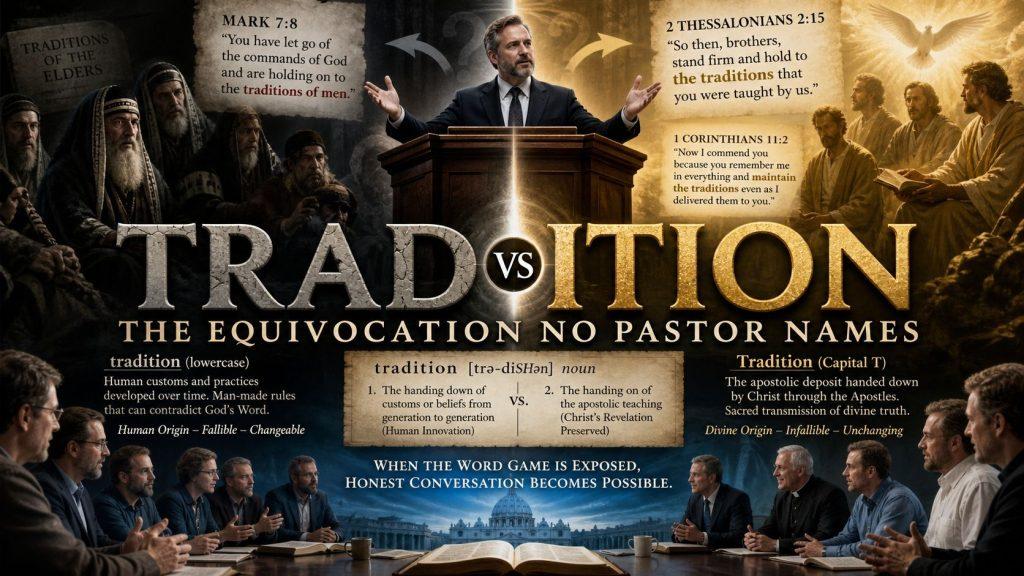
Brief Overview
- Most Protestant rejection of Tradition rests on a single word played in two different senses, and almost no one points this out from the pulpit.
- Lower case tradition means human custom, while Sacred Tradition means the living transmission of the apostolic deposit under the Holy Spirit.
- Scripture itself draws this distinction by condemning the first kind and commanding the second, which means the wholesale dismissal of tradition is not biblical at all.
- Once the equivocation breaks open, the conversation between Catholics and serious Protestants can finally happen on honest ground.
The One Word Doing All the Damage
Walk into almost any Evangelical Bible study and listen for the word tradition. You will hear it used as a slur. Tradition is what the Pharisees had. Tradition is what Jesus rejected. Tradition is what Rome added on top of the pure Gospel. The word functions as a conversation stopper, and the case against Catholicism is treated as essentially closed once it has been deployed.
The trouble is that the English word is doing two completely different jobs at the same time, and almost nobody flags this in a Sunday sermon. Lower case tradition means a custom passed down by human beings, which may be good or bad, neutral or harmful, ancient or recent. Capital T Tradition in Catholic and Orthodox theology means something else entirely. It refers to the living transmission of the apostolic deposit of faith, safeguarded by the Holy Spirit through the visible Church.
These two things are not the same. Treating them as if they were is what philosophers call equivocation, the logical fallacy of using one word in two different senses inside the same argument. Until that move is named, the conversation cannot start.
What Scripture Itself Does With the Word
Read the Greek New Testament carefully and the equivocation falls apart immediately. The word translated tradition is paradosis, from the verb paradidomi, meaning to hand over. It appears thirteen times. Some of those uses are negative, as in Mark 7:13, where Jesus rebukes the scribes for nullifying God’s word through their tradition. Other uses are positive, and they are commands.
Catholic Share is a one-person ministry. If this content helps you, consider supporting it.
Paul writes in 2 Thessalonians 2:15, “So then, brethren, stand firm and hold to the traditions which you were taught by us, either by word of mouth or by letter.” In 1 Corinthians 11:2 he praises the Corinthians because they maintain the traditions just as he delivered them. In 1 Corinthians 15:3 he uses the verb form for the Gospel itself, saying he delivered what he had received. In Jude 3 the faith itself is called something once for all delivered to the saints.
The same Greek word carries both senses in Scripture. Some traditions destroy faith. Other traditions transmit it. Lump them together and you have already misread the text.
Why the Equivocation Survives
If the distinction is this clear in Scripture, why does the equivocation persist? Honest answer first. Most pastors who use the word tradition negatively are not consciously trying to mislead anyone. They inherited the slogan from their own teachers, and the slogan has the comfortable feel of obvious truth. The Reformation polemic against Rome relied on this rhetorical move from the beginning, and five centuries of repetition have made it feel self-evident.
There is also a second reason the equivocation survives. Catholic apologists sometimes fail to name it cleanly. They argue against Sola Scriptura on other grounds while leaving the basic linguistic confusion intact. The result is two sides talking past each other for decades, each convinced the other is missing the obvious point.
Catholic Share is a one-person ministry, and readers who choose supporting this work are remembered by name in prayer.
The fix is simple. Whenever the word tradition shows up in a conversation about faith, ask which kind is meant. Human custom, or apostolic deposit. Once the question lands, the equivocation cannot survive a second round of honest discussion.
How the Catechism Draws the Line
The Catholic Church draws this distinction explicitly. The Catechism teaches that the Tradition coming from the apostles, which hands on what they received from Christ and the Holy Spirit, must be distinguished from the various theological, disciplinary, liturgical, and devotional traditions that have arisen in particular regions and times (CCC 83). Those secondary traditions can be retained, modified, or even abandoned under the guidance of the Magisterium.
The Catechism also teaches that Sacred Tradition and Sacred Scripture are bound closely together and communicate one with the other (CCC 80). They flow from the same divine source, move toward the same goal, and together form one sacred deposit of the Word of God committed to the Church.
That distinction matters. Catholics do not claim that every custom in the Church is binding. Lace mantillas, the rosary in its specific bead count, the shape of clerical vestments, the timing of Christmas, even the rules of fasting, are disciplinary or devotional traditions, not Sacred Tradition. They can change. Sacred Tradition cannot, because it transmits the apostolic faith.
Tests for Telling the Two Apart
If lower case tradition and Sacred Tradition are different categories, how does a person tell which is which in practice? The Church has used three working tests for almost two thousand years.
First, authentic Tradition can be traced back to the apostles and their immediate successors, not to a later innovator. Second, it is held across the whole Church, not in one regional pocket. Third, it is consistent with Sacred Scripture, since both flow from the same Spirit and cannot contradict each other.
Apply those tests honestly and the picture clears up fast. The Real Presence in the Eucharist passes all three. So does the episcopate, prayer for the dead, infant baptism, and the intercession of saints. Items that fail one or more tests, such as recent devotional novelties or merely local customs, do not enjoy the same authority, and the Church has always treated them differently.
So, Where Does This Leave the Honest Reader?
The whole Protestant case against Catholic Tradition collapses if the equivocation is broken open. Scripture itself uses the word in two senses, condemns one and commands the other. The Church has spent two thousand years distinguishing apostolic Tradition from human custom and applying real tests to tell them apart. The claim that all tradition is suspect cannot survive contact with the New Testament.
The honest path for any serious Christian is to stop using tradition as a slur and start asking which kind is on the table in each specific case. That conversation will not always end in agreement, but it will at least be the right conversation.
Catholic Share is a one-person ministry that publishes everything for free. If this article served you, you can subscribe to the free newsletter for weekly writing, or help keep articles like this freely available by choosing to support this ministry.
This Article Was Made Possible By Supporters Like You
Catholic Share survives on reader generosity, not corporate sponsors. If this article deepened your faith or helped you share it with someone, consider joining our Patreon. For as little as $5 per month, you sustain this ministry, and we pray for every patron by name. You can also support us with a one time gift via PayPal at catholicshare@outlook.com.