
The Five Faces of Apostolic Tradition You Should Know
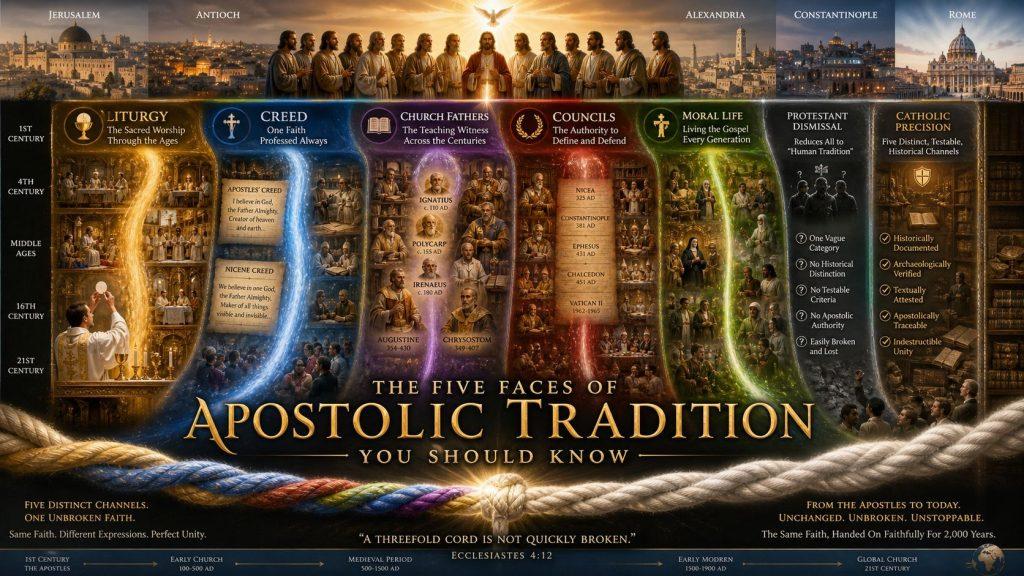
Brief Overview
- Sacred Tradition is not a single thing handed down on paper, which is why Protestant attempts to dismiss it as one category usually miss the point entirely.
- The apostolic deposit moves through five distinguishable channels, including liturgy, creed, the Fathers, the councils, and the moral life of the Church.
- Each face of Tradition can be tested and traced historically, which makes the Catholic position more rigorous than the rumor that it floats on pious imagination.
- A serious Christian who studies all five faces will find that the apostolic faith looks remarkably the same across continents, centuries, and languages.
Why Protestant Critics Keep Missing the Target
Protestant arguments against Tradition almost always treat it as if it were a second Bible, a hidden book of teachings the Catholic Church claims to possess alongside Scripture. The picture is then easy to attack. Where is this book? Why has nobody seen it? Why does it keep changing?
The trouble is that Sacred Tradition is not that kind of thing at all. It is not a corpus of written propositions waiting to be cataloged. It is the living transmission of the apostolic deposit through the whole life of the Church, and it moves through five distinct channels at once. Attacking the wrong picture is a fight against a position no Catholic actually holds.
To take Tradition seriously, you have to know how it actually functions. There are five faces.
The First Face: Liturgical Tradition
Christian worship was structured long before any New Testament book was written. The earliest Eucharistic prayers preserved in the Didache, composed somewhere between AD 60 and 90, contain language that goes well beyond anything in the canonical Gospels. The Anaphora of Addai and Mari from the Syriac tradition may date to the first century. The Divine Liturgy of Saint James in Jerusalem, the Liturgy of Saint Mark in Alexandria, and the Liturgy of Saint Basil in Cappadocia all preserve patterns of worship handed down from the apostles themselves.
Catholic Share is a one-person ministry. If this content helps you, consider supporting it.
These liturgies confess the Real Presence, offer the Eucharist as sacrifice, pray for the dead, and invoke the saints. They do so in language that predates or runs alongside the formation of the New Testament canon. The old Latin principle is lex orandi, lex credendi, the law of prayer is the law of belief. What the Church prayed from the beginning is what the Church believed from the beginning.
The Catechism teaches that the liturgy is the privileged place where the Church catechizes the faithful and transmits the apostolic faith (CCC 1075). The liturgy is Tradition in action.
The Second Face: Creedal Tradition
The Apostles’ Creed, the Niceno-Constantinopolitan Creed, and the regional rules of faith found in Irenaeus and Tertullian all summarize the apostolic deposit in formulas that go beyond the literal text of Scripture. The word Trinity is not in the Bible. The Greek homoousios, used at Nicaea to define the Son as one in substance with the Father, is not in the Bible. The phrase “two natures in one Person” defining Christ at Chalcedon is not in the Bible.
These formulas were never invented in a vacuum. They were drawn out of the apostolic deposit in response to specific heresies, defining what the Church had always believed in language sharp enough to exclude error. Every Protestant who confesses the Nicene Creed on Sunday morning is confessing a Traditional definition.
Articles like this stay free because of the readers who choose supporting this work.
The creed is not a substitute for Scripture. It is Scripture’s faithful summary, given by the Church that received Scripture from the apostles.
The Third Face: Patristic Tradition
The unanimous consensus of the Church Fathers on any given doctrine carries weight precisely because they are spread across centuries, continents, languages, and theological schools, and yet agree. When Ignatius in Antioch around AD 107, Justin Martyr in Rome around 150, Irenaeus in Gaul around 180, Tertullian in Carthage around 200, Cyril in Jerusalem around 350, John Chrysostom in Constantinople around 400, and Augustine in Hippo around 420 all teach the same thing about the Eucharist, that is not a regional opinion. That is the apostolic mind.
The Catechism speaks of attention to the analogy of faith and to the unanimous consent of the Fathers as a criterion for interpreting Scripture (CCC 113). Patristic Tradition is not a fan club for old men. It is the testimony of the bishops, martyrs, and teachers who received the faith one or two generations from the apostles and passed it on intact.
A Protestant reading of any doctrine that puts itself against the unanimous patristic witness is making a serious historical claim, namely that the apostles preached one Gospel and the men they personally trained immediately misunderstood it. That claim is hard to sustain on the evidence.
The Fourth Face: Conciliar Tradition
The Church has always settled major disputes in council. The pattern starts in Acts 15, where the apostles convene in Jerusalem, debate the question of Gentile circumcision, and issue a decree that opens with the words, “it has seemed good to the Holy Spirit and to us.” The ecumenical councils that followed, beginning with Nicaea in 325, defined the Trinity, the Incarnation, the canon of Scripture, and the boundaries of orthodoxy.
Without conciliar Tradition, there is no Trinity as we confess it. There is no hypostatic union, which means the Church’s teaching that Christ is one Person in two natures, fully God and fully man. There is no fixed list of inspired books. The councils did not invent these things. They defined what the apostolic Tradition had always held, using language designed to exclude specific errors. A Christian who rejects conciliar Tradition wholesale rejects the very mechanism by which the basic doctrines of historic Christianity were formulated.
The Fifth Face: Moral and Devotional Tradition
The Christian moral tradition on questions like abortion, contraception, divorce, infanticide, and sexual ethics is older and more unified than any single biblical proof text could establish. The Didache, written between AD 60 and 90, forbids abortion in chapter two using language identical to what every apostolic Church has held ever since. The early Church’s witness on marriage, on the sanctity of life, and on sexual purity is one voice from the first century forward.
Devotional Tradition, including the cult of the saints, prayer for the dead, the use of icons in the East, and the rosary in the West, grew organically out of the same apostolic deposit. The earliest known prayer to Mary, the Sub Tuum Praesidium, dates to roughly AD 250 in Egypt. The veneration of relics appears in the second-century Martyrdom of Polycarp. None of this is medieval invention.
So, What Do You Do With Five Faces?
The point of identifying the five faces is not to overwhelm anyone with complexity. The point is that Sacred Tradition is much more concrete and testable than its critics usually allow. You can read the early liturgies. You can read the creeds. You can read the Fathers. You can read the council decrees. You can study the moral and devotional life of the early Christians. The witness is open to anyone willing to do the work.
What that witness shows, with stubborn consistency, is that the apostolic faith looks remarkably the same across the five channels. Liturgy, creed, Fathers, councils, and moral life all confess the same things. That convergence is not coincidence. It is the fingerprint of a single deposit transmitted faithfully, and it is exactly what you would expect if Christ kept His promise to send the Spirit of truth to His Church.
Catholic Share is a one-person ministry that publishes everything for free. If this article served you, you can subscribe to the free newsletter for weekly writing, or help keep articles like this freely available by choosing to support this ministry.
This Article Was Made Possible By Supporters Like You
Catholic Share survives on reader generosity, not corporate sponsors. If this article deepened your faith or helped you share it with someone, consider joining our Patreon. For as little as $5 per month, you sustain this ministry, and we pray for every patron by name. You can also support us with a one time gift via PayPal at catholicshare@outlook.com.