
The Protestant Doctrines That Secretly Run on Tradition
Brief Overview
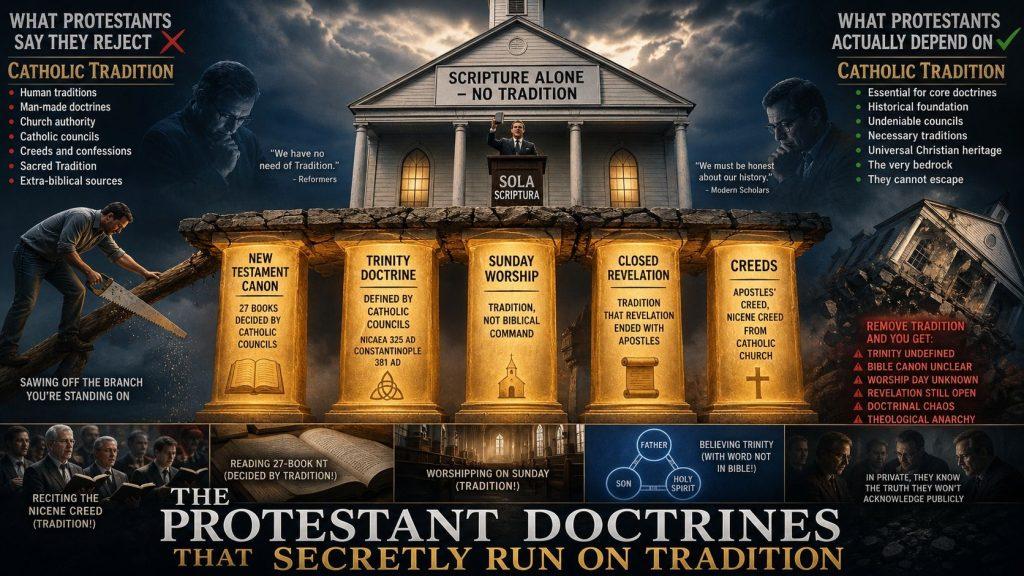
- Most Protestants who reject Sacred Tradition actually rely on Traditional decisions every Sunday morning without realizing it.
- The New Testament canon, the doctrine of the Trinity, Sunday worship, the closing of public revelation, and the standard reading of key creeds all rest on Tradition.
- This dependence is not a Catholic invention to score points, but a basic historical fact any honest Protestant scholar will concede in private.
- Either Tradition is reliable and Protestants are right to trust it on these doctrines, or Tradition is unreliable and several core Protestant beliefs lose their foundation.
The Quiet Inconsistency Nobody Names
Most Protestants believe that the Bible alone is the rule of faith, and that Catholic Tradition is a corruption that ought to be rejected wholesale. The trouble starts when you ask them how they got their Bible, how they know it has 27 New Testament books rather than 24 or 30, how they know God is three Persons in one Substance, and why they worship on Sunday rather than Saturday.
The honest answer to all of those questions is the same. Tradition. The decision about which books belong in the New Testament was made by Catholic councils in the late fourth century. The doctrine of the Trinity in its precise formulation was defined at Nicaea and Constantinople. Sunday worship is the apostolic practice handed down through the early Church, never spelled out as a command in any single verse.
A Christian who rejects Tradition as a category has to explain why he keeps using Tradition’s results. That explanation is not easy to give without contradicting himself.
The Canon of the New Testament
Open any Protestant Bible and look at the table of contents. Twenty-seven New Testament books, in a specific order, no more and no fewer. No verse in any of those books lists the contents. No author of any of those books tells you which other books should be included. The list is not in the Bible.
Catholic Share is a one-person ministry. If this content helps you, consider supporting it.
So where did it come from? It came from the Church. The 27-book canon was settled by Catholic synods at Hippo in 393 and Carthage in 397, drawing on patristic discernment and liturgical use. Before those councils, the boundaries of the canon were genuinely uncertain in places. Some communities used the Shepherd of Hermas, the Epistle of Barnabas, and the Didache as Scripture. Some excluded Hebrews, James, 2 Peter, 2 and 3 John, Jude, and Revelation. The Church had to discern which writings carried apostolic authority and which did not.
The Catechism teaches that it was by the apostolic Tradition that the Church discerned which writings are to be included in the list of sacred books (CCC 120). Every Protestant who closes the New Testament after Revelation is trusting a Catholic Traditional judgment.
The Doctrine of the Trinity
The word Trinity is not in the Bible. The phrase “one God in three Persons” is not in the Bible. The technical term homoousios, meaning of one substance, which the Council of Nicaea used in 325 to confess that the Son shares the very essence of the Father, is not in the Bible.
The Arians of the fourth century read the same Scripture as the orthodox bishops. They built their theology on a careful exegesis of passages like John 14:28, where Jesus says “the Father is greater than I,” and Proverbs 8:22, which speaks of Wisdom being created. By a Sola Scriptura argument alone, the Arians had a serious case. The Church defeated them not by quoting more verses, but by appealing to the apostolic Tradition that had always confessed the Son as fully divine.
Catholic Share is a one-person ministry, and readers who choose supporting this work are remembered by name in prayer.
A Protestant who confesses Nicene Trinitarianism is operating on Tradition. He may not say so, but he is. The same is true of the doctrine of the hypostatic union, the rejection of Apollinarianism, Nestorianism, Eutychianism, and Monothelitism, and the standard reading of the divine and human natures of Christ. All of these were defined by ecumenical councils within the Catholic Tradition.
Sunday Worship
The fourth commandment names the seventh day. Exodus 20:8 to 11 commands Israel to remember the Sabbath, which falls on Saturday, and to keep it holy. Yet almost every Protestant on earth worships on Sunday.
Where does that practice come from? It comes from Tradition. The early Christians moved their primary worship to the first day of the week, the day of the Resurrection, very early in the apostolic period. Acts 20:7 and 1 Corinthians 16:2 show the practice already established, but neither passage commands it as a binding rule. The full theological reasoning, the shift of the Sabbath rest into the Lord’s Day, develops in the Fathers and is codified in the early liturgies.
Seventh-day Adventists, in their own way, are the most consistent Sola Scriptura Protestants on this point. They have noticed that the Bible alone does not command Sunday worship, and they have drawn the obvious conclusion. Every other Protestant who worships on Sunday is, on this one practice, a closet traditionalist.
The Closing of Public Revelation
Most Protestants believe that public revelation closed with the death of the last apostle and that no new revelation can add to the deposit of faith. This is the standard reason given for rejecting the claims of Joseph Smith, Muhammad, Ellen G. White, and various other founders of post-apostolic religious movements.
The trouble is that the Bible nowhere says, “public revelation ends when John dies.” The principle is Traditional. It comes from the Church’s discernment of the apostolic age as a unique and unrepeatable period in salvation history. The Catechism teaches that the Christian economy is the new and definitive covenant and will never pass away, and that no new public revelation is to be expected before the glorious manifestation of our Lord Jesus Christ (CCC 66).
Every Protestant who rejects Mormonism on the grounds that revelation is closed is using a Catholic Traditional argument. The argument is sound. The inconsistency is in claiming to reject Tradition while wielding it.
The Hidden Pattern
Notice the pattern. On every major doctrine where Protestantism agrees with historic Christianity, Tradition is doing the load-bearing work. On every major doctrine where Protestantism breaks from historic Christianity, the rejection of Tradition is what enables the break.
When the canon needs to be fixed, Tradition is trusted. When the Trinity needs to be defended, Tradition is trusted. When the day of worship needs to be set, Tradition is trusted. But when the Real Presence, infant baptism, the priesthood, or Marian devotion comes up, Tradition is suddenly unreliable. The principle is not applied consistently because consistent application would force Protestants to accept either much more Catholic doctrine or much less of the basic Christian inheritance than they currently hold.
So, What Should an Honest Reader Do?
If Tradition is reliable enough to give us the canon, the Trinity, the day of worship, and the closing of revelation, then it is not honest to reject it on other doctrines simply because they are unfamiliar. If Tradition is unreliable, then the Protestant has a much bigger problem than Catholic doctrine. He has to explain how he knows which 27 New Testament books are inspired without an authority capable of telling him.
The Catholic answer, that Scripture and Tradition are two streams of the one Word of God committed to the Church (CCC 81), is the only position that holds together under sustained pressure. Every other position has to use Tradition while pretending not to.
Catholic Share is a one-person ministry that publishes everything for free. If this article served you, you can subscribe to the free newsletter for weekly writing, or help keep articles like this freely available by choosing to support this ministry.
This Article Was Made Possible By Supporters Like You
Catholic Share survives on reader generosity, not corporate sponsors. If this article deepened your faith or helped you share it with someone, consider joining our Patreon. For as little as $5 per month, you sustain this ministry, and we pray for every patron by name. You can also support us with a one time gift via PayPal at catholicshare@outlook.com.