
The Vincentian Canon: Catholicism’s Quality Control
Brief Overview
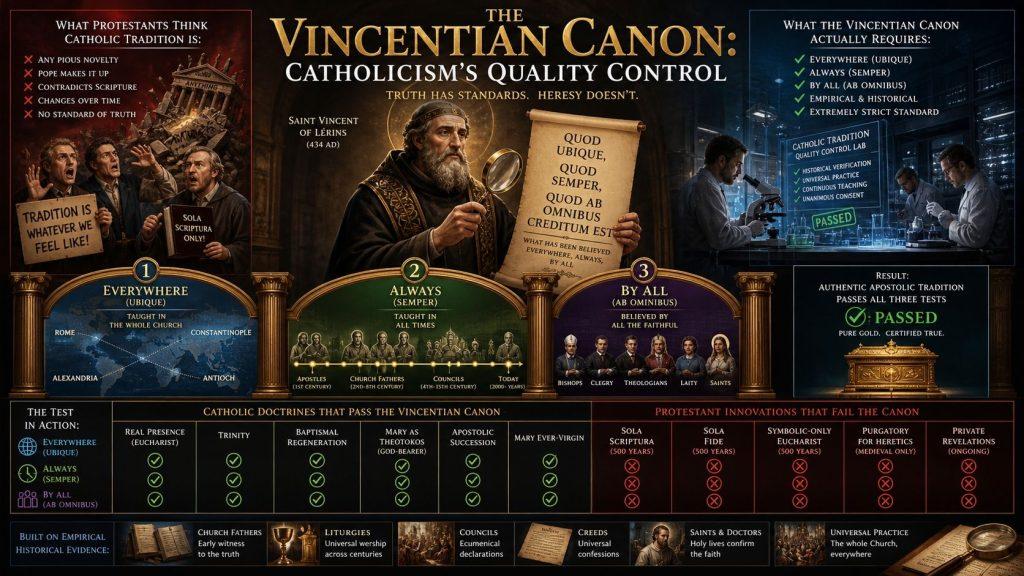
- Catholic Tradition is sometimes caricatured as an open door for any pious novelty, which is the opposite of what the Church has actually taught for nearly sixteen hundred years.
- Saint Vincent of Lerins in AD 434 gave the Church a positive triple test for authentic Tradition that has shaped Catholic theology ever since.
- The test holds that genuine apostolic Tradition must be held everywhere, always, and by all, which is a stricter standard than most Protestants assume Catholics use.
- Applying the Vincentian Canon honestly clarifies which Catholic doctrines stand on solid ground and exposes which Protestant claims about Tradition simply do not survive the evidence.
A Test Older Than the Reformation by a Thousand Years
Protestants sometimes assume that Catholic Tradition is a kind of grab bag where any pious story or medieval custom can be promoted into binding doctrine if enough people repeat it long enough. The actual Catholic position is much more demanding than that, and the demanding standard is not a modern invention designed to answer Reformation polemics. It is from 434 AD, more than a thousand years before Luther was born.
The standard comes from Saint Vincent of Lerins, a monk in southern Gaul who wrote a short work called the Commonitorium. The book is barely fifty pages in most editions. It poses a single question. How do we tell authentic Christian Tradition from heretical innovation when both sides claim to read Scripture correctly?
Vincent’s answer became the working principle of Catholic theological discernment for fifteen centuries. Most Protestants have never heard of it.
The Rule Itself
Vincent’s rule reads in Latin, ubique, semper, ab omnibus, which translates to “everywhere, always, by all.” In the Commonitorium he writes that in the Catholic Church itself, all possible care must be taken that the faith held is the one believed everywhere, always, and by all the faithful.
Catholic Share is a one-person ministry. If this content helps you, consider supporting it.
The rule is a triple test. Universality, meaning the doctrine is held across the whole Church and not in one regional pocket. Antiquity, meaning the doctrine goes back to the apostolic age and not to a later innovator. Consent, meaning the doctrine is confessed by the body of the faithful as expressed through the Fathers and the councils, not by an isolated school of thought.
A doctrine that passes all three is authentic apostolic Tradition. A doctrine that fails one or more is suspect. This is not vague piety. It is a workable historical test that anyone with access to the Fathers and the early liturgies can apply.
What the Rule Excludes
Notice what the Vincentian Canon excludes immediately. It excludes any innovation that pops up in one century with no earlier witness. It excludes any teaching held only in one region or by one school. It excludes any private revelation that contradicts the consensus of the wider Church. It excludes novelty dressed up as renewal.
This is why Catholic theology has always treated apparitions, private revelations, and devotional novelties with caution. Even approved apparitions like Lourdes and Fatima do not add to the deposit of faith. They are permitted as aids to piety because they conform to what the Church already teaches. They could never overturn what the Church teaches, because the Vincentian principle would block them.
If this kind of writing helps you, you can keep it freely available for others by supporting this work.
The same principle works against any movement that claims a hidden truth recovered after centuries of obscurity. By definition, such a claim fails the test of antiquity and consent. The Gnostics tried this. The Manichees tried this. The Reformers, in their own way, tried this.
What the Rule Confirms
Now apply the test positively. Which doctrines pass the triple standard? Quite a few, and the list shapes Catholic confidence on contested questions.
The Real Presence in the Eucharist passes. Ignatius of Antioch teaches it around AD 107. Justin Martyr teaches it around 150. Irenaeus, Cyril of Jerusalem, Ambrose, John Chrysostom, and Augustine all teach it. Every Eastern and Oriental Church preserves it today, including those that have not been in communion with Rome for fifteen centuries. Universality, antiquity, consent. The doctrine passes.
The episcopate as the structure of Church governance passes. Ignatius is already insisting on the bishop as the center of Christian unity around AD 107. The threefold ministry of bishop, presbyter, and deacon is universal in the second century and present in every apostolic Church today. Prayer for the dead passes, attested in early Christian tombstones, the Acts of Paul and Thecla, Tertullian, and the universal liturgies. The intercession of saints passes, with the earliest known prayer to Mary, the Sub Tuum Praesidium, dating to roughly AD 250 in Egypt.
Each of these doctrines clears the Vincentian bar with room to spare.
What Happens When the Rule Is Applied to Sola Scriptura
Now apply the same test to Sola Scriptura. Was the Bible alone as the sole rule of faith held everywhere? No. It was unknown to the Eastern Churches, the Oriental Churches, and the entire Western Church for fifteen centuries. Was it held always? No. It first appears in the sixteenth century with Luther. Was it held by all? No. Not one Father of the first millennium teaches it, and no apostolic Church on earth holds it today except those founded after the Reformation.
By Vincent’s standard, Sola Scriptura is not a recovery of authentic Christian Tradition. It is the kind of novelty Vincent wrote his book to expose. The principle fails the test of universality, antiquity, and consent simultaneously. It cannot trace itself back, it cannot point to a wider witness, and it cannot show the consensus of the Fathers.
This is not a Catholic-only verdict. Eastern Orthodox theologians reach the same conclusion using the same patristic method. The witness against Sola Scriptura runs across every apostolic communion on earth.
The Question of Development
Some readers will ask whether Vincent’s rule freezes doctrine in place forever. It does not. Vincent himself addresses this directly in the Commonitorium. He compares the development of doctrine to the growth of a human body from infancy to maturity. The body changes in size and capacity, but it remains the same body. Authentic development preserves the type, the same essential identity, while becoming clearer and more articulate over time.
The Catechism reflects this same principle when it teaches that the understanding of the realities and words handed down grows in the Church under the assistance of the Holy Spirit (CCC 94). Real development is not innovation. It is the slow maturation of what was already given. The Marian dogmas, the precise definitions of the Trinity, and the articulation of the seven sacraments are all developments of seeds already present in the apostolic age.
So, Does Catholicism Actually Have Quality Control?
Yes, and the quality control is older, sharper, and more demanding than most Protestants assume. The Vincentian Canon has been the working rule of Catholic theological discernment for nearly sixteen hundred years. It rules out novelty, regional eccentricity, and private claims that contradict the consensus of the apostolic age. It also confirms exactly the doctrines that contemporary Protestant polemics most often reject.
A serious Christian who wants to think clearly about Tradition should learn Vincent’s rule and apply it honestly to every disputed point. The exercise will be uncomfortable in places. It will confirm Catholic teaching in places no Protestant pulpit ever does. But it will at least bring the conversation onto the same historical ground the early Church actually used.
Catholic Share is a one-person ministry that publishes everything for free. If this article served you, you can subscribe to the free newsletter for weekly writing, or help keep articles like this freely available by choosing to support this ministry.
This Article Was Made Possible By Supporters Like You
Catholic Share survives on reader generosity, not corporate sponsors. If this article deepened your faith or helped you share it with someone, consider joining our Patreon. For as little as $5 per month, you sustain this ministry, and we pray for every patron by name. You can also support us with a one time gift via PayPal at catholicshare@outlook.com.