
Why Sola Scriptura Failed Against Every Early Heretic
Brief Overview
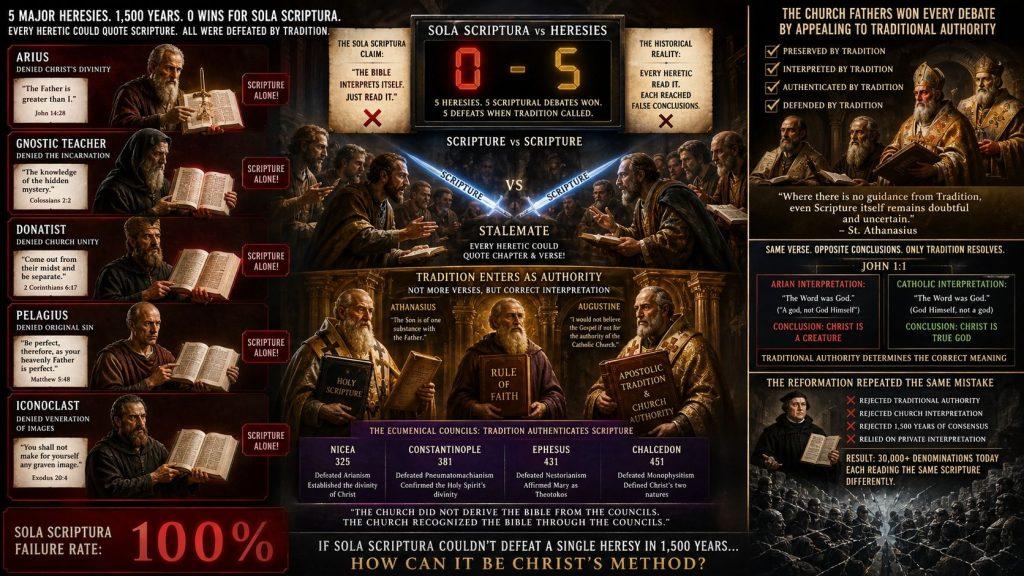
- Every major heresy in the first five centuries of Christianity was, in form, a Sola Scriptura heresy that built its case on a careful reading of Scripture.
- The Arians, Gnostics, Donatists, Pelagians, and Iconoclasts all quoted the Bible expertly, and the Church did not defeat them by quoting more verses.
- The Fathers consistently appealed to the apostolic Tradition and the rule of faith as the authority that settled what Scripture meant in disputed passages.
- A doctrine that fails against every major heresy in the patristic age cannot be the rule Christ left to safeguard the faith.
The Pattern Protestants Are Rarely Shown
Modern Protestant apologetics often presents Sola Scriptura as the principle that protects Christianity from heresy. The Bible is clear, the argument runs, and any serious heretic gets refuted by patient Bible study. The trouble is that Church history flatly contradicts this picture.
Every major heresy in the first five centuries built its case on Scripture. Arius quoted his Bible expertly. The Gnostics quoted Paul more often than the orthodox bishops did. The Donatists, the Pelagians, the Nestorians, and the Iconoclasts all produced careful exegetical arguments for their positions. They were not theological amateurs. They were trained readers of Scripture who reached heretical conclusions because Scripture, read by individuals without an authoritative Tradition, does not settle every question by itself.
The Church survived not because it had more Scripture than the heretics. It had the same Scripture. It survived because it had the apostolic Tradition that told it how to read Scripture.
Arius and the Battle Over the Son
The most famous test case is the Arian controversy of the fourth century. Arius taught that the Son was the first and greatest of all creatures, but a creature, not eternally God in the way the Father is. He was not a fool. He was a respected priest of Alexandria with a substantial following, and his case was built on Scripture.
Catholic Share is a one-person ministry. If this content helps you, consider supporting it.
He pointed to John 14:28, where Jesus says, “the Father is greater than I.” He pointed to Proverbs 8:22, which in the Greek Septuagint speaks of Wisdom being created at the beginning of God’s ways. He pointed to Colossians 1:15, which calls Christ “the firstborn of all creation.” He pointed to Mark 13:32, where Jesus says the Son does not know the day of His return. On a flat reading of these verses without an interpretive framework, Arius had a real case.
The Church defeated Arianism at the Council of Nicaea in 325, not by quoting more verses, but by appealing to the apostolic Tradition that had always confessed the full divinity of the Son. The council used the non-biblical term homoousios, meaning of one substance, to define what the Bible meant. Without that Traditional intervention, Sola Scriptura alone would not have settled the matter. Arianism nearly won the fourth century, and Saint Jerome later wrote that the whole world groaned to find itself Arian. What pulled the Church back was Tradition.
The Gnostics and the Pauline Letters
Move back to the second century. The Gnostics were the most sophisticated readers of Paul in the early Church. Valentinus, Basilides, and Marcion all built elaborate systems of theology by selecting and interpreting Pauline passages. Marcion went so far as to compile his own canon, consisting of an edited Luke and ten Pauline epistles. He claimed to be the true Paulinist, recovering the original Gospel from Jewish corruption.
Irenaeus of Lyons, writing around AD 180 in Against Heresies, did not refute the Gnostics primarily by quoting more verses. He refuted them by appealing to the apostolic Tradition preserved in the Churches founded by the apostles, whose bishops could be traced back through unbroken succession. He argued that the Gnostics could not produce such a succession because their teachings were recent inventions. The rule of faith, the regula fidei, was the framework that told Christians how to read Paul correctly.
Catholic Share is a one-person ministry, and readers who choose supporting this work are remembered by name in prayer.
If Sola Scriptura had been the early Christian rule, Irenaeus would have lost the argument. Marcion had a Bible. Marcion read his Bible. Marcion reached the wrong conclusion. The framework, not the text alone, was what kept the apostolic faith intact.
The Donatists, the Pelagians, the Iconoclasts
The pattern repeats across the centuries. The Donatists of fourth-century North Africa argued from Numbers 19 and other purity texts that sacraments administered by unworthy clergy were invalid. Their exegesis was not absurd. Augustine refuted them by appealing to the universal practice of the Church and the apostolic Tradition that the sacraments are Christ’s, not the minister’s.
The Pelagians built a careful case from passages emphasizing human moral effort and freedom. They quoted Scripture exhaustively. The Church defeated them at the Council of Carthage in 418 and at Ephesus in 431 by appealing to the apostolic Tradition on grace, original sin, and the necessity of baptism.
The Iconoclasts of the eighth and ninth centuries cited the second commandment in Exodus 20 against the veneration of images. Their exegesis was not silly on the surface. The Church responded at the Second Council of Nicaea in 787 by appealing to the apostolic Tradition of incarnational worship, in which the visible image of the invisible God in Christ legitimized the veneration of sacred images. The argument turned on Tradition.
In every case, the Bible was on the table and both sides were reading it. The framework supplied by apostolic Tradition was the difference between orthodox and heretical readings.
What the Fathers Actually Said About This
The Fathers said openly what the historical pattern shows. Tertullian, around AD 200 in The Prescription Against Heretics, argued that heretics had no right to appeal to Scripture at all, because Scripture belonged to the Church that had received it from the apostles. Read in isolation from the rule of faith, Scripture could be twisted to mean anything.
Saint Vincent of Lerins, writing in 434, addressed exactly this question. He noted that heretics were skilled in quoting Scripture and that the Bible alone could not settle their challenges, because the same texts could be read in different ways. The solution, he argued, was to read Scripture within the consensus of the Catholic Church across the centuries.
Saint Augustine put the point sharply in his work against the Manichees. He famously wrote that he would not have believed the Gospel if the authority of the Catholic Church had not moved him to do so. That is a Father whom many Reformers claimed as their patron, and his rule of faith is not Sola Scriptura.
The Hard Question for Modern Protestants
Place the modern situation against this pattern. If Sola Scriptura had been the apostolic principle, the Church would have used it to defeat Arius, Marcion, Pelagius, Nestorius, and the Iconoclasts. She did not. She used apostolic Tradition, conciliar authority, and the consensus of the Fathers. The principle that modern Protestants claim to be the rule that protects orthodoxy is the one principle the early Church never actually used to protect orthodoxy.
This is uncomfortable history, but it is not Catholic spin. Any serious patristic scholar, Protestant or Catholic, will tell you that the Fathers operated with a Scripture-and-Tradition framework. The Reformation broke with that framework. The result was the proliferation of competing Protestant communities, each reading the same Bible and reaching contradictory conclusions, exactly as the early heretics had done.
So, Can a Bible Alone Protect the Faith?
The historical record gives a clear answer. No. A Bible alone could not protect the faith against Arius. It could not protect the faith against the Gnostics. It could not protect the faith against the Pelagians, the Donatists, or the Iconoclasts. In every case where the early Church faced a serious heresy, the heretics had the Bible too, and they read it carefully. The Church needed something more, and what she had was apostolic Tradition under the guidance of the Holy Spirit.
The Catholic position is not that Scripture is unclear or untrustworthy. The Catholic position is that Scripture lives inside the Church that received it, interpreted within the Tradition that delivered it, under the teaching office Christ established to safeguard it. That arrangement is what defeated the early heresies. Anything less has a long and unbroken record of failure.
Catholic Share is a one-person ministry that publishes everything for free. If this article served you, you can subscribe to the free newsletter for weekly writing, or help keep articles like this freely available by choosing to support this ministry.
This Article Was Made Possible By Supporters Like You
Catholic Share survives on reader generosity, not corporate sponsors. If this article deepened your faith or helped you share it with someone, consider joining our Patreon. For as little as $5 per month, you sustain this ministry, and we pray for every patron by name. You can also support us with a one time gift via PayPal at catholicshare@outlook.com.