
Brief Overview
- The Catholic Church has not issued a blanket condemnation of every new weapon technology, but it has established firm moral principles that make several modern weapons deeply problematic or outright impermissible under just war doctrine.
- Nuclear, biological, and chemical weapons face the strongest condemnation in Catholic teaching because their indiscriminate nature makes them incapable of satisfying the non-negotiable principle of discrimination, which requires that armed force distinguish between combatants and innocent civilians (CCC 2314).
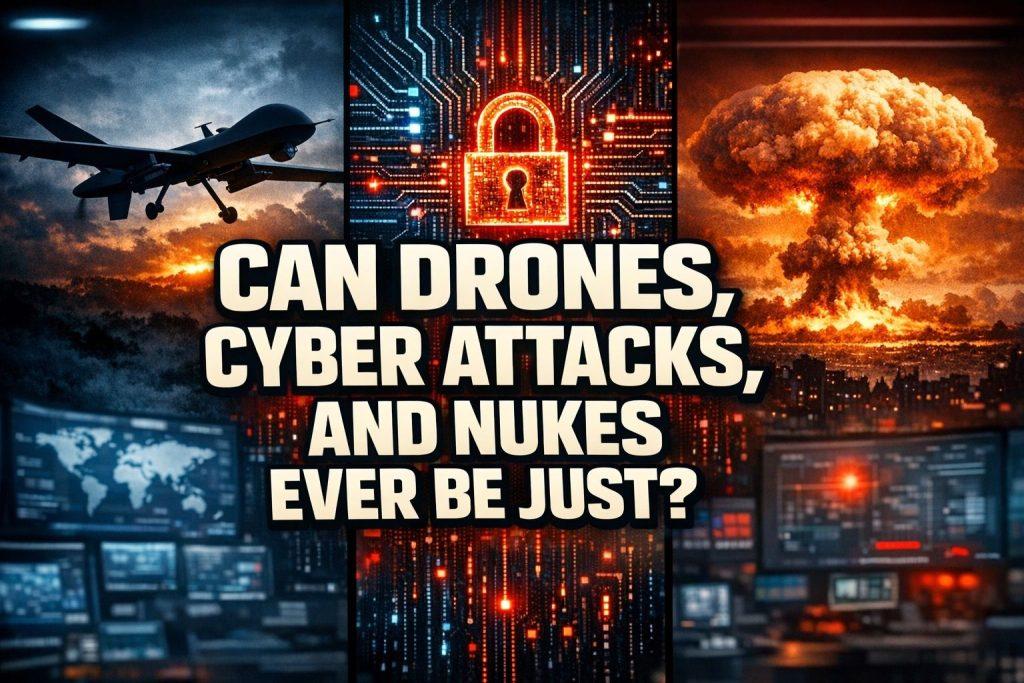
- Drone strikes and cyber warfare are not automatically unjust, but they raise serious moral questions about accountability, proportionality, and the lowered psychological threshold for using lethal force when the operator faces no personal risk.
- Catholics are not excused from making hard moral judgments about modern warfare simply because the technology is new; the same principles that governed swords and cannons govern missiles and malware.
The Two Principles That Judge Every Weapon
Before applying Catholic moral teaching to specific technologies, you need to understand the two governing principles that the Church uses to evaluate any weapon or military tactic. The first is discrimination, also called non-combatant immunity, which holds that armed force must distinguish between legitimate military targets and innocent civilians. The Catechism states directly that non-combatants, wounded soldiers, and prisoners must be respected and treated humanely (CCC 2313). The second is proportionality, which requires that the harm caused by a military action not exceed the military objective it aims to achieve. Together, these two principles form the moral backbone of what the tradition calls jus in bello, the rules governing how a war is conducted once it has begun.
These are not soft guidelines that nations consult when convenient. The Church teaches that moral law retains its full force during armed conflict, and that the outbreak of war does not make every act between warring parties permissible (CCC 2312). That applies to every weapon system a government chooses to deploy, whether it existed in the thirteenth century or was designed last year.
Nuclear Weapons: Where the Church Draws the Hardest Line
The Catholic Church’s position on nuclear weapons has grown progressively clearer and more demanding over the past several decades. The Second Vatican Council, in Gaudium et Spes, declared that every act of war directed at the indiscriminate destruction of whole cities or vast areas with their inhabitants is a crime against God and man that merits firm and unequivocal condemnation. The Catechism repeats this teaching directly in CCC 2314, noting that modern scientific weapons, specifically naming atomic, biological, and chemical weapons, provide the opportunity to commit exactly these kinds of crimes.
The reason nuclear weapons face such categorical treatment is straightforward: by their very design, they cannot discriminate. A nuclear weapon detonated over a city does not strike combatants while sparing civilians. It destroys indiscriminately, which means its use categorically violates the principle of discrimination regardless of the military objective being pursued. Pope Francis made this explicit during his 2019 visit to Hiroshima, stating that the use of atomic energy for purposes of war is immoral. He went further, saying that even the possession of nuclear weapons is immoral, a position that represents a significant development beyond the conditional tolerance of nuclear deterrence that Pope John Paul II allowed in 1982 as a temporary measure on the road toward disarmament. The Church’s trajectory on this question has moved consistently in one direction, toward rejection, not accommodation.
Drone Strikes: Technology That Makes Hard Questions Harder
Drone warfare is a genuinely complicated moral situation, and Catholics who dismiss that complexity are not being honest with the tradition. On one hand, precision-guided drone technology can, in principle, reduce civilian casualties compared with conventional bombing by allowing a more targeted strike against a specific military objective. The United States Conference of Catholic Bishops acknowledged in a 2014 document on drones that within just wars, drone strikes could limit civilian casualties compared with other military technologies.
On the other hand, drones introduce serious moral distortions that just war doctrine cannot ignore. First, the physical distance between the operator and the target removes the psychological weight that has historically served as a natural brake on the use of lethal force. A soldier who faces the person he is about to kill operates under a fundamentally different moral pressure than someone controlling a weapon from a facility thousands of miles away. This lowered threshold for lethal action raises real concerns about whether the last resort condition, requiring that all other means have been genuinely exhausted, is being applied with the rigor the Church demands. Second, so-called “signature strikes,” where targets are selected based on behavioral patterns rather than confirmed identity, create serious problems for the discrimination principle. Killing someone because an algorithm identified their behavior as suspicious does not meet the standard the Church requires for the use of lethal force against a specific person. Catholic moral theologians, including those writing in peer-reviewed journals of moral theology, have identified this practice as deeply incompatible with the tradition’s demand that force be directed at actual combatants rather than probable ones.
Cyber Warfare: The Moral Frontier the Church Hasn’t Fully Mapped
Cyber warfare presents Catholic moral theology with its most genuinely novel challenge because it does not map neatly onto traditional categories of armed force. A cyberattack that disables an enemy nation’s military command systems looks very different from one that takes down a power grid serving a civilian population. The first might satisfy the discrimination principle; the second almost certainly does not, because cutting electricity to hospitals, water treatment facilities, and civilian infrastructure produces foreseeable and serious harm to non-combatants.
The Church has not issued a comprehensive document specifically addressing cyber warfare, but the existing framework of just war principles applies directly. Proportionality demands that even a non-kinetic attack, one that kills no one directly, must not produce civilian harm disproportionate to its military objective. Discrimination demands that cyber operations target military systems rather than civilian infrastructure. Right intention demands that cyber tools not be used for economic sabotage, political destabilization, or coercive intimidation that falls outside legitimate self-defense. What makes cyber warfare particularly dangerous from a moral standpoint is the ease with which it can be conducted covertly, without formal declaration, and with significant civilian effects that governments can plausibly deny intending. None of that makes it morally acceptable. As Romans 13:4 reminds us, legitimate authority bears the sword as God’s servant for good, and that obligation does not change when the sword is made of code rather than steel.
The Seductive Lie of “Clean” Modern Warfare
One of the most serious moral traps that modern military technology creates is the illusion of clean, precise, consequence-free warfare. Drone advocates point to reduced pilot casualties and precision targeting. Cyber warfare advocates point to the absence of direct killing. Nuclear deterrence advocates once argued that mutual assured destruction preserved peace. Each of these arguments contains a partial truth and a serious distortion.
The partial truth is that some technologies, used with genuine moral discipline, can reduce certain kinds of harm. The distortion is the implication that technological sophistication somehow relaxes the moral demands of just war rather than sharpening them. The Church has consistently rejected that reasoning. Gaudium et Spes warned explicitly that the destructive power of modern weapons places an even heavier burden on the proportionality calculation, not a lighter one. A weapon that makes killing easier does not make killing more permissible. The moral weight increases with the capacity for harm.
So, Can Any of These Ever Be Just?
The honest Catholic answer is that it depends, and that dependence carries the full weight of just war’s demanding criteria. Drone strikes within a genuinely just war, directed at confirmed military targets with serious efforts to minimize civilian casualties and with proportionate force, are not categorically ruled out by Church teaching. Cyber operations that target military systems, are authorized by legitimate authority, serve a just cause, and avoid disproportionate civilian harm can similarly pass moral scrutiny.
Nuclear weapons are a different matter. Their inherent indiscrimination makes their use in any realistic scenario a grave moral violation, and the Church’s consistent movement toward condemning even their possession reflects a serious reckoning with that reality. The question Catholics must resist is the one that asks which side in a conflict is righteous enough to justify crossing these lines. The principles exist precisely because no cause, however just it appears, licenses the deliberate or foreseen destruction of innocent lives on a mass scale. Matthew 5:9 calls peacemakers blessed, not because peace is easy but because the work of protecting it requires exactly the kind of moral seriousness that just war doctrine demands.
Disclaimer: This article presents Catholic teaching for educational purposes. For official Church teaching, consult the Catechism and magisterial documents. For personal spiritual guidance, consult your parish priest or spiritual director. Questions? Contact editor@catholicshare.com
Sign up for our Exclusive Newsletter
- 📌 Add CatholicShare as a Preferred Source on Google
- 🎁 Join us on Patreon for Premium Content
- 🎧 Check Out These Catholic Audiobooks
- 📿 Get Your FREE Rosary Book
- 📱 Follow Us on Flipboard
-

Recommended Catholic Books
Discover hidden wisdom in Catholic books — invaluable guides enriching faith and satisfying curiosity. #CommissionsEarned
- The Early Church Was the Catholic Church
- The Case for Catholicism - Answers to Classic and Contemporary Protestant Objections
- Meeting the Protestant Challenge: How to Answer 50 Biblical Objections to Catholic Beliefs
As an Amazon Associate, I earn from qualifying purchases. Thank you for your support.