
Brief Overview
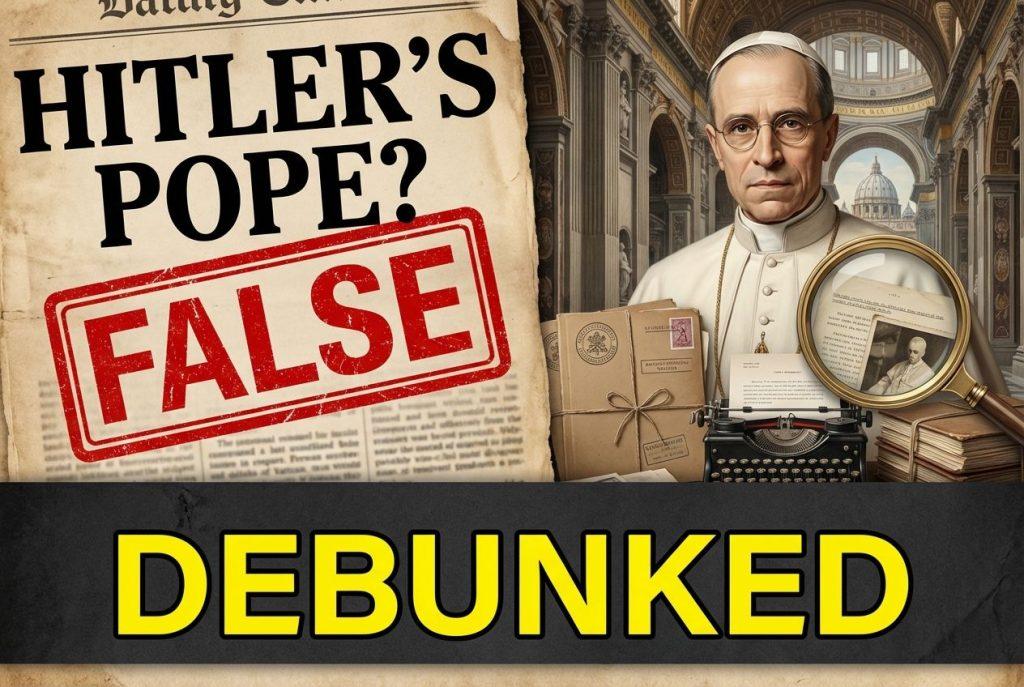
- The label “Hitler’s Pope” falsely portrays Pope Pius XII as sympathetic to Nazi Germany when historical evidence shows he actively opposed Hitler’s regime throughout his career.
- Jewish leaders and Holocaust survivors praised Pope Pius XII immediately after World War II for his efforts to save Jewish lives, contradicting the narrative that emerged decades later.
- Historical records demonstrate that the Catholic Church under Pius XII saved between 700,000 and 860,000 Jews during the Holocaust, more than any other organized rescue effort.
- The 1999 book that popularized the “Hitler’s Pope” label has been widely criticized by scholars for factual errors, misrepresentation of documents, and biased interpretation of historical evidence.
- Pope Pius XII publicly condemned Nazi racial ideology and persecution through various means, including encyclicals, Christmas addresses, and Vatican Radio broadcasts.
- The strategic use of quiet diplomacy rather than explosive public denunciations was a calculated decision based on evidence that public protests increased Nazi retaliation against Jews and Catholics.
Understanding the Origins of the False Narrative
The phrase “Hitler’s Pope” entered popular discourse through John Cornwell’s 1999 book of the same name, which accused Pope Pius XII of collaboration with Nazi Germany and indifference to the Holocaust. This work arrived decades after the events it described and contradicted the overwhelming praise that Jewish leaders had offered Pope Pius XII upon his death in 1958. The timing of this accusation matters because those who lived through the war and witnessed the Pope’s actions firsthand held vastly different views. Golda Meir, then Israel’s Foreign Minister, sent a message of condolence to the Vatican stating, “We share in the grief of humanity at the passing away of His Holiness Pope Pius XII. In a generation afflicted by wars and discords, he upheld the highest ideals of peace and compassion.” The Chief Rabbi of Rome, Israel Zolli, was so moved by what he witnessed of the Pope’s protection of Jews that he converted to Catholicism after the war and took the baptismal name Eugenio in honor of Eugenio Pacelli, Pope Pius XII’s birth name. These contemporary witnesses knew the truth that later critics would attempt to obscure.
The narrative gained traction despite being built on a foundation of selective evidence and misrepresented documents. Cornwell himself later admitted that some of his initial conclusions were too harsh, yet the damage to Pope Pius XII’s reputation had already spread widely. Multiple historians and scholars, including some who are not Catholic, have systematically refuted the book’s central claims. The Israeli diplomat and historian Pinchas Lapide, who was Jewish and had no religious motivation to defend a pope, conducted extensive research and concluded that the Catholic Church under Pius XII saved at least 700,000 to 860,000 Jewish lives. Rabbi David Dalin went further, arguing that Pope Pius XII deserved recognition as a Righteous Gentile by Yad Vashem, Israel’s Holocaust memorial. The false narrative persists not because of historical evidence but because sensational accusations often spread faster than careful corrections. Understanding why this label is false requires examining the actual historical record rather than accepting later revisionist accounts that ignore or distort the testimony of those who were there.
The Historical Record Before Becoming Pope
Eugenio Pacelli’s opposition to Nazism began long before his election as Pope Pius XII in 1939. As Vatican Secretary of State under Pope Pius XI, Pacelli was the principal author of the 1937 encyclical Mit Brennender Sorge, which translates to “With Burning Anxiety.” This document represents one of the strongest condemnations of Nazi ideology ever issued by the Catholic Church. The encyclical condemned Nazi racism, the idolatry of the state, and the persecution of the Church. It was written in German rather than the customary Latin precisely so that German Catholics would understand its message clearly. The encyclical was smuggled into Germany and read from every Catholic pulpit on Palm Sunday 1937, reaching millions of German Catholics simultaneously. Hitler’s fury at this public rebuke was immediate and intense; the Nazi regime responded with increased persecution of German Catholics, closing Catholic schools, arresting priests, and intensifying propaganda against the Church.
The Nazis understood that Pacelli was their enemy, not their friend. German intelligence files from before the war explicitly identified Cardinal Pacelli as hostile to National Socialism. When Pacelli was elected Pope in 1939, the Nazi newspaper Der Stürmer ran hostile articles attacking him. The German government considered him a political opponent because of his consistent opposition to their ideology. Some critics point to the 1933 Concordat between the Vatican and Nazi Germany as evidence of collaboration, but this interpretation ignores the historical context. The Concordat was a diplomatic treaty designed to protect the rights of German Catholics who were already facing persecution under the new Nazi regime. Similar concordats existed with many other nations, including democratic ones; they were standard tools of Vatican diplomacy. The treaty did not represent approval of Nazism but rather an attempt to secure legal protections for the Church and its members. The Nazis violated the Concordat almost immediately, and the Vatican’s protests against these violations fill volumes of diplomatic correspondence. Pacelli himself criticized the German bishops for not opposing Hitler strongly enough before the Concordat was signed, showing his awareness of the Nazi threat from the very beginning.
Throughout the 1930s, Pacelli worked tirelessly through diplomatic channels to oppose Nazi expansion and ideology. He maintained contact with members of the German resistance, including those who would later attempt to assassinate Hitler. He warned other European leaders about the dangers of appeasing Hitler’s territorial ambitions. When he became Pope in March 1939, he inherited a Church already in conflict with Nazi Germany, and he continued that conflict throughout the war. The historical record shows a man who recognized the evil of Nazism early and consistently opposed it through every means available to him. The accusation that he was “Hitler’s Pope” requires ignoring all of this documented opposition and focusing only on what critics claim he did not do publicly. This selective reading of history serves rhetoric rather than truth. The eighth commandment forbids bearing false witness against one’s neighbor, and this principle applies to how we discuss historical figures as well as living persons; CCC 2464 teaches that we must not misrepresent the truth in our relations with others, and this obligation extends to how we characterize the actions of those who came before us.
Public Condemnations and Vatican Radio
Pope Pius XII did not maintain silence about Nazi atrocities, contrary to what critics claim. His Christmas address of 1942 specifically condemned the murder of people based on race or nationality. Speaking over Vatican Radio on Christmas Eve, he lamented the hundreds of thousands who, “without any fault of their own, sometimes only by reason of their nationality or race, are marked down for death or progressive extinction.” Allied leaders and Jewish organizations understood this as a clear reference to the Holocaust. The New York Times covered the address with the headline “Pope is Aligned with Democracies” and explicitly noted his condemnation of Nazi treatment of Jews and occupied peoples. This was not isolated rhetoric; it was part of a pattern of public statements that contemporary observers clearly understood as opposition to Nazi crimes. The language may seem measured by today’s standards, but in the diplomatic context of 1942, when the outcome of the war remained uncertain and millions of Catholics lived under Nazi occupation, the Pope’s words were understood as a powerful moral condemnation.
Vatican Radio broadcast regular condemnations of Nazi persecution throughout the war years. These broadcasts were so effective that the Nazi regime attempted to jam the radio signals to prevent Germans from hearing them. In 1940, Vatican Radio explicitly condemned Nazi treatment of Polish Jews, describing the forced ghettos and persecution in occupied Poland. These broadcasts reached audiences throughout Europe and were reported in newspapers in free countries, including the United States and Great Britain. The New York Times printed numerous articles during the war years praising Pope Pius XII for his moral leadership and his defense of persecuted peoples. Albert Einstein, writing in Time Magazine in 1940, stated, “Only the Church stood squarely across the path of Hitler’s campaign for suppressing truth. I never had any special interest in the Church before, but now I feel a great affection and admiration because the Church alone has had the courage and persistence to stand for intellectual truth and moral freedom.” Einstein’s words came from a Jewish scientist with no institutional loyalty to the Catholic Church; he spoke from his observation of what was actually happening during the war.
The claim that Pius XII remained silent requires ignoring all of these public statements and broadcasts. Critics sometimes argue that he should have been more explicit in naming Hitler and the Nazi party directly, but this criticism fails to account for the dangerous reality faced by Catholics and Jews in occupied territories. When the Dutch bishops issued an explicit public protest against the deportation of Jews in 1942, the Nazi response was swift and brutal. They immediately accelerated the deportation of Catholic Jews, people of Jewish ancestry who had converted to Catholicism, in direct retaliation for the bishops’ statement. Edith Stein, a Jewish convert to Catholicism who became a Carmelite nun and is now Saint Teresa Benedicta of the Cross, was among those murdered in this reprisal. Pope Pius XII learned from this tragedy that explicit public denunciations could make the situation worse for those he was trying to protect. His measured public statements combined with intensive behind-the-scenes rescue efforts represented a strategic approach designed to save the maximum number of lives. The morality of this approach can be debated, but it cannot be accurately described as silence or indifference.
The Rescue Network and Direct Action
The most powerful evidence against the “Hitler’s Pope” narrative comes from the concrete rescue efforts organized by the Vatican during the war. The Catholic Church established an extensive network that hid Jews in convents, monasteries, churches, and even within the Vatican itself. In Rome, when the Nazi occupation began in 1943, Pope Pius XII ordered Catholic institutions throughout the city to open their doors to Jewish refugees. More than 4,000 Jews found shelter in the Vatican and in the 155 convents and monasteries of Rome. The Chief Rabbi of Rome at that time, Israel Zolli, witnessed these rescue efforts firsthand and later testified to the Pope’s role in saving Roman Jews. When the Nazis demanded gold from Rome’s Jewish community in 1943, threatening deportation if they could not pay, Pope Pius XII ordered the Vatican treasury to be opened to provide whatever was needed. Although the Jewish community ultimately raised the gold themselves, the Pope’s immediate willingness to empty the Church’s treasury to save Jewish lives speaks volumes about his priorities.
These rescue efforts extended far beyond Rome. In Hungary, the papal nuncio distributed thousands of baptismal certificates and protective documents to Jews facing deportation. Church institutions throughout occupied Europe provided hiding places, false identity papers, and escape routes. Bishops and priests throughout Europe responded to Vatican guidance by sheltering Jews and other refugees at great personal risk; hundreds of clergy were arrested, sent to concentration camps, or executed for protecting Jews. German historian Michael Feldkamp’s research in the Vatican archives revealed that Pope Pius XII personally saved at least 15,000 Jews through direct interventions. The broader Catholic rescue network saved hundreds of thousands more. Pinchas Lapide’s estimate of 700,000 to 860,000 Jews saved through Catholic Church efforts represents more lives than were saved by all other institutions and rescue organizations combined. These numbers are not speculation; they come from documented cases of individuals hidden, transported, or protected through Catholic networks during the war.
The rescue efforts required secrecy to be effective. Public announcements of what the Church was doing would have endangered both the rescuers and those being rescued. The Gestapo monitored Vatican communications and arrested clergy who were caught helping Jews. The strategy of quiet action while maintaining diplomatic channels allowed the Church to continue rescue operations throughout the war. After the war ended, Jewish survivors and leaders praised Pope Pius XII precisely because they knew what he had done. The World Jewish Congress donated money to Vatican charities in gratitude. Jewish communities around the world sent expressions of thanks. These were not people who had been fooled or who were unaware of the facts; they were the survivors themselves, expressing gratitude to the man whose actions had helped save their lives or the lives of their loved ones. The later attempt to rewrite this history ignores the testimony of those who were actually there and who knew the truth of what had happened. CCC 2477 teaches that respect for the reputation of persons forbids rash judgment, and CCC 2479 explains that detraction, disclosing another’s faults without valid reason, is a sin against the eighth commandment.
Jewish Testimony and Recognition
The strongest refutation of the “Hitler’s Pope” narrative comes from the Jewish community’s own response to Pope Pius XII during and immediately after the war. When Pope Pius XII died in October 1958, Jewish leaders throughout the world mourned his passing and praised his wartime efforts. Golda Meir’s statement of condolence was not a polite diplomatic formality but a genuine expression of gratitude from someone who understood what the Pope had done. The Israeli Philharmonic Orchestra performed in memory of Pope Pius XII, an extraordinary honor rarely given to non-Jewish religious leaders. Jewish newspapers published tributes recognizing his efforts to save Jewish lives during the Holocaust. These responses came from people who had every reason to be critical if the Pope had actually been indifferent to Jewish suffering. They praised him because they knew the historical reality; many of them were survivors who had been helped by Catholic rescue networks or knew others who had been saved.
Rabbi David Dalin’s research uncovered extensive documentation of Jewish gratitude toward Pope Pius XII. In his book “The Myth of Hitler’s Pope,” Rabbi Dalin argues that Jewish leaders understood and appreciated the Pope’s strategy of quiet diplomacy combined with active rescue efforts. He points out that the criticism of Pius XII emerged primarily in the 1960s, decades after the events, and often came from people who had not lived through the war or who had political motivations for attacking the Catholic Church. The contemporaries who actually witnessed the Pope’s actions, both Jewish and non-Jewish, told a completely different story. Pinchas Lapide, the Israeli diplomat and historian who documented the Church’s rescue efforts, explicitly stated that Pope Pius XII and the Catholic Church saved more Jewish lives than any other institution or individual. This assessment came from careful research in both Vatican and Israeli archives, examining documented cases of Jews who survived because of Catholic intervention.
The Chief Rabbi of Rome’s conversion to Catholicism after the war deserves particular attention. Israel Zolli had worked closely with Vatican officials during the Nazi occupation of Rome and had witnessed their efforts to protect Jews firsthand. While he insisted that his conversion was based on a spiritual vision rather than gratitude, the fact remains that a man in his position would never have embraced Catholicism if he believed the Pope had been indifferent to Jewish suffering or collaborated with Nazis. He took the baptismal name Eugenio specifically to honor Pope Pius XII. His testimony carries special weight because he had intimate knowledge of what actually happened in Rome during the critical period of Nazi occupation. The claim that Pius XII was “Hitler’s Pope” requires dismissing the testimony of the very people who were rescued, who witnessed the rescue efforts, and who expressed gratitude for what had been done. This dismissal of Jewish testimony by later critics, many of whom are not Jewish themselves, represents a troubling erasure of survivor voices in favor of ideological narratives.
The Dutch Bishops and the Strategy of Prudence
One of the most frequently cited arguments for why Pope Pius XII chose measured language rather than explosive public denunciations comes from the tragic events in the Netherlands in 1942. The Catholic and Protestant churches in Holland initially cooperated in drafting a joint protest against the Nazi deportation of Dutch Jews. However, the Protestant churches ultimately decided to send their protest privately to the Nazi authorities, while the Catholic bishops chose to read their protest publicly from every Catholic pulpit in Holland on July 20, 1942. The pastoral letter explicitly condemned the persecution of Jews and called on Catholics to oppose Nazi racial policies. The Nazi response was immediate and brutal; within days, they ordered the arrest and deportation of all Catholic Jews in Holland, people of Jewish ancestry who had converted to Catholicism. The Nazis explicitly told church officials that this accelerated deportation was in retaliation for the public protest. Protestant Jews were not targeted in the same way because the Protestant churches had not made a public statement.
Among those arrested and murdered in this reprisal was Edith Stein, the philosopher and Carmelite nun who is now recognized as Saint Teresa Benedicta of the Cross. Her death and the deaths of hundreds of other Catholic Jews demonstrated the terrible price of public protest in Nazi-occupied territory. Pope Pius XII learned about these events and understood that explicit public condemnations could endanger the very people he was trying to protect. This was not cowardice or indifference; it was a painful recognition that in a totalitarian system, public rhetoric could be counterproductive if it led to increased persecution. The Pope faced an agonizing moral dilemma with no perfect solution. He could issue explosive public statements that would satisfy critics and make his position clear, but such statements might lead to more deaths. Alternatively, he could work quietly through diplomatic channels and rescue networks, saving as many lives as possible while accepting that some would later accuse him of insufficient public condemnation. He chose the path that he believed would save more lives, even knowing it would damage his reputation.
This choice reflects the virtue of prudence, which Catholic teaching recognizes as essential for applying moral principles to complex situations. Prudence does not mean avoiding difficult stands; it means choosing the most effective means to achieve good ends. CCC 2489 teaches that charity and respect for the truth should guide communication, but this does not mean that every truth must be announced publicly in every circumstance. The Pope had to balance multiple moral obligations, the duty to speak truth, the duty to protect the innocent, the duty to preserve the Church’s ability to continue rescue operations, and the duty to avoid actions that would lead to greater evil. Critics who insist he should have issued more explicit public condemnations often fail to explain how such statements would have improved the situation or saved more lives. The historical evidence from Holland suggests that explicit protests led to increased killings. The Pope’s responsibility was not primarily to posterity’s opinion of him but to the actual lives he could save in the immediate crisis.
The strategy of quiet diplomacy combined with active rescue succeeded in saving hundreds of thousands of lives. In Italy, where the Vatican had the most direct influence, approximately 85 percent of Jews survived the war, a far higher percentage than in countries where the Church had less ability to intervene. In France, where French bishops and Catholic institutions actively protected Jews with Vatican support, survival rates were similarly higher than in Eastern European countries where the Church had less infrastructure or where Communist authorities restricted Church activities. These statistics suggest that the Pope’s approach was effective in achieving its primary goal of saving lives. The moral evaluation of historical figures should consider not only what they said but what they accomplished. A pope who had issued more satisfying public statements but saved fewer lives would not have better served either morality or the Jewish people. The accusation that Pius XII was “Hitler’s Pope” ignores both the strategy he chose and the results it achieved.
Scholarly Criticism of Cornwell’s Book
John Cornwell’s “Hitler’s Pope” has been systematically dismantled by numerous scholars, both Catholic and non-Catholic, who have pointed out its fundamental errors. The book’s central thesis rests on a misrepresentation of a 1917 letter that Pacelli wrote while serving as papal nuncio in Germany. Cornwell presented this letter as evidence of anti-Semitism, but subsequent scholars demonstrated that Cornwell had mistranslated and misinterpreted the document. The letter was actually a description of the political chaos in Munich during the communist uprising, not an expression of racial hatred. Cornwell’s interpretation ignored the political context and imposed a reading that the text does not support. This error matters because it formed part of the foundation for Cornwell’s claim that Pacelli harbored anti-Jewish sentiments from early in his career. When the foundation crumbles, the entire structure built upon it becomes suspect.
Multiple historians have documented additional errors throughout Cornwell’s book. He omitted or minimized evidence that contradicted his thesis while emphasizing selective quotations and documents that seemed to support his argument. He ignored the testimony of Jewish leaders and Holocaust survivors who had praised Pius XII. He dismissed or explained away the extensive documentation of Catholic rescue efforts. Cornwell later admitted in interviews that he had perhaps been too harsh in his judgments, but these admissions came after his book had already achieved its purpose of changing public perception of Pius XII. The damage was done; the sensational title and accusations had spread widely while the later corrections received far less attention. Holocaust historian Michael Feldkamp called Cornwell’s work “polemical” rather than historical scholarship. Sir Martin Gilbert, one of the most respected Holocaust historians, criticized the book for ignoring evidence and misrepresenting Pope Pius XII’s actual record.
The scholarly consensus among historians who have actually examined the full documentary evidence is that Pope Pius XII actively opposed Nazism and worked to save Jewish lives. This consensus does not mean there are no criticisms; some scholars argue that the Pope could have done more or that different strategies might have been more effective. However, these nuanced scholarly debates are fundamentally different from the accusation that he was “Hitler’s Pope” or that he collaborated with or supported the Nazi regime. The latter accusation is not supported by the historical evidence and represents a distortion of the historical record. Rabbi David Dalin, who is Jewish and has no institutional loyalty to defend the Catholic Church, explicitly called the “Hitler’s Pope” narrative a myth and documented the extensive evidence of Pius XII’s opposition to Hitler and his efforts to save Jews. When Jewish scholars defend a pope against accusations of anti-Semitism and collaboration with Nazis, this should carry significant weight in how we evaluate competing historical claims.
The persistence of the false narrative despite scholarly refutation raises questions about why false accusations spread so effectively. Part of the answer lies in the psychological appeal of conspiracy theories and hidden evil; it is more dramatic to imagine that a religious leader secretly supported genocide than to acknowledge the more complex reality of difficult moral choices in impossible situations. Part of the answer lies in anti-Catholic prejudice; some critics of the Catholic Church have been willing to accept and promote negative characterizations without carefully examining the evidence. Part of the answer lies in the nature of public discourse, where sensational accusations receive more attention than careful corrections. Whatever the reasons for its persistence, the “Hitler’s Pope” narrative represents a violation of the eighth commandment’s requirement to respect truth. CCC 2487 teaches that every offense against justice and truth requires reparation, even if the offense was unintentional; those who have spread false accusations against Pope Pius XII have an obligation to correct the record.
The Opening of Vatican Archives
In 2020, Pope Francis opened the Vatican archives covering Pope Pius XII’s pontificate, allowing scholars unprecedented access to millions of documents. Critics of Pius XII had long claimed that the Vatican was hiding damaging evidence in these archives, suggesting that full transparency would confirm the accusations against him. The opening of the archives has not confirmed these accusations. Instead, the documents have provided additional evidence of Pope Pius XII’s opposition to Nazism and his efforts to help Jews. Researchers have found letters showing that the Pope received detailed information about the Holocaust as early as 1942 and responded by intensifying Vatican rescue efforts. They have found documentation of financial support provided to Jewish families, of interventions with various governments on behalf of Jews facing deportation, and of instructions to Catholic institutions to shelter refugees.
Some documents have revealed the Pope’s awareness of atrocities in more explicit detail than was previously known, but this awareness actually supports the argument that he was actively opposing the Nazis rather than ignoring the Holocaust. The Pope received regular reports from bishops and nuncios throughout occupied Europe describing Nazi persecution of Jews and others. He used this information to guide Vatican diplomatic efforts and to coordinate rescue operations. The archives show a pope who was intensely engaged with the crisis, seeking every possible means to save lives while recognizing the limitations of his power. The Vatican had no army, no economic leverage, and limited diplomatic influence once the war began. What it had was a worldwide network of clergy and Catholic institutions, and the Pope mobilized this network for rescue efforts on an unprecedented scale.
The archive opening has also revealed documents showing the difficult decisions the Pope faced. Some materials show debates within the Vatican about whether stronger public statements would help or harm the situation. These documents reveal a leadership grappling seriously with moral dilemmas, not ignoring them. The Pope consulted with bishops who were living under Nazi occupation and received their assessments of how different approaches would affect the local situation. In most cases, these local bishops advised against explosive public protests, warning that such protests would lead to increased persecution of both Catholics and Jews. The Pope’s decisions were informed by the advice of those who were living through the reality on the ground, not by indifference to suffering. The complexity revealed in these documents contradicts the simplistic narrative of either heroic public defiance or silent collaboration; the reality was of careful strategy aimed at saving lives while preserving the Church’s ability to continue rescue operations.
Scholars continue to study the newly available documents, and research will continue for years. However, the initial findings have not supported the “Hitler’s Pope” narrative. If anything, they have strengthened the case that Pope Pius XII actively opposed the Nazi regime and worked systematically to save Jewish lives. The critics who claimed the archives would reveal damaging secrets have been proven wrong. The archives reveal a man who faced terrible circumstances and made difficult choices guided by the goal of saving as many lives as possible. This does not mean every decision was perfect or beyond criticism, but it decisively refutes the accusation that he was indifferent to Jewish suffering or sympathetic to Nazi ideology. The principle of charity demands that we interpret the actions of others in the best reasonable light when the evidence supports such interpretation; CCC 2478 teaches that we must avoid rash judgment, hasty assumptions about another’s guilt without sufficient evidence.
The New York Times and Contemporaneous Reporting
During World War II, the New York Times published numerous articles praising Pope Pius XII for his moral leadership and his opposition to Nazi tyranny. These contemporary reports provide crucial evidence of how informed observers understood the Pope’s actions while they were happening. On Christmas Day 1941, the Times editorialized that “the voice of Pius XII is a lonely voice in the silence and darkness enveloping Europe this Christmas” and praised his condemnation of totalitarian aggression. In 1942, after the Pope’s Christmas address that condemned the murder of people based on race, the Times headline read “Pope is Aligned with Democracies” and the article explicitly noted his reference to “hundreds of thousands” who were killed “because of their nationality or race.” These were not subtle or hidden messages; contemporary journalists understood exactly what the Pope was saying and reported it as clear opposition to Nazi policies.
Throughout the war years, the Times published articles describing Vatican efforts to help Jews and other refugees. In December 1942, the newspaper reported on Vatican protests to various governments about the treatment of Jews in occupied territories. In 1943, it described how the Vatican was sheltering refugees in Rome. These reports came from journalists who were covering the war in real time and who had access to information from Rome. Their reporting provides a contemporaneous record of how informed, non-Catholic observers understood the Pope’s actions. The fact that the Times and other newspapers praised Pius XII during the war, when the stakes were highest and when any collaboration with Nazis would have been immediately apparent, carries more weight than accusations made decades later by people who did not witness the events firsthand.
The contrast between wartime reporting and later accusations is striking. During the war, when people had every reason to be critical of any religious leader who failed to oppose Nazism, secular newspapers praised Pope Pius XII. After the war, Jewish organizations expressed gratitude for his efforts. It was only in the 1960s, when a new generation removed from the events began to question the historical record, that the accusations of silence and collaboration emerged. This timing raises questions about the motivations for the changed narrative. Some scholars have suggested that Cold War politics played a role; criticism of Pius XII became a way to criticize the Catholic Church’s strong anti-Communist stance in the postwar period. Others have noted that the Second Vatican Council’s changes to Catholic practice led some to criticize previous popes as a way of pushing for further changes. Whatever the reasons, the fact remains that those who lived through the war told one story, while critics decades later told a completely different story.
The historical method requires giving more weight to contemporaneous evidence than to later interpretations. When witnesses who were present at the time say one thing, and critics who were not present say something different decades later, we should be skeptical of the later claims unless they provide compelling new evidence. In the case of Pope Pius XII, the new evidence that has emerged, particularly from the Vatican archives, has supported the contemporaneous accounts rather than the later accusations. The New York Times reporting during the war provides a valuable record of how informed observers understood the Pope’s actions in real time. These reports described a pope who opposed Nazi tyranny, who used his moral authority to condemn atrocities, and who worked to help victims of persecution. The “Hitler’s Pope” narrative requires dismissing all of this contemporaneous evidence in favor of a revisionist interpretation that emerged decades after the fact.
The Broader Catholic Resistance to Nazism
Pope Pius XII’s opposition to Nazism must be understood in the context of the broader Catholic Church’s resistance to the Nazi regime. Throughout Nazi-occupied Europe, Catholic clergy and laity resisted Nazi ideology and policies at enormous personal cost. In Germany itself, thousands of Catholic priests were imprisoned for opposing the regime. The Nazis established a special section of Dachau concentration camp for clergy, where approximately 2,800 Catholic priests and religious were imprisoned; many did not survive. These men were arrested for preaching against Nazi ideology, for protecting Jews, or simply for maintaining loyalty to the Catholic faith against Nazi attempts to create a subservient state church. The fact that the Nazis felt compelled to imprison so many Catholic clergy demonstrates that the Church was not collaborating with the regime but actively opposing it.
In Poland, the Nazi regime specifically targeted the Catholic Church, executing thousands of priests and closing Catholic institutions. In France, Catholic institutions sheltered Jews and provided support for the resistance. In Belgium and Holland, Catholic leaders spoke against Nazi deportations despite the risks. Throughout occupied Europe, convents and monasteries became hiding places for Jews and other refugees. Catholic lay people risked their lives to help their Jewish neighbors. These resistance efforts were not spontaneous or disconnected from Vatican leadership; they represented a coordinated response to Nazi persecution, guided by the moral principles that Pope Pius XII articulated and the practical assistance that the Vatican provided through diplomatic channels and financial support. The thousands of Catholics who died resisting the Nazis demonstrate that the Church as an institution was not complicit with Nazi ideology but actively opposed to it.
The Catholic Church’s own suffering under Nazi persecution refutes the claim that Pope Pius XII collaborated with Hitler. If the Pope had been sympathetic to the Nazi regime, Catholic institutions would not have been closed, Catholic publications would not have been banned, Catholic clergy would not have been imprisoned and executed. The Nazis understood the Catholic Church as an obstacle to their totalitarian ambitions because the Church taught that ultimate authority belonged to God rather than to the state, that all human beings possessed inherent dignity regardless of race, and that moral law could not be overridden by political expediency. These teachings were fundamentally incompatible with Nazi ideology, and the Nazis recognized this incompatibility. Their persecution of the Catholic Church was not an unfortunate misunderstanding but a deliberate attempt to eliminate an institution that challenged their authority and their ideology.
The thousands of individual Catholics who resisted the Nazis, often at the cost of their lives, were inspired by the moral teachings of the Church and by the example of Pope Pius XII. These people understood that their faith required them to oppose evil even at great personal risk. Many of them explicitly cited the Pope’s teachings as the foundation for their resistance. To call Pope Pius XII “Hitler’s Pope” dishonors not only his memory but the memory of all these Catholics who died resisting Nazism. It ignores the documented reality of Catholic opposition to Nazi evil and substitutes a false narrative that serves ideological purposes rather than historical truth. CCC 2464 reminds us that the eighth commandment forbids misrepresenting the truth in our relations with others, and this includes how we characterize historical events and historical figures; we have an obligation to respect the truth even when doing so complicates our narratives or challenges our assumptions.
Moral Complexity and Historical Judgment
The question of how Pope Pius XII should have responded to the Holocaust involves genuine moral complexity that the “Hitler’s Pope” label completely obscures. The Pope faced a situation with no perfect options. He could issue explicit public condemnations of Hitler and Nazi genocide, which would clearly establish his moral position for history but might lead to increased persecution of both Jews and Catholics in occupied territories. Alternatively, he could work quietly through diplomatic channels and rescue networks, saving as many lives as possible while risking that future generations would accuse him of silence. He chose the latter approach because he judged it would save more lives, and the historical evidence suggests he was correct; the Catholic Church saved more Jews than any other institution, and approximately 85 percent of Jews in Italy survived the war, a far higher percentage than in countries where the Church had less influence or where religious leaders took different approaches.
Reasonable people can debate whether the Pope’s strategic choices were the best possible responses to the situation. Some argue that a more explicit public stance would have inspired greater resistance to Nazi policies. Others counter that such explicit statements would have been counterproductive, pointing to the Dutch bishops’ experience as evidence. This debate belongs to the realm of legitimate historical disagreement about strategy and tactics. However, this legitimate debate is completely different from the accusation that Pope Pius XII was “Hitler’s Pope” or that he was indifferent to Jewish suffering. The evidence decisively refutes those accusations. He clearly opposed Hitler, he clearly worked to save Jewish lives, and he clearly understood the moral evil of Nazi genocide. The question is not whether he opposed the Nazis but whether his specific approach was the most effective possible response.
Catholic teaching on prudence helps frame this question properly. Prudence is the virtue that helps us apply moral principles to specific situations. It does not change moral absolutes; genocide is always evil, and opposing genocide is always required. Prudence concerns the means chosen to oppose evil and protect the innocent. The Pope exercised prudence by choosing methods he believed would save the most lives rather than methods that would establish the clearest possible public record of his opposition. Critics who insist he should have done otherwise have an obligation to explain how their preferred approach would have saved more lives. Simply asserting that he should have spoken more explicitly, without demonstrating that such speech would have improved outcomes, does not constitute a compelling moral argument. The Pope’s responsibility was to the living people whose lives he could save, not primarily to his reputation with future historians.
The broader lesson concerns how we judge historical figures and how we understand moral responsibility in complex situations. Simple narratives of heroes and villains may be emotionally satisfying, but they often distort history and fail to honor the genuine moral struggles that people faced in terrible circumstances. Pope Pius XII faced one of history’s greatest evils with limited power and had to make strategic choices with incomplete information and uncertain outcomes. He chose to prioritize saving lives over making dramatic public gestures, and the evidence suggests his choices succeeded in saving hundreds of thousands of people. This record deserves respect rather than the slander of calling him “Hitler’s Pope.” We honor the truth, we honor the Holocaust’s victims, and we honor the memory of all who resisted evil by accurately describing what actually happened rather than accepting false narratives that serve ideological agendas at the expense of historical reality. As Catholics committed to truth, we must reject the false witness against Pope Pius XII while acknowledging the legitimate complexity of the moral questions his situation involved; CCC 2489 teaches that charity and respect for truth should dictate all communication, and this principle requires both defending the unjustly accused and maintaining intellectual honesty about historical complexity.
Disclaimer: This article presents Catholic teaching for educational purposes. For official Church teaching, consult the Catechism and magisterial documents. For personal spiritual guidance, consult your parish priest or spiritual director. Questions? Contact editor@catholicshare.com
Sign up for our Exclusive Newsletter
- 📌 Add CatholicShare as a Preferred Source on Google
- 🎁 Join us on Patreon for Premium Content
- 🎧 Check Out These Catholic Audiobooks
- 📿 Get Your FREE Rosary Book
- 📱 Follow Us on Flipboard
-

Recommended Catholic Books
Discover hidden wisdom in Catholic books — invaluable guides enriching faith and satisfying curiosity. #CommissionsEarned
- The Early Church Was the Catholic Church
- The Case for Catholicism - Answers to Classic and Contemporary Protestant Objections
- Meeting the Protestant Challenge: How to Answer 50 Biblical Objections to Catholic Beliefs
As an Amazon Associate, I earn from qualifying purchases. Thank you for your support.