
Brief Overview
- The Catholic Church teaches that Sacred Scripture must be read and interpreted within its proper context, including the literary forms, historical circumstances, and the unity of the whole Bible.
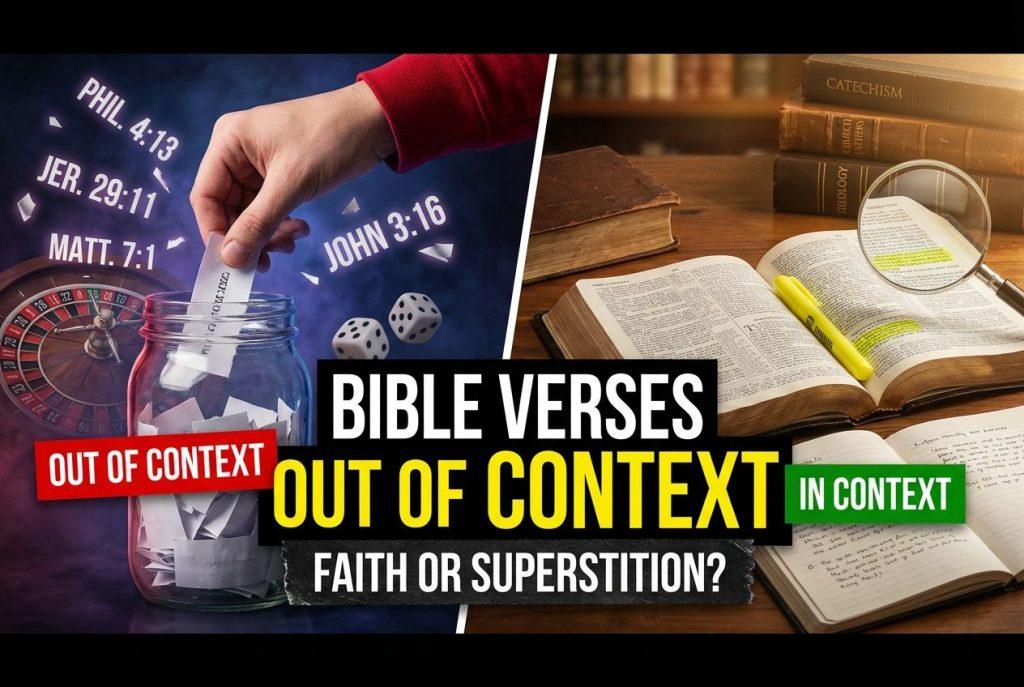
- Treating individual Bible verses as magical formulas or daily affirmations without understanding their context contradicts the Church’s guidance on proper scriptural interpretation.
- The Catechism identifies superstition as attributing magical importance to practices that should be approached with proper interior dispositions and understanding.
- Divination practices, which attempt to manipulate or control divine power through formulas or signs, are explicitly condemned by Catholic teaching.
- Authentic engagement with Scripture requires studying the text within the living Tradition of the Church and allowing the Holy Spirit to work genuine conversion in the heart.
- Catholics are called to read Scripture prayerfully through methods like lectio divina, which respects the sacred text while fostering true spiritual transformation rather than treating verses as good luck charms.
Understanding Catholic Teaching on Biblical Interpretation
The Catholic Church maintains a rich and ancient tradition regarding how believers should approach Sacred Scripture. The Second Vatican Council document Dei Verbum, promulgated in 1965, provides comprehensive guidance on divine revelation and the proper interpretation of the Bible. This document emphasizes that God speaks to humanity through human authors, and therefore readers must pay careful attention to what those authors truly intended to communicate. The sacred writers composed their texts within specific historical and cultural contexts, using the literary forms and conventions of their time. To understand what God reveals through Scripture, believers must investigate the meaning the sacred writers really intended to express. This requires attention to literary forms, historical circumstances, and the customary styles of communication that prevailed when the texts were written. Simply pulling a verse from its context and applying it as a personal message ignores the careful work of understanding that the Church requires. The reader who treats Scripture this way fails to respect the human authorship through which God chose to communicate. Such an approach fundamentally misunderstands the nature of biblical inspiration and the collaborative relationship between divine and human authorship that produced the sacred texts.
The Catechism of the Catholic Church provides specific criteria for proper scriptural interpretation in paragraphs 109 through 119. These guidelines emphasize that Scripture must be read and interpreted in the light of the same Holy Spirit by whom it was written. This means attending to three essential principles that work together to ensure faithful interpretation. First, readers must be attentive to the content and unity of the whole Scripture, recognizing that despite the diversity of books, the Bible forms a unity centered on Christ Jesus. Second, Scripture must be read within the living Tradition of the whole Church, which carries the living memorial of God’s Word in her heart. Third, interpreters must be attentive to the analogy of faith, which means the coherence of the truths of faith among themselves and within the whole plan of revelation. These three principles work together to prevent the kind of isolated, context-free reading that characterizes the misuse of Scripture as a collection of magic formulas. When someone opens the Bible randomly and claims whatever verse they land on as God’s personal message for the day, they violate all three of these principles. They ignore the unity of Scripture by treating one verse as independent from its larger context. They bypass the Church’s Tradition and teaching authority. They fail to consider how any particular verse fits within the coherent whole of divine revelation. This approach reduces the inspired Word of God to a technique for obtaining personal guidance, which fundamentally distorts its nature and purpose.
The Problem of Superstition in Religious Practice
The Catholic Church addresses the issue of superstition directly in the Catechism, particularly in sections dealing with the First Commandment. Paragraph 2111 defines superstition as the deviation of religious feeling and of the practices this feeling imposes. Superstition can even affect the worship offered to the true God when someone attributes importance in a magical way to certain practices that are otherwise lawful or necessary. The key characteristic of superstition lies in attributing efficacy to the mere external performance of religious acts, apart from the interior dispositions those acts demand. When a person falls into superstition, they believe the power resides in the external action itself rather than in God’s grace working through proper faith and disposition. This understanding directly applies to the misuse of Scripture as daily affirmations or magic formulas. When someone believes that randomly reading a Bible verse will automatically produce guidance, comfort, or blessing regardless of their understanding or interior state, they have adopted a superstitious approach to the sacred text. They attribute to the mere act of reading words a power that operates independently of faith, understanding, and relationship with God. This represents exactly the kind of magical thinking that the Church identifies as superstitious. The Word of God certainly has power, but that power works through the Holy Spirit in hearts that are open, receptive, and properly disposed to receive divine truth.
The Catechism further develops this teaching in paragraphs 2115 through 2117, which address divination and magic. While God can reveal the future to prophets and saints, the proper Christian attitude involves confidently placing oneself in the hands of Providence regarding the future and giving up unhealthy curiosity about it. All forms of divination are to be rejected, including practices that falsely claim to unveil the future. Consulting horoscopes, astrology, interpretation of omens and lots, and similar practices conceal a desire for power over time, history, and ultimately other human beings. They express a wish to conciliate hidden powers and contradict the honor, respect, and loving fear owed to God alone. The practice of randomly opening the Bible to receive a message for the day shares characteristics with these condemned practices of divination. Both attempt to gain knowledge or guidance through a technique or formula rather than through authentic relationship with God. Both treat sacred things as instruments to be manipulated for personal purposes. Both bypass the normal means through which God communicates with His people, including prayer, discernment, spiritual direction, and the teaching authority of the Church. While the person engaged in this practice may have sincere intentions, the method itself resembles divination more closely than it resembles authentic Catholic spiritual practice. The external similarity to techniques like bibliomancy, which various religions have used to divine messages from sacred texts, should give Catholic believers serious pause about adopting such methods.
The Danger of Treating Scripture as a Talisman
When believers approach the Bible as a source of random inspirational messages rather than as a coherent revelation requiring study and understanding, they effectively reduce Scripture to a kind of talisman. A talisman is an object believed to possess magical properties that can bring good fortune or protection to its possessor. In superstitious thinking, the power resides in the object itself or in the correct performance of rituals associated with it, independent of genuine spiritual realities. Treating Bible verses as daily affirmations functions similarly when the person believes the words themselves, regardless of context or understanding, will produce positive effects in their life. This approach fundamentally misunderstands how God’s Word actually works in the lives of believers. Scripture transforms people not through magical power residing in the words themselves, but through the Holy Spirit working in receptive hearts that understand and respond to divine truth. The prophet Isaiah records God saying that His word shall not return to Him empty but shall accomplish that which He purposes. However, this divine efficacy works through genuine proclamation, hearing, understanding, and faithful response, not through using verses as incantations or formulas. The difference between authentic engagement with Scripture and superstitious use parallels the difference between receiving the Eucharist with proper disposition versus treating it as a good luck charm. In both cases, the sacred reality truly contains divine power, but that power operates through grace working in faith, not through automatic magical effect.
Historical examples illustrate how Christian communities have sometimes fallen into superstitious uses of Scripture. In various periods, people have treated Bible texts as protective amulets, wearing verses in pouches or placing them in homes as wards against evil. Some have practiced sortes sanctorum, a form of bibliomancy that involved randomly opening the Bible to determine God’s will. The Church has consistently discouraged such practices precisely because they represent superstitious approaches to sacred texts. The Bible itself warns against treating divine revelation superstitiously. When the Israelites began treating the Ark of the Covenant as a magical object that would automatically bring them victory in battle, they suffered defeat because they had substituted superstition for genuine covenant relationship. Similarly, in the New Testament, some people attempted to use the name of Jesus as a magical formula without authentic relationship with Him, as seen in the story of the seven sons of Sceva in the Acts of the Apostles. These biblical examples demonstrate that even genuinely sacred words and names lose their proper efficacy when approached superstitiously rather than faithfully. The power resides not in the formula but in the relationship with the living God who speaks through these means. Contemporary believers who treat Bible verses as daily affirmations without context repeat this ancient error in modern form. They seek the benefits of divine guidance while bypassing the demanding work of actual scriptural study, prayer, and submission to God’s revealed will.
How Context Changes Meaning
The importance of context in biblical interpretation cannot be overstated, as removing verses from their context regularly produces serious misunderstandings and misapplications. A verse that appears to offer comfort or promise when read in isolation may actually mean something quite different within its proper context. For example, Jeremiah 29:11 states, “For I know the plans I have for you, declares the Lord, plans for welfare and not for evil, to give you a future and a hope.” This verse frequently appears on greeting cards, motivational posters, and social media as a general promise of God’s good plans for individual lives. However, in its proper context, God speaks these words specifically to the Jewish exiles in Babylon, promising that after seventy years of exile, He will bring them back to their land. The promise was corporate rather than individual, specific rather than general, and conditional upon the people’s repentance and return to covenant faithfulness. Applying this verse directly to modern individual circumstances without acknowledging its original context and meaning demonstrates exactly the kind of interpretive problem that arises from treating Scripture as a collection of isolated affirmations. The verse does reveal important truths about God’s character and His care for His people, but those truths must be understood and applied through proper interpretation that respects the original context. Reading the entire chapter of Jeremiah 29 reveals a much richer and more complex message than the isolated verse suggests, including warnings about false prophets and calls to seek the welfare of the city where God has sent His people into exile.
Another commonly misapplied verse illustrates the same problem. Philippians 4:13 declares, “I can do all things through him who strengthens me.” Many believers quote this verse as a promise of unlimited capability or success in any endeavor. However, Paul writes this statement in the context of explaining his contentment in all circumstances, whether well-fed or hungry, in abundance or in need. The “all things” he references specifically means the ability to be content in every situation, not the power to accomplish any goal one desires. The verse immediately preceding states, “I have learned the secret of facing plenty and hunger, abundance and need.” Paul speaks about spiritual strength for faithful endurance, not supernatural empowerment for personal ambitions. Understanding this context completely transforms how a believer should apply the verse. It becomes a promise of grace for difficult circumstances rather than a guarantee of success in comfortable pursuits. The person who randomly lands on this verse and claims it as encouragement for a business venture or athletic competition has fundamentally misunderstood Paul’s meaning. This misunderstanding harms rather than helps spiritual life because it creates false expectations and misrepresents God’s actual promises. Authentic faith requires the humility to study Scripture carefully and submit personal desires to God’s actual revealed will rather than conforming Scripture to support predetermined wishes. The Church’s insistence on proper contextual interpretation protects believers from these kinds of self-deception and ensures that they actually encounter God’s Word rather than projecting their own desires onto the text.
The Role of Literary Forms and Genre
Catholic teaching emphasizes that proper biblical interpretation requires attention to literary forms and genres used by the sacred writers. The Second Vatican Council’s document Dei Verbum explicitly states that truth is differently presented and expressed in various types of historical writing, prophetical texts, poetical texts, and other forms of literary expression. This means that readers must recognize whether they are reading historical narrative, poetry, prophecy, wisdom literature, apocalyptic vision, or another genre, because each genre communicates truth in its own distinctive way. Poetry uses metaphor, hyperbole, and symbolic language that would be misunderstood if read as literal historical description. Prophecy often contains conditional elements and uses symbolic imagery that requires interpretation within the prophetic tradition. Wisdom literature presents general principles and observations about life that admit exceptions rather than absolute promises. Treating all biblical texts as though they function identically leads to serious interpretive errors. The person who randomly selects a verse without considering its literary genre will frequently misapply it. A poetic expression of trust in God’s protection becomes a guarantee against all physical harm. A wisdom proverb describing general patterns becomes an absolute promise. An apocalyptic vision using symbolic numbers and images gets interpreted as literal prediction of current events. Each of these errors stems from failing to recognize and respect the literary form through which God chose to communicate particular truths.
Consider the differences between reading the historical books of Samuel and Kings versus reading the Psalms. The historical books narrate events that actually occurred, though they interpret those events theologically and select details to serve their theological purposes. The Psalms express the prayers, praise, laments, and spiritual experiences of God’s people through poetry, using vivid imagery, emotional intensity, and metaphorical language. A statement in Samuel about God’s promise to David establishes historical and theological facts about the Davidic covenant. A similar statement in a Psalm expresses the psalmist’s trust and hope in poetic form, inviting readers to make that trust their own. Both texts convey divine truth, but they do so through different literary means that require different interpretive approaches. The random verse selector ignores these crucial distinctions, treating every sentence in Scripture as interchangeable in function and application. This approach does violence to the sacred text by refusing to read it according to the nature of its composition. It reflects an unwillingness to engage in the actual work of biblical study, preferring instead a shortcut that treats the Bible as a spiritual vending machine, dispensing messages on demand. The Church’s teaching about literary forms protects believers from these errors by insisting that God’s truth must be understood according to the means through which He chose to reveal it. This requires effort, study, and often the guidance of teachers and commentaries, but it leads to genuine encounter with God’s revealed Word rather than projection of personal desires onto randomly selected texts.
The Church as Interpreter
Catholic teaching assigns a crucial role to the Church as the authentic interpreter of Sacred Scripture. Dei Verbum clearly states that the task of authentically interpreting the Word of God, whether written or handed on, has been entrusted exclusively to the living teaching office of the Church, whose authority is exercised in the name of Jesus Christ. This teaching office, called the Magisterium, does not stand above the Word of God but serves it, teaching only what has been handed on. The Magisterium listens to the Word devoutly, guards it scrupulously, and explains it faithfully in accord with a divine commission and with the help of the Holy Spirit. This means that individual believers do not approach Scripture in isolation but within the community of faith that the Holy Spirit guides. The Church, through her teaching authority, provides guardrails that prevent believers from wandering into serious error when interpreting Scripture. When someone randomly selects verses and interprets them according to personal inclination without reference to Church teaching or tradition, they effectively reject this divine provision for ensuring faithful interpretation. They claim for themselves an authority that Christ gave to the Church as a whole, operating as though the Holy Spirit speaks directly to them through whatever text they happen upon, independently of the community of faith and its teaching authority.
This individualistic approach to Scripture reflects Protestant principles of private interpretation more than Catholic understanding. The Protestant Reformation emphasized the individual believer’s right and responsibility to interpret Scripture according to personal conscience, rejecting the Church’s teaching authority. This principle, while sincere in its origins, led to endless multiplication of interpretations and divisions among Christians. The Catholic Church maintains that Christ established a teaching authority precisely to preserve unity and guard against error in understanding revelation. When a Catholic treats the Bible as a personal message generator, selecting verses randomly and interpreting them according to individual preference, they functionally adopt a Protestant approach to Scripture while remaining nominally Catholic. This represents an incoherent position that claims Catholic identity while rejecting Catholic principles. The proper Catholic approach involves reading Scripture within the living Tradition of the Church, which includes the teachings of councils, the writings of Church Fathers and Doctors, the liturgy, and the ordinary and extraordinary Magisterium. These sources work together to ensure that contemporary believers understand Scripture faithfully, in continuity with how the Church has understood it throughout the centuries. The person who wants a quick, easy answer through random verse selection rejects this rich heritage of faithful interpretation in favor of what essentially amounts to spiritual fortune-telling dressed in Christian vocabulary.
Interior Disposition and Authentic Transformation
The Catholic understanding of how God’s Word works in believers’ lives emphasizes the necessity of proper interior disposition. The Catechism teaches that attributing efficacy to religious practices based on their mere external performance, apart from the interior dispositions they demand, constitutes superstition. This principle applies directly to Scripture reading. Simply reading words, even inspired words, produces no automatic spiritual benefit if the reader lacks proper disposition of heart and mind. The Word of God certainly possesses power, but that power operates through the Holy Spirit working in receptive hearts. The Holy Spirit uses Scripture to convict believers of sin, instruct them in righteousness, reveal Christ more fully, and conform them to His image. These transformative effects require genuine openness, humility, willingness to be challenged and changed, and submission to God’s will. The person who treats Bible verses as daily affirmations typically seeks comfort, encouragement, or confirmation of existing plans rather than genuine transformation. They want Scripture to support their current path rather than potentially redirect it. This approach lacks the authentic openness to correction and conversion that characterizes proper disposition for receiving God’s Word. It reflects a consumerist mentality that treats Scripture as a resource for personal well-being rather than as divine revelation that makes claims on the whole person.
Authentic transformation through Scripture requires several elements that random verse selection typically bypasses. First, the reader must approach the text with humility, recognizing that God’s thoughts are higher than human thoughts and His ways higher than human ways. This humility creates space for the text to challenge existing assumptions and perspectives rather than merely confirming them. Second, the reader needs context and understanding, which require study, reflection, and often guidance from teachers. The Ethiopian eunuch in the Acts of the Apostles provides a biblical example when he tells Philip that he cannot understand the Scripture unless someone guides him. Third, genuine transformation requires application that goes beyond feeling encouraged or motivated. The Word must be allowed to examine the heart, expose sin, correct error, and demand concrete changes in behavior and attitude. James warns against being merely hearers of the Word who deceive themselves; believers must be doers who act on what they hear. The random verse selector rarely moves beyond the hearing stage to genuine doing because the selection process itself resists the kind of sustained engagement with particular texts that leads to real change. Fourth, Scripture reading should occur in the context of prayer, allowing genuine dialogue between the soul and God. This differs fundamentally from using the Bible as an oracle or fortune-telling device. Prayer involves speaking to God and listening for His voice through various means, including Scripture, but always with recognition that God remains sovereign over how and when He speaks. The person who demands a message by randomly opening the Bible attempts to control the process, which contradicts the posture of humble receptivity that prayer requires.
Lectio Divina and Proper Scriptural Prayer
The Catholic tradition offers a time-tested method for prayerful engagement with Scripture called lectio divina, which means divine reading. This ancient practice, rooted in monastic tradition and recommended by the Catechism, provides a structured yet flexible approach to encountering God through His Word. Lectio divina typically involves four movements: reading, meditation, prayer, and contemplation. The reading phase involves carefully and slowly reading a particular passage of Scripture, often repeatedly, to hear what the text actually says. The meditation phase involves reflecting on the text, considering its meaning in context and how it relates to life today. The prayer phase involves responding to God based on what the Scripture has revealed, whether in thanksgiving, petition, confession, or praise. The contemplation phase involves resting in God’s presence, allowing the Word to work deeply in the heart without forcing or analyzing. This method respects the nature of Scripture as divine revelation that deserves careful attention and thoughtful response. It allows God to speak through His Word while requiring human cooperation through study, reflection, and prayer. Unlike random verse selection, lectio divina works with substantial portions of text, respects context, and allows time for genuine understanding and response. It represents the kind of serious engagement with Scripture that the Church encourages.
The differences between lectio divina and random verse selection illustrate the distinction between authentic Catholic spirituality and superstitious practice. Lectio divina begins with a chosen passage, often from the daily Mass readings, which ensures connection to the Church’s liturgical life and communal worship. The random approach begins wherever the Bible happens to open, with no connection to the Church’s prayer or teaching. Lectio divina proceeds deliberately through reading and re-reading, seeking genuine understanding of the text’s meaning. The random approach seeks immediate application without concern for understanding. Lectio divina involves extended meditation that considers multiple dimensions of meaning and application. The random approach typically involves brief reading followed by claiming whatever comfort or promise the verse seems to offer. Lectio divina culminates in contemplation that rests in God’s presence rather than seeking tangible results. The random approach aims at obtaining practical guidance or encouragement for the day ahead. Lectio divina recognizes that not every Scripture passage will speak powerfully on every occasion; some readings require patient wrestling, while others yield insight only gradually. The random approach expects every verse to deliver an immediate message, which creates false expectations and leads to forcing meaning onto texts. Lectio divina integrates Scripture reading with the larger context of Catholic life including Mass, sacraments, formal prayer, and moral living. The random approach tends toward individualism that separates Scripture from its proper ecclesial context. These contrasts demonstrate why the Church recommends lectio divina and why the random selection method should be abandoned in favor of more authentic practices.
The Unity of Scripture and Progressive Revelation
Catholic teaching emphasizes that Scripture must be understood as a unified whole rather than as a collection of isolated statements. The Bible tells a single grand narrative of God’s relationship with humanity, from creation through fall, redemption, and ultimately to the promised consummation in Christ. This narrative unfolds progressively, with later revelation building upon and fulfilling earlier revelation. The Old Testament prepares for and points toward Christ, who represents the fullness of divine revelation. The New Testament reveals the meaning that was hidden in the Old. Any particular verse or passage derives its full meaning from its place within this larger story. The person who randomly selects verses ignores this essential unity and treats Scripture as a scattered collection of wise sayings or promises rather than as coherent revelation. This fragmented approach prevents understanding the Bible’s actual message. For example, many Old Testament passages that promise prosperity and long life to those who follow God’s ways made sense within the old covenant relationship between God and Israel. Those promises were conditional upon obedience and applied corporately to the nation. In the new covenant revealed through Christ, the focus shifts from earthly prosperity to spiritual blessing and eternal life. Physical blessings are not the primary promise; rather, believers receive forgiveness, adoption as God’s children, the indwelling Holy Spirit, and the hope of resurrection. Understanding this shift requires grasping Scripture’s unity and progressive revelation.
When someone randomly lands on an Old Testament promise about prosperity and claims it as a personal guarantee without understanding its covenantal context and how Christ fulfills and transforms such promises, they misinterpret Scripture in ways that can cause real spiritual harm. They may expect material blessings that God never promised to Christians in those terms. When those blessings fail to materialize, their faith may be damaged, or they may conclude that they lack sufficient faith or that God has failed them. The problem lies not with God or with Scripture but with the faulty interpretive method that took the verse out of context and applied it incorrectly. Catholic teaching about the unity of Scripture protects believers from these errors by insisting that every text be understood in relation to the whole. Particular passages illuminate one another. New Testament texts explain how to understand Old Testament passages. The Gospels show how Jesus fulfills prophecies and transforms institutions like sacrifice, priesthood, and law. The epistles explain how to live in light of Christ’s death and resurrection. When someone engages with Scripture properly, studying books in their entirety, comparing passages that address similar themes, and learning from Church teaching about how texts relate to one another, they gradually come to understand the Bible’s coherent message. This process takes time, effort, and often guidance from teachers and resources. The random verse selector rejects this process in favor of instant gratification, but the instant gratification comes at the cost of genuine understanding and authentic relationship with God through His revealed Word.
Scripture Within Living Tradition
The Catholic Church teaches that Scripture and Tradition form one sacred deposit of the Word of God committed to the Church. Sacred Tradition takes the Word of God entrusted by Christ and the Holy Spirit to the apostles and hands it on to their successors in its full purity. This means that Scripture does not stand alone as the sole source of divine revelation; rather, both Scripture and Tradition flow from the same divine wellspring. The Church’s understanding of Scripture has been shaped by centuries of study, prayer, and teaching by saints, Fathers, Doctors, theologians, and the Magisterium. This living Tradition provides essential context for understanding what Scripture means. The ancient practice of reading Scripture within the community of faith, in the context of liturgy, with attention to how earlier generations of Christians understood particular texts, ensures continuity and guards against novel interpretations that contradict the faith once delivered to the saints. When someone randomly selects verses and interprets them according to personal preference without reference to how the Church has understood those texts, they effectively reject this Tradition. They claim that their personal, immediate impression of a text’s meaning carries the same weight as the Church’s centuries of prayerful reflection. This represents not humility but hubris, an unwillingness to receive wisdom from the community of faith across time and space.
The Church Fathers provide numerous examples of careful, prayerful interpretation that respects context, considers multiple meanings, and connects texts to the larger framework of Christian faith. Augustine, Jerome, John Chrysostom, Ambrose, and others devoted enormous effort to understanding Scripture properly. Their commentaries reveal patient study, comparison of texts, attention to original languages, and most importantly, reading Scripture through the lens of Christ and the rule of faith. Modern believers stand as heirs to this interpretive tradition, which protects them from error and enriches their understanding. The person who wants a quick answer through random selection essentially declares this rich heritage irrelevant. They prefer their own immediate impression to the considered judgment of saints and scholars. This attitude reflects the broader contemporary tendency toward radical individualism that rejects authority and tradition in favor of personal autonomy. Catholic faith requires humility that recognizes the need for teachers, acknowledges the authority of the Church, and gratefully receives the wisdom of earlier generations. Scripture reading should occur within this living Tradition, consulting commentaries, studying Church teaching, and learning from spiritual directors and guides. These resources help believers understand what texts meant in their original contexts, how the Church has understood them throughout history, and how they apply to contemporary life. This process may seem less immediate and exciting than randomly opening the Bible and claiming whatever verse appears, but it leads to genuine growth in understanding and authentic relationship with God through His revealed Word.
Distinguishing Guidance from Manipulation
A crucial distinction exists between genuinely seeking God’s guidance and attempting to manipulate divine communication through superstitious techniques. God certainly guides His people, and Scripture serves as one means through which He provides guidance. The Bible contains promises, commands, wisdom, and examples that shape Christian life and inform decisions. However, God typically guides through the ordinary means He has established rather than through extraordinary interventions. These ordinary means include regular Scripture reading and study, prayer, the sacraments, spiritual direction, the advice of mature Christians, the teaching of the Church, and the gifts of wisdom and prudence. When believers faithfully use these means, they grow in ability to recognize God’s will and make good decisions. They learn to think according to Christian principles and to evaluate situations in light of biblical wisdom. This gradual formation of conscience and character represents how God normally guides His people. The person who randomly opens the Bible seeking a specific answer for a decision essentially bypasses these ordinary means, demanding instead an extraordinary intervention. They want God to speak directly through whatever verse they happen upon, providing clear direction without the need for wisdom, discernment, or thoughtful consideration. This approach reflects impatience with God’s normal ways of guiding and implies that the ordinary means are insufficient.
Furthermore, this technique puts the person in control rather than submitting to God’s sovereignty. By demanding a message through verse selection, the individual essentially tells God when and how to speak. True prayer involves speaking to God and listening for His voice, but listening requires openness to hearing in whatever way and timing God chooses. God may speak through Scripture during regular reading, through a homily, through a conversation, through circumstances, or through the quiet prompting of conscience. He may also require waiting without immediate answer, teaching patience and trust. The random verse selector refuses to wait or to receive guidance through ordinary means, instead demanding instant clarity through a technique that treats the Bible as a spiritual fortune cookie. This attitude resembles divination more than prayer. Divination attempts to force knowledge of the future or revelation of hidden things through techniques and formulas. Prayer humbly asks and trusts God to answer in His wisdom and timing. The external similarity between randomly selecting Bible verses and practices like bibliomancy should trouble thoughtful Catholics. Different religions have used the random opening of sacred texts as a divination technique. The fact that Christians use the Bible rather than another text does not automatically sanctify the practice if the underlying attitude resembles divination. The Church’s clear teaching against divination applies to this practice even when the person means well and uses Christian terminology. Good intentions do not transform superstitious practices into authentic spirituality.
The Problem of Confirmation Bias
Random Bible verse selection creates significant problems related to confirmation bias, the human tendency to notice and remember information that confirms existing beliefs while ignoring information that challenges them. When someone randomly opens the Bible, they typically interpret whatever verse appears in ways that support their current desires, plans, or emotional state. A verse that could be read multiple ways gets interpreted according to what the person wants to hear. A warning or challenge gets overlooked in favor of a verse that offers comfort or encouragement. Over time, this pattern reinforces existing attitudes rather than allowing Scripture to challenge and transform. The person develops a distorted view of the Bible as a book that always agrees with them, always encourages them, and never seriously confronts them with uncomfortable truths. This represents a form of self-deception that hinders spiritual growth. Authentic engagement with Scripture often proves uncomfortable. The Word of God, as the Letter to the Hebrews states, is living and active, sharper than any two-edged sword, piercing to the division of soul and of spirit, of joints and of marrow, and discerning the thoughts and intentions of the heart. This penetrating quality of Scripture should lead to conviction of sin, correction of error, and call to repentance. The random verse selector, however, typically avoids this discomfort by interpreting everything positively.
The problem becomes even more serious when people begin to believe that God speaks to them directly through randomly selected verses. This belief can lead to poor decision-making based on misinterpreted Scripture taken out of context. Someone might make a major life decision based on a verse that seems to provide confirmation when proper understanding of that verse would give no such guidance. Financial decisions, relationship choices, career moves, and other significant matters might be influenced by biblical texts that have no actual relevance to those situations. The person mistakes their own desires and interpretations for God’s voice, potentially with serious consequences. The Church’s insistence on proper interpretation, attention to context, guidance from teaching authority, and discernment through ordinary means protects believers from these dangers. When major decisions must be made, the Church recommends prayer, consultation with spiritual directors, consideration of circumstances, attention to Church teaching, and patient discernment over time. Scripture certainly informs this process, but through careful study of relevant biblical principles and wisdom rather than through random selection. The person who wants a shortcut through verse selection may end up worse off than if they had simply used common sense and prudent judgment. They add a veneer of spirituality to what amounts to impulsive decision-making, believing they follow divine guidance when they actually follow their own inclinations dressed in biblical language.
Teaching Children Proper Reverence for Scripture
Parents and catechists who introduce children to Scripture bear responsibility for teaching proper reverence and appropriate use of the Bible. Children naturally learn by imitation, observing how adults treat sacred things. When children see parents or teachers randomly opening the Bible for daily messages, they learn that this represents normal Christian practice. They absorb the implicit message that the Bible functions as a divine fortune cookie rather than as a revelation requiring study and understanding. This early formation shapes their approach to Scripture throughout life, potentially preventing them from developing mature engagement with biblical texts. The better approach involves teaching children to read and study Scripture systematically, starting with age-appropriate stories and passages. Young children can learn biblical narratives about creation, the patriarchs, Moses, the prophets, and especially about Jesus’s life and teaching. As they grow, they can begin reading longer portions, studying books in their entirety, and learning about context and interpretation. Throughout this process, adults should model careful reading, thoughtful reflection, and humble submission to Scripture’s teaching. Children should see adults consulting commentaries, discussing difficult passages, and wrestling with how biblical principles apply to contemporary situations. They should learn that Scripture requires effort to understand but rewards that effort with deep wisdom and genuine encounter with God’s Word.
Religious education programs should teach proper biblical interpretation as an integral part of catechesis. Students should learn about literary genres, historical contexts, and the development of revelation throughout salvation history. They should understand how the Church has interpreted Scripture throughout the centuries and why the Church’s teaching authority matters for faithful interpretation. They should learn to distinguish authentic Catholic practices like lectio divina from superstitious approaches. This formation equips young people to engage with Scripture fruitfully throughout their lives rather than treating it as a magical text. Unfortunately, some Catholic educational materials and devotional resources for children and youth present the random verse selection approach, sometimes explicitly encouraging children to open the Bible randomly when they need guidance. This represents poor catechesis that forms young people in superstitious rather than authentic Catholic practices. Publishers, authors, and educators should examine their materials carefully and eliminate anything that treats Scripture as a fortune-telling device or magical object. Catholic children deserve formation in authentic Catholic spirituality that respects the nature of biblical revelation and teaches them to engage with Scripture seriously. The time invested in proper formation pays dividends throughout life as young people grow into adults who love Scripture, study it carefully, and allow it to shape their lives according to God’s actual will revealed through proper interpretation.
Addressing Common Objections
Some people defend the practice of randomly selecting verses by appealing to stories of saints or other Christians who received guidance through such means. These accounts sometimes describe someone opening the Bible randomly at a crucial moment and finding a verse that spoke powerfully to their situation. Several points address this objection. First, exceptional cases do not establish general rules. God certainly can speak through any means He chooses, including through a randomly opened Bible. His sovereignty means He can work through flawed methods when He wishes. However, God’s ability to work through a practice does not mean that practice should be adopted as normal spirituality. God has worked through donkeys, burning bushes, and handwriting on walls, but nobody should expect these as ordinary means of divine communication. Second, many of these stories come from Protestant rather than Catholic contexts and reflect Protestant approaches to Scripture. Catholics should not simply adopt Protestant practices without considering whether they align with Catholic principles. Third, even when such stories come from Catholic sources, they typically describe extraordinary moments of crisis or conversion rather than daily practice. The person facing a life-threatening situation who cries out to God and happens to open to a comforting verse has a different experience from someone who uses this method routinely to obtain daily messages. Fourth, these accounts often involve significant hindsight interpretation, with people reading profound meaning into coincidences. The human mind excels at finding patterns and meaning even in random events.
Another objection claims that criticizing random verse selection imposes rules that restrict the Holy Spirit. According to this argument, the Holy Spirit can guide believers to particular verses, and insisting on systematic study quenches spiritual spontaneity. This objection misunderstands both the nature of the Holy Spirit’s work and the purpose of proper biblical interpretation. The Holy Spirit certainly guides believers, including in their Scripture reading. The Spirit may indeed bring particular passages to mind or make certain texts particularly meaningful at specific times. However, the Spirit works through rather than against human understanding. God inspired Scripture through human authors who wrote in human languages using human literary forms. The Spirit who inspired the writing also guides interpretation, but this guidance does not bypass the need for understanding what the human authors intended to communicate. The Spirit does not contradict Himself by inspiring one meaning when Scripture was written and then providing different meanings to later readers who ignore original context. Furthermore, the Church’s teaching about proper interpretation does not restrict the Spirit but protects believers from mistaking their own thoughts for the Spirit’s guidance. The person who randomly selects verses and claims the Spirit led them to those texts may indeed experience the Spirit’s guidance, but they may also be projecting their own desires onto random coincidence. Proper interpretation provides criteria for distinguishing genuine spiritual insight from self-deception. The Spirit guides believers into all truth, as Jesus promised, but this guidance operates through the Church’s teaching and the ordinary means of grace, not through bypassing human understanding and treating Scripture as a magic book.
Practical Steps Toward Better Engagement
Catholics who have developed habits of random verse selection can take practical steps toward more authentic engagement with Scripture. First, commit to reading the daily Mass readings as a regular practice. The Church provides these readings following a carefully designed lectionary that covers significant portions of Scripture over several years. Reading the same passages the whole Church reads connects personal Scripture engagement with communal worship and ensures exposure to a wide variety of texts. Many resources provide the daily readings along with commentary, making them accessible for personal study. Second, choose a biblical book to read systematically from beginning to end. Start with one of the Gospels or a New Testament letter. Read a manageable section each day, perhaps one chapter or a few paragraphs. Use a Catholic study Bible or commentary to understand context and difficult passages. This sustained engagement with a single book allows genuine understanding of its message and themes. Third, learn and practice lectio divina, using resources from reliable Catholic sources. Many retreat centers, parishes, and online resources offer guidance in this ancient practice. Allow time for each phase, resisting the urge to rush toward quick application. Fourth, consider joining a Bible study group at your parish or forming one with friends. Studying Scripture in community provides accountability, multiple perspectives, and opportunity to learn from others. Make sure the group uses Catholic materials and respects Church teaching about interpretation.
Fifth, consult reliable Catholic commentaries and resources when reading Scripture. The Navarre Bible, the Catholic Commentary on Sacred Scripture series, and works by respected Catholic scholars provide solid guidance for understanding biblical texts. Invest in a good Catholic study Bible with notes that explain context and meaning. Sixth, develop the habit of reading Scripture in the context of prayer, speaking to God about what you read and asking the Holy Spirit for understanding and the grace to apply biblical truth to your life. Remember that prayer involves listening as well as speaking, but listening means receptivity to however God chooses to communicate rather than demanding messages through random selection. Seventh, be patient with the process of spiritual growth through Scripture. Understanding develops gradually through consistent engagement over time. Not every reading will produce dramatic insights or emotional responses. Some passages require wrestling and repeated reading before they yield their treasures. The goal is not daily inspiration but gradual transformation through sustained contact with God’s revealed Word. Finally, if you struggle to break the habit of random selection, ask a spiritual director or confessor for accountability and guidance. Acknowledge that this practice represents a form of superstition even if you meant well. Ask God’s forgiveness for treating His Word disrespectfully and His grace for developing better practices. The Church provides abundant resources for authentic spiritual life, including proper engagement with Scripture. Taking advantage of these resources leads to genuine growth rather than the illusion of spirituality that superstitious practices create.
Disclaimer: This article presents Catholic teaching for educational purposes. For official Church teaching, consult the Catechism and magisterial documents. For personal spiritual guidance, consult your parish priest or spiritual director. Questions? Contact editor@catholicshare.com
Sign up for our Exclusive Newsletter
- 📌 Add CatholicShare as a Preferred Source on Google
- 🎁 Join us on Patreon for Premium Content
- 🎧 Check Out These Catholic Audiobooks
- 📿 Get Your FREE Rosary Book
- 📱 Follow Us on Flipboard
-

Recommended Catholic Books
Discover hidden wisdom in Catholic books — invaluable guides enriching faith and satisfying curiosity. #CommissionsEarned
- The Early Church Was the Catholic Church
- The Case for Catholicism - Answers to Classic and Contemporary Protestant Objections
- Meeting the Protestant Challenge: How to Answer 50 Biblical Objections to Catholic Beliefs
As an Amazon Associate, I earn from qualifying purchases. Thank you for your support.