
Brief Overview
- Catholic churches across the Netherlands are being repurposed into gyms, bookstores, apartments, and cultural venues due to declining attendance and secularization.
- The Diocese of Amsterdam announced in 2022 that 60% of its churches would need to close within five years because of fewer churchgoers and volunteers.
- Statistics show that Catholic identification in the Netherlands dropped from 26% in 2013 to 17% by 2024, representing a significant decline in one generation.
- Church buildings that once served as centers of Catholic worship are now deconsecrated and sold for secular purposes when parishes can no longer maintain them.
- The trend reflects broader secularization across Western Europe where religious practice has decreased dramatically since the 1960s.
- Understanding this phenomenon requires examining both the theological meaning of church buildings and the historical factors that led to this situation.
The Current Situation in the Netherlands
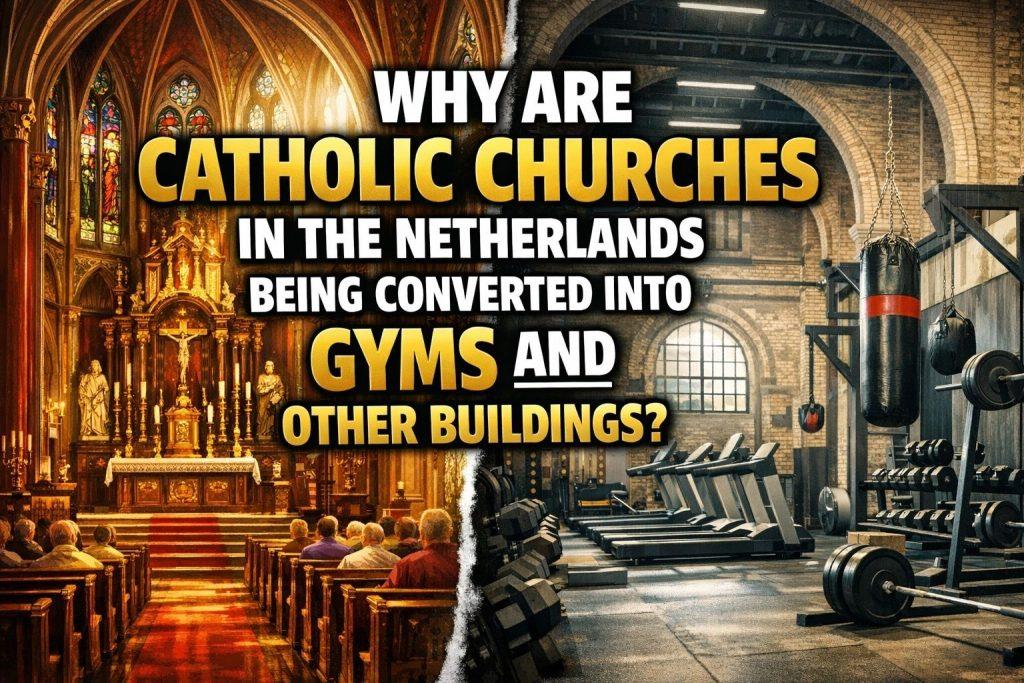
The repurposing of Catholic churches in the Netherlands has become a visible symbol of religious decline in Western Europe. A church in Maastricht that now operates as a fitness center has captured international attention through social media and news coverage. The sight of exercise equipment beneath vaulted ceilings and stained glass windows strikes many Catholics as jarring. Similar conversions have occurred throughout the country. A church in Utrecht has been transformed into a gym. Another in Arnhem first became a skate hall before being converted to house a gym and padel courts. A church in Hilversum now contains a bounce park with inflatable slides. These transformations represent more than aesthetic changes to historic buildings. They signal a fundamental shift in how Dutch society relates to religious institutions and Catholic faith.
The statistics behind these conversions tell a sobering story about the state of Catholicism in the Netherlands. As of 2019, the number of parishes had dropped from 1,525 in 2003 to 760, representing a loss of more than half in just sixteen years. One or two churches were closing each week during that period. Projections from 2014 suggested that two-thirds of all Roman Catholic churches would need to shut down by 2025. The Diocese of Amsterdam’s 2022 announcement confirmed these predictions were accurate. Church attendance has plummeted even more dramatically than formal membership numbers suggest. Only a small percentage of those who still identify as Catholic attend Mass regularly. The combination of declining attendance, fewer priests, aging congregations, and mounting maintenance costs has made it impossible to keep all church buildings operational.
The geographic concentration of these closures varies across different regions of the Netherlands. The southern provinces, historically the most Catholic areas of the country, have seen particularly significant losses. The Diocese of ‘s-Hertogenbosch reported that Catholics became a minority within its boundaries by 2014. Urban centers like Amsterdam, Utrecht, and Rotterdam have experienced rapid secularization. Rural areas face challenges related to population decline and the inability to support multiple small parishes. Some dioceses have attempted to merge parishes and consolidate Mass schedules. However, these efforts have only slowed rather than reversed the trend. The physical landscape of Dutch Catholicism has changed permanently. Buildings that once anchored neighborhood life now serve entirely different purposes.
Historical Context of Church Building in Catholic Tradition
Understanding the current situation requires examining how Catholics have historically viewed church buildings and their purpose. The early Church did not construct dedicated worship spaces for the first several centuries of its existence. Christians gathered in homes, as described in Acts 2:42-47, where believers “broke bread at home and ate their food with glad and generous hearts, praising God and having the goodwill of all the people.” The house church model predominated during times of persecution. Secret worship spaces, like the hidden Catholic church in Amsterdam’s attic from the Protestant era, demonstrate how Catholics maintained their faith even without official buildings. The Catacombs in Rome served as both burial sites and places of worship. These historical examples show that the Church has always been primarily about people gathered in faith rather than architectural structures.
The construction of grand church buildings began after Christianity became legal in the Roman Empire under Constantine in the fourth century. Basilicas emerged as the primary architectural form for Christian worship. These buildings served multiple purposes beyond housing the liturgy. They functioned as gathering spaces for the community, refuges for those seeking sanctuary, centers for charitable distribution, and visible signs of Christian presence in society. The medieval period saw the construction of magnificent cathedrals across Europe. Gothic architecture reached toward heaven with soaring spires and large windows. These buildings took generations to complete and represented enormous communal investment. The beauty of church architecture was understood as offering glory to God and inspiring the faithful. Sacred art, statues, and stained glass served educational purposes for populations that could not read.
The Catholic understanding of church buildings developed theological significance beyond their practical functions. Churches were consecrated and set apart as sacred spaces. The presence of the tabernacle containing the Blessed Sacrament made Catholic churches different from other buildings. Catholics genuflected upon entering to acknowledge Christ’s real presence in the Eucharist. The altar, as the place of sacrifice where the Mass was celebrated, held central importance. Relics of saints were often placed within or beneath altars. Holy water fonts at entrances reminded the faithful of their baptism. Confessionals provided spaces for the Sacrament of Reconciliation. The baptismal font marked the entrance point into Christian life. Every architectural element served a liturgical or devotional purpose. The building itself was understood as facilitating encounter with the divine.
The Second Vatican Council in the 1960s brought renewed emphasis on the Church as the People of God rather than primarily an institution or building. The Constitution on the Sacred Liturgy emphasized active participation of the faithful in worship. Liturgical reforms sometimes led to architectural changes in existing churches. Altars were moved forward to allow the priest to face the people. Greater attention was given to the ambo where Scripture was proclaimed. The assembly’s role as participants rather than passive observers was stressed. However, these reforms did not diminish the importance of sacred spaces. Vatican II documents emphasized that church buildings should be “truly worthy and beautiful” and “signs and symbols of heavenly realities.” The goal was balancing proper reverence for sacred space with recognition that the gathered community constitutes the Church. This theological foundation remains relevant when considering what it means to see church buildings repurposed for secular use.
Theological Understanding of Church and Temple
Sacred Scripture provides essential context for understanding what the Church truly is and how it relates to physical buildings. Jesus himself addressed this question directly in his conversation with the Samaritan woman at Jacob’s well. When she raised the question of where people should worship, Jesus responded, “Woman, believe me, the hour is coming when you will worship the Father neither on this mountain nor in Jerusalem… God is spirit, and those who worship him must worship in spirit and truth” (John 4:21-24). This statement was revolutionary in its context. The Samaritans and Jews disputed whether Mount Gerizim or Jerusalem was the proper place for worship. Jesus transcended the entire debate by declaring that authentic worship is not fundamentally about location. True worship occurs in spirit and truth, not because of a particular building or mountain. This teaching establishes a principle that remains valid today.
The Apostle Paul developed this concept further in his letters to early Christian communities. Writing to the Corinthians, he asked, “Do you not know that you are God’s temple and that God’s Spirit dwells in you? If anyone destroys God’s temple, God will destroy that person. For God’s temple is holy, and you are that temple” (1 Corinthians 3:16-17). Paul was addressing the community collectively, as indicated by the plural form of “you” in the Greek text. The believers together formed God’s temple. This was not merely metaphorical language. Paul was teaching that God’s dwelling place had shifted from the Jerusalem temple to the community of believers. The Holy Spirit made his home among and within the faithful. This meant the Church as people had become the true temple. Physical buildings might house the assembly, but they were not themselves the essential element.
Peter used similar imagery in his first letter when he wrote, “Come to him, a living stone, though rejected by mortals yet chosen and precious in God’s sight, and like living stones, let yourselves be built into a spiritual house, to be a holy priesthood, to offer spiritual sacrifices acceptable to God through Jesus Christ” (1 Peter 2:4-5). The image of living stones constructed into a spiritual house emphasizes the organic and dynamic nature of the Church. Each believer is a living stone. Together they form something greater than any physical structure. Christ himself is the cornerstone of this spiritual building. The priesthood of all believers functions within this living temple. This biblical vision presents the Church as fundamentally about relationships among people united to Christ rather than about buildings made of stone and mortar.
The Catechism of the Catholic Church incorporates these scriptural teachings into its explanation of what the Church is. The Church is described as the People of God, the Body of Christ, and the Temple of the Holy Spirit (CCC 781-810). These three images work together to express different dimensions of the Church’s identity. As People of God, the Church is constituted by those called into relationship with the Father. As Body of Christ, believers are united to Christ as head and to one another as members. As Temple of the Holy Spirit, the Church is the dwelling place where God lives among his people. None of these images equates the Church with a building. The Catechism does address church buildings and their importance, but always in service of the assembly and the liturgy. The building exists for the people, not the people for the building.
This theological foundation provides crucial perspective when confronting the reality of church closures and conversions. The loss of a church building does not mean the disappearance of the Church itself, at least not in an absolute sense. The Church continues to exist wherever believers gather in Christ’s name. Jesus promised, “For where two or three are gathered in my name, I am there among them” (Matthew 18:20). This promise does not require a consecrated building. The early Christians proved that vibrant faith communities could exist without dedicated church structures. Modern Catholics can theoretically maintain their faith without church buildings. However, this theological truth does not mean the loss of church buildings is insignificant or that we should be indifferent to it. The real question is what the loss of these buildings reveals about the state of faith communities themselves.
The Role and Importance of Sacred Spaces
While the Church is primarily people rather than buildings, Catholic tradition has consistently valued sacred spaces as important for worship and spiritual life. This is not a contradiction of the scriptural teaching that believers are God’s temple. Rather, it recognizes that humans are embodied creatures who relate to the spiritual through physical means. God works through material reality. This principle is evident in the sacraments, where physical elements like water, bread, wine, and oil become vehicles of grace. Similarly, physical spaces set apart for worship serve genuine spiritual purposes. The blessing and consecration of church buildings acknowledges their role in facilitating encounter between God and his people. Sacred architecture, art, and design can raise minds and hearts toward divine realities.
The presence of the Blessed Sacrament in the tabernacle gives Catholic churches a distinctive character that other Christian worship spaces may lack. Catholics believe in the real presence of Jesus Christ in the consecrated Eucharist. When the Blessed Sacrament is reserved in a church, Christ is truly present there. This is not merely symbolic. The tabernacle lamp burns continuously as a sign of this presence. Catholics have traditionally visited churches for prayer and adoration before the Blessed Sacrament. The church building becomes a place where one can literally be in the presence of Christ. Perpetual adoration chapels maintain this presence for continuous prayer. This reality makes the question of church buildings more complex than it might otherwise be. When a church closes and is deconsecrated, the Blessed Sacrament is removed and the building ceases to be a place of Christ’s eucharistic presence.
Church architecture has historically served catechetical and devotional functions that contribute to faith formation. Stained glass windows depicted biblical scenes and saints’ lives for congregations that could not read. Stations of the Cross invited meditation on Christ’s passion. Statues of Mary and the saints reminded believers of the communion of saints. Crucifixes made visible the sacrifice that the Mass makes present. The layout of church buildings, with gathering space, nave, sanctuary, and altar, reflected the movement of liturgy and the hierarchy of sacred realities. High ceilings and careful acoustics created an atmosphere distinct from everyday spaces. These elements of sacred architecture and art shaped how Catholics understood and experienced their faith. Younger generations who grow up without access to these spaces may lack certain formative experiences that shaped Catholic identity for centuries.
The gathering of the community for worship requires physical space, and church buildings have served this essential function throughout history. While house churches worked for small groups, growing communities needed larger spaces. Sunday Mass brings together sometimes hundreds of people who need room to assemble. Churches provide space for processions, for choirs, for liturgical movement. They accommodate the practical needs of worship like seating, accessibility, climate control, and acoustics. Churches also serve as gathering places for community events beyond Mass. Parish halls host meals and meetings. Classrooms provide space for religious education. These practical considerations mean that communities of a certain size require dedicated buildings. The question is whether declining communities still need large buildings that were constructed for much larger congregations.
The beauty of church architecture represents an offering to God and a witness to transcendent realities. The medieval builders who constructed cathedrals that took generations to complete were making a statement about what they valued most. They invested enormous resources in structures designed to glorify God. This represented a communal sacrifice and commitment. Beautiful churches in town centers served as visible reminders of Catholic faith in predominantly Catholic societies. They shaped the physical landscape and declared that spiritual realities mattered most. When these buildings are converted to gyms or bookstores, a certain witness is lost. The town center no longer points toward God in the same way. This shift in the physical landscape reflects and reinforces the shift in cultural priorities. What a society builds and maintains reveals what it values.
Factors Leading to Church Closures in the Netherlands
The wave of church closures and conversions in the Netherlands results from multiple converging factors rather than a single cause. Secularization is the most obvious and significant factor. The Netherlands has experienced one of the most rapid processes of secularization in Europe. Weekly church attendance declined dramatically beginning in the 1960s and 1970s. The generation that came of age during that period largely abandoned religious practice. Their children were often not baptized or raised in the faith. By the early twenty-first century, the majority of Dutch people identified as having no religion. Those who retained Catholic identity often did not practice their faith actively. This collapse of religious participation happened within two or three generations. The speed and extent of this change is remarkable even by Western European standards.
The Dutch Pastoral Council of the 1960s and early 1970s has been identified by some analysts as contributing to the crisis in Dutch Catholicism. This national gathering of Catholics attempted to implement Vatican II reforms but went beyond what the Council documents actually prescribed. Progressive theological trends gained strong influence. Traditional devotions and practices were sometimes dismissed as outdated. Emphasis shifted away from distinctive Catholic teachings toward social justice and dialogue with modern culture. Some clergy embraced heterodox views on moral and doctrinal questions. While the Pastoral Council cannot be blamed for all subsequent decline, it coincided with the period when Dutch Catholics began leaving the Church in large numbers. The correlation between progressive reforms and declining practice has been noted by scholars, though causation remains debated.
Demographic and economic factors have also contributed significantly to church closures. The Netherlands, like much of Europe, has an aging population and low birth rate. Older Catholics who still practice their faith are not being replaced by younger generations. Many rural areas have experienced population decline as young people move to cities for education and employment. This leaves behind older, smaller populations unable to support parish life. The cost of maintaining historic church buildings has become prohibitive for shrinking congregations. Heating, repairs, insurance, and basic upkeep require substantial resources. Buildings constructed for congregations of five hundred struggle when only fifty people attend Mass. The financial burden becomes unsustainable. Parishes face the choice of closure or merger with other struggling parishes.
The shortage of priests has made it impossible to maintain the parish structure that existed in previous generations. Fewer young men are entering seminaries. Older priests are retiring and dying. One priest may now be responsible for multiple parishes and communities. This means Mass schedules must be reduced and consolidated. Weekday Masses become rare. The personal pastoral presence of a resident priest in each community is no longer possible. When parishes merge, a decision must be made about which church buildings to keep and which to close. Usually the largest or most centrally located building remains open while others are sold. This practical necessity results from the priest shortage, which itself results from the broader crisis of faith and practice. All these factors feed into one another in a self-reinforcing cycle of decline.
Cultural factors in Dutch society have created an environment where religious faith is increasingly marginalized. The Netherlands is known for its progressive social values and strong emphasis on individual autonomy. Traditional religious moral teaching is often viewed as oppressive or outdated. Catholic positions on sexuality, marriage, and life issues are particularly rejected by mainstream culture. Young people who might otherwise retain some connection to the faith feel pressure to conform to secular cultural norms. Remaining Catholic and practicing the faith requires swimming against strong cultural currents. This social pressure, combined with the lack of strong faith formation in families and parishes, means few young Dutch people see compelling reasons to maintain Catholic identity. The result is that each generation becomes more secular than the last.
The Significance of Empty and Repurposed Churches
The sight of a church converted to a gym or bookstore carries symbolic weight beyond the practical question of building use. These conversions make visible and concrete what has happened to faith in Dutch society. An empty church is a silent witness to lost faith. A church that once gathered hundreds of people for worship now hosts a handful of elderly attendees. The contrast between past and present is painfully obvious. When that church is deconsecrated and sold for secular purposes, the transformation becomes permanent and irreversible. The community’s religious history is erased or becomes a curiosity. Tourists might admire the architecture while having no connection to the faith that produced it. The building that once pointed toward God now points toward consumption, entertainment, or utility. This represents a spiritual tragedy regardless of the practical necessity involved.
For older Catholics who remember these churches in their prime, the conversions represent profound loss. These were the buildings where they were baptized, made their First Communion, were married, and buried their loved ones. The buildings hold memories and meaning that cannot be replicated elsewhere. Family histories are tied to these spaces. Seeing a gym where the altar once stood can feel like a desecration, even when the building has been properly deconsecrated according to Church law. The emotional and spiritual impact on those who remain faithful should not be dismissed as mere nostalgia. These buildings were tangible expressions of a faith community’s life over generations. Their loss is real and legitimate.
The conversion of churches to secular uses raises questions about respect for religious heritage and the handling of sacred spaces. Church law requires deconsecration before a Catholic church can be used for secular purposes (CCC 1211). This involves a formal ceremony removing the sacred character of the building. Altars are dismantled. Consecrated elements are removed or destroyed appropriately. The building reverts to ordinary use. However, this legal process does not fully address the ethical questions involved. Should former churches be used for any purpose whatsoever? Are some uses more appropriate than others? Many people find the conversion of churches to gyms, bars, or nightclubs particularly offensive. Others argue that adaptive reuse at least preserves the buildings architecturally. These questions have no easy answers and involve balancing multiple legitimate concerns.
Some argue that converting churches to community uses is preferable to demolition or abandonment. An empty building falling into disrepair serves no one and represents a waste of historical and architectural heritage. If a building can be preserved through adaptive reuse, perhaps this is better than complete loss. Bookstores, libraries, cultural centers, and affordable housing have all been suggested as more appropriate uses than commercial entertainment venues. The Dutch government has sometimes intervened to preserve historic church buildings as cultural monuments even when they no longer serve religious purposes. This approach separates the building’s architectural value from its religious function. While pragmatic, it further reinforces the secularization by treating churches primarily as cultural rather than spiritual heritage.
The psychological impact of empty and repurposed churches on the remaining Catholic community should not be underestimated. Decline becomes visible and tangible. The faithful who remain can feel abandoned, demoralized, and marginalized. Younger Catholics may question whether their faith has a future. The physical landscape no longer supports or reinforces Catholic identity. Children grow up without the visual reminder of churches in every neighborhood. The normalization of church closures can create a sense of inevitability about further decline. Conversely, the shock of seeing a church become a gym might prompt some to recommit to their faith. The visibility of the crisis forces a confrontation with reality. Whether this leads to resignation or renewal depends partly on how Church leaders and faithful respond.
Lessons from Church History and Other Contexts
The current situation in the Netherlands, while dramatic, is not entirely without historical precedent. The Church has faced periods of persecution, suppression, and cultural hostility throughout its history. The early Church thrived without buildings and under persecution. The Islamic conquests of the seventh and eighth centuries saw thousands of churches converted to mosques across North Africa, the Middle East, and eventually parts of Europe. The Protestant Reformation resulted in the confiscation of Catholic churches in regions that became Protestant. The French Revolution and subsequent revolutionary movements across Europe in the eighteenth and nineteenth centuries led to church closures, confiscations, and conversions to secular use. The Church survived all of these crises, though not without significant losses and trauma.
Communist persecution in the twentieth century resulted in massive suppression of the Church in Russia, Eastern Europe, China, and elsewhere. Churches were destroyed, converted to warehouses or museums, or simply locked and abandoned. Priests were imprisoned or killed. Catholics were forbidden to practice their faith publicly. The Church went underground in many places. Yet when communism fell in Eastern Europe, the Church experienced significant revival in some countries. Poland maintained strong Catholic identity even under communist rule. This historical experience demonstrates that the Church can survive without buildings and even without freedom. However, it also shows the damage that results from such persecution. The Church in former communist countries still struggles with the legacy of decades of suppression.
The difference between the Netherlands situation and historical persecution is that Dutch church closures result from internal abandonment rather than external oppression. No one is preventing Dutch Catholics from practicing their faith. The government is not confiscating churches or imprisoning believers. Rather, Catholics themselves have chosen to stop participating in Church life. This voluntary nature makes the situation more troubling in some ways. The faith has not been taken from the Dutch people; they have given it up willingly. This suggests that evangelization and catechesis failed somewhere along the way. Multiple generations were not effectively formed in the faith or given compelling reasons to maintain their Catholic identity. The failure is primarily internal to the Church rather than imposed from outside.
Contemporary examples of vibrant Catholic communities can provide instructive contrasts. Parts of Africa, Asia, and Latin America are experiencing growth in Catholic faith and practice. The Church in these regions often combines traditional devotion with active evangelization. Strong emphasis on Scripture study, prayer, and community involvement characterizes thriving parishes. Youth ministry and young adult formation receive priority attention. These communities demonstrate that Catholic faith can remain vibrant in the modern world. The question is what conditions allow faith to flourish and what factors contribute to decline. Cultural context matters enormously, as does the quality of faith formation and pastoral leadership. Simply importing successful models from other contexts may not work, but they offer insights worth considering.
Some dioceses in the United States and Europe have begun addressing their own situations of declining practice and excess church buildings. Mergers and consolidations are becoming common. Some dioceses have undertaken strategic planning processes to determine which churches to keep and how to cluster remaining parishes for effectiveness. These efforts attempt to be proactive rather than reactive. Consultation with affected communities, clear communication about decisions, and attention to the pastoral impact of closures can help manage difficult transitions. However, no amount of planning eliminates the pain of closing a church. The question remains whether these efforts address the deeper problem of declining faith or merely manage the symptoms.
The Path Forward for the Church in Secularized Contexts
The crisis facing the Church in the Netherlands and similar contexts demands honest assessment and creative response. Business as usual is not an option when the majority of baptized Catholics no longer practice their faith. Maintaining institutional structures designed for a Catholic culture no longer serves effectively in a post-Christian society. Some Church leaders and thinkers advocate for what might be called a “missionary” approach. This perspective recognizes that Western Europe, including the Netherlands, has become mission territory. The Church cannot assume people know basic Catholic teaching or have personal relationship with Christ. Active evangelization becomes necessary rather than optional. Small, committed communities might be more effective than large, nominal parishes. This missionary perspective has significant implications for how the Church organizes itself and deploys its resources.
The renewal of faith formation at all levels stands as an urgent priority. Many Catholics who left the Church had only superficial understanding of their faith. Childhood religious education often failed to provide deep grounding in Scripture, theology, prayer, and Catholic identity. Many young people graduated from religious education without developing personal relationship with Christ or understanding why Catholic faith matters. Adult faith formation has been neglected in many parishes. The assumption that people learned everything they needed as children ignores the reality that faith must mature and develop throughout life. Serious, substantive formation that engages the intellect and heart is necessary for creating disciples capable of living and sharing the faith in a secular culture.
Strengthening the quality of liturgy and preaching can help retain and attract Catholics. Poor liturgy and irrelevant preaching contribute to people leaving the Church. If Sunday Mass feels meaningless or is celebrated carelessly, why would people make the effort to attend? Beautiful, reverent liturgy that follows the Church’s guidelines can inspire and form the faithful. Preaching that connects Scripture to contemporary life and presents the Gospel clearly makes a difference. Music that is both prayerful and accessible helps people participate more fully. Attention to hospitality ensures that visitors and occasional attendees feel welcome. These elements of parish life may seem basic, but they significantly impact whether people continue practicing their faith.
Building authentic community within parishes addresses a real need in secular society. Many people experience isolation and loneliness despite being connected digitally. Small faith-sharing groups, service opportunities, and social events help people form relationships. When Catholics experience genuine friendship and support within their parish, they are more likely to remain active. Community also provides accountability and encouragement for living the faith. Parents especially need support in forming their children when broader culture contradicts Catholic values. Intentional community building requires effort and leadership, but it makes parish life more than an hour on Sunday morning. Some parishes have successfully developed strong communities even in secular environments.
The witness of faithful Catholics living their vocation seriously in the world serves as a powerful form of evangelization. Married couples who model faithful, joyful sacramental marriage offer an attractive alternative to cultural norms. Parents who prioritize faith formation for their children demonstrate that Catholic identity matters. Single people who live chastity with grace and purpose counter cultural messages. Those who serve the poor, work for justice, or create beauty give visible expression to Gospel values. Personal holiness and authentic Christian living attract others more effectively than programs or arguments. The Church grows primarily through the witness of believers whose lives demonstrate that faith is real and transformative. The question is whether Catholic communities are producing and supporting such witnesses.
Practical Considerations for Remaining Communities
Catholic communities that continue in increasingly secular contexts face practical challenges that require wisdom and creativity. Maintaining buildings designed for larger congregations strains the resources of smaller communities. Regular assessment of actual needs versus available resources is necessary. Some communities may need to accept that their current building is not sustainable. Moving to a smaller, more manageable space might enable the community to focus energy on faith and mission rather than building maintenance. This requires difficult conversations and willingness to let go of attachment to particular buildings. However, the people matter more than the building. A vibrant community in a modest space is preferable to a dying community in a beautiful but burdensome building.
Collaboration among neighboring parishes can allow resource sharing while maintaining local communities. Multiple communities might share a priest, forming a cluster or pastoral area. Administrative functions can be centralized while preserving individual parish identities. Some communities might specialize in particular ministries or serve specific populations. For example, one church might focus on traditional liturgy while another emphasizes contemporary music and styles. This allows people to find a community that fits their needs while maintaining overall Catholic unity. Collaboration requires humility and flexibility, but it can be more effective than isolated parishes competing for limited people and resources. Regional thinking rather than parochial thinking serves everyone better.
Investment in digital technology and online presence has become necessary rather than optional. Younger generations expect to find information online and connect through digital platforms. A parish website should be attractive, functional, and regularly updated. Social media provides opportunities for evangelization and communication. Live streaming of Mass serves those unable to attend physically while also reaching potential newcomers. Online faith formation resources supplement in-person offerings. Digital tools cannot replace in-person community and sacramental life, but they extend the Church’s reach. Parishes that ignore digital possibilities miss opportunities to connect with people where they are. This requires learning new skills and perhaps hiring or training people with relevant expertise.
Evangelization must become a priority for every Catholic community rather than something delegated to specialists. Every member of a parish community can share their faith in everyday life through word and example. Parishes can provide training in basic apologetics and evangelization techniques. Creating a culture where faith sharing is normal and expected makes a difference. Inviting non-practicing family members, friends, and neighbors to parish events or programs is simple but effective. Alpha courses and similar programs provide structured opportunities for people to explore Christian faith. The point is making evangelization everyone’s responsibility rather than assuming that simply opening the doors is sufficient. In a secular culture, the Church must actively reach out rather than waiting for people to come.
Focusing on young adults and families serves the Church’s long-term future. If younger generations do not practice the faith, the Church will continue declining regardless of other efforts. Youth ministry and young adult programs require significant investment of personnel and resources. Creating spaces where young Catholics can meet others who share their faith addresses a real need. Service opportunities, retreats, and social events help young people experience Church as relevant to their lives. Supporting young families with quality children’s programs, babysitting, and mentoring makes participation more feasible. The families who remain active despite cultural pressures need substantial support. Parishes that prioritize younger generations position themselves for potential growth; those that neglect them guarantee decline.
Theological and Spiritual Responses
The crisis facing the Church in the Netherlands and similar contexts demands theological reflection and spiritual response alongside practical action. Understanding the situation through the lens of faith rather than merely analyzing it sociologically makes a difference. The Church exists by God’s grace and providence rather than human effort alone. This means ultimate hope rests in God’s faithfulness rather than human strategies. Prayer, conversion, and holiness matter more than organizational restructuring or program development. While practical responses are necessary, they will not succeed without spiritual foundation. The Church has survived far worse crises through the intercession of saints, the power of prayer, and the working of the Holy Spirit. This same hope remains available today.
Acknowledging the reality of sin and failure provides important context for understanding Church decline. The sins of Church leaders, including the sexual abuse scandals and cover-ups that have done enormous damage to Church credibility, have driven many people away. The failure of catechesis and evangelization represents a pastoral failure with serious consequences. The accommodation to secular culture rather than prophetic witness has made the Church less distinctive and compelling. Division and infighting within the Church weaken witness and confuse the faithful. These failures must be admitted honestly rather than denied or minimized. Confession and repentance are necessary starting points for renewal. Only by acknowledging failures can the Church move toward correction and healing.
The concept of a “smaller, purer Church” has been discussed by various theologians and Church leaders. Pope Benedict XVI suggested that the Church might become smaller but more faithful in increasingly secular contexts. This perspective accepts that nominal Christianity is disappearing and argues that committed discipleship matters more than large numbers. A smaller community of genuine believers might have greater impact than large numbers of those with only superficial connection to faith. This view does not celebrate decline but recognizes it as potential purification. The challenge is ensuring that smallness results from genuine commitment rather than failure to evangelize. A small, inward-focused Church that neglects mission would be unfaithful to Christ’s command to make disciples of all nations.
Trust in divine providence provides comfort and perspective during difficult times. Jesus promised that the gates of hell would not prevail against his Church (Matthew 16:18). This promise remains valid regardless of circumstances in any particular time or place. The Church has survived persecutions, heresies, schisms, and scandals throughout two millennia. The Holy Spirit guides the Church according to Christ’s promise. This does not mean human effort is unnecessary or that decline should be accepted passively. Rather, it means that work for renewal should be grounded in confidence that God remains faithful. Anxiety and despair are not appropriate responses for Christians who trust in God’s providence. Hope based on faith in God’s promises sustains believers through difficult periods.
Mary’s role as Mother of the Church and intercessor provides spiritual resource for renewal. Marian devotion has historically been strong in Dutch Catholicism. Renewed emphasis on consecration to Mary, praying the Rosary, and seeking her intercession could contribute to spiritual renewal. Mary accompanied the early Church from its beginning, praying with the apostles after Christ’s Ascension (Acts 1:14). Her maternal care for the Church continues. The great Marian shrines and devotions have often been sources of renewal and conversion throughout Church history. Entrusting the situation in the Netherlands and similar contexts to Mary’s intercession is appropriate spiritual response. Combining trust in her prayers with practical human effort represents authentic Catholic spirituality.
Learning from Scripture About Community and Faith
The New Testament provides multiple examples of how early Christian communities maintained faith in hostile or indifferent cultural contexts. The community described in Acts 2:42-47 offers an instructive model. These early believers “devoted themselves to the apostles’ teaching and fellowship, to the breaking of bread and the prayers.” They gathered regularly for worship and teaching. They shared meals and resources. They experienced “awe” because of the signs and wonders performed. They demonstrated generosity toward one another and “the goodwill of all the people.” This combination of worship, teaching, fellowship, and service characterized vibrant early Christian community. The result was that “day by day the Lord added to their number those who were being saved.” Growth occurred naturally as a result of authentic community life rather than through programs or strategies alone.
Paul’s letters to various communities address challenges that remain relevant today. The Corinthian church faced division, immorality, and confusion about doctrine and practice. Paul corrected errors firmly while affirming his love for the community. He called them to unity based on their shared identity in Christ. The church in Ephesus was urged to “maintain the unity of the Spirit in the bond of peace” (Ephesians 4:3). Paul reminded the Philippians to have the mind of Christ, characterized by humility and service (Philippians 2:5-11). These letters demonstrate that Christian communities have always required formation, correction, and encouragement. Perfect communities have never existed. The early Church faced serious problems, yet the Gospel continued spreading. Contemporary challenges, while serious, are not unprecedented or insurmountable.
The letters to the seven churches in Revelation (Revelation 2-3) include both commendation and correction for each community. Some churches were praised for their faithfulness under persecution but criticized for tolerating false teaching. Others were commended for love and service but warned about losing their first love. The church in Laodicea received particularly harsh criticism for being “lukewarm” and self-satisfied despite spiritual poverty. These messages remind us that external success does not guarantee spiritual health. A church might appear thriving while actually being spiritually dead. Conversely, a small, persecuted community might be highly pleasing to God. The question is faithfulness rather than numbers or worldly success. This biblical perspective challenges assumptions about what constitutes a successful church.
Jesus’s parables about the kingdom of God provide further insight. The parable of the sower (Matthew 13:3-9) teaches that the Word produces different results depending on the receptivity of those who hear it. Some seed falls on hard ground, some among thorns, and some on good soil. Only the seed on good soil produces abundant fruit. This parable suggests that evangelization will not always be successful; much depends on hearers’ receptivity. The parable of the wheat and weeds (Matthew 13:24-30) teaches that good and evil will coexist until final judgment. Trying to create a perfectly pure community is premature and risks destroying the good along with the bad. These parables counsel patience, realism, and trust in God’s ultimate justice rather than anxiety about mixed results.
The greatest commandment to love God with all one’s being and to love neighbor as oneself (Matthew 22:37-39) provides the foundation for all Christian life and community. Communities that embody this double commandment attract others by their visible love. The early Christians were known for their mutual love and care, especially for the poor and vulnerable. Jesus said that all people would know his disciples by their love for one another (John 13:35). This remains the most powerful witness. Programs, strategies, and structures matter only insofar as they support communities of authentic love. When love is absent, no amount of organizational excellence will produce genuine Christian community. When love is present, people are drawn toward the light they see in believers’ lives.
Hope Amid Decline
Despite the serious challenges facing the Church in the Netherlands and similar contexts, reasons for hope remain. First, the Church belongs to Christ and exists by his promise rather than human effort alone. Jesus assured his disciples that he would be with them always, until the end of the age (Matthew 28:20). The Holy Spirit guides the Church according to Christ’s promise. God’s grace is more powerful than human sin and failure. History demonstrates that the Church has survived catastrophes that appeared terminal at the time. Trusting in divine providence rather than human capability provides unshakeable foundation for hope. This does not mean passivity but rather confidence that human effort cooperates with divine grace.
Second, quality matters more than quantity in building the kingdom of God. A small group of genuine disciples can have enormous impact through their faith, witness, and service. The early Church began with twelve apostles and about one hundred twenty disciples gathered after the Resurrection (Acts 1:15). This tiny group eventually transformed the Roman Empire. Throughout history, renewal movements have often begun with small committed groups rather than massive organizations. The current situation may be preparing conditions for such renewal by clarifying what Catholic faith actually requires. Those who remain active in an indifferent or hostile culture have chosen faith consciously rather than merely inheriting it. This conscious choice can produce deeper commitment and more authentic discipleship.
Third, signs of renewal exist even amid overall decline. Some young adults are rediscovering traditional Catholic faith and practice. Intentional communities focused on prayer and mission are emerging. Some parishes have experienced growth by emphasizing evangelization and authentic community. These signs of life, though often small and scattered, demonstrate that renewal is possible. They provide models and inspiration for others. The fact that any communities are thriving in secular contexts proves that faith can survive and grow. Learning from these examples and applying their insights elsewhere might contribute to broader renewal. The presence of any green shoots amid apparent death suggests the possibility of future growth.
Fourth, suffering and decline can produce spiritual fruit when received with faith. The experience of marginalization can strip away false securities and force believers to rely on God alone. Losing institutional power and cultural privilege might help the Church recover its identity as a pilgrim people rather than an established institution. The prophetic witness of a minority community living countercultural values can be more compelling than the comfortable accommodation of a majority culture. Persecution and difficulty have historically strengthened rather than destroyed the Church. While no one should desire suffering, accepting it with faith when it comes can lead to purification and renewal. The current crisis might ultimately produce a more faithful Church.
Finally, the communion of saints and the power of prayer provide resources beyond human capacity. Catholics believe in the intercession of Mary and all the saints. Countless holy men and women have faced challenges as serious as those confronting the contemporary Church. Their prayers and example remain available. Moreover, Catholics worldwide can support one another through prayer. The universal Church includes vibrant communities that can intercede for those facing difficulty. Prayer has power to change hearts, circumstances, and entire cultures. Sustained prayer for renewal, conversion, and vocations can bear fruit that human effort alone cannot produce. Hope grounded in God’s power and the communion of saints transcends any merely human basis for optimism. This theological hope sustains believers through dark times and enables perseverance when circumstances seem impossible.
Disclaimer: This article presents Catholic teaching for educational purposes. For official Church teaching, consult the Catechism and magisterial documents. For personal spiritual guidance, consult your parish priest or spiritual director. Questions? Contact editor@catholicshare.com
Sign up for our Exclusive Newsletter
- 📌 Add CatholicShare as a Preferred Source on Google
- 🎁 Join us on Patreon for Premium Content
- 🎧 Check Out These Catholic Audiobooks
- 📿 Get Your FREE Rosary Book
- 📱 Follow Us on Flipboard
-

Recommended Catholic Books
Discover hidden wisdom in Catholic books — invaluable guides enriching faith and satisfying curiosity. #CommissionsEarned
- The Early Church Was the Catholic Church
- The Case for Catholicism - Answers to Classic and Contemporary Protestant Objections
- Meeting the Protestant Challenge: How to Answer 50 Biblical Objections to Catholic Beliefs
As an Amazon Associate, I earn from qualifying purchases. Thank you for your support.