
Brief Overview
- Eucharistic Adoration is the practice of praying in the presence of the consecrated Host, which the Catholic Church teaches is the body, blood, soul, and divinity of Jesus Christ truly and substantially present.
- Many first-timers arrive expecting a peaceful, consoling experience and leave feeling distracted, restless, or spiritually flat, which is a normal part of the practice rather than a sign it is not working.
- The Church actively encourages Eucharistic Adoration as a direct extension of the Mass, not a separate devotion invented by pious Catholics with extra time on their hands.
- Committing to a regular holy hour without understanding what Adoration actually is and how to approach it will likely lead to frustration and abandonment within a few weeks.
What You Are Actually Doing When You Walk Through That Door
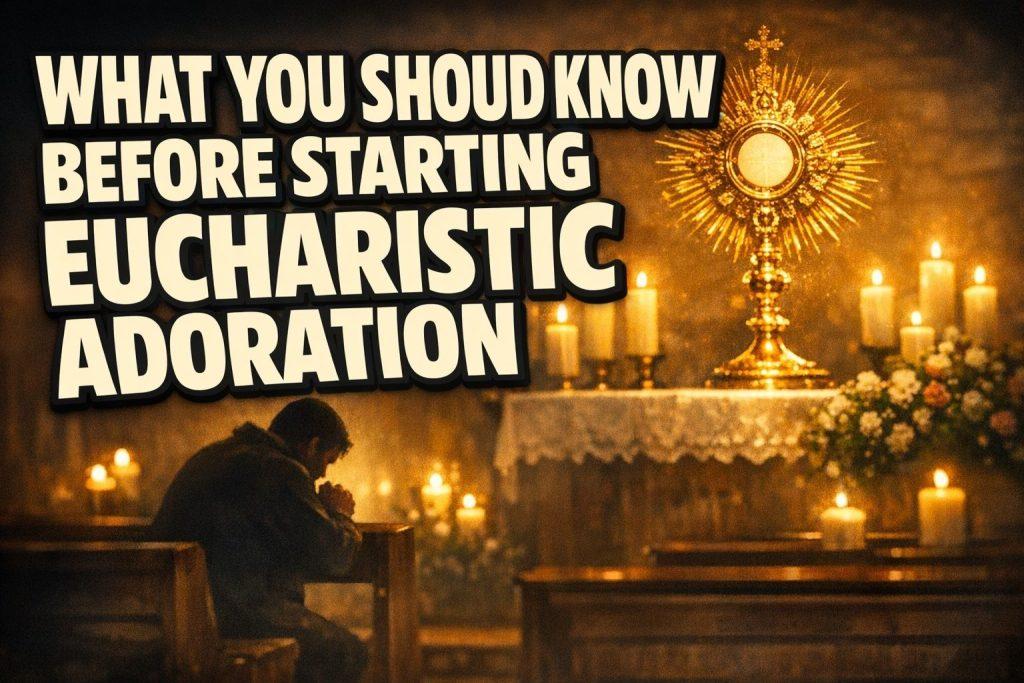
Eucharistic Adoration is not meditation in a quiet church. It is not a Catholic version of mindfulness. When you enter the adoration chapel and kneel before the monstrance, the golden vessel holding the exposed Host, you are kneeling before Jesus Christ. The Church teaches that the whole Christ, body, blood, soul, and divinity, is truly, really, and substantially present in the Eucharistic species (CCC 1374). That is not a metaphor, a pious feeling, or a symbol the community agrees to honor. It is the consistent teaching of Scripture, the Church Fathers, the Council of Trent, and every pope since.
This matters before you begin because it sets the posture of the entire practice. You are not going to a quiet room to collect your thoughts. You are going to be with a Person. St. John in his Gospel records Jesus saying, “I am the living bread that came down from heaven; whoever eats this bread will live forever” (John 6:51). The Church’s understanding of that promise is the foundation on which every hour of Adoration rests. You do not need to feel his presence to be in it. The feeling follows faith, not the other way around.
The Distraction Problem Nobody Warns You About
Here is the honest truth most Adoration guides skip over: your mind will wander constantly, especially in the beginning. You will kneel before Christ truly present and find yourself thinking about your grocery list, a conversation that annoyed you last Tuesday, or whether you left the stove on. This does not mean you are failing at prayer. It means you are a human being with a restless mind, and the saints dealt with the same thing.
St. Teresa of Avila, one of the great masters of contemplative prayer, wrote candidly about the difficulty of keeping the mind still in prayer. She did not suggest that distraction was a sign of unworthiness. She taught that gently returning the attention to God, again and again, was itself the practice. Each return is an act of the will choosing God. That is prayer. Come to Adoration expecting the distraction, and you will not be thrown by it. Fight it with a quiet, repeated act of intention rather than with frustration at yourself.
You Need a Plan for Your Time
An hour in front of the Blessed Sacrament with no structure and no preparation will feel very long for most people starting out. This is not a flaw in the practice. It is a signal that you need to bring something with you until interior silence becomes more natural.
Many Catholics divide their holy hour into movements. Begin with vocal prayer, perhaps the Rosary, the Chaplet of Divine Mercy, or a Psalm. Psalm 46:10 captures the spirit of Adoration simply: “Be still and know that I am God.” Use the middle portion for spiritual reading, a few pages of Scripture, the writings of a saint, or a meditation on the Mass. End with conversational prayer, speaking to Christ directly about what is actually in your heart. Over time, the structure loosens and silence fills more of the hour naturally. But starting with structure is not a spiritual crutch. It is good sense.
The Difference Between Adoration and Mass Matters
Some Catholics wonder whether Adoration is redundant if they already attend Mass. This question reflects a misunderstanding of what each practice offers. The Mass is the sacrifice of Christ made present; it is the summit of Catholic worship, and nothing substitutes for it. Adoration flows from the Mass as its extension. The same Christ present on the altar at the moment of consecration remains present in the tabernacle and in the monstrance. The Church teaches that as faith in the Real Presence deepened through history, the practice of silent adoration outside of Mass developed organically as a response to that faith (CCC 1379). The Catechism quotes St. John Paul II directly on the point: “The Church and the world have a great need for Eucharistic worship. Jesus awaits us in this sacrament of love” (CCC 1380).
Adoration deepens your experience of Mass because you learn to recognize what you are receiving. Catholics who pray regularly before the Blessed Sacrament report that their attention at Mass sharpens over time. The two practices reinforce each other directly.
Perpetual Adoration Commitments Are Serious
Many parishes run perpetual adoration programs where volunteers take a weekly holy hour to ensure the Blessed Sacrament is never left unattended. If you sign up for a regular slot, you are making a real commitment, not a casual suggestion. Parishes depend on adorers keeping their hours, particularly the difficult ones in the middle of the night.
Before you commit to a weekly slot, especially an overnight one, be honest with yourself about your schedule and your current prayer life. Starting with occasional, unscheduled visits to the chapel before taking on a committed hour is a sound approach. Signing up and then repeatedly missing your slot leaves the Blessed Sacrament exposed without a guardian. Take the commitment seriously from the start.
Is This Something You Are Ready to Begin?
Eucharistic Adoration is one of the most direct forms of prayer available to a Catholic, and it asks for something correspondingly direct in return: your time, your attention, and your willingness to show up even when nothing feels particularly spiritual. The grace is real whether you feel it or not. The Church has never promised consolation on demand. She has promised that Christ is present, that worship offered to him is never wasted, and that the practice bears fruit in souls and in the world in ways that often remain invisible to the person kneeling in the chapel.
Start small. Go once. Bring your missal, a Rosary, or a Gospel. Kneel down and tell Christ honestly that you do not quite know what you are doing yet. That honesty is itself a prayer, and it is a better beginning than arriving with manufactured piety you do not actually feel. The grace of Adoration does not require your emotional readiness. It requires your presence.
Disclaimer: This article presents Catholic teaching for educational purposes. For official Church teaching, consult the Catechism and magisterial documents. For personal spiritual guidance, consult your parish priest or spiritual director. Questions? Contact editor@catholicshare.com
Sign up for our Exclusive Newsletter
- 📌 Add CatholicShare as a Preferred Source on Google
- 🎁 Join us on Patreon for Premium Content
- 🎧 Check Out These Catholic Audiobooks
- 📿 Get Your FREE Rosary Book
- 📱 Follow Us on Flipboard
-

Recommended Catholic Books
Discover hidden wisdom in Catholic books — invaluable guides enriching faith and satisfying curiosity. #CommissionsEarned
- The Early Church Was the Catholic Church
- The Case for Catholicism - Answers to Classic and Contemporary Protestant Objections
- Meeting the Protestant Challenge: How to Answer 50 Biblical Objections to Catholic Beliefs
As an Amazon Associate, I earn from qualifying purchases. Thank you for your support.