
Brief Overview
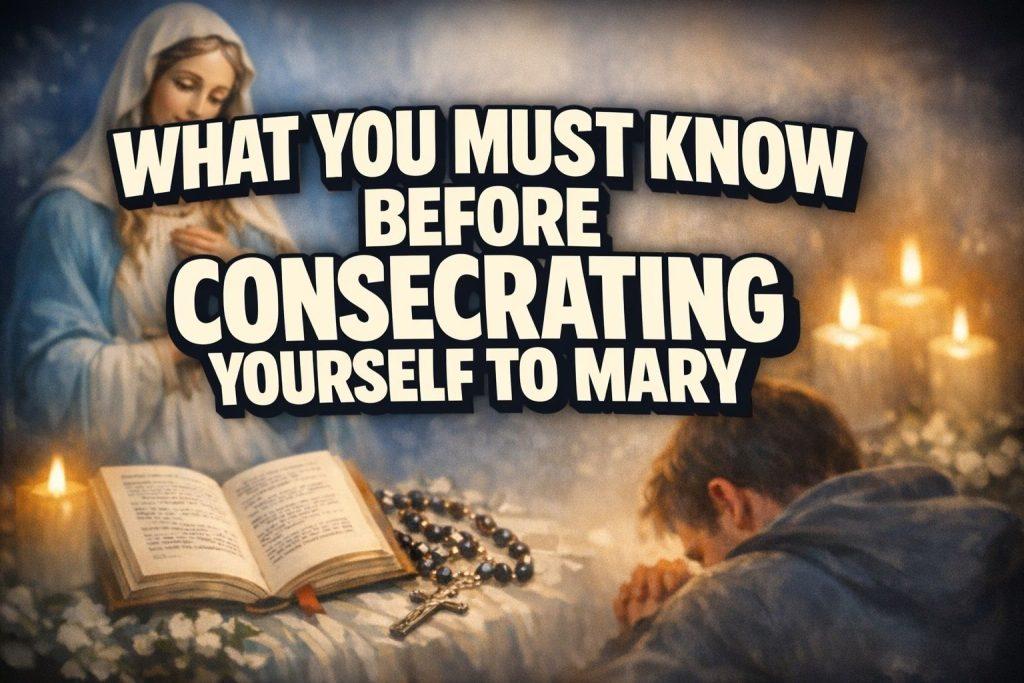
- Marian consecration is not a Catholic trend or a spiritual upgrade; it is a formal, lifelong act of self-giving to Jesus through Mary, modeled on Christ’s own relationship with his mother and rooted in centuries of approved Catholic Tradition.
- Many people complete the 33-day preparation, make the consecration, and then discover they have no clear idea what it is supposed to change about their actual daily life.
- The Church affirms devotion to Mary as intrinsic to Christian worship, and some of the greatest saints and popes, including St. Louis de Montfort and Pope John Paul II, considered total consecration to Mary the most direct path to conformity with Christ (CCC 971).
- Marian consecration is not a guarantee of spiritual consolation, not a protection from suffering, and not a substitute for the hard interior work that holiness requires regardless of which devotional path you follow.
This Is Not a Devotional Practice. It Is a Surrender.
The word “consecration” carries specific weight in Catholic theology, and that weight matters before you commit to it. To consecrate something is to set it apart entirely for God. When you consecrate yourself to Mary, you are not simply asking for her intercession or committing to a Rosary practice. You are formally placing yourself, your merits, your prayers, your suffering, your entire spiritual life, into her hands, so that she may present them to her Son. St. Louis de Montfort, whose 1712 work True Devotion to the Blessed Virgin remains the foundational text for this practice, described it as “holy slavery,” a voluntary and complete gift of oneself that mirrors the way Mary gave herself entirely to God at the Annunciation.
That language may sound extreme, but de Montfort’s logic is precise. He argues that because Jesus came into the world through Mary, the most fitting way to go to Jesus is through the same door. This is not a theological innovation. Pope John Paul II made this consecration the defining expression of his entire pontificate, taking as his motto “Totus Tuus,” Latin for “Totally Yours,” drawn directly from de Montfort’s prayer. He consecrated not only himself but the whole world to the Immaculate Heart of Mary. When a pope makes a practice the center of his spiritual life and his papal ministry, it deserves serious attention from anyone approaching it casually.
What the Church Actually Teaches About Mary’s Role
Some Catholics approach Marian consecration with anxiety about whether it oversteps proper boundaries, giving Mary attention that belongs to God alone. This concern reflects a genuine theological instinct, but it rests on a misreading of what the Church actually teaches. The Catechism states that devotion to the Blessed Virgin is “intrinsic to Christian worship” and that the Church rightly honors her with special devotion, distinct from adoration, which belongs to God alone (CCC 971).
The scriptural basis for entrusting oneself to Mary runs directly through the Gospel of John. At the Annunciation, Mary said in Luke 1:38, “Behold, I am the handmaid of the Lord; let it be done to me according to your word.” That total availability to God is precisely the disposition the consecration asks you to imitate. At the Cross, Christ looked at the beloved disciple and said in John 19:27, “Behold, your mother.” The Church has read that moment not as a private arrangement between two individuals but as Christ giving Mary to every disciple who follows him. Consecration to Mary is, at its core, taking that gift seriously.
The 33 Days Are Preparation, Not the Consecration Itself
Most people are introduced to Marian consecration through a 33-day preparation program. St. Louis de Montfort’s original preparation, as found in True Devotion to the Blessed Virgin, is demanding, theologically dense, and requires significant prayer time each day. Fr. Michael Gaitley’s 33 Days to Morning Glory offers a more accessible modern version, drawing on de Montfort as well as St. Maximilian Kolbe, Blessed Teresa of Calcutta, and Pope John Paul II. Both approaches are legitimate. Neither one is the consecration itself.
The 33 days exist to prepare your heart and mind for the act of consecration, which is made on the final day, ideally on a Marian feast. The preparation is meant to deepen your understanding of who Mary is, why she matters, and what you are actually committing to. If you rush through the readings or treat the 33 days as a checklist, you will arrive at the consecration day with a warm feeling and very little substance. Take the preparation seriously. Read slowly. Pray the prayers rather than reciting them. The consecration is only as meaningful as the interior work that precedes it.
Nobody Tells You What Changes After You Say the Words
Here is the honest part that most guides skip. You will say the Act of Consecration on your chosen Marian feast day, and then you will go home, or go to work, or make dinner, and your life will look exactly the same as it did the day before. There will be no immediate interior shift, no flood of peace, no noticeable change in temptation, difficulty, or spiritual clarity. Many people find this genuinely disorienting, because the devotional culture around Marian consecration sometimes suggests a before-and-after quality that does not match most people’s actual experience.
What de Montfort actually teaches is that the consecration is a commitment to a way of living, not a single event. The daily renewal of the consecration, formally recommended by de Montfort, means waking up each day and choosing again to place yourself and your actions in Mary’s hands. It means asking, before decisions large and small, whether this is something you would willingly hand to her. That habitual orientation is what slowly reshapes the interior life. The consecration day is the beginning of the practice, not the summit of it.
The Language of Slavery Requires Honest Reckoning
De Montfort’s use of the term “holy slavery” troubles some modern readers, and the discomfort is worth sitting with rather than dismissing. He distinguishes sharply between three kinds of slavery: slavery by nature, because all creatures belong entirely to God; slavery by force, through sin; and voluntary slavery of love, freely chosen as an act of devotion. The third kind, he argues, is the highest expression of the creature’s relationship with God, because it is chosen freely and offered generously.
The point is not discomfort for its own sake. It is that this consecration asks for everything, not your prayer life while you keep control of the rest. It asks for your merits, your suffering, your good works, and your spiritual freedom, all placed in Mary’s care so she can offer them to Christ purified of the self-interest that attaches to most of what we do. That is a serious claim. If you are not ready to take it seriously, there is no shame in waiting until you are. A consecration made lightly, as a devotional accessory, is not the thing de Montfort is describing.
So, Is Marian Consecration the Right Step for You Now?
Marian consecration is one of the most serious spiritual commitments a Catholic can make outside the sacraments, and it deserves to be treated that way. It is not the right next step for someone looking for a spiritual boost, a new practice to try, or a way to feel more Catholic. It is the right step for someone who has genuinely wrestled with what total self-giving to God looks like, who understands that Mary leads to Christ rather than away from him, and who is willing to let a daily practice, not a single ceremony, do the real work of formation over months and years.
If that is where you are, begin the 33-day preparation with intention and honesty. Read de Montfort himself, even a few chapters, alongside whatever modern guide you use. Make the consecration on a feast day that carries meaning for you. Then renew it the next morning, and the morning after that. Pope John Paul II carried “Totus Tuus” not as a motto on a crest but as the daily orientation of his entire priestly and papal life. That is the scale of what you are agreeing to, and it is genuinely worth the weight of the commitment.
Disclaimer: This article presents Catholic teaching for educational purposes. For official Church teaching, consult the Catechism and magisterial documents. For personal spiritual guidance, consult your parish priest or spiritual director. Questions? Contact editor@catholicshare.com
Sign up for our Exclusive Newsletter
- 📌 Add CatholicShare as a Preferred Source on Google
- 🎁 Join us on Patreon for Premium Content
- 🎧 Check Out These Catholic Audiobooks
- 📿 Get Your FREE Rosary Book
- 📱 Follow Us on Flipboard
-

Recommended Catholic Books
Discover hidden wisdom in Catholic books — invaluable guides enriching faith and satisfying curiosity. #CommissionsEarned
- The Early Church Was the Catholic Church
- The Case for Catholicism - Answers to Classic and Contemporary Protestant Objections
- Meeting the Protestant Challenge: How to Answer 50 Biblical Objections to Catholic Beliefs
As an Amazon Associate, I earn from qualifying purchases. Thank you for your support.