
Brief Overview
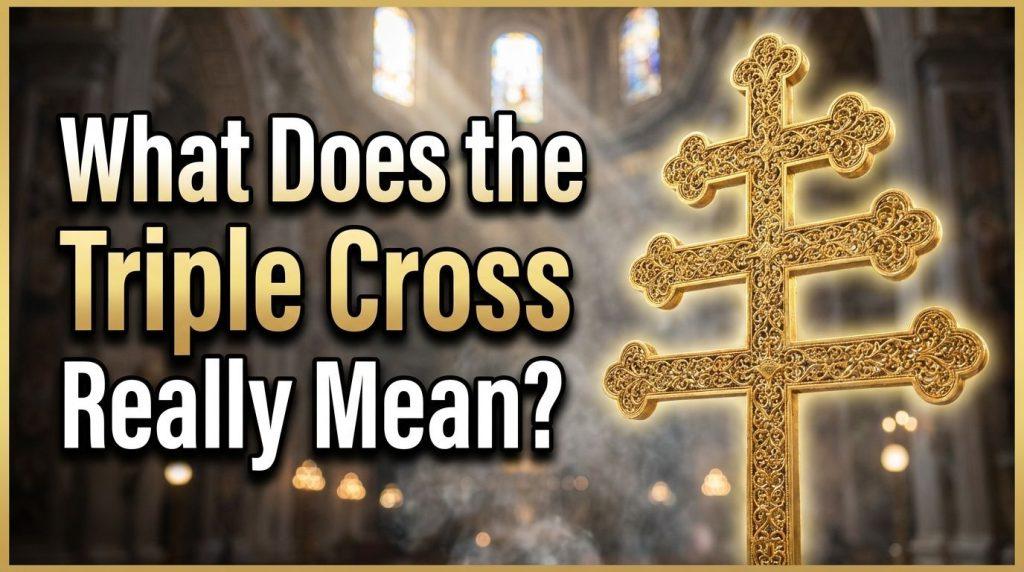
- The triple cross, also called the papal cross, features three horizontal bars on a vertical staff and serves as the official emblem of the papacy in Catholic tradition.
- The three bars commonly represent the Holy Trinity, the Father, the Son, and the Holy Spirit, expressing the foundation of Christian belief.
- Another interpretation connects the three bars to Christ’s threefold office as priest, prophet, and king, which all believers share through baptism.
- Catholics also make a triple sign of the cross on the forehead, lips, and heart before the Gospel reading at Mass.
- The three crosses at Calvary mentioned in Scripture provide another meaning, representing Christ crucified between two thieves.
- Understanding the triple cross enriches Catholic worship and connects believers to deep theological truths about Christ’s redemptive sacrifice.
The Papal Cross and Its Historical Significance
The papal cross stands as one of the most recognizable symbols within Catholic ecclesiastical art and tradition. This distinctive cross features three horizontal crossbars arranged on a vertical staff, with each bar decreasing in length from bottom to top. The Church reserves this particular design exclusively for the pope, making it a unique mark of papal authority and office. When you see the papal cross displayed in religious art, on papal vestments, or carried in processions, it signals the presence and authority of the successor of Saint Peter. The design has deep historical roots that stretch back centuries in Christian tradition, though its exact origins remain somewhat unclear in historical records.
The three bars of the papal cross carry rich layers of meaning that connect to fundamental Catholic beliefs. The most common interpretation relates the three crossbars to the Holy Trinity. This understanding emphasizes how the Father, the Son, and the Holy Spirit remain at the very center of Christian faith and papal ministry. The pope serves as the visible head of the Church on earth, but he always acts in service to the Triune God. Each time the papal cross appears, it reminds believers that God exists as three divine persons in one divine nature. This mystery forms the foundation of all Christian theology and practice, as the Catechism explains when discussing the centrality of the Trinity in Catholic life.
The second major interpretation connects the three bars to the threefold office that Christ exercised during his earthly ministry. Jesus functioned as priest, prophet, and king throughout his mission. As priest, he offered himself as the perfect sacrifice for human sin. As prophet, he proclaimed the truth of God’s kingdom and will. As king, he established his reign over all creation through his death and resurrection. The papal cross thus symbolizes how the pope participates in and continues these three offices of Christ in his role as shepherd of the universal Church. This understanding appears in various Church documents and theological writings throughout Catholic history.
Some traditions also interpret the three bars as representing different aspects of papal jurisdiction and responsibility. According to this view, the bars symbolize the pope’s spiritual authority over heaven, earth, and purgatory, or alternatively, his role as father of kings, governor of the world, and vicar of Christ. While these interpretations appear less frequently in official Church teaching, they demonstrate how Catholics throughout history have sought to understand the fullness of papal ministry. The pope carries tremendous responsibility as shepherd of over one billion Catholics worldwide, and the triple cross expresses the weight and scope of this sacred office.
The papal cross appears most prominently during major Church ceremonies and papal events. When the pope celebrates Mass in Saint Peter’s Basilica or travels to different nations, the papal cross often accompanies him as a visible sign of his office. Some popes have carried a staff topped with a papal cross during liturgical celebrations, though this practice has varied over time. Pope Leo XIII received a special triple-barred cross staff for the golden jubilee of his priesthood in 1888. The design of these staffs and crosses has evolved throughout Church history, but the basic form of three horizontal bars has remained constant as the distinctive mark of papal authority.
The distinction between the papal cross and other forms of crosses used in Church hierarchy helps Catholics understand different levels of ecclesiastical authority. Archbishops use a cross with two horizontal bars, sometimes called a patriarchal cross, while bishops use the standard single-bar Latin cross. This gradation of crosses provides a visual system that communicates different offices within the Church’s hierarchical structure. The system reminds believers that the Church operates with ordered authority, where different pastors exercise their ministry in communion with each other and under the pope’s supreme pastoral care. Each cross type honors the sacred office it represents while maintaining proper distinctions between different roles in Church leadership.
The symbolism of the papal cross extends beyond mere decoration or insignia. It points to theological realities about Christ’s presence in his Church and the way he continues to shepherd his flock through visible, human instruments. The pope does not act on his own authority but serves as Christ’s vicar on earth. Every exercise of papal authority should reflect Christ’s own ministry as priest, prophet, and king. The triple cross reminds both the pope and the faithful that papal ministry exists to serve the mission Christ entrusted to Peter and his successors. This symbol calls the pope to humble service even as it marks his unique position in the Church’s structure.
Catholic artists have depicted the papal cross in countless ways throughout history, from medieval manuscripts to modern digital graphics. The cross appears in papal coats of arms, on Church buildings associated with the papacy, and in religious goods sold to pilgrims and faithful worldwide. These artistic representations help spread awareness of papal authority and foster unity among Catholics globally. When believers see the papal cross, they recognize it as a sign of communion with the pope and through him with the entire Catholic Church. This visual unity matters greatly in a worldwide Church that spans many cultures, languages, and traditions.
The theological depth of the papal cross becomes even clearer when we consider how it relates to the cross of Christ himself. All Christian crosses ultimately point back to Calvary, where Jesus died for human salvation. The papal cross, with its three bars, does not replace or overshadow the simple cross of Christ but rather interprets it through the lens of Trinitarian theology and Christ’s threefold office. The cross remains the central symbol of Christianity because it represents God’s love poured out for humanity. The papal cross takes this central truth and applies it specifically to the ministry of the pope, who must proclaim and safeguard the message of the cross for all generations.
Understanding the papal cross helps Catholics appreciate the gift of visible unity that Christ gave his Church through the office of Peter. Jesus prayed that his followers would be one, and he established structures of authority to maintain that unity across time and space. The pope serves as the visible principle and foundation of Church unity, as the Second Vatican Council taught. Every time we see the papal cross, we can remember to pray for the Holy Father and for the unity of all Christians. We can also reflect on our own baptismal calling to share in Christ’s priestly, prophetic, and kingly office, living out our faith in communion with the successor of Peter and the worldwide Church.
The Triple Sign of the Cross Before the Gospel
Catholic liturgy includes a beautiful practice that many faithful perform before the Gospel reading at Mass. This gesture involves making three small crosses with the thumb, one on the forehead, one on the lips, and one on the heart. The priest or deacon who will proclaim the Gospel leads this gesture, and the congregation joins in this silent prayer. This triple signing happens right after the priest announces which Gospel will be read and before he begins the actual proclamation. The practice has ancient roots in Christian worship, though it does not appear in every Catholic rite or tradition. Many Catholics learned this gesture as children and continue it throughout their lives without fully understanding its rich meaning.
The three small crosses represent a prayer that God’s Word will take root in three essential aspects of our being. When we sign our forehead, we ask that the Gospel message will be in our thoughts and minds. This gesture expresses our desire to think about God’s Word, to meditate on it, and to let it shape our understanding of reality. Our minds need the truth of Scripture to combat false ideas and worldly thinking that can lead us away from God. The forehead signing reminds us that faith engages our intellect, not just our emotions. Catholics believe that faith and reason work together, and the Gospel provides the ultimate truth that our minds seek.
The signing of the lips comes second in this triple gesture. Here we pray that we will speak God’s Word with our mouths, proclaiming the Gospel through our conversations and witness. This part of the gesture acknowledges that hearing the Gospel creates a responsibility to share it with others. Christians are meant to be evangelizers who spread the good news of Jesus Christ. Our words have tremendous power to build up or tear down, to encourage or discourage, to spread truth or falsehood. By signing our lips, we ask God to purify our speech and make us bold proclaimers of his truth. This gesture also reminds us to use our words carefully, speaking with charity and truth in all situations.
The final small cross marks the heart, the center of our being where love and will reside. This gesture expresses our desire that God’s Word will penetrate deeply into our hearts, transforming our loves and desires. The heart represents the core of human personality in biblical and Catholic anthropology. We ask that the Gospel will not just inform our minds or shape our speech but will fundamentally change who we are at the deepest level. This transformation of the heart represents true conversion, where we turn away from sin and toward God with our whole being. The heart signing completes the triple gesture by acknowledging that authentic Christianity requires interior transformation, not just external conformity.
This threefold gesture thus engages the whole person in receiving God’s Word. Catholics understand that human beings possess intellect, will, and emotions that work together in integrated ways. The Gospel must touch all these dimensions of human existence to truly transform us. We cannot simply know the Gospel intellectually without letting it affect our behavior and desires. Likewise, emotional responses to Scripture need grounding in true understanding and practical application. The triple signing before the Gospel reading expresses this holistic approach to receiving divine revelation. It prepares us to hear God’s Word with our entire being, ready to be changed by what we hear.
The practice connects to the broader Catholic understanding of how grace works through signs and symbols. Catholics believe that physical gestures and material things can carry spiritual meaning and effect. We do not separate the spiritual from the material but understand that God works through creation to reach us. The sign of the cross itself represents this sacramental worldview, where visible signs point to and convey invisible realities. When we make these three small crosses, we engage our bodies in prayer, not just our minds. This embodied spirituality recognizes that we are not pure spirits but enfleshed souls who need physical expressions of spiritual truths.
The timing of this gesture, right before the Gospel proclamation, highlights the special reverence Catholics show for Scripture, particularly the Gospels. The four Gospels hold a unique place in Christian worship because they directly tell the story of Jesus Christ. While all Scripture is inspired by God and valuable for teaching, the Gospels provide our primary access to the words and deeds of our Savior. Catholic liturgy marks this special status through various practices, including standing for the Gospel reading, using a special Gospel book, and having a procession with candles and incense. The triple signing adds another layer to this reverence, personally preparing each believer to receive Christ’s words with an open and ready heart.
Some Catholics perform this gesture consistently at every Mass, while others may do it occasionally or not at all. The Church does not require this practice, and it remains an optional devotion rather than a mandatory liturgical action. However, those who practice it often find that it helps them focus and prepare for the Gospel reading. In an age of constant distraction, where our minds wander easily even during worship, having a physical gesture that engages our attention proves valuable. The triple signing provides a moment to consciously turn our thoughts toward God’s Word and away from the countless concerns and worries that crowd our minds.
The gesture also creates a sense of participation in the liturgy beyond just sitting and listening. Catholic liturgy aims for active participation from all the faithful, not just the clergy. While the priest has specific roles that only he can fulfill, the laity also participates actively through prayers, songs, responses, and gestures like this triple signing. This shared action creates unity among the assembled faithful as everyone performs the same gesture simultaneously. We pray together, not just as isolated individuals but as members of the Body of Christ gathered for worship. The triple signing thus contributes to the corporate nature of Catholic worship.
Teaching children about this practice provides an excellent opportunity for catechesis about Scripture and prayer. When parents and catechists explain the meaning behind the three small crosses, they help young people understand that every gesture in Catholic worship carries meaning. Nothing in the liturgy exists merely for show or tradition without purpose. Each action, word, and symbol serves to draw us closer to God and help us worship more fully. By learning the triple signing and its meaning, children develop a deeper appreciation for how Catholics approach Scripture with reverence and a desire for personal transformation through God’s Word.
The Three Crosses at Calvary
Scripture records that Jesus was crucified between two criminals on Calvary, creating a scene of three crosses that holds powerful theological meaning. The Gospel of Luke provides the fullest account of this event, including the conversation between Jesus and the two men dying beside him. This historical moment demonstrates fundamental truths about human freedom, God’s mercy, and the nature of salvation. The three crosses present three different responses to the presence of Christ and three different eternal destinies. Catholics can learn much from meditating on this scene and considering what each cross represents in terms of human response to divine grace.
The central cross held Jesus Christ, the Son of God, who died as the perfect sacrifice for human sin. His cross represents redemption, the price paid to free humanity from slavery to sin and death. Jesus chose to accept crucifixion out of love for the Father and love for all people. He could have called upon legions of angels to rescue him, as he told his disciples, but instead he embraced the cross as the means of accomplishing salvation. Catholic theology emphasizes that Christ’s death was not merely a tragedy or an unfortunate end to a good man’s life; rather, it was the central act of divine love that reconciles humanity to God, as the Catechism teaches when discussing Christ’s redemptive sacrifice (CCC 618).
The cross on one side held a criminal who mocked Jesus even as both suffered together. This man represents those who reject God’s mercy despite being confronted with clear evidence of divine love. The Gospels tell us that this criminal joined with the crowds in taunting Jesus, demanding that he save himself and them if he truly was the Christ. His response to suffering remained locked in bitterness, anger, and refusal to acknowledge his own sinfulness. This cross symbolizes the tragedy of human pride and hardness of heart. Even when faced with God himself suffering beside him, this man chose mockery over repentance, demonstrating the terrible reality of human freedom to reject divine grace.
The third cross held another criminal, traditionally called the Good Thief or Saint Dismas by Catholic tradition, who recognized his own sinfulness and Jesus’ innocence. This man rebuked his fellow criminal, acknowledging that they deserved their punishment while Jesus had done nothing wrong. Then he made a simple, faith-filled request, asking Jesus to remember him when Christ came into his kingdom. This statement reveals remarkable faith from a man dying in agony. He saw beyond the apparent defeat and humiliation to recognize Jesus as a king with a coming kingdom. His cross represents the hope available to every sinner who turns to Christ in repentance, regardless of how late in life that turning occurs.
Jesus’ response to the Good Thief demonstrates the boundless mercy of God and the immediate effect of sincere repentance. Our Lord promised this dying criminal that he would be with Christ in paradise that very day. This promise shows that salvation does not depend primarily on the quantity of good works we perform or the length of time we spend serving God. Rather, it depends on faith in Christ and genuine sorrow for sin. The Good Thief had no time to perform acts of penance, attend Mass, or practice works of mercy. Yet he entered paradise because he recognized Jesus as Lord and trusted in his mercy. This truth offers profound hope to every sinner and demonstrates that it is never too late to turn to God.
The scene of the three crosses at Calvary illustrates the doctrine of human freedom and divine grace working together. God offers his grace to all people, as demonstrated by Jesus’ presence between two criminals, equally accessible to both. Yet the two men responded completely differently to the same grace. One rejected it through mockery and hardness of heart, while the other accepted it through humility and faith. Catholic teaching maintains that grace does not override human freedom but rather enables it to function properly, choosing the good. The three crosses show this dynamic clearly; God offers salvation freely, but human beings must freely accept or reject that offer.
This biblical scene also teaches about the nature of true repentance. The Good Thief did not merely feel sorry for being caught or punished. He acknowledged that he deserved his punishment, showing genuine acceptance of responsibility for his sins. He also recognized Jesus as innocent and worthy of honor, showing proper understanding of who God is. Finally, he made a humble request rather than demanding salvation as a right. These elements characterize authentic Catholic contrition: acknowledgment of sin, recognition of God’s holiness, and humble trust in divine mercy. The sacrament of reconciliation embodies these same principles when Catholics confess their sins and receive absolution.
Catholic devotion to the Good Thief has produced various prayers and practices over the centuries. Some believers pray to Saint Dismas for the grace of a happy death or for the conversion of hardened sinners. Others meditate on his story when they feel burdened by past sins, drawing hope from the fact that Jesus welcomed this criminal into paradise. The Church celebrates the feast of the Good Thief on March 25 in some traditions, though this observance is not universal. These devotions help keep alive the powerful message that no sinner falls beyond the reach of God’s mercy if they genuinely repent.
The three crosses also reveal something about the nature of redemptive suffering. Jesus’ suffering held infinite value because of who he was, the divine Son of God in human flesh. His pain and death accomplished the salvation of the world. The Good Thief’s suffering, united with Christ’s through faith and love, became redemptive for his own soul and brought him to paradise. The impenitent thief’s suffering remained merely penal, a punishment for his crimes without redemptive value because he refused to unite it with Christ. This distinction matters for understanding the Catholic teaching about redemptive suffering. Our pain does not save us automatically, but when we unite it with Christ’s cross through faith and love, it participates in his redemptive work.
Modern Catholics can apply the lesson of the three crosses to their own lives in practical ways. We face constant choices about how to respond to Christ’s presence and invitation. Like the Good Thief, we can acknowledge our sinfulness, trust in God’s mercy, and ask Jesus to remember us. Or like the impenitent thief, we can harden our hearts, refuse to admit our faults, and reject divine grace. The choice remains ours, but the consequences are eternal. Every day presents opportunities to turn toward Christ or away from him through our thoughts, words, and actions. The three crosses remind us that our response to Jesus determines our ultimate destiny.
The Trinity and the Triple Cross
The Holy Trinity stands at the absolute center of Catholic faith and life. Catholics believe and profess that God exists as three persons, Father, Son, and Holy Spirit, in one divine nature. This mystery exceeds human understanding but forms the foundation of everything else we believe about God, creation, and salvation. The triple cross, whether in the form of the papal cross or other three-barred designs, serves as a visual reminder of this central doctrine. When believers see three elements united in one cross, it naturally points the mind toward the three persons united in one God. This connection makes the triple cross a powerful teaching tool and devotional symbol.
The doctrine of the Trinity developed gradually in the early Church as Christians reflected on Scripture and their experience of God. The New Testament clearly presents the Father as God, Jesus as God, and the Holy Spirit as God, yet insists that there is only one God. The early ecumenical councils wrestled with how to articulate this truth clearly while avoiding heresies that denied either the threeness or the oneness of God. The formulation of one nature and three persons became the standard way to express this mystery. Catholics profess this faith every time they make the sign of the cross, saying “In the name of the Father, and of the Son, and of the Holy Spirit” (CCC 2157).
The three bars of the triple cross can help believers meditate on the distinct persons of the Trinity and their roles in salvation history. The Father appears throughout Scripture as the creator and source of all that exists. He sends his Son into the world out of love for humanity and gives the Holy Spirit to dwell in believers. The Son becomes incarnate as Jesus Christ, living, dying, and rising to accomplish our redemption. The Holy Spirit proceeds from the Father and the Son, sanctifying believers and dwelling in the Church to guide her into all truth. These distinct missions of the three persons all work together for the single purpose of human salvation.
Understanding the Trinity as a communion of love helps Catholics grasp something of this mystery, though it remains ultimately beyond full comprehension. The Father eternally loves the Son, and the Son eternally loves the Father, and this mutual love is so real and substantial that it exists as the third person, the Holy Spirit. This eternal exchange of love within God’s own being forms the model for all human relationships and the goal of Christian life. We are called to enter into this divine communion through grace, participating in the love that flows eternally among the three persons. The triple cross symbolizes this loving communion that we are invited to share.
The Trinity also reveals that God is not a solitary, isolated being but exists in eternal relationship. This truth has implications for how we understand human nature and destiny. Human beings are made in God’s image, which means we are fundamentally relational creatures designed for communion with God and each other. Sin damages these relationships, creating isolation and division. Salvation through Christ restores communion, bringing us back into right relationship with God and neighbor. The three bars of the triple cross, distinct yet united in one symbol, image this restored communion that characterizes the Kingdom of God.
Catholic liturgy constantly invokes the Trinity, showing how central this doctrine is to Christian worship. We begin and end prayers in the name of the Trinity. The Gloria prayer praises each person individually, Father, Son, and Holy Spirit. The Eucharistic Prayer addresses the Father through the Son in the Holy Spirit, expressing the Trinitarian structure of Christian prayer. The final blessing at Mass sends forth the faithful in the name of the Trinity. These repeated references form Catholic consciousness around Trinitarian faith. The triple cross fits naturally into this liturgical context as another way to express and remember the central mystery of our faith.
The baptismal formula given by Jesus himself explicitly names the three persons of the Trinity. Christians are baptized “in the name of the Father, and of the Son, and of the Holy Spirit,” as recorded in Matthew 28:19. This threefold formula has been used from the earliest days of the Church and remains essential for valid baptism. When Catholics make the sign of the cross, they repeat this baptismal formula, renewing their baptismal identity. The triple cross can serve as a visual representation of this baptismal calling, reminding believers that we belong to the Triune God who claimed us in the waters of baptism.
Heretical movements throughout Church history have often attacked the doctrine of the Trinity, either denying the divinity of Christ or the Holy Spirit, or confusing the persons, or proposing various forms of tritheism. The Church has consistently defended the full doctrine against these errors because so much depends on getting this right. If Jesus were not fully divine, he could not save us. If the Holy Spirit were merely a force rather than a person, we could not have true communion with God. If there were three separate gods, we would fall into paganism. The triple cross stands as a simple but powerful witness to orthodox Trinitarian faith.
The incomprehensibility of the Trinity reminds us that God exceeds all human categories and understanding. We can know true things about God through revelation, but we cannot exhaust the mystery of the divine being. This humility before mystery characterizes authentic Catholic faith. We do not claim to fully understand God but trust in what he has revealed about himself. The triple cross invites contemplation rather than complete explanation. We look at its three bars united in one cross and allow it to draw our minds toward the infinite mystery of divine love that eternally exists as three-in-one and one-in-three.
Modern Catholics living in an increasingly secular culture need strong symbols that proclaim the distinctiveness of Christian faith. The doctrine of the Trinity sets Christianity apart from other monotheistic religions and from various forms of spirituality that reduce God to an impersonal force. The triple cross boldly proclaims that the God Christians worship is not a vague higher power but the specific God who has revealed himself as Father, Son, and Holy Spirit. Wearing or displaying a triple cross becomes a public witness to this faith, a conversation starter that can lead to evangelization and deeper understanding of Catholic belief.
Christ’s Threefold Office and the Baptized
Catholic theology teaches that Jesus Christ exercised three primary roles or offices during his earthly life and continues to exercise them now in glory. He functioned as priest, prophet, and king. These three offices encompass the fullness of Christ’s mission and provide a framework for understanding everything he did and taught. The triple cross can represent these three offices, reminding believers of the complete and perfect work that Christ accomplished. More remarkably, Catholics believe that all the baptized share in these three offices of Christ, called to exercise priestly, prophetic, and kingly functions in their own lives according to their state.
Christ’s priestly office centers on his role as mediator between God and humanity. A priest offers sacrifice and intercedes for the people. Jesus offered the perfect sacrifice by giving himself on the cross, shedding his blood for the forgiveness of sins. He continues to intercede for us in heaven, always living to make intercession for those who approach God through him, as Hebrews 7:25 explains. This priestly work of Christ accomplished reconciliation between God and humanity, bridging the gap that sin had created. Catholics celebrate this ongoing priestly work in every Mass, where Christ’s sacrifice becomes present through the ministry of ordained priests who act in his person.
As prophet, Jesus proclaimed the truth about God and his kingdom. He taught with authority, explaining the Scriptures and revealing divine mysteries. He spoke God’s word to the people of his time and continues to speak through Scripture and Church teaching today. Prophets in biblical tradition did not primarily predict the future but rather spoke God’s word to their generation, calling people to repentance and faithfulness. Jesus fulfilled this prophetic role perfectly, and his words remain the ultimate standard for truth. Everything in Catholic teaching must align with the revelation given through Christ, the Word made flesh.
Christ’s kingly office manifests in his establishment of God’s kingdom on earth and his ultimate authority over all creation. Unlike earthly kings who rule through power and coercion, Jesus reigns through humble service and sacrificial love. His kingship paradoxically manifests most fully on the cross, where he conquered sin and death through apparent weakness and defeat. The Resurrection vindicated his claim to kingship, and the Ascension established him at God’s right hand, where he rules with the Father. His kingdom is not of this world, as he told Pilate, but it nevertheless exercises real authority over human hearts and destinies.
Through baptism, every Catholic becomes a sharer in these three offices of Christ. This truth has profound implications for how we understand our Christian vocation. We are not merely passive recipients of salvation but active participants in Christ’s ongoing mission in the world. The Catechism teaches that the baptized share in Christ’s priestly, prophetic, and kingly functions (CCC 1241). This sharing transforms our understanding of what it means to be a Christian. We are not just saved individuals but members of a priestly people called to continue Christ’s work through the particular circumstances of our lives.
The priestly character that all baptized Catholics receive enables us to offer spiritual sacrifices to God. We exercise our baptismal priesthood by offering ourselves to God each day, living our ordinary activities with love and dedication. Parents caring for children, workers doing their jobs faithfully, students pursuing their education, all can offer these activities as spiritual sacrifices when done in union with Christ. Catholics also participate in the priesthood through active engagement at Mass, offering the Eucharistic sacrifice along with the ordained priest. This common priesthood differs essentially from the ordained priesthood but remains real and important for Christian life.
The prophetic office of the baptized calls us to proclaim the Gospel through word and example. Every Catholic bears responsibility for evangelization according to their gifts and circumstances. Parents exercise this prophetic role when they teach their children about the faith. Teachers do so when they present Catholic truth clearly and winsomely. All believers fulfill this calling when they live with integrity, allowing their lives to witness to the truth of the Gospel. The prophetic office also includes speaking truth to power when necessary, defending the dignity of every human person, and working for justice and peace in society.
Our share in Christ’s kingly office means we are called to exercise proper dominion over creation and our own passions. This kingship begins with self-mastery, ruling over our desires and impulses so that reason and faith guide our choices rather than mere emotion or appetite. We also exercise kingship through stewardship of the earth and its resources, using created things wisely and caring for the environment. Christian kingship means serving others rather than dominating them, following Christ’s example of washing his disciples’ feet. The baptized exercise royal dignity by living as adopted children of God, heirs to eternal life.
The triple cross becomes particularly meaningful when understood in light of this baptismal calling. Each bar can remind us of one office we share with Christ: priest, prophet, king. This visual reminder helps Catholics remember the dignity and responsibility that came with their baptism. We are not merely trying to be good people or follow moral rules. We are participating in the very life and mission of Jesus Christ, empowered by the Holy Spirit to continue his work in the world. This elevated understanding of Christian vocation combats the mediocrity and complacency that can afflict modern religious practice.
Living out these three offices requires conscious effort and ongoing formation. We need to study Scripture and Church teaching to exercise our prophetic office well. We need to grow in prayer and self-discipline to offer worthy spiritual sacrifices. We need to develop the virtues that enable us to rule our own lives and serve others effectively. The sacraments, particularly the Eucharist and Reconciliation, provide essential grace for living out our baptismal calling. Regular reception of these sacraments strengthens us to fulfill the threefold office we received at baptism.
The Second Vatican Council emphasized this teaching about the threefold office of all the baptized, recovering an emphasis that had been somewhat obscured in previous centuries. The Council wanted to overcome an overly clerical understanding of the Church, where lay people were seen as passive recipients of ministry from priests. Instead, the Council taught that all members of the Church have active roles to play, exercising their baptismal priesthood, prophecy, and kingship in ways appropriate to their state in life. This teaching empowers lay Catholics to see their ordinary lives as the primary place where they live out their Christian vocation.
Understanding the triple cross in relation to Christ’s threefold office thus becomes deeply practical rather than merely theoretical. It calls each believer to reflect on how they are living out their baptismal identity. Are we offering our lives as spiritual sacrifices? Are we proclaiming the Gospel through our words and actions? Are we exercising proper dominion over ourselves and caring well for God’s creation? These questions flow naturally from contemplating what the triple cross represents. The symbol becomes an examination of conscience and a call to more faithful discipleship.
The Redemptive Meaning of the Cross in Catholic Teaching
The cross of Jesus Christ stands at the absolute center of Catholic faith, life, and worship. Everything in Christianity flows from and points toward the cross, where God’s love for humanity was poured out completely. The Catechism emphasizes that Christ’s death on the cross constitutes the unique sacrifice that accomplishes definitive redemption (CCC 617-618). Without the cross, there would be no salvation, no Church, no Christian hope. Catholics venerate the cross not as an instrument of torture but as the sign of God’s victory over sin and death. The triple cross, in all its forms, ultimately directs attention to this central mystery of redemption accomplished on Calvary.
Scripture presents the cross as the means by which God reconciles the world to himself. Jesus himself predicted his death multiple times, explaining that the Son of Man must suffer and die before rising on the third day. He told his disciples that he came to give his life as a ransom for many, as recorded in Mark 10:45. Saint Paul preaches Christ crucified as the power and wisdom of God in First Corinthians 1:23-24. The New Testament consistently interprets Jesus’ death not as a tragic accident or unfortunate end but as the fulfillment of God’s eternal plan of salvation. The cross reveals the depth of divine love and the seriousness of human sin.
Catholic theology explains the redemptive power of Christ’s death through several complementary models. Christ’s death functions as sacrifice, offering perfect atonement for sin to God the Father. It also works as ransom, paying the price to free humanity from slavery to sin and Satan. The cross demonstrates God’s love, showing the extent to which divine mercy will go to save sinners. It serves as satisfaction, repairing the damage that sin caused to the relationship between God and creation. No single model captures the full reality; rather, these various perspectives together help us grasp something of the infinite significance of what happened on Calvary.
The voluntary nature of Christ’s sacrifice matters tremendously for understanding its redemptive value. Jesus was not an unwilling victim but freely chose to lay down his life out of love for the Father and for humanity. His obedience unto death reversed Adam’s disobedience and opened the way for renewed relationship between God and human beings. The Letter to the Philippians celebrates this obedience in its great Christological hymn in Philippians 2:6-11. Jesus emptied himself, taking the form of a slave, becoming obedient to death, even death on a cross. This free self-offering makes his death infinitely valuable and effective for salvation.
The cross also reveals the justice and mercy of God working together. Justice requires that sin be punished; God cannot simply ignore or overlook evil without compromising his holiness. Yet mercy desires that sinners be saved rather than condemned. In Christ’s death, justice and mercy kiss each other, as the Psalmist poetically expresses it. The punishment for sin falls on Jesus, satisfying justice, while those who deserve punishment receive mercy through faith in his sacrifice. This resolution of the apparent tension between justice and mercy demonstrates the wisdom of God’s plan of salvation.
Catholic devotion to the cross takes many forms, from the simple sign of the cross to elaborate liturgical celebrations like the Stations of the Cross. Many Catholics wear crucifixes or display them in their homes as constant reminders of Christ’s love. The Veneration of the Cross on Good Friday provides a particularly moving moment in the liturgical year when the faithful come forward to kiss or touch the cross. These devotions keep the reality of Christ’s sacrifice ever before the minds and hearts of believers. They prevent us from forgetting the price that was paid for our redemption.
The cross also functions as the Christian response to the problem of suffering. Human beings inevitably face pain, loss, illness, and death in this fallen world. Christianity does not explain away suffering or promise that believers will avoid it. Instead, the faith teaches that suffering can become redemptive when united with Christ’s cross. Saint Paul writes in Colossians 1:24 that he rejoices in his sufferings and fills up what is lacking in Christ’s afflictions for the sake of his body, the Church. This bold statement does not mean Christ’s sacrifice was insufficient but rather that believers can participate in his redemptive work by uniting their sufferings with his.
The doctrine of redemption through the cross combats various errors and distortions that arise in every age. Some people imagine that they can save themselves through good works or moral effort. The cross teaches that only God can save, and salvation comes as a free gift received through faith. Others fall into despair, thinking their sins are too great to be forgiven. The cross proclaims that no sin is beyond the reach of divine mercy for those who repent. Still others trivialize sin, thinking it does not matter much how we live. The cross reveals the terrible seriousness of sin, which required nothing less than God’s own death to overcome.
The relationship between the cross and the Resurrection forms another essential element of Catholic teaching. The cross does not stand alone but always points forward to Easter morning. Jesus died but did not remain dead. His Resurrection vindicates his claims and demonstrates the victory won on Calvary. Catholics understand that we are saved by Christ’s death and Resurrection together, not by his death alone. The cross plants the seed of new life that bursts forth in the Resurrection. Every cross, including the triple cross, implicitly contains this Easter hope within it.
The Mass makes present the sacrifice of the cross in an unbloody manner, allowing believers of every generation to participate in that saving event. The Eucharistic liturgy is not a mere memorial or symbolic reenactment but rather makes really present the once-for-all sacrifice of Calvary. When Catholics attend Mass, they stand at the foot of the cross with Mary and John, witnessing and participating in Christ’s self-offering to the Father. This understanding of the Mass as making present Christ’s sacrifice explains why Catholics consider Sunday Mass obligatory and why the Eucharist stands at the center of Catholic life.
The call to take up our cross and follow Jesus extends the redemptive meaning of the cross into Christian discipleship. Jesus told his followers that anyone who wished to come after him must deny themselves, take up their cross, and follow him. This does not mean seeking out suffering for its own sake but rather accepting the difficulties that come with faithful Christian living. Following Jesus often brings opposition, misunderstanding, sacrifice, and hardship. The disciple embraces these realities as participation in the cross of Christ, trusting that they lead to resurrection life. This teaching gives meaning and purpose to the inevitable sufferings of human existence.
The Historical Development of Cross Symbolism
The cross as a Christian symbol has a complex history that stretches back to the earliest days of the Church. In the first centuries, Christians were sometimes reluctant to use the cross as a public symbol because it represented a shameful form of execution. The Roman Empire used crucifixion to punish the worst criminals, and the idea of worshiping a crucified God seemed foolish to educated Romans and scandalous to Jews. Early Christian art more often depicted the Good Shepherd or the fish than the cross. Yet gradually, as the Christian movement grew and the historical distance from the Crucifixion increased, the cross emerged as the preeminent Christian symbol.
The conversion of Constantine in the fourth century marked a major turning point in the public display of Christian symbols. According to tradition, Constantine saw a vision of the cross with the words “In this sign you will conquer” before the Battle of Milvian Bridge in 312. His subsequent victory and conversion led to imperial support for Christianity and much greater freedom to display Christian symbols publicly. The discovery of what was believed to be the True Cross by Saint Helena, Constantine’s mother, further increased devotion to the cross. Churches began prominently displaying crosses, and the sign became widely recognized as marking Christian identity.
Different styles and forms of the cross developed in various Christian communities over the centuries. The Latin cross with its longer lower arm became standard in Western Christianity. Eastern Christianity developed distinctive forms like the three-barred Russian Orthodox cross. Celtic Christians created the Celtic cross with its circle around the intersection. The tau cross, shaped like the letter T, represents the cross that Saint Francis embraced. Each style carries particular associations and meanings while fundamentally representing the same reality of Christ’s death for humanity’s sins.
The triple cross or papal cross has less clear origins than some other cross forms, but it appears in Christian art and symbolism by at least the medieval period. Some scholars trace its development to earlier multi-barred crosses used in various Eastern Christian traditions. The association with papal authority seems to have solidified over centuries of use in ecclesiastical heraldry and papal ceremonies. The decision to use three bars rather than two or four naturally suggested connections to Trinitarian theology and Christ’s threefold office, though these symbolic interpretations likely developed alongside rather than before the design itself.
The Protestant Reformation brought new questions and controversies about cross symbolism. Some reformers worried that Catholics focused too much on crucifixes and crosses as objects rather than on the inner spiritual reality of redemption. Many Protestant churches adopted simpler aesthetic approaches, using plain crosses without the figure of Christ or avoiding visual symbols altogether in some cases. Catholic tradition maintained its emphasis on the crucifix, arguing that the figure of Christ on the cross keeps before believers’ eyes the concrete reality of what he suffered for our salvation. This difference in approach to religious imagery continues to distinguish Catholic and Protestant aesthetics.
The Counter-Reformation saw renewed emphasis on Catholic distinctive practices, including veneration of the cross and use of crucifixes. The Council of Trent defended the legitimate use of religious images and symbols against Protestant criticisms. Catholic art of the Baroque period often featured dramatic depictions of the Crucifixion, emphasizing the suffering of Christ and the emotional response that should evoke in believers. These artistic traditions continued to shape Catholic visual culture for centuries and still influence how many Catholics think about and depict the cross.
Modern Catholics live in a pluralistic religious environment where Christian symbols like the cross are no longer universally recognized or respected. Wearing a cross or displaying one in the home makes a public statement about religious identity and commitments. Some Catholics have chosen to wear various forms of crosses, including triple crosses, as a way of witnessing to their faith in secular contexts. These symbols can open conversations about faith and provide opportunities for evangelization. They also serve as personal reminders to the wearer about their identity as a follower of the crucified and risen Christ.
The cross has also become commercialized in modern Western culture, appearing on jewelry, clothing, and accessories sometimes divorced from any religious meaning. This development creates challenges for Catholics who want to honor the cross as a sacred symbol rather than merely a fashion accessory. The Church encourages believers to treat crosses and crucifixes with respect appropriate to their sacred significance. Blessing crosses, displaying them reverently in homes, and avoiding their use in disrespectful ways all help maintain proper understanding of what the cross represents.
Various devotions and practices centered on the cross have enriched Catholic spirituality over the centuries. The Stations of the Cross provide a way to meditate on Christ’s Passion by following him from his condemnation to his burial. The Five Wounds devotion focuses on the injuries Christ suffered on the cross. Prayers like the Cross Prayer and various litanies honor the cross as the instrument of salvation. These practices help Catholics not just understand the cross intellectually but enter into its mystery spiritually and emotionally.
The relationship between the cross and other Christian symbols provides another layer of meaning. The cross often appears with the crown, representing Christ’s kingship. It combines with the heart to symbolize the Sacred Heart of Jesus. Alpha and omega letters surround it to indicate that Christ is the beginning and end. These combinations enrich the meaning of the cross by connecting it with other aspects of Christian faith. The triple cross fits into this larger symbolic system, where various visual elements work together to communicate the fullness of Catholic belief.
Contemporary Catholic artists continue to create new interpretations of the cross while maintaining connection to tradition. Some produce abstract or stylized crosses that speak to modern aesthetic sensibilities. Others create elaborate traditional crucifixes using precious materials and detailed craftsmanship. This ongoing artistic engagement with the cross demonstrates its continuing power to inspire creativity and devotion. The triple cross appears in this contemporary art alongside other forms, serving as one way among many to express the inexhaustible reality of Christ’s redeeming love shown on Calvary.
Practical Application for Catholic Life
Understanding the various meanings of the triple cross should lead to practical changes in how Catholics live their faith daily. Knowledge about symbols and theology remains incomplete if it does not shape actual behavior and choices. The triple cross calls believers to concrete actions that flow from the truths it represents. Catholics can take several specific steps to incorporate the rich meaning of the triple cross into their spiritual lives and witness to the world. These practices range from simple gestures to deeper commitments that touch every area of life.
First, Catholics can cultivate the habit of making the sign of the cross more mindfully and reverently. Many believers perform this gesture routinely without thinking about what it means. Taking a moment to consciously invoke the Trinity and remember our baptismal identity transforms this simple action into genuine prayer. Before making the sign of the cross, pause and recall that you are about to call upon the Father, Son, and Holy Spirit. Touch your forehead, chest, and shoulders deliberately, aware that you are marking yourself with the sign of salvation. This renewed attention to the sign of the cross connects directly to the meaning of the triple cross.
The practice of making the triple signing before the Gospel reading provides another practical application. Catholics who have not previously done this gesture can begin incorporating it into their Mass attendance. Make three small crosses with your thumb on your forehead, lips, and heart as the priest announces the Gospel. As you do so, consciously pray that God’s Word will be in your mind, on your lips, and in your heart. This simple practice takes only seconds but significantly deepens engagement with the Scripture proclaimed at Mass.
Catholics should also examine how well they are living out the threefold office they received at baptism. Set aside time for honest self-reflection about your priestly, prophetic, and kingly roles. Ask yourself: How am I offering my daily activities as spiritual sacrifices to God? Am I proclaiming the Gospel through my words and example? Do I exercise proper self-mastery and stewardship? Where you identify weaknesses, make concrete plans for improvement. Perhaps commit to offering morning prayers of dedication, or look for opportunities to share faith with others, or work on conquering a particular vice.
Growing in awareness of the Trinity enriches Catholic prayer and worship. Study resources about Trinitarian theology to deepen your understanding of this central mystery. Notice how liturgical prayers are addressed to the Father through the Son in the Holy Spirit, and let this structure shape your own prayer. Thank each person of the Trinity for their particular work in your salvation. This attention to Trinitarian faith connects to the triple cross as a symbol of the three persons in one God.
Meditating on the three crosses at Calvary provides material for ongoing spiritual reflection. Read the Gospel accounts of the Crucifixion slowly and prayerfully, imagining yourself present at the scene. Consider which of the two criminals you more closely resemble in your response to Christ. Examine whether you tend toward mockery and hardness of heart or toward repentance and trust. Thank God for the mercy shown to the Good Thief and ask for grace to respond to Jesus with similar faith. This meditation can be particularly fruitful during Lent and Holy Week.
Supporting the ministry of the Holy Father represents another practical application of understanding the papal cross. Catholics can pray regularly for the Pope, asking God to strengthen and guide him in his tremendous responsibilities. Stay informed about papal teachings and letters, reading them with docility and a desire to learn. Defend the papacy against attacks and misunderstandings while maintaining proper critical faculties. Recognize that unity with the Pope matters for Catholic identity and mission. When you see the papal cross, let it prompt a quick prayer for the Holy Father.
Cultivating proper devotion to the cross of Christ should be central to any Catholic’s spiritual life. Display a crucifix prominently in your home, perhaps in the main living area where it reminds everyone in the household of Christ’s love. Make it a practice to venerate the cross at least on Good Fridays by kissing or touching it reverently. Consider praying the Stations of the Cross regularly, especially during Lent, walking with Jesus through his Passion. These devotions keep the reality of the cross at the center of consciousness rather than pushing it to the margins.
Catholics should also consider how they bear their own crosses as followers of Christ. Every person faces difficulties, disappointments, losses, and sufferings of various kinds. Rather than simply trying to avoid or escape these hardships, look for ways to unite them with Christ’s suffering on the cross. Offer your pains and struggles to God as spiritual sacrifices. Trust that difficulties accepted with faith can become redemptive. This approach to suffering transforms it from mere burden to participation in the mystery of salvation.
Teaching children about the triple cross and its meanings provides an excellent opportunity for family catechesis. Explain to young people why the Pope uses a cross with three bars and what those bars represent. Show them how to make the triple sign before the Gospel reading and teach them the prayer that accompanies it. Tell them the story of the Good Thief and what it reveals about God’s mercy. These lessons stick with children when parents take time to explain Catholic symbols and practices rather than just performing them without explanation.
Catholics can also witness to their faith through appropriate display of crosses, including triple crosses where suitable. Wearing a cross or crucifix makes a public statement about religious identity. Choosing designs that are beautiful and meaningful rather than merely fashionable helps maintain proper reverence. A pendant featuring a triple cross can spark conversations about Catholic faith when others ask about its meaning. Such opportunities for evangelization arise naturally when believers wear symbols of their faith openly.
Participating more fully in the Mass connects to everything the triple cross represents. The Eucharist makes present Christ’s sacrifice on the cross. The Mass is Trinitarian in structure, addressed to the Father through the Son in the Holy Spirit. When Catholics receive Communion, they participate in Christ’s priestly offering and are strengthened to live out their baptismal calling as priest, prophet, and king. Regular, devout Mass attendance remains the center of Catholic life and the source from which all other practices flow.
Finally, Catholics should maintain proper balance in their use and understanding of religious symbols like the triple cross. These symbols serve important functions in teaching, devotion, and witness, but they remain means rather than ends. The ultimate goal is not to master symbolic systems but to grow in relationship with the Triune God and conformation to Christ. Symbols help achieve that goal but should never replace the reality to which they point. Keep the triple cross in proper perspective as a valuable aid to faith rather than becoming obsessed with symbolic minutiae.
Disclaimer: This article presents Catholic teaching for educational purposes. For official Church teaching, consult the Catechism and magisterial documents. For personal spiritual guidance, consult your parish priest or spiritual director. Questions? Contact editor@catholicshare.com
Sign up for our Exclusive Newsletter
- 📌 Add CatholicShare as a Preferred Source on Google
- 🎁 Join us on Patreon for Premium Content
- 🎧 Check Out These Catholic Audiobooks
- 📿 Get Your FREE Rosary Book
- 📱 Follow Us on Flipboard
-

Recommended Catholic Books
Discover hidden wisdom in Catholic books — invaluable guides enriching faith and satisfying curiosity. #CommissionsEarned
- The Early Church Was the Catholic Church
- The Case for Catholicism - Answers to Classic and Contemporary Protestant Objections
- Meeting the Protestant Challenge: How to Answer 50 Biblical Objections to Catholic Beliefs
As an Amazon Associate, I earn from qualifying purchases. Thank you for your support.