
Brief Overview
- The tongues of fire that descended at Pentecost represent the Holy Spirit coming upon the apostles to empower them for their mission of evangelizing the world.
- This manifestation fulfilled Christ’s promise to send the Advocate and marked the birth of the Church as a visible, public community.
- Fire symbolizes the Holy Spirit’s purifying, illuminating, and transforming power that burns away sin and kindles divine love in believers’ hearts.
- The division of tongues shows that each person receives the Holy Spirit individually while remaining united in one body.
- Pentecost reverses the confusion of Babel, as people from many nations heard the apostles speaking in their own languages about God’s mighty works.
- The fire imagery connects to Old Testament theophanies where God revealed Himself through fire, establishing continuity between old and new covenants.
The Pentecost Event in Acts
The second chapter of Acts provides the scriptural foundation for understanding tongues of fire. The apostles and disciples, about one hundred twenty people, gathered in Jerusalem for the Jewish feast of Pentecost. This feast occurred fifty days after Passover and celebrated the wheat harvest and the giving of the Law at Mount Sinai. The disciples remained in the upper room as Jesus had commanded, waiting for the promised Holy Spirit. Mary the Mother of Jesus was present, along with other women and Jesus’ brothers. They devoted themselves to constant prayer, preparing their hearts for what would come. On the morning of Pentecost, suddenly a sound like a mighty rushing wind filled the entire house where they sat. This sound came from heaven, indicating divine rather than natural origin. The Greek word used suggests violent wind or hurricane, not gentle breeze.
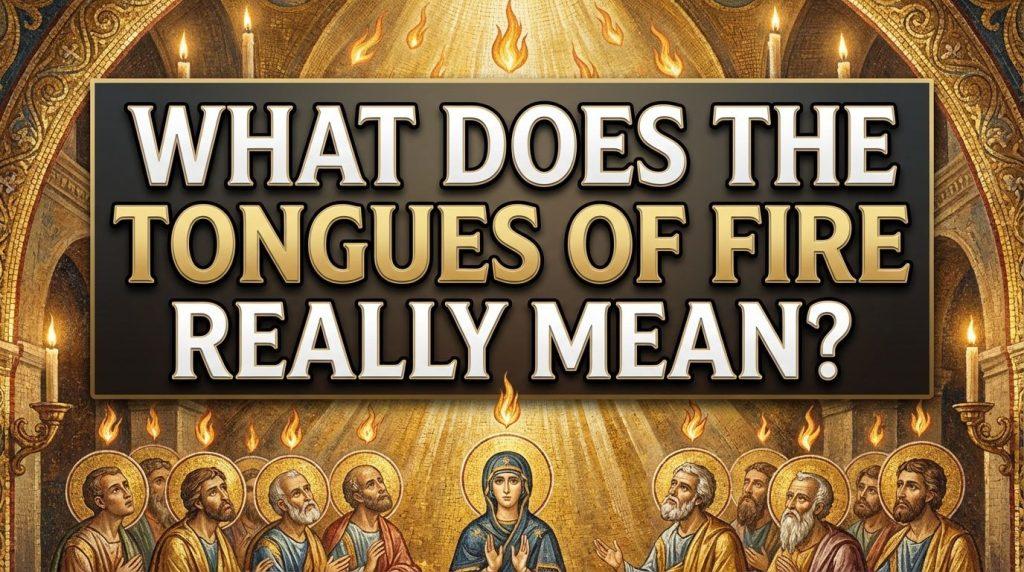
Immediately after the wind, divided tongues as of fire appeared and rested on each person present. The text carefully notes that tongues appeared “as of fire,” indicating they resembled fire without necessarily being natural flames. These fiery tongues divided and settled individually on each disciple. The personal nature of this distribution shows that the Holy Spirit comes to each believer individually, not merely to the community as a whole. Every person received their own tongue of fire, their own portion of the Spirit. This fulfilled Joel’s prophecy that God would pour out His Spirit on all flesh, that sons and daughters would prophesy, young men see visions, and old men dream dreams (Acts 2:17-18). The Spirit would not be limited to priests, prophets, or kings as in the Old Testament but would be given to all believers regardless of age, gender, or social status.
The immediate effect of receiving the Holy Spirit was that all began speaking in other languages as the Spirit enabled them. Jews from every nation under heaven were staying in Jerusalem for the feast. When they heard the sound, a crowd gathered and was bewildered because each heard the disciples speaking in his own native language. Parthians, Medes, Elamites, residents of Mesopotamia, Judea, Cappadocia, Pontus, Asia, Phrygia, Pamphylia, Egypt, Libya, Crete, and Rome all heard the wonders of God proclaimed in their languages. Some amazed hearers asked what this meant. Others mocked, saying the disciples were drunk on new wine. Peter then stood and delivered the first Christian sermon, explaining that this was the fulfillment of prophecy. He proclaimed Jesus’ death, resurrection, and lordship. About three thousand people believed and were baptized that day. The Church had begun its public mission.
Fire in Old Testament Theophanies
Fire appears consistently throughout the Old Testament as the sign of God’s presence and action. When God called Moses from the burning bush, the bush blazed with fire yet was not consumed (Exodus 3:2). This miraculous fire demonstrated God’s transcendent nature and His ability to be present without destroying what He touches. Moses hid his face, fearing to look at God, showing the proper human response to divine manifestation. God identified Himself as the God of Abraham, Isaac, and Jacob, then commissioned Moses to lead Israel out of Egypt. The fire served as authentication of the divine commission. Later, when God gave the Law at Mount Sinai, the mountain blazed with fire reaching to the heavens (Deuteronomy 4:11). Thick clouds and darkness surrounded the fire, and God spoke from the midst of the fire. The people trembled and stood at a distance, overwhelmed by the terrifying display.
The pillar of fire guided Israel through the wilderness for forty years. By day, a pillar of cloud led them; by night, a pillar of fire gave them light (Exodus 13:21-22). This constant visible presence of God accompanied the people on their long march to the promised land. The fire provided light for traveling at night and protection from enemies. It demonstrated God’s faithfulness to His covenant promises. When Solomon dedicated the Temple in Jerusalem, fire came down from heaven and consumed the burnt offering and sacrifices, and the glory of the Lord filled the Temple (2 Chronicles 7:1). The priests could not enter because God’s glory filled the building. This fire authenticated the Temple as God’s dwelling place and showed His acceptance of the sacrifices. The people fell on their faces and worshiped, saying the Lord is good and His steadfast love endures forever.
Elijah’s confrontation with the prophets of Baal on Mount Carmel included fire from heaven as proof of the true God. After Baal’s prophets failed to bring fire down on their sacrifice despite hours of frantic calling and cutting themselves, Elijah prayed briefly and fire fell from heaven (1 Kings 18:38). The fire consumed not only the sacrifice but also the wood, stones, dust, and water in the trench. This overwhelming display proved that the Lord alone is God. The people fell on their faces and declared that the Lord is God. These Old Testament fire theophanies established a pattern. Fire marks divine presence, demonstrates God’s power, authenticates His messengers, and demands human reverence. The tongues of fire at Pentecost fit this established pattern. They mark the Holy Spirit’s presence, demonstrate His power, authenticate the apostles’ mission, and inspire awe in witnesses.
Fire as Symbol of the Holy Spirit
Fire serves as a particularly fitting symbol for the Holy Spirit’s nature and work. Fire transforms whatever it touches, changing solid wood into ash, light, and heat. Similarly, the Holy Spirit transforms believers, changing sinful humans into holy children of God. This transformation is not superficial or cosmetic but fundamental, altering the very substance of what we are. Before receiving the Spirit, we are slaves to sin, unable to please God or fulfill His law. After receiving the Spirit, we become new creations with capacity for righteousness and holiness. Saint Paul describes this radical change when he writes that if anyone is in Christ, he is a new creation; the old has passed away, the new has come (2 Corinthians 5:17). This recreation happens through the Holy Spirit’s transforming fire.
Fire purifies by burning away impurities and dross. In the ancient world, metalworkers used intense heat to separate pure metal from worthless slag. The refiner sat watching the metal carefully, removing it from fire at exactly the right moment when his reflection appeared clearly on the surface. The Holy Spirit similarly purifies believers by burning away sin, selfishness, and attachment to worldly things. This purification can be painful, as anyone who has experienced spiritual trials knows well. Yet it is necessary for holiness. Malachi prophesied that the Lord would come like a refiner’s fire and like fullers’ soap, sitting as a refiner of silver (Malachi 3:2-3). He would purify the sons of Levi until they presented offerings in righteousness. This purifying fire of the Spirit operates throughout Christian life, gradually removing all that is not of God until we reflect His image clearly.
Fire provides light that dispels darkness and enables sight. Before the Holy Spirit comes, people walk in spiritual darkness, unable to perceive truth or understand divine things. Natural human reason has limits; it can know God exists and deduce some moral truths but cannot penetrate supernatural mysteries. The Holy Spirit illuminates minds, enabling believers to grasp what God reveals. Jesus promised that when the Spirit of truth comes, He will guide believers into all truth (John 16:13). This does not mean Christians automatically know everything or never make mistakes. Rather, it means the Spirit teaches us divine truth, helps us understand Scripture, and shows us God’s will. The light of the Spirit enables us to see ourselves clearly, recognizing sins we previously ignored or rationalized. It helps us see God’s goodness and love more perfectly. It shows us the path we should walk and the choices we should make.
Fire as Love’s Symbol
Fire represents passionate love and desire, making it appropriate for symbolizing divine charity the Holy Spirit produces in hearts. The Song of Solomon describes love as strong as death, its flames as a blazing fire, a raging flame that many waters cannot quench (Song of Solomon 8:6-7). This poetic language captures love’s consuming intensity and indestructibility. The Holy Spirit kindles divine love within believers, love for God and for neighbor. This is not natural affection or emotional attraction but supernatural charity, participation in God’s own love. The Catechism teaches that charity is the theological virtue by which we love God above all things for His own sake and love our neighbor as ourselves for the love of God (CCC 1822). This love is poured into our hearts through the Holy Spirit given to us (Romans 5:5).
The martyrs demonstrated love’s fiery intensity most clearly. They endured torture and death rather than deny Christ, showing that love for Him surpassed even love of life itself. Their courage seems humanly impossible, and indeed it was. Natural human love falters under extreme pressure. The supernatural love the Spirit kindles, however, proves stronger than fear, pain, or death. Polycarp, the elderly bishop of Smyrna, faced burning at the stake in the second century. When offered freedom if he would curse Christ, he replied that he had served Christ eighty-six years and Christ had never wronged him, so how could he blaspheme his king and savior? The flames could not consume his love, though they destroyed his body. Countless martyrs throughout history demonstrated similar love’s fire, proving the Spirit’s power to transform cowards into heroes.
The Holy Spirit’s love also expresses itself through zealous service and sacrifice for others. Those filled with the Spirit cannot remain passive or indifferent to others’ needs. They burn with desire to share the gospel, serve the poor, and advance God’s Kingdom. This holy zeal drove the apostles to travel throughout the known world proclaiming Christ despite danger and hardship. It motivated missionaries to leave comfortable homes and risk their lives in foreign lands. It inspired the founding of hospitals, schools, orphanages, and countless charitable works. This active, practical love flows from the Spirit’s fire within believers’ hearts. When that fire burns brightly, Christians cannot help but express love through action. When it burns low, faith becomes merely formal and lifeless. Maintaining the fire requires constant attention through prayer, sacraments, and deliberate choices to love even when difficult or costly.
The Divided Tongues
The tongues of fire appeared divided, settling individually on each person at Pentecost. This distribution pattern reveals important truths about how the Holy Spirit works. First, it shows that every believer receives the Spirit personally, not merely as part of a group. Christianity is not collective salvation where people are saved or sanctified en masse. Each person must personally receive Christ and the Spirit He sends. Each must individually respond to grace and cooperate with the Spirit’s work. The Church is indeed a community, the body of Christ, but it consists of individual members each personally united to the Head. The divided tongues illustrate this personal dimension of Christian life. God calls each person by name and gives His Spirit to each individually.
Second, the division suggests diversity of gifts and callings within the one body. Saint Paul extensively develops this teaching in his letters. He writes that there are varieties of gifts but the same Spirit, varieties of service but the same Lord, varieties of activities but the same God who empowers them all (1 Corinthians 12:4-6). To each is given the manifestation of the Spirit for the common good. Some receive wisdom, others knowledge, others faith, healing, miracles, prophecy, discernment, tongues, or interpretation. These diverse gifts all come from the one Spirit who apportions to each individually as He wills. The divided tongues at Pentecost foreshadow this diversity. Each person received their own tongue of fire, just as each receives particular gifts and calling from the Spirit.
Third, the tongues remained tongues of fire even when divided. They did not become smaller or weaker by division but retained full fiery nature. This shows that the Holy Spirit gives Himself fully to each believer. He is not divided or diminished by being given to many. Each Christian receives the complete Holy Spirit, not a fraction or portion. The Spirit is infinite and cannot be divided into parts. When ten thousand people receive the Spirit, each receives the same Holy Spirit the apostles received at Pentecost. This is possible because the Spirit is God, and God’s infinite nature allows Him to give Himself completely to each person while remaining completely Himself. The mystery exceeds human comprehension but the reality is certain. Every baptized and confirmed Catholic possesses the Holy Spirit dwelling within as in a temple.
Pentecost and Babel Reversed
The tongues of fire at Pentecost connect thematically to the tower of Babel incident in Genesis 11. At Babel, humanity united in pride attempted to build a tower reaching heaven and make a name for themselves. God responded by confusing their language so they could not understand each other. This forced dispersion ended the building project and scattered people across the earth. The confusion of languages became punishment for prideful rebellion and symbol of human division. Ever since Babel, language barriers have separated peoples and nations, making communication difficult and contributing to conflict. The multiplicity of languages represents humanity’s fractured condition after sin. Where once all spoke one language and were one people, now thousands of languages divide the human race.
Pentecost reverses Babel’s confusion. At Babel, God divided one language into many to scatter prideful builders. At Pentecost, the Holy Spirit enables apostles to speak many languages to gather scattered peoples into one Church. Those who witnessed Pentecost heard the wonders of God proclaimed in their native tongues. Parthians, Medes, Elamites, and people from every nation understood the gospel message. The Spirit overcame language barriers, enabling communication where Babel created confusion. This does not mean everyone suddenly spoke one language again. Rather, it means the Spirit empowered cross-cultural communication in service of gospel proclamation. The Church from its beginning was multilingual and multicultural, united not by common language or ethnicity but by common faith in Christ and shared reception of the Spirit.
The reversal of Babel shows that the Holy Spirit creates unity from diversity rather than demanding uniformity. The Church welcomes people from all nations, languages, and cultures without requiring them to abandon their particular identities. A Parthian can remain Parthian while becoming Christian. An Egyptian retains Egyptian culture while joining the Church. The Spirit does not erase human diversity but sanctifies it, ordering it toward God’s purposes. This unity in diversity reflects the Trinity itself, where three distinct persons share one divine nature. The Father, Son, and Holy Spirit are not identical or interchangeable but distinct persons in perfect unity. Similarly, the Church consists of many distinct members united in one body. The tongues of fire settling on each individual while joining all into one Spirit-filled community expresses this profound unity-in-diversity perfectly.
The Apostles’ Transformation
The tongues of fire transformed the apostles from fearful, confused men into bold witnesses willing to die for Christ. Before Pentecost, they hid behind locked doors fearing the Jewish authorities who crucified Jesus (John 20:19). Peter had denied Jesus three times when questioned by a servant girl. The others fled when Jesus was arrested, abandoning Him in His hour of greatest need. Even after the resurrection, they remained uncertain about their mission and unsure how to proceed. Jesus had told them to wait in Jerusalem for the Father’s promise, but what would happen after that remained unclear. They were simple fishermen and tax collectors, uneducated and untrained for the massive task ahead. They lacked eloquence, theological training, social connections, or political power. By every natural measure, they were completely inadequate for establishing a worldwide movement.
Receiving the Holy Spirit changed everything. The same Peter who denied Christ now stood boldly before thousands and proclaimed Him as Lord and Messiah. He accused the Jewish leaders of killing the author of life and called them to repentance. When threatened and beaten by authorities, he and John replied that they must obey God rather than men (Acts 5:29). They could not stop speaking about what they had seen and heard. This courage came not from themselves but from the Holy Spirit within them. The transformation proves the Spirit’s power to change human nature completely. Cowards became martyrs. Simple fishermen became teachers who turned the world upside down. Uneducated men confounded philosophers and defeated empires. None of this would have been possible without the Holy Spirit’s empowering presence symbolized by tongues of fire.
The apostles’ transformation demonstrates what the Spirit can do in any believer who cooperates with grace. We may feel inadequate for the tasks God gives us. We may lack natural talents, education, or resources. We may be tempted to focus on our weaknesses and limitations. The Pentecost account teaches us to focus instead on the Holy Spirit’s power. He can work through anyone who opens their heart to Him. He can use our weaknesses to display His strength more clearly. He can accomplish through us what we could never achieve on our own. The tongues of fire that empowered the apostles still empower Christians today through the sacraments of Baptism and Confirmation. We have access to the same Holy Spirit they received. Our job is not to be naturally impressive but to be Spirit-filled and Spirit-led. When we are, God can do through us what He did through the apostles.
Sacramental Connection to Confirmation
The Catholic Church sees Pentecost as intimately connected to the sacrament of Confirmation. At Confirmation, the bishop or priest extends hands over candidates and prays that they receive the Holy Spirit with His sevenfold gifts. He then anoints each person’s forehead with sacred chrism while saying, “Be sealed with the Gift of the Holy Spirit.” This sacramental action makes present for each believer what happened to the apostles at Pentecost (CCC 1302-1305). The tongues of fire may not be visible, but the reality they symbolized occurs. The Holy Spirit comes upon the confirmed Christian to strengthen them for witness and service. The anointing with chrism signed by the cross marks the person as belonging to Christ and empowered by His Spirit.
Confirmation completes the grace of Baptism. Baptism incorporates us into Christ’s body and gives us the Holy Spirit’s indwelling presence. Confirmation perfects this baptismal grace, providing a fuller outpouring of the Spirit. The two sacraments together correspond to Jesus’ baptism in the Jordan followed by His anointing with the Spirit. They also correspond to Easter and Pentecost, resurrection and empowerment. Without Confirmation, baptismal grace remains incomplete. The person belongs to Christ but lacks full equipment for Christian mission. Confirmation provides this equipment, enabling mature participation in the Church’s life and apostolate. The military language sometimes used for Confirmation, calling the confirmed person a “soldier of Christ,” reflects this mission-oriented character. The tongues of fire symbolize not passive religious sentiment but active power for evangelization and witness.
Some Catholics undervalue Confirmation, viewing it as mere graduation from religious education rather than profound sacramental encounter. They approach it casually, fulfilling an obligation without understanding or desire. This attitude misses Confirmation’s true significance. The sacrament offers nothing less than personal Pentecost, the coming of the Holy Spirit upon the believer. Those who receive it worthily with faith and proper disposition experience real transformation. They receive strength to resist temptation, courage to witness to Christ, zeal for souls, and love for God and neighbor. These effects may not be immediately dramatic but they are genuinely supernatural. The tongues of fire that appeared visibly at Pentecost descend invisibly on every person confirmed. The same Spirit who empowered the apostles empowers every confirmed Catholic. We should approach this sacrament with reverence, preparation, and eager expectation of receiving what Christ promised.
Fire’s Purifying Work
The Holy Spirit’s fire purifies believers by burning away sin and attachment to earthly things. This purification operates throughout Christian life, beginning at conversion and continuing until death or final perfection. Saint John the Baptist announced that the coming Messiah would baptize with the Holy Spirit and fire (Matthew 3:11). He warned that Christ’s winnowing fork is in His hand to clear the threshing floor, gathering wheat into the barn and burning chaff with unquenchable fire. This imagery shows the Spirit’s discriminating work, separating what is valuable from what is worthless. The chaff represents sin, vice, and worldly attachments that must be burned away. The wheat represents the purified self that will be preserved for eternal life.
Spiritual writers describe this purifying fire operating through various means. Active purification involves our deliberate efforts to resist temptation, practice virtue, and mortify disordered desires. We cooperate with grace by choosing good and rejecting evil, disciplining bodies and minds, and cultivating holiness. This active work is necessary but insufficient alone. Passive purification involves God working in us through circumstances beyond our control. Illness, loss, failure, betrayal, or other sufferings serve as fire that tests and refines us. We cannot choose these trials or determine their intensity. We can only accept them and allow them to accomplish God’s purposes. Saint John of the Cross describes the dark nights of sense and spirit as passive purifications that strip away all that is not God. These trials feel like the soul is being burned in fire, hence the metaphor’s aptness.
The purifying fire reaches its completion in purgatory for those who die in grace but imperfectly purified. The Catholic Church teaches that those who die in God’s friendship but still carry temporal punishment for sin undergo final purification before entering heaven (CCC 1030-1032). This purification is typically described as fire, following Saint Paul’s teaching that each person’s work will be tested by fire (1 Corinthians 3:13-15). If what was built survives, the builder will receive a reward. If it burns up, the builder will suffer loss but will be saved, though as through fire. This purgatorial fire is not punishment in the strict sense but the final removal of remaining impurity. It is the last touch of the Holy Spirit’s refining work before the soul enters God’s presence. The tongues of fire that came at Pentecost thus point toward the complete purification every saved soul must undergo.
Fire’s Illuminating Power
The Holy Spirit’s fire illuminates minds, enabling believers to understand divine truth and perceive spiritual realities. This illumination differs from natural intelligence or acquired knowledge. Someone may be brilliant academically yet blind spiritually. Someone else may be uneducated yet possess profound spiritual wisdom. The difference is the Holy Spirit’s light. Jesus warned that though seeing, people do not perceive, and though hearing, they do not understand (Matthew 13:13-15). Natural human faculties, damaged by sin, cannot grasp spiritual truth without supernatural help. The Spirit must open eyes that are blind and ears that are deaf. He must illuminate minds darkened by ignorance and sin.
This illumination operates in multiple ways. First, the Spirit helps believers understand Scripture. The Bible is not merely human writing but God’s word, and only God can fully explain what He meant. When we read Scripture with faith and prayer, the Spirit teaches us its meaning. Passages we have read many times suddenly reveal new depths. Apparent contradictions resolve. Difficult teachings become clear. The saints testify that Scripture became like a new book after their conversions. What previously seemed dry or confusing came alive with meaning. This change resulted from the Spirit’s illuminating fire opening their understanding. Second, the Spirit helps believers grasp Church teaching. Catholic doctrine can seem complex or counterintuitive to modern minds. The Trinity, Incarnation, Eucharist, and other mysteries exceed natural comprehension. The Spirit enables faith that accepts these truths and understanding that penetrates them as far as possible in this life.
Third, the Spirit illuminates conscience, showing us God’s will for specific situations. We face countless decisions where right action is unclear. Should I take this job? How should I respond to this person? What is God calling me to do? Natural prudence helps, but many situations exceed merely human wisdom. The Spirit guides by illuminating conscience, producing interior conviction about the right path. This guidance comes not through audible voices or dramatic signs but through quiet interior promptings and attractions. Those who cultivate sensitivity to the Spirit learn to recognize His voice and distinguish it from their own thoughts or demonic suggestions. The fire that descended at Pentecost continues burning in believers’ hearts, providing light for the path ahead. We need never walk in darkness because the Spirit’s light is always available to those who seek it.
Fire’s Empowering Energy
The tongues of fire at Pentecost empowered the apostles for miraculous works and effective ministry. Immediately after receiving the Spirit, they performed signs and wonders that authenticated their message. Peter healed a crippled beggar in Jesus’ name (Acts 3:6-8). The apostles performed many signs and wonders among the people (Acts 5:12). Even their shadows falling on the sick brought healing. These miracles proved that God was with them and confirmed their testimony about Jesus. The Holy Spirit continues empowering believers today, though often in less dramatic ways. He provides supernatural energy to do what we could not do naturally. Exhausted parents find strength to care for crying children. Missionaries endure hardships that would break ordinary people. Teachers reach troubled students who seemed unreachable. Social workers maintain compassion despite constant exposure to suffering.
The Spirit’s power also enables moral victories that exceed natural capability. Someone battling addiction for decades suddenly finds freedom. A person carrying bitter resentment for years discovers capacity to forgive. Someone enslaved to lust gains self-control. These victories are not merely psychological breakthroughs or willpower triumphs. They are the Holy Spirit working in weakness, providing power to overcome sin. Saint Paul learned this when God told him that His grace was sufficient and His power was made perfect in weakness (2 Corinthians 12:9). Paul boasted in his weaknesses so that Christ’s power would rest upon him. This paradox characterizes Christian life. We are weak, but the Spirit makes us strong. We are insufficient, but grace makes us sufficient. The fire that empowered the apostles empowers us.
Accessing this empowerment requires humility that admits need and faith that trusts God’s provision. Proud people who rely on their own strength never experience the Spirit’s power because they do not seek it. They attempt Christian life through natural effort and inevitably fail or settle for mediocrity. Humble people who know their weakness cry out for help and receive it. They discover the Spirit’s power is real and available. This power comes especially through prayer and sacraments. When we pray, the Spirit intercedes for us with groans too deep for words (Romans 8:26). When we receive the Eucharist, we consume the source of all spiritual power. When we confess sins, we receive grace to resist future temptation. These means of grace provide ongoing access to Pentecost’s power. The tongues of fire continue descending on those who seek them through the channels Christ established.
Personal Pentecost Through Prayer
Every Christian can and should experience personal Pentecost through prayer. This does not mean expecting dramatic visible manifestations like fire or wind. It means opening ourselves fully to receive the Holy Spirit who has already been given. Many Catholics live far below the spiritual power available to them because they never ask for the Spirit’s fullness. Jesus promised that the Father would give the Holy Spirit to those who ask (Luke 11:13). This is not asking for what we lack but asking to experience fully what we already possess potentially. Baptism and Confirmation gave us the Holy Spirit. Deliberate prayer opens us to His active work in our lives.
Praying for the Holy Spirit should be regular and specific. We can pray the traditional prayer, “Come Holy Spirit, fill the hearts of your faithful and kindle in them the fire of your love.” This ancient prayer invokes the same Spirit who came at Pentecost. We can pray for particular gifts or fruits we need. Someone struggling with fear prays for fortitude. Someone lacking wisdom prays for that gift. Someone cold in charity prays for love’s fire to be rekindled. The Spirit responds to sincere prayers offered in faith. We should also create space for the Spirit to work through silence and contemplative prayer. When we quiet our minds and hearts before God, the Spirit can teach, guide, and transform us. Many Christians pray constantly but never listen. They speak to God but do not wait for His response. Contemplative silence allows the Spirit to speak within.
Some Christians worry that praying for the Holy Spirit’s fullness is presumptuous or unnecessary. They reason that they already received the Spirit at Baptism and Confirmation, so further seeking is superfluous. This misunderstands how the Christian life works. The Spirit is indeed given in the sacraments, but His gifts and fruits develop gradually through cooperation. A seed planted in soil has life from the beginning, but it must be watered and tended to grow and bear fruit. Similarly, the Spirit dwelling in us must be cultivated through prayer, obedience, and deliberate seeking. The apostles had been with Jesus for three years before Pentecost. They had seen His miracles and heard His teaching. Yet they still needed to wait and pray for the Spirit’s promised coming. We likewise need to wait on God in prayer, asking for what He wants to give. The tongues of fire will descend not visibly but really, transforming us as they transformed the first Christians.
Conclusion
The tongues of fire that descended at Pentecost represent the Holy Spirit coming to empower the Church for its mission. These divided tongues rested individually on each person while uniting all into one Spirit-filled community. Fire symbolizes the Spirit’s purifying work that burns away sin, His illuminating power that reveals truth, His empowering energy that enables supernatural living, and His love that consumes and transforms hearts. The Pentecost event fulfilled Old Testament promises and reversed Babel’s confusion, enabling the gospel to spread across language and cultural barriers. It transformed fearful apostles into bold witnesses willing to die for Christ. The Catholic Church connects Pentecost to Confirmation, where each believer receives personal outpouring of the Spirit. The same fire that came upon the apostles comes upon every confirmed Catholic, though usually invisibly. This fire continues purifying, illuminating, empowering, and transforming believers throughout their lives. Growing in the Spirit requires cooperation through prayer, sacraments, and deliberate cultivation of gifts and fruits. Every Christian can experience personal Pentecost by opening themselves fully to receive the Spirit already given. The tongues of fire still descend on those who seek them with faith and desire. They still empower witnesses, still transform sinners into saints, still enable the impossible, and still kindle divine love in human hearts. Understanding what the tongues of fire mean helps Catholics appreciate the gift they have received and motivates them to fan into flame the Spirit’s fire within them.
Disclaimer: This article presents Catholic teaching for educational purposes. For official Church teaching, consult the Catechism and magisterial documents. For personal spiritual guidance, consult your parish priest or spiritual director. Questions? Contact editor@catholicshare.com
Sign up for our Exclusive Newsletter
- 📌 Add CatholicShare as a Preferred Source on Google
- 🎁 Join us on Patreon for Premium Content
- 🎧 Check Out These Catholic Audiobooks
- 📿 Get Your FREE Rosary Book
- 📱 Follow Us on Flipboard
-

Recommended Catholic Books
Discover hidden wisdom in Catholic books — invaluable guides enriching faith and satisfying curiosity. #CommissionsEarned
- The Early Church Was the Catholic Church
- The Case for Catholicism - Answers to Classic and Contemporary Protestant Objections
- Meeting the Protestant Challenge: How to Answer 50 Biblical Objections to Catholic Beliefs
As an Amazon Associate, I earn from qualifying purchases. Thank you for your support.