
Brief Overview
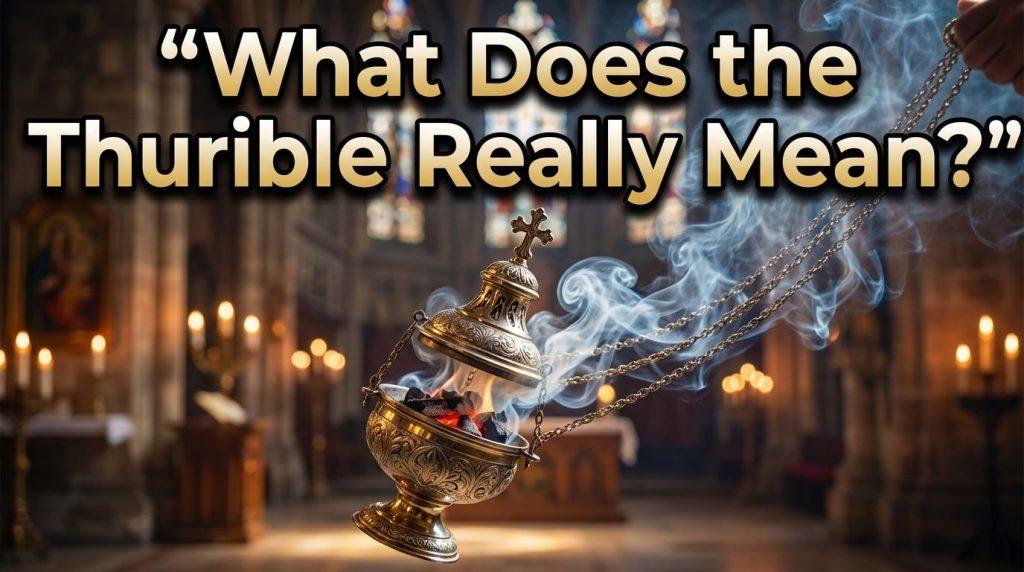
- The thurible is a metal vessel suspended from chains that holds burning charcoal and incense during Catholic liturgical worship.
- Rising incense smoke symbolizes the prayers of the faithful ascending to heaven and the sanctifying grace of the Holy Spirit at work in worship.
- Biblical roots of incense use extend from the Old Testament altar of incense through New Testament imagery in Revelation.
- The thurible’s structure typically includes three or four chains representing the Holy Trinity and a perforated lid allowing fragrant smoke to escape.
- Incensing during Mass occurs at specific moments including the entrance procession, Gospel proclamation, offertory, and consecration.
- The practice connects earthly liturgy with heavenly worship where saints and angels offer prayers as incense before God’s throne.
The Physical Nature and Structure of the Thurible
The thurible stands as one of the most recognizable liturgical instruments in Catholic worship, though many people may not know its proper name. This metal vessel hangs from chains and contains burning charcoal upon which small amounts of incense are placed. The word thurible comes from the Latin term turibulum, which itself derives from the word for incense. The basic design consists of a metal bowl or container with a base allowing it to stand upright when not in use. A perforated lid covers the top, featuring holes or openings that allow the fragrant smoke to escape while containing the hot charcoal safely inside. The chains attached to the lid allow the server or priest to swing the thurible, dispersing the incense smoke throughout the sacred space. Most thuribles have either three or four chains, with the three-chain design carrying special theological meaning by representing the three Persons of the Holy Trinity. The chains connect to a metal disk or plate at the top, making it easy to hold and swing the vessel during liturgical ceremonies.
The thurible works in conjunction with another liturgical vessel called the incense boat or navicula, named for its boat-like shape. This smaller container holds the loose grains of incense that have not yet been burned. Inside the boat rests a small spoon used to transfer the incense onto the hot coals. During Mass, when the priest wishes to use incense, he blesses it and then places spoonfuls onto the burning charcoal in the thurible. The incense immediately begins to smoke, producing a fragrant cloud that fills the church. The altar server carrying the boat is sometimes called the boat bearer, and this role requires careful attention to ensure the incense is available when needed. The materials used for thuribles vary from simple brass to ornate silver or gold, often featuring decorative elements such as angels, crosses, or intricate engravings. Some thuribles include bells that ring softly as the censer swings, adding an auditory dimension to the sensory experience of the liturgy.
The practical function of the thurible requires proper technique and safety awareness. The charcoal must be lit well before Mass begins, usually about fifteen to twenty minutes in advance, allowing it to become thoroughly heated and covered with a layer of ash. Only hot charcoal produces the immediate smoke needed when incense is added. The server who carries the thurible, traditionally called the thurifer, must learn to swing it properly to keep the charcoal burning and to distribute the smoke effectively. Too little swinging and the charcoal may go out; too much and hot ash might escape. The thurifer walks with the thurible held away from the body, usually swinging it gently in a rhythmic pattern. When presenting the thurible to the priest, the server opens the lid by raising the chains, allowing the priest to place incense on the coals. After blessing the incense, the priest returns the thurible to the server, who then uses it to incense various persons or objects according to the liturgical rubrics. The weight of a thurible filled with burning charcoal requires strength and coordination, making this role one that younger altar servers often grow into over time.
Biblical Foundations of Incense in Worship
The use of incense in worship stretches back thousands of years to the earliest periods of Jewish religious practice, establishing a clear biblical foundation for its continued use in Catholic liturgy. God himself commanded the use of incense in the worship of ancient Israel, giving Moses specific instructions for constructing an altar of incense in the tabernacle. The Book of Exodus records these divine directives in detail, describing an altar made of acacia wood overlaid with gold, placed before the veil separating the Holy Place from the Holy of Holies. Aaron the high priest was commanded to burn fragrant incense on this altar every morning when he tended the lamps, and again each evening, creating a perpetual offering of incense before the Lord. This daily practice established incense as an integral part of legitimate worship according to God’s own design. The formula for the sacred incense was also specified, a mixture of specific spices and frankincense that was reserved exclusively for religious use. Making or using this particular blend for any secular purpose was strictly forbidden, demonstrating that incense held a sacred character in worship.
The Old Testament contains numerous references to incense that reveal its symbolic meaning within the covenant relationship between God and his people. Psalm 141:2 makes the connection explicit, with the psalmist praying that his prayer would rise before God like incense and his lifted hands like an evening sacrifice. This verse established the primary symbolism that would carry forward into Christian worship, understanding incense as a visible representation of prayer ascending to heaven. The prophet Malachi spoke of a time when pure offerings would be made to God’s name among all nations, a prophecy Christians understand as fulfilled in the worship of the Church. Isaiah’s vision of the heavenly throne room included smoke filling the temple, creating an atmosphere of mystery and holiness that incense would later evoke in earthly worship. The practice of burning incense was so central to temple worship that when Zechariah the priest was chosen by lot to burn incense in the temple, it was considered a once-in-a-lifetime honor. Luke 1:9-10 describes this moment when the whole assembly of people prayed outside during the incense offering, and the angel Gabriel appeared to announce the coming birth of John the Baptist. This New Testament account shows the continuity of incense use from the Old Covenant into the time of Christ.
The Book of Revelation provides the clearest New Testament foundation for the liturgical use of incense by showing its place in heavenly worship. Revelation 5:8 describes the twenty-four elders who fall before the Lamb, each holding harps and golden bowls full of incense, which are identified explicitly as the prayers of the saints. This remarkable image shows that the prayers of believers on earth are offered before God’s throne as incense by the saints in heaven. Later, Revelation 8:3-4 presents an even more detailed picture, describing an angel standing at the altar with a golden censer, to whom much incense was given to offer with the prayers of all the saints. The smoke of the incense rose with the prayers of the saints from the angel’s hand before God. These passages demonstrate that incense represents prayer not merely as a symbolic gesture humans invented, but as a reality reflecting the actual worship taking place in heaven. The Church on earth, in her liturgy, participates in this heavenly reality, and the use of incense makes this invisible reality visible and tangible. The biblical pattern moves from command in the Old Testament, through confirmation in the Gospels, to revelation of heavenly truth in the Apocalypse.
Primary Symbolic Meanings of the Thurible and Incense
The thurible and the incense it carries communicate multiple layers of theological meaning that enrich Catholic worship and deepen the spiritual experience of those participating in the liturgy. The most fundamental symbolism is that of prayer ascending to heaven, made visible in the rising smoke. When the faithful see incense smoke drifting upward, they are reminded that their prayers, though invisible and spiritual, truly rise to God. This visual reminder encourages prayer during the liturgy and connects the physical gathering of believers with the spiritual reality of communion with God. The Catechism of the Catholic Church explains that sacramental celebrations involve meetings between God’s children and their Father, conducted through dialogue that includes both words and actions, and the burning of incense participates in this dialogue. The smoke carries no inherent power to make prayers more effective, but it serves as a sign that makes the invisible reality of prayer perceptible to human senses. Just as water makes the invisible grace of baptism visible, incense makes the invisible movement of prayer toward God something we can see and smell.
The second major symbolic meaning involves sanctification and purification, the setting apart of people and objects for sacred purposes. The smoke of burning incense represents the action of the Holy Spirit who sanctifies and purifies the Church. When the priest incenses the altar, he is not making the altar holy by this action, for the altar has already been consecrated. Rather, he is signifying and acknowledging its holiness, marking it as set apart for divine worship. Similarly, when the priest incenses the congregation, this action signifies that the baptized are holy, made members of Christ’s body and temples of the Holy Spirit. The cloud of incense creates a sensory experience of being enveloped in something greater than oneself, an appropriate symbol for the transforming presence of the Holy Spirit. This sanctifying aspect connects to the Old Testament practice of anointing with oil and the New Testament imagery of being sealed with the Spirit. The sweet fragrance of the incense also recalls the “aroma of Christ” mentioned in 2 Corinthians 2:15, where believers are described as spreading the fragrance of the knowledge of God everywhere. Through baptism and ongoing participation in the sacraments, Christians become living offerings whose lives give off a spiritual fragrance pleasing to God.
The thurible and incense also create a sense of sacred mystery and transcendence that lifts the minds and hearts of worshipers beyond ordinary experience. The clouds of smoke partially veil and partially reveal, creating an atmosphere reminiscent of God’s presence on Mount Sinai, hidden in clouds, or the glory cloud that filled the temple in Solomon’s time. This veiling function serves an important purpose in worship, reminding us that God cannot be comprehended fully by human understanding. We see through a glass darkly, as Saint Paul wrote, and incense smoke provides a physical expression of this spiritual truth. The mystery evoked by incense helps create a sense of the sacred that distinguishes liturgical worship from ordinary gatherings. The fragrance itself works on memory and emotion in ways that purely intellectual worship cannot, engaging the whole person in the act of worship. Smell is closely linked to memory in human psychology, and the distinctive scent of liturgical incense becomes associated with sacred moments and spaces. When people encounter that fragrance again, it can immediately transport them back to experiences of worship, prayer, and encounter with the divine. This multi-sensory approach to worship recognizes that humans are not merely souls trapped in bodies, but unified persons whose physical senses participate in spiritual realities.
The Thurible in the Structure of the Mass
The General Instruction of the Roman Missal provides specific directions for when and how incense may be used during the celebration of Mass, revealing the theological significance of different moments in the liturgy. The use of incense is optional rather than mandatory for most Masses, though it is traditionally employed during more solemn celebrations such as Sunday Masses, feast days, and special occasions. Understanding when incense is used helps illuminate what each part of the Mass accomplishes in the worship of God. The first opportunity for incensing comes during the entrance procession, when the thurifer leads the procession carrying the smoking thurible. This incensing signifies that sacred worship is about to begin and creates an atmosphere of solemnity and reverence. The fragrant smoke announces that something extraordinary is taking place, that the congregation is gathering not for ordinary business but for participation in divine mysteries. The procession through the church filled with incense smoke visually proclaims that Christ himself is coming to his people through the ministry of the priest.
Once the procession reaches the sanctuary, the priest incenses the altar and the cross, if the cross is located near the altar. This incensing acknowledges the altar as the place of sacrifice and the cross as the instrument of our redemption. The priest walks around the altar, swinging the thurible so that smoke envelops this most sacred furnishing. The altar represents Christ himself, the cornerstone of the Church, and incensing it honors Christ present in the liturgical action about to unfold. The number of swings given varies according to what is being incensed. Three double swings are given to the Most Blessed Sacrament, a relic of the Holy Cross, and images of Christ exposed for public veneration. Two double swings are given to relics and images of saints exposed for veneration, to the priest celebrant, and to the offerings of bread and wine. Single swings are given to the other clergy and to the congregation. These varying numbers of swings create a hierarchy of honor that reflects Catholic teaching about the appropriate veneration due to different persons and objects. The three swings honor the Trinity, while lesser numbers show appropriate but lesser degrees of reverence.
The Gospel procession provides another significant moment for incensing. Before the deacon or priest proclaims the Gospel, the Book of the Gospels may be incensed with three double swings. This action honors Christ who speaks to his Church through the proclamation of the Gospel. The incense surrounding the Gospel book makes visible the reverence Catholics hold for sacred Scripture, particularly for the words of Christ recorded in the four Gospels. The smoke rising around the reader and the book creates a moment of heightened attention and solemnity. Following the Gospel proclamation, incense may be used during the preparation of the gifts, also called the offertory. The priest incenses the bread and wine that have been placed on the altar, then the cross and the altar itself. After this, the deacon or another minister incenses the priest and then the congregation. This sequence of incensing represents the whole Church, both clergy and lay faithful, being offered to God along with the gifts of bread and wine that will become the Body and Blood of Christ. The congregation stands while being incensed, receiving this gesture as an acknowledgment of their dignity as baptized members of Christ’s body. Some parishes also use incense during the elevation of the consecrated Host and chalice after the words of consecration, though this practice varies. The incense at this moment honors the Real Presence of Christ, now truly present under the appearances of bread and wine.
Historical Development of the Thurible in Christian Worship
The thurible and the use of incense in Christian worship have a complex history that stretches from the earliest days of the Church through various cultural and geographical contexts. Early Christians initially avoided using incense because of its strong association with pagan worship and emperor cult practices in the Roman Empire. Burning incense before images of the emperor or pagan gods was a common religious act, and Christians who refused to do so faced persecution and martyrdom. This association made early Christians hesitant to incorporate incense into their own worship, even though it had clear biblical precedent from Jewish temple practice. The first Christians, many of whom were Jews, would have been familiar with incense from temple worship, but the break with Judaism and the need to distinguish Christian practice from pagan ritual influenced early liturgical development. By the fourth century, however, after the persecution ended and Christianity became legal and then dominant in the Roman Empire, the Church began to incorporate incense into liturgical celebrations. The earliest documented use of incense in Western Christian liturgy comes from the seventh century, when thuribles were employed to honor the bishop and the Book of the Gospels. The Eastern Churches began using incense in their liturgies somewhat earlier, and the practice spread gradually throughout the Christian world.
The thurible itself underwent various design changes and artistic developments over the centuries. Archaeological evidence suggests that early Christian thuribles were simpler in design than later medieval and Renaissance examples. The basic function remained constant: a container for burning charcoal and incense, suspended from chains. However, the artistic elaboration increased dramatically during the Middle Ages when metalworkers created increasingly ornate thuribles decorated with precious metals, jewels, and intricate religious imagery. Some medieval thuribles were crafted in the shape of churches or castles, with the smoke emerging from windows and doors. Others featured detailed engravings of saints, biblical scenes, or symbolic designs. The chains themselves became objects of artistic attention, sometimes fashioned from precious metals and designed with decorative links. Different regions developed distinct styles of thuribles, and studying these variations helps historians understand the movement of artistic influences across medieval Europe. The Renaissance and Baroque periods produced even more elaborate thuribles, some of which have survived and are now displayed in church treasuries and museums.
The use of incense declined significantly in many parts of the Western Church following the Protestant Reformation, though Eastern Catholic and Orthodox churches maintained the practice consistently. Some Protestant reformers rejected incense along with other liturgical elements they considered unnecessary additions to pure gospel simplicity. The Catholic Church retained incense in its liturgy but saw varied practice depending on local custom and available resources. The Second Vatican Council’s liturgical reforms in the 1960s led to renewed interest in the symbolic dimensions of liturgical worship, including the use of incense. The council documents emphasized the importance of signs and symbols that engage the whole person in worship, and this theological vision supported the continued and even expanded use of incense in Catholic liturgy. The revised Roman Missal following Vatican II provided clear rubrics for when and how incense should be used, standardizing practice while allowing for pastoral flexibility. Today, the use of incense remains optional for most Masses, though it is commonly employed during more solemn celebrations. Some parishes use incense regularly, others only on special occasions, and still others rarely or never. This variation reflects both theological emphases and practical considerations such as the cost of incense, the availability of trained servers, and concerns about allergies or respiratory sensitivities among parishioners.
The Theology of Sensory Worship
The thurible and incense represent the Catholic Church’s commitment to engaging all human senses in worship, reflecting a theology that takes seriously the goodness of creation and the Incarnation of Christ. Catholic worship is not purely intellectual or spiritual but involves the whole person, body and soul, in the encounter with God. This approach distinguishes Catholic liturgy from more minimalist forms of Christian worship that emphasize the preaching of the word and the interior disposition of the worshiper while minimizing or eliminating ceremonial elements. The Catholic understanding recognizes that human beings experience reality through their bodies and that God chose to reveal himself through material creation and ultimately through taking on human flesh in Jesus Christ. If God himself entered into material creation through the Incarnation, then material things can serve as vehicles of grace and means of encountering the divine. The use of incense follows this incarnational logic, employing a physical substance to communicate spiritual realities. The smoke that is visible to the eyes, the fragrance that fills the nose, the sound of chains, and even the warmth radiating from the thurible all work together to create a multi-sensory experience of worship.
The Catechism teaches that liturgical celebrations are meetings between God’s children and their Father, accomplished through Christ and in the power of the Holy Spirit, taking the form of dialogue through actions and words. Incense functions as part of this liturgical dialogue, a physical action that speaks a spiritual language. The burning of incense is not mere decoration or atmosphere-creation but a symbolic action that carries meaning and communicates truth. This understanding of symbolic action runs throughout Catholic sacramental theology. Baptism uses water not because God cannot forgive sins without water, but because the physical washing with water makes visible and tangible the spiritual washing of regeneration. Similarly, incense is used not because God cannot hear prayers without it, but because the rising smoke makes visible the reality of prayer ascending to heaven. These material signs serve pedagogical and devotional purposes, teaching the faith and helping believers enter more fully into the mysteries being celebrated. The Second Vatican Council emphasized that liturgy should be both fully intelligible to participants and rich in symbolic elements that lift minds and hearts to God.
Critics sometimes charge that Catholic emphasis on liturgical ceremony amounts to empty ritualism that distracts from authentic faith and interior conversion. The Church responds that authentic ceremony, far from distracting from true faith, actually expresses and strengthens it. The use of incense and other liturgical elements becomes problematic only when treated as magical actions that automatically produce effects regardless of faith and intention. When properly understood as signs that express faith and evoke response, liturgical symbols like incense enhance rather than diminish authentic worship. The prophets of ancient Israel condemned empty ritual divorced from justice and mercy, but they never rejected ritual itself. Jesus criticized hypocritical religious practice but participated fully in the temple worship of his time. The key distinction lies between ritual treated as a substitute for faith versus ritual that expresses and deepens faith. Incense used thoughtlessly becomes mere showmanship, but incense used with understanding becomes a means of entering more fully into the paschal mystery of Christ’s death and resurrection. The fragrance filling the church reminds worshipers that they are participating in something beyond ordinary experience, that the veil between heaven and earth becomes thin in the sacred liturgy, and that their prayers truly rise to God.
Practical and Pastoral Dimensions
The practical use of incense in parish life involves both opportunities and challenges that require pastoral wisdom and sensitivity. The most common practical concern involves health effects, as some people experience allergic reactions or respiratory irritation from incense smoke. Pastors must balance the legitimate spiritual benefits of incense use with care for parishioners who may have difficulty breathing when exposed to smoke. Some parishes address this by using incense only occasionally, allowing those sensitive to smoke to plan around those liturgies. Others use smaller amounts of incense or choose milder varieties that produce less smoke. The placement of seats may also be considered, allowing sensitive individuals to sit farther from the main areas where incense is used. Communication helps tremendously; when the parish bulletin announces that incense will be used at particular Masses, people can make informed choices about attendance or seating. This pastoral approach recognizes both the value of the tradition and the real physical needs of congregation members. The goal is inclusion rather than exclusion, finding ways to maintain rich liturgical practice while accommodating those with special needs.
Training altar servers to use the thurible properly requires time and attention but pays dividends in enhancing worship. Young servers often view being trained as thurifer as a mark of growing responsibility and take pride in mastering this more complex liturgical role. The physical coordination required helps develop discipline and focus, while the theological explanation of what the incense means contributes to faith formation. Many adults who served as altar servers remember their time carrying the thurible as particularly meaningful, a moment when they felt truly involved in something important. This formation of young people in liturgical ministry plants seeds that may bear fruit throughout their lives. The thurifer role also teaches practical lessons about preparation and attention to detail. The charcoal must be lit in time, the incense boat must be filled and ready, and the server must know when and where to present the thurible to the priest. These responsibilities help young people learn reliability and the importance of their contribution to something larger than themselves. Parishes that invest in training servers well often find that this investment strengthens the overall quality of their liturgical celebrations.
The decision about how frequently to use incense involves weighing various factors including parish tradition, resources, and the nature of particular celebrations. Some parishes maintain the practice of using incense every Sunday, treating the Lord’s Day with high solemnity. Others reserve incense for major feast days such as Christmas, Easter, Pentecost, and patronal feasts. Still others use it more rarely or not at all. The Roman Missal leaves this largely to pastoral judgment rather than imposing strict requirements. Pastors consider factors such as the size and ventilation of the church building, the availability of trained servers, the cost of incense and charcoal, and the preferences and sensitivities of the congregation. Introducing or reintroducing incense into a parish that has not used it regularly requires catechesis to help people understand the meaning and purpose. Without proper explanation, incense might seem like empty ceremony or unnecessary complication. With good catechesis, it becomes an opportunity to deepen appreciation for the Church’s rich liturgical tradition and to engage more fully in worship. The gradual approach often works well, beginning with major feasts and gradually expanding use as familiarity and appreciation grow.
The Thurible and the Communion of Saints
The use of incense in Catholic worship connects directly to the doctrine of the communion of saints, the teaching that all members of Christ’s body, whether on earth, in purgatory, or in heaven, remain in communion with one another through Christ. The biblical imagery from Revelation shows the saints in heaven offering the prayers of believers on earth as incense before God’s throne. This image reveals that the liturgy celebrated in parish churches participates in the eternal liturgy of heaven. When Catholics gather for Mass, they join with angels and saints in worshiping God. Incense makes this invisible reality visible, creating a sensory link between the earthly celebration and the heavenly reality. The smoke rising from the thurible symbolizes not only the prayers of those physically present but also the prayers of the entire Church across time and space. This communal dimension of prayer stands in contrast to purely individualistic approaches to worship. Catholic liturgy is inherently communal, involving the whole body of Christ, and incense helps express this corporate character.
The practice of incensing relics of saints acknowledges the honor due to those who died faithful to Christ and now live with him in glory. When a thurible is swung before the relics of a saint, this action venerates both the saint and, through the saint, Christ who worked powerfully in that person’s life. The distinction between the worship due to God alone and the veneration appropriate for saints remains clear in the varying numbers of swings. Three double swings honor God present in the Blessed Sacrament, while two double swings venerate saints and their relics. This measured approach prevents the confusion of worship with veneration while still acknowledging the special place saints hold in the Church. The incensing of relics often occurs during the celebration of a saint’s feast day or when relics are exposed for public veneration. The fragrant smoke surrounding the relics creates an atmosphere of reverence and reminds the faithful that these holy men and women now stand before God and continue to pray for the Church on earth. Their prayers, like incense, rise before God’s throne and obtain blessings for those who ask their intercession.
The communion of saints extends also to those who have died and are being purified in purgatory before entering fully into the presence of God. Catholic funeral liturgies traditionally use incense to honor the body of the deceased and to signify prayers rising to God on behalf of the departed soul. The coffin or urn containing the cremated remains may be incensed during the funeral Mass, acknowledging both the dignity of the human body and the spiritual reality of the soul’s continued existence. This use of incense expresses hope in the resurrection of the body and confidence in God’s mercy toward those who have died in friendship with him. The prayers of the living truly help those who have died, and incense makes visible this spiritual reality of intercessory prayer. The funeral liturgy becomes not just a memorial service but an active participation in the paschal mystery, trusting that Christ who passed through death to resurrection brings his faithful followers along the same path. The incense at funerals thus serves multiple purposes: honoring the deceased, symbolizing prayers for the dead, and proclaiming faith in resurrection and eternal life.
Incense and the Sacrifice of the Mass
The relationship between incense and sacrifice runs throughout scripture and liturgical tradition, connecting the thurible to the sacrificial nature of the Mass. In the Old Testament, incense accompanied the daily sacrifices offered in the temple, creating a sweet-smelling aroma that was pleasing to God. The Book of Exodus describes how Aaron was to burn incense morning and evening along with the regular sacrifices. This connection between incense and sacrifice was not coincidental but revealed something about the nature of true worship. Sacrifice involves giving something valuable to God, offering back to the Creator some portion of what he has first given. The incense itself, made from precious spices and resins, represented something of value being consumed and transformed in the fire. As it burned, the incense was utterly given over, changed from solid resin to fragrant smoke. This transformation paralleled the transformation of the worshiper who offers himself to God, being changed and purified through the action of divine grace. The ascending smoke symbolized the worshiper’s desire to rise toward God, to be lifted out of purely earthly existence into communion with the divine.
The Mass is the unbloody re-presentation of Christ’s sacrifice on Calvary, making present in a sacramental way the one sacrifice that reconciled humanity with God. When incense is used during the preparation and offering of the gifts, it emphasizes the sacrificial character of what is taking place. The priest incenses the bread and wine that will become Christ’s Body and Blood, acknowledging that these elements are being prepared for their transformation into the sacrifice of Christ. The incensing of the altar reinforces that this is the place of sacrifice, where Christ’s offering will become present. The incensing of the priest and people signifies that they too are being offered to God, not as autonomous sacrifices separate from Christ, but as members of his body participating in his one sacrifice. Saint Paul wrote that Christians should present their bodies as living sacrifices, holy and pleasing to God, and the incense used during Mass makes visible this total self-offering that should characterize Christian life. The fragrant smoke enveloping the gathered assembly proclaims that all are being consecrated, set apart for God’s service, transformed by participation in the Eucharistic sacrifice.
The sacrificial imagery becomes particularly powerful during the Eucharistic Prayer when the bread and wine are consecrated and become truly the Body and Blood of Christ. Some parishes use incense during the elevation immediately following the words of consecration, swinging the thurible so that clouds of smoke surround the elevated Host and chalice. This practice, though not universal, creates a striking visual parallel to the Old Testament imagery of God’s glory filling the temple in a cloud. The smoke partially veils the sacred mysteries, acknowledging that while Christ makes himself truly present, he remains beyond complete human comprehension. The incense at the elevation also serves as a gesture of adoration, offering to Christ now truly present the honor and worship due to God alone. The three double swings given to the Blessed Sacrament correspond to the three Persons of the Trinity, reminding worshipers that Christ’s sacrifice leads to communion with Father, Son, and Holy Spirit. This moment brings together all the symbolism of incense: prayer, sacrifice, sanctification, mystery, and adoration combine in the offering of the Eucharist, the source and summit of Christian life.
Teaching and Catechesis on the Thurible
Effective catechesis about the thurible and incense helps Catholics appreciate and enter more fully into the liturgical celebrations of their faith. Many Catholics have seen incense used at Mass without fully understanding its meaning or biblical foundation. This gap between practice and understanding represents a pastoral opportunity. When priests take time to explain why incense is used and what it symbolizes, they help people move from passive observation to active participation in the liturgy. This teaching can occur through various means including homilies, bulletin articles, parish website content, religious education classes, and pre-Mass announcements. The explanation need not be lengthy or overly technical. Simple statements connecting the rising smoke to rising prayers, or mentioning the biblical precedent in Revelation, can significantly enhance understanding. Children especially benefit from explanations that engage their natural wonder and curiosity about liturgical objects and actions. Letting children see the thurible up close, explaining how it works, and perhaps even allowing them to smell the incense helps create positive associations and lasting memories.
Adult faith formation programs offer ideal settings for deeper exploration of incense and other liturgical symbols. A session on understanding the Mass could include segments on various elements including incense, vestments, gestures, and the arrangement of the sanctuary. Participants might examine an actual thurible, learn about its construction and use, and discuss the layers of meaning it carries. Reading and discussing relevant Scripture passages such as Psalm 141:2 and Revelation 8:3-4 grounds the practice in biblical tradition. Exploring the history of incense use shows how the Church has maintained this practice across centuries and cultures, adapting forms while preserving meaning. Discussion questions might invite participants to share their own experiences with incense at Mass, whether positive, negative, or neutral, and to reflect on how understanding the symbolism affects their perception. This kind of formation helps overcome the barrier where liturgical practices seem like empty ritual or merely decorative elements. When people understand that incense carries genuine theological meaning and connects to Scripture and Tradition, they can engage with it more fruitfully.
Parents bear primary responsibility for forming their children in the faith, and teaching about the thurible offers a concrete opportunity for this formation. When families attend Mass together and incense is used, parents can briefly explain what is happening and what it means. These small moments of teaching accumulate over time, building understanding and appreciation. Families might also explore the topic at home through age-appropriate books about the Mass, videos explaining liturgical elements, or craft projects such as making a paper model of a thurible. Some families purchase small amounts of incense for home prayer, allowing children to experience the connection between the fragrance they smell at church and their own prayer life at home. This domestic use of incense requires appropriate safety precautions but can create meaningful prayer experiences, especially during special seasons like Advent or Lent. The practice of blessing homes with incense on the Feast of the Epiphany or at Easter represents another way families can integrate this element of Catholic tradition into their domestic church. These home practices complement and reinforce what children experience in the parish liturgy, creating continuity between church and home.
Contemporary Questions and Concerns
The use of incense in contemporary Catholic worship raises various questions and concerns that pastoral leaders must address with both faithfulness to tradition and sensitivity to current circumstances. The most frequent concern involves health issues, particularly respiratory conditions aggravated by smoke exposure. Asthma, chronic obstructive pulmonary disease, chemical sensitivities, and allergies can all be triggered by incense smoke. These are genuine medical conditions, not mere preferences or complaints, and they deserve serious consideration. Dismissing such concerns as weakness or lack of faith fails in charity and pastoral care. Yet completely eliminating incense from liturgy based on the sensitivities of some congregation members may deprive the whole community of a rich element of worship. The challenge lies in finding balanced solutions. Some parishes designate certain Masses as incense-free, allowing those with sensitivities to worship without difficulty while maintaining incense use at other Masses. Installing or improving ventilation systems can help dissipate smoke more quickly. Using smaller amounts of incense or choosing higher-quality varieties that produce less smoke may reduce problems. Clearly communicating when incense will be used allows people to make informed decisions. These practical accommodations demonstrate respect for all members of the community while preserving liturgical tradition.
Questions about the ecological and economic dimensions of incense use reflect broader contemporary concerns about environmental stewardship and just resource allocation. Frankincense and myrrh, traditional components of church incense, come from trees that are increasingly threatened by climate change and overharvesting. Some of these trees grow in regions experiencing conflict and instability, raising questions about supply chains and ethical sourcing. The cost of good quality incense may seem difficult to justify when parishes face budget pressures and urgent needs. These concerns merit attention and should be weighed thoughtfully. On one hand, the quantities of incense used by Catholic churches globally represent a tiny fraction of global resource consumption. On the other hand, the principle of responsible stewardship applies to all areas of life, and the Church should model ethical consumption. Parishes can investigate sources of sustainably harvested incense, support fair trade suppliers, and use incense judiciously rather than wastefully. The value of maintaining liturgical traditions must be balanced against other values including environmental responsibility and economic justice. This balancing requires prudential judgment rather than absolute rules, and different communities may reach different conclusions based on their particular circumstances.
Cultural dimensions of incense use present both opportunities and challenges in an increasingly diverse Church. In many cultures, burning incense carries religious meanings quite different from Catholic usage. Some converts from other religious traditions may find Catholic incense use confusing or problematic because of associations with their former religious practice. Buddhist, Hindu, and other Eastern religious traditions use incense extensively, and Catholic practice might seem to blur religious boundaries. Pastoral sensitivity requires acknowledging these concerns while explaining the distinct Catholic understanding and biblical foundation for incense. The fact that different religions use incense does not make it inappropriate for Catholic worship any more than the fact that different religions pray makes prayer inappropriate. Catholics should understand clearly that the incense used in Mass symbolizes prayer and sanctification according to biblical imagery, not an attempt to imitate or syncretize with other faiths. At the same time, this shared practice across religious traditions might serve as a point of dialogue, showing how different faiths have recognized the appropriateness of using material elements to symbolize spiritual realities. The particularity of Catholic faith remains clear while acknowledging common ground with other traditions in the use of symbolic elements in worship.
Conclusion: Recovering Rich Liturgical Practice
The thurible stands as one of many liturgical elements that connect contemporary Catholics with the Church’s rich tradition stretching back through centuries to biblical origins. In an age that often values efficiency, simplicity, and practicality above all else, the thurible witnesses to different values. It proclaims that worship deserves beauty, that engaging the senses helps human beings encounter the divine, that time-tested traditions carry wisdom worth preserving, and that visible signs can communicate invisible realities. The fragrant smoke rising from the thurible creates no material product, accomplishes no practical task, and serves no utilitarian purpose. Its value lies entirely in its symbolic and spiritual dimensions, in what it signifies and in how it helps worshipers enter more fully into the sacred mysteries being celebrated. This runs counter to contemporary culture’s emphasis on productivity and efficiency, offering instead the vision of worship as an end in itself, valuable simply because it gives glory to God and sanctifies those who offer it. The thurible thus becomes not merely a liturgical implement but a sign of contradiction, challenging the assumptions and values of a society that often reduces everything to instrumental utility.
Recovering appreciation for the thurible and other rich liturgical elements represents part of the broader task of liturgical formation that every generation of Catholics must undertake. The Second Vatican Council called for full, conscious, and active participation in the liturgy, but this participation requires understanding. People cannot fully participate in what they do not understand, and they cannot understand what has not been taught. The responsibility for this formation falls on pastors, catechists, parents, and all who share in the teaching mission of the Church. Explaining the meaning of the thurible and incense gives people tools for deeper engagement with the Mass, moving them from mere attendance toward genuine participation. This formation need not be burdensome or overly academic. Clear, simple explanations connecting liturgical practice to Scripture and theology serve most people well. The goal is not to turn every Catholic into a liturgical scholar but to help ordinary believers understand and appreciate the worship they offer Sunday after Sunday. When Catholics understand that the smoke rising from the thurible represents their prayers ascending to heaven, that simple knowledge can transform their experience of the liturgy. They begin to pay attention in new ways, to pray more intentionally, to feel more connected to the action taking place at the altar.
The thurible ultimately points beyond itself to the reality of prayer, sacrifice, and communion with God that lies at the heart of Christian faith. The vessel is only metal, the incense only resin, the smoke only vapor. Yet through these simple materials, something profound occurs. The invisible becomes visible, the spiritual becomes tangible, and earth touches heaven. The prayers of the faithful truly rise to God, not because smoke has power to carry them, but because God in his goodness has established creation as the medium through which he communicates grace and through which humanity responds in worship. The thurible serves this divine economy of salvation, this pattern of grace descending and thanksgiving ascending. When properly understood and used, it enhances worship without becoming the focus of worship. It serves rather than dominates, helps rather than hinders, enriches rather than distracts. The sweet fragrance filling the church, the smoke rising toward the ceiling, the rhythmic swing of the chains all work together to create an atmosphere conducive to prayer and to remind the gathered assembly that they stand in the presence of the living God. This is the authentic meaning of the thurible, and recovering this understanding strengthens Catholic worship and deepens Catholic faith.
Disclaimer: This article presents Catholic teaching for educational purposes. For official Church teaching, consult the Catechism and magisterial documents. For personal spiritual guidance, consult your parish priest or spiritual director. Questions? Contact editor@catholicshare.com
Sign up for our Exclusive Newsletter
- 📌 Add CatholicShare as a Preferred Source on Google
- 🎁 Join us on Patreon for Premium Content
- 🎧 Check Out These Catholic Audiobooks
- 📿 Get Your FREE Rosary Book
- 📱 Follow Us on Flipboard
-

Recommended Catholic Books
Discover hidden wisdom in Catholic books — invaluable guides enriching faith and satisfying curiosity. #CommissionsEarned
- The Early Church Was the Catholic Church
- The Case for Catholicism - Answers to Classic and Contemporary Protestant Objections
- Meeting the Protestant Challenge: How to Answer 50 Biblical Objections to Catholic Beliefs
As an Amazon Associate, I earn from qualifying purchases. Thank you for your support.