
Brief Overview
- The ship symbol in Christian tradition represents the Church as a vessel of salvation carrying believers safely through the storms of life toward eternal life.
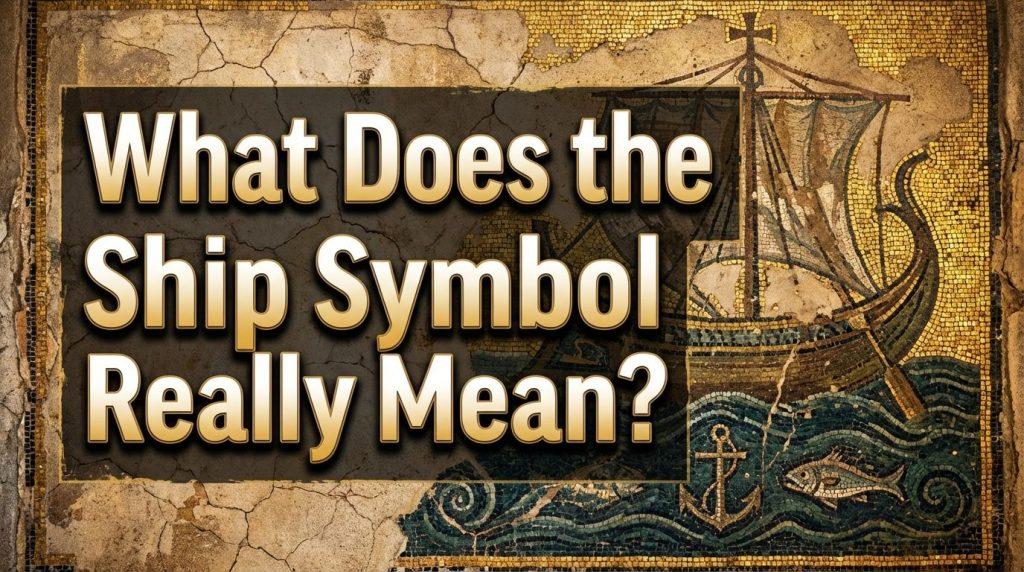
- This imagery appears in early Christian art, particularly in the catacombs, where the ship’s mast forms a cross symbolizing Christ’s saving power.
- The Latin word “navis” for ship gives us the term “nave” for the main body of a church building, reflecting this ancient symbolism.
- Scripture provides foundation for ship imagery through accounts of Noah’s ark, Jonah, and the apostles’ boat on the Sea of Galilee with Jesus.
- Church Fathers developed extensive theological meaning from ship symbolism, seeing the Church as the ark of salvation outside which none can be saved.
- The ship symbol emphasizes the necessity of remaining within the Church and under proper leadership to reach the safe harbor of heaven.
The Biblical Foundation of Ship Imagery
The ship as a symbol of salvation begins with Noah’s ark in the book of Genesis. God commanded Noah to build an ark to save his family and representatives of all animals from the flood that would destroy sinful humanity. The ark provided the only means of survival when waters covered the earth, killing all outside its protection. This narrative establishes the pattern of salvation through a vessel that separates the saved from the perishing. The ark had one door through which Noah and his family entered, just as Christ is the one door to salvation. Inside the ark, people and animals lived in safety while judgment fell on the world outside. The proportions and construction of the ark followed God’s precise instructions, showing that salvation comes through divinely appointed means. When the flood ended, the ark came to rest on Mount Ararat and Noah’s family emerged to repopulate the earth. This story provided early Christians with a powerful type or foreshadowing of the Church.
Saint Peter explicitly connects Noah’s ark to baptism in his first epistle. He writes that God’s patience waited in the days of Noah while the ark was being prepared, and only eight persons were saved through water (1 Peter 3:20-21). Peter then states that baptism now saves believers, not as a removal of dirt from the body but as an appeal to God for a clear conscience through the resurrection of Jesus Christ. This connection makes the ark a clear symbol of the Church, which saves through the waters of baptism. Just as entrance into the ark meant salvation from the flood, entrance into the Church through baptism means salvation from sin and death. The eight persons saved in the ark foreshadow the Church beginning on the eighth day, Sunday, when Christ rose from the dead. The water that destroyed the wicked world also lifted the ark to safety, just as baptismal water both drowns the old self and raises the new self to life in Christ.
The Gospels record several significant events involving boats and water that contribute to ship symbolism. Jesus often taught from boats when addressing crowds on the shore, using the boat as a pulpit or teaching platform. He called fishermen to follow Him and made them fishers of men, transforming their boats into instruments of evangelization. The most dramatic boat episode occurs when Jesus slept in a boat during a storm on the Sea of Galilee. The disciples panicked as waves threatened to swamp the vessel, but Jesus rose and calmed the wind and sea with His word. This miracle demonstrates Christ’s power over chaos and danger, providing the foundation for seeing the Church as a safe vessel even in turbulent times. After His resurrection, Jesus appeared to the disciples while they fished and directed them to a miraculous catch. He cooked breakfast for them on the shore and reinstated Peter with the threefold question about love. These boat-centered encounters show Jesus establishing His Church through the apostles and their successors.
Early Christian Use of Ship Symbolism
The earliest Christians adopted the ship as one of their primary symbols, second only to the fish and anchor in frequency of appearance. Archaeological evidence from the Roman catacombs shows numerous depictions of ships carved or painted on tomb walls. These underground burial chambers where Christians gathered for worship and funerals contain some of our best evidence of early Christian symbolism. The ship appears both alone and combined with other symbols, particularly the cross. Artists often drew the ship’s mast as a cross or showed a cross displayed on the sail. This combination united the Church and Christ’s saving death in one image. The simplicity and clarity of the ship symbol made it easily recognizable even to illiterate believers. A simple curved line for the hull and a vertical line for the mast could represent the entire concept.
The ship symbol served multiple purposes in the persecuted early Church. First, it reminded believers that they belonged to a community of salvation, not facing dangers alone but together in one vessel. The communal nature of the Church as ship countered Roman individualism and provided comfort during persecution. Second, it expressed hope that despite present suffering, the Church was headed toward a safe destination. The ship may encounter storms, but it will reach harbor eventually. Third, it functioned as a semi-secret symbol that Christians could recognize without attracting hostile attention. Roman authorities might see a ship as decorative or memorial art without perceiving its Christian meaning. Fourth, it connected believers to biblical narratives that gave meaning to their situation. When they saw a ship, they remembered Noah, Jonah, Peter, and Jesus calming the storm. These biblical connections strengthened faith and provided interpretive frameworks for understanding present trials.
The Church Fathers developed theological interpretations of ship symbolism in their writings. Tertullian wrote that the Church is called a ship because through its ministry we arrive at the harbor of eternal life. Hippolytus of Rome compared the Church to a ship tossed by waves but not submerged, led by the skilled pilot Christ toward the peaceful haven. Clement of Alexandria described the Church as a swift ship with Christ as pilot, guided by the Holy Spirit, carrying His children through baptism to the Father’s haven. Ambrose of Milan preached that the Church is a ship in which we cross the sea of this world to reach our homeland. Augustine extensively used ship imagery, particularly in his commentaries on Psalm 83. These patristic interpretations established ship symbolism firmly in Christian tradition. Medieval and modern Catholic teaching continues to draw on these early explanations of what the ship represents and how believers should understand their relationship to the Church.
The Church as Ark of Salvation
Catholic doctrine teaches that the Church founded by Christ is necessary for salvation, often expressed in the phrase “outside the Church there is no salvation.” This teaching, rooted in Scripture and constant tradition, finds clear expression in ship and ark imagery (CCC 846-848). Just as Noah’s ark provided the only means of salvation from the flood, the Church provides the ordinary means God has established for saving humanity from sin and death. This does not mean that everyone who lacks formal Church membership is automatically condemned. God can save through extraordinary means those who through no fault of their own do not know the gospel. However, for those who recognize the Catholic Church as the one Christ founded, refusing to enter or remain in it constitutes rejection of God’s appointed means of grace. The Church is necessary not because God lacks power to save otherwise but because He has chosen to work through the community He established.
The ark symbolism emphasizes unity as essential to salvation. Noah’s ark was one vessel with one door, not multiple boats or several entrances. Similarly, Christ founded one Church, not many denominations or competing communities. The Catholic Church maintains it is this one Church of Christ, possessing the fullness of the means of salvation through apostolic succession, valid sacraments, and complete doctrine (CCC 816). Other Christian communities possess elements of truth and sanctification to varying degrees, but they lack the fullness found in Catholicism. The ship imagery challenges the modern notion that all churches are equally valid paths to God. If multiple contradictory churches all save equally, then the ship symbol makes no sense. Why build or enter one particular ark if any floating log will do? The traditional Catholic understanding insists that Christ established a specific, identifiable community with clear boundaries and authority structure.
The necessity of the Church as ark of salvation includes the necessity of baptism, the sacrament that incorporates people into the Church. Water plays a dual role in the Noah narrative: it destroys the wicked but also lifts the ark to safety. Baptismal water similarly destroys sin while raising the baptized to new life. Without baptism, entry into the ark remains incomplete. The Catholic Church recognizes baptism of desire for those who would accept baptism if they knew of its necessity but die before receiving it. She also recognizes baptism of blood for martyrs who die witnessing to Christ before formal baptism. These exceptions acknowledge God’s mercy and power to save outside ordinary means. However, they do not eliminate baptism’s necessity or make it optional. Parents who refuse to baptize their children or adults who dismiss baptism as unimportant reject God’s appointed means of entering the ark of salvation. The Church urgently calls all people to repentance and baptism, the entry point into the saving vessel.
The Nave of the Church Building
Catholic church architecture incorporates ship symbolism directly in the design and terminology of buildings. The main body of a church where the congregation gathers is called the nave, a term deriving from the Latin “navis” meaning ship. This architectural feature typically forms a long rectangular space, shaped somewhat like the hull of a ship. The nave extends from the entrance to the sanctuary, carrying worshipers forward toward the altar where Christ is made present in the Eucharist. Traditional churches built before modern innovations almost universally employed this nave design. The symbolism remains so embedded in Catholic architecture that even contemporary church buildings often retain a recognizable nave despite more flexible or circular layouts. Calling this space the nave reminds worshipers every time they enter that they have boarded the ship of the Church.
The resemblance between naves and ships often extends beyond nomenclature to deliberate design elements. Many traditional churches feature vaulted ceilings that curve like the inverted hull of a ship. The wooden beams supporting these ceilings sometimes show clear ship-like construction. In coastal regions particularly, builders skilled in shipbuilding often worked on churches, bringing their craft expertise to sacred architecture. Some churches feature actual ship models hanging from the nave ceiling, making the symbolism explicit. These suspended vessels serve as ex-votos, offerings of thanksgiving from sailors who survived dangerous voyages. They also function as teaching tools, helping the faithful understand the Church-as-ship theology. The visual impact of entering a nave designed to evoke a ship reinforces the idea that Christians are passengers on a shared vessel.
The orientation of the nave contributes additional symbolic meaning. Traditional churches face east, with the entrance at the west and the sanctuary at the east. Worshipers entering from the west and moving toward the altar thus travel eastward, toward the rising sun. Christians from earliest times associated east with Christ, the Sun of Righteousness who rises to bring light and salvation. The nave carries believers toward Christ in the sanctuary, just as the Church carries souls toward Christ in heaven. This eastward movement mirrors the passage from death to life, darkness to light, sin to grace. The nave is not neutral space but a processional way, a path of transformation. Every time Catholics walk down the nave toward the altar, they symbolically rehearse the Christian life’s basic direction: movement toward union with Christ. Modern churches that abandon traditional orientation lose this rich symbolic layer.
Christ as Captain of the Ship
The ship of the Church requires a captain or pilot to guide it safely to harbor. Christian tradition universally identifies Christ as the captain who steers the vessel. He is not a passenger but the one in command, directing the ship’s course and ensuring its safe arrival. This imagery appears in early Christian art where Christ stands at the helm or holds a steering oar. The Gospels support this identification through the storm-calming miracle, where Jesus demonstrates mastery over wind and waves. The disciples cried out in fear, “Master, we are perishing,” but Christ’s word brought immediate calm (Luke 8:24). His ability to command natural forces reveals His divine authority. The storm represents the chaos and danger threatening the Church throughout history. Persecution, heresy, schism, and scandal arise like waves attempting to swamp the vessel. Yet Christ remains in the ship, and His presence guarantees ultimate safety.
Christ’s role as captain includes knowing the proper course to reach the destination. Human wisdom cannot chart the way to heaven; only divine guidance can lead souls to eternal life. The apostles were experienced fishermen who knew the Sea of Galilee intimately, yet they panicked in the storm. Their natural knowledge and skill proved insufficient when supernatural danger arose. Similarly, human philosophy, worldly wisdom, and secular ideologies cannot guide people to salvation. Only Christ knows the way because He is the way (John 14:6). His teaching provides the navigation charts the Church follows. His example shows the course believers must take. His grace provides the power to stay on course despite contrary winds. Trusting Christ as captain means accepting His authority even when His directions seem counterintuitive or difficult. The ship may tack against the wind, taking a longer path than seems necessary. Passengers may question the captain’s judgment. Yet those who trust His expertise will arrive safely while those who mutiny or abandon ship will perish.
The presence of Christ as captain provides assurance during trials that would otherwise cause despair. Church history includes periods of terrible crisis: the Arian controversy that saw most bishops fall into heresy, the Western Schism with competing papal claimants, Renaissance corruption that provoked the Protestant Reformation, modern scandals that have shaken confidence. Each crisis seemed capable of destroying the Church entirely. Yet the ship remained afloat, battered but not sunk. Christ’s promise that the gates of hell will not prevail against His Church (Matthew 16:18) finds fulfillment in this miraculous survival. The Church’s persistence through two millennia of hostility, internal corruption, and cultural change cannot be explained naturally. It provides evidence of supernatural protection. Christ may appear to sleep during storms, as He did in the boat on Galilee. The disciples woke Him in panic, asking if He cared that they were perishing. He does care, and He exercises His care by preserving the ship He captains.
The Apostles and Their Successors as Crew
While Christ serves as captain of the Church’s ship, the apostles and their successors function as the crew who carry out His commands. Jesus chose twelve apostles and gave them authority to teach, sanctify, and govern the Church in His name. Peter received special authority as chief apostle, the rock on which Christ built His Church (Matthew 16:18-19). This hierarchical structure appears in ship imagery where Peter often holds the steering oar under Christ’s direction. The apostles operated the ship’s functions: hoisting sails, managing ropes, bailing water, and performing the physical work of sailing. They did not act independently but under the captain’s orders. Their authority derived entirely from Christ who appointed them. Yet their role remained essential, for the captain works through the crew to operate the ship.
The apostolic succession preserves this crew structure throughout Church history. Bishops are successors of the apostles, receiving through ordination the same authority Christ gave the Twelve. They teach the faith, celebrate sacraments, and exercise pastoral governance over local churches. The Pope, as successor of Peter, holds primacy among bishops and serves as visible head of the Church on earth. This hierarchical structure protects the Church from chaos and division. A ship needs clear command, not competing authorities each claiming to speak for the captain. When crew members contradict each other or the captain, the ship cannot function properly. Catholic ecclesiology maintains that Christ established visible leadership to preserve unity and ensure faithful transmission of His teaching. Denying this structure amounts to claiming the ship needs no crew or that any passenger can assume command.
The relationship between Christ and Church leadership resembles that between a ship’s captain and crew rather than a democracy where passengers vote on the ship’s direction. Christ did not establish the Church as a democratic institution where truth is determined by majority vote or popular opinion. He gave authority to specific persons and their successors, creating a structure where divine truth flows from Him through appointed channels. This is not arbitrary authoritarianism but wise provision for human nature’s weaknesses. Left to ourselves, we quickly fall into error and division. The hierarchy protects the deposit of faith and maintains unity that would otherwise fracture. Those who reject Church authority effectively claim they can pilot themselves to heaven, abandoning the ship Christ provided. History shows such individuals typically adopt errors and lead others astray. The ship symbolism teaches that salvation is corporate and hierarchical, not individualistic and democratic.
Storms and Dangers Threatening the Ship
The Church’s ship constantly encounters storms and dangers on its voyage through history. Jesus warned that following Him would bring persecution, and Church history confirms this prediction. Roman emperors attempted to destroy Christianity through systematic persecution, executing believers and confiscating property. Later, Islamic conquests conquered Christian territories and forced conversions. Communist regimes murdered millions of Christians and suppressed Church activity. Contemporary Western culture pursues softer persecution through mockery, marginalization, and legal restrictions. These external attacks represent storms that threaten to swamp the ship. Waves of hostility crash against the hull, attempting to break it apart or sink it. Yet the ship survives, proof of Christ’s abiding presence. No empire has managed to destroy the Church despite many attempts.
Internal problems pose equal or greater danger than external persecution. Heresy arises when teachers promote false doctrines contrary to apostolic teaching. The early Church fought Gnosticism, Arianism, Pelagianism, and other errors that threatened to corrupt faith. Medieval struggles included conflicts over authority and discipline. Protestantism broke from Catholic unity, creating lasting divisions. Modernism attempted to accommodate faith to secular philosophy, undermining supernatural belief. Each heresy represents a mutiny where crew members or passengers reject the captain’s orders and try to seize control. If successful, these mutinies would steer the ship onto rocks or into enemy waters. God preserves the Church by raising up defenders of orthodoxy who refute errors and maintain true teaching. Councils define doctrine clearly, marking safe channels and warning of dangerous shoals. The teaching authority of Pope and bishops functions as a compass, keeping the ship on course despite winds of fashionable opinion.
Moral corruption among clergy and laity poses another danger to the ship. When Christians live no differently than pagans, the Church loses credibility and influence. Scandal causes weaker believers to lose faith and unbelievers to mock. Renaissance popes who fathered children and pursued wealth brought shame on the Church and contributed to Protestant revolt. Contemporary clergy abuse scandals have damaged countless souls and driven people from the faith. These sins are like leaks in the hull, allowing water to enter and threatening to sink the vessel. Yet God provides remedies through reform movements, holy leaders who model authentic Christianity, and the sacrament of confession which repairs the damage of sin. The Church repeatedly experiences renewal after corruption, demonstrating supernatural resilience. Human sin cannot destroy what God protects, though it causes terrible harm. The ship analogy helps believers maintain hope during scandals, remembering that Christ remains captain despite crew failures.
Passengers on the Ship
All baptized Christians are passengers on the Church’s ship, carried toward heaven by the vessel Christ captains. This shared identity as passengers emphasizes the communal nature of salvation. We do not each sail individual boats or swim independently toward our destination. We travel together in one ship, our fates interconnected. What affects one passenger affects all. When some fall into sin, the whole community suffers damage. When some achieve holiness, the whole Church benefits. This organic unity finds expression in the doctrine of the Mystical Body of Christ, where all believers form one living organism (CCC 787-796). The ship image makes this unity concrete and visible. Passengers can see that they share one vessel and one voyage.
Being a passenger involves both privileges and responsibilities. The privileges include protection from the storms raging outside the ship, access to provisions stored aboard, guidance toward the destination, and companionship of fellow travelers. Passengers need not know how to sail or navigate; the crew handles those technical matters. They must simply trust the captain and cooperate with the crew’s directions. However, passengers also bear responsibilities. They must not jump overboard or attempt to sink the ship. They must accept discipline and follow rules necessary for safe operation. They must assist fellow passengers who fall ill or struggle with difficulties. They must maintain the ship through financial support and active participation in its life. A passenger who refuses these responsibilities while claiming the privileges acts unjustly and endangers the entire company.
Some passengers mistakenly think they can enjoy salvation benefits while rejecting Church authority or obligations. They want Christ as Savior but not Lord, grace without obedience, heaven without cross. The ship imagery exposes this error. A person cannot simultaneously board and abandon the ship, accept and reject the captain’s authority, demand crew services while refusing to follow crew instructions. Those who attempt this contradiction essentially try to walk on water by their own power, which inevitably ends in drowning. The Church is not a cafeteria where people select only appealing elements while rejecting difficult ones. It is a ship where passengers accept the complete package: Christ, His teaching, His sacraments, His appointed leaders. Selective Christianity is not Christianity but a self-invented religion that ultimately cannot save because it is not the ark God provided.
Baptism as Boarding the Ship
Baptism serves as the means of boarding the Church’s ship. This sacrament cleanses original sin, infuses sanctifying grace, and incorporates the person into Christ’s Mystical Body (CCC 1262-1274). Before baptism, a person remains outside the ark in the dangerous waters of sin and death. Baptism brings them safely aboard, placing them under Christ’s protection and giving them access to all the Church’s spiritual resources. The baptismal promises renounce Satan and profess faith in the Trinity, establishing the fundamental commitments of Christian life. Parents who have infants baptized act on their behalf, bringing them onto the ship before they can choose for themselves. These children will later confirm their baptismal promises when they receive the sacrament of Confirmation.
The urgency of baptism follows logically from the ship symbolism. If the Church is the ark of salvation and baptism is the means of boarding, then baptism becomes necessary for salvation. Jesus explicitly states this necessity in His conversation with Nicodemus: “Unless one is born of water and Spirit, he cannot enter the kingdom of God” (John 3:5). The early Church understood this clearly and baptized converts immediately after instruction. Delaying baptism without serious reason makes no sense if one grasps its significance. Parents who postpone children’s baptism or claim they should wait until the child is old enough to choose leave their children outside the ark in spiritual danger. Adults who recognize truth of the Catholic faith but delay baptism until a more convenient time gamble with their eternal destiny. Death can come unexpectedly, leaving no opportunity for a delayed baptism.
The baptismal rite itself incorporates water imagery that connects to ship symbolism. The blessing of baptismal water recalls the flood, the crossing of the Red Sea, and Christ’s baptism in the Jordan. These biblical waters separate the saved from the lost, symbolizing passage from death to life. Immersing the candidate in water or pouring water over the head signifies drowning the old self enslaved to sin. Rising from the water signifies birth of the new self who lives for God. This death and rebirth happens through union with Christ’s death and resurrection. The baptized person boards the ship as a new creation, forgiven and made God’s adopted child. They receive the white garment symbolizing purity and the candle symbolizing Christ’s light. These signs indicate their new status as passengers on the ark headed for eternal life.
The Eucharist as Provisions for the Voyage
The Church’s ship must carry provisions to sustain passengers during the long voyage to heaven. The Eucharist serves as the primary and essential provision Christ supplies. In this sacrament, believers receive Christ’s Body and Blood under the appearances of bread and wine. Jesus instituted the Eucharist at the Last Supper and commanded His disciples to repeat this action in His memory (Luke 22:19-20). The early Church obeyed, gathering each Sunday to celebrate what they called the breaking of bread. This weekly Eucharistic celebration sustained believers through persecution and trial. It continues to sustain Catholics through all trials today. Without this supernatural food, passengers would spiritually starve during the journey to heaven.
The Eucharist’s necessity for spiritual life appears in Christ’s own words. He declares that unless we eat His flesh and drink His blood, we have no life in us (John 6:53). This shocking statement caused many disciples to abandon Him, unable to accept such teaching. Yet Jesus did not soften or explain away His words. He meant them literally, and the Catholic Church has always understood them literally. The Eucharist is not merely symbolic or commemorative but truly makes present Christ’s Body, Blood, Soul, and Divinity (CCC 1373-1381). Transubstantiation describes how the substance of bread and wine becomes the substance of Christ while the appearances remain unchanged. This miracle occurs at every Mass through the priest’s consecration. Receiving Holy Communion unites believers intimately with Christ, strengthening their connection to the ship’s captain and fellow passengers.
Regular reception of the Eucharist should characterize every serious Catholic’s life. The Church requires attendance at Mass on Sundays and holy days, with worthy reception of Communion at least once yearly during Easter season (CCC 2042). However, this represents a bare minimum, not an ideal. Many Catholics receive Communion at every Mass they attend, whether daily or weekly. This frequent reception maintains spiritual strength and deepens union with Christ. Those who rarely receive the Eucharist deprive themselves of essential nourishment, like passengers who refuse to eat ship’s provisions. They will grow weak and unable to fulfill their responsibilities. Some excuse themselves by claiming unworthiness, which ironically shows misunderstanding. We approach the Eucharist precisely because we are unworthy and need Christ’s grace. Proper disposition requires freedom from mortal sin and belief in the Real Presence, not perfect virtue.
The Sacrament of Reconciliation as Repair
Ships require constant maintenance and repair to remain seaworthy. Wood rots, metal corrodes, and normal wear creates problems requiring attention. The Church’s ship similarly needs ongoing repair due to sin’s damage. The sacrament of Reconciliation provides this essential repair service. When Catholics confess their sins to a priest, Christ forgives through the priest’s ministry and restores sanctifying grace lost through mortal sin (CCC 1446-1470). This sacrament repairs the breaches sin creates in the ship’s hull, preventing water from flooding in and sinking the vessel. Without regular confession, damage accumulates until the Christian life becomes unmanageable and faith itself may be lost.
Many Catholics neglect the sacrament of Reconciliation, confessing rarely or never despite Church requirement of annual confession for those in mortal sin. This neglect represents refusing necessary repairs while the ship actively leaks. Some claim they confess directly to God and need no priest. This ignores Christ’s explicit establishment of sacramental confession through giving apostles authority to forgive sins (John 20:22-23). Others avoid confession from embarrassment or pride, unwilling to admit sins to another person. Yet this humbling precisely contributes to the sacrament’s healing power. Verbalizing sins to a priest breaks their power over us and enables us to receive concrete absolution and guidance. Still others dismiss confession as outdated or psychologically harmful. Research actually shows regular confession promotes mental health and well-being rather than causing damage.
The sacrament of Reconciliation benefits even those in a state of grace without mortal sins. Venial sins, while not destroying grace, weaken our spiritual lives and make falling into serious sin more likely. Regular confession of venial sins helps eliminate bad habits, strengthens virtue, and increases grace. Many saints confessed weekly or even daily, recognizing confession’s value for spiritual growth. The priest’s counsel provides individualized guidance suited to one’s specific struggles. The grace received strengthens us against future temptation. The act of confessing itself cultivates humility and self-knowledge. Passengers on the Church’s ship should actively seek this repair service rather than avoiding it. A ship constantly maintained stays in far better condition than one allowed to deteriorate until major problems develop. Similarly, Christians who confess regularly maintain stronger spiritual health than those who wait until crisis forces them to act.
The Destination: Heaven as Safe Harbor
Every ship sails toward a destination, and the Church’s ship is headed for heaven, the safe harbor where the voyage ends. Heaven represents perfect communion with God in eternal happiness (CCC 1023-1029). This final destination gives meaning and direction to the entire journey. Without a destination, the voyage would be pointless wandering. Catholics should constantly remember they are traveling toward heaven, using this awareness to evaluate choices and priorities. Does this action move us toward our destination or away from it? Does this relationship help or hinder our progress toward the harbor? This eschatological perspective protects against becoming too comfortable or invested in earthly things. The ship is not home; the harbor is home.
The nature of heaven as destination affects how passengers should conduct themselves during the voyage. Since heaven is eternal life with God, the voyage should prepare us for that reality. We must learn to love God above all things and our neighbor as ourselves. We must practice virtue and overcome vice. We must grow in knowledge of God through prayer and study. We must participate in worship that anticipates the heavenly liturgy. All these spiritual practices prepare us for our final destination like sailors preparing to enter port. Those who ignore these preparations will find themselves unfit for heaven when the ship arrives. Heaven is not a place where sinful people continue their earthly habits forever. It is perfect holiness where nothing impure can enter. The voyage exists precisely to purify and prepare passengers for this holy destination.
The certainty of heaven as destination should produce hope even during difficult voyages. Storms may rage, the ship may rock violently, passengers may suffer seasickness or fear. Yet if the ship will certainly reach harbor, these temporary difficulties become bearable. Saint Paul writes that present sufferings cannot compare with the glory that will be revealed (Romans 8:18). This perspective sustained martyrs, confessors, and countless ordinary Catholics through trials that would otherwise crush hope. The ship may be battered but it will arrive because Christ captains it and has promised to bring it safely home. This certain hope distinguishes Christians from those without faith who see death as absolute ending. We know the voyage concludes not in shipwreck but in safe arrival at the most glorious harbor imaginable, where our beloved Captain welcomes us home.
Dangers of Abandoning Ship
The ship symbolism makes clear that leaving the Church represents abandoning the only vessel of salvation. Throughout history, some Catholics have left the Church through apostasy, heresy, or schism. Apostasy means completely rejecting Christian faith. Heresy means obstinately denying or doubting a doctrine of faith while claiming to remain Christian. Schism means refusing communion with the Pope and bishops while maintaining Christian belief (CCC 2089). All three represent leaving the ship, whether by jumping overboard, starting a rival boat, or trying to commandeer the vessel from proper authorities. These actions place one’s salvation in serious jeopardy because they reject the means God established for saving souls.
Some people leave the Church in anger over clergy misconduct, disagreement with teachings, or attraction to Protestant communities. The ship imagery should make them reconsider such drastic action. Yes, some crew members have behaved badly, but that does not make the ship itself invalid or the captain incompetent. Abandoning ship because of crew failures means choosing to drown rather than accepting the protection the vessel still offers. Yes, some Church teachings challenge modern sensibilities, but the captain knows the proper course better than passengers. Jumping ship rather than trusting Christ’s wisdom means preferring one’s own judgment to divine guidance. Yes, Protestant churches may seem more appealing in certain respects, but they represent rival vessels lacking the full means of grace. Switching ships means trading the ark for a raft or dinghy that cannot complete the voyage to heaven.
The Catholic Church calls those who have left to return and be reconciled. The sacrament of Reconciliation can restore those who have separated themselves through sin. Those who joined Protestant denominations can be received back through confession and profession of faith. Those who stopped practicing can return and resume participation in Church life. The father in Jesus’ parable eagerly welcomed the prodigal son home, and the Church eagerly welcomes returning Catholics. However, return requires acknowledging that leaving was wrong and accepting Church authority going forward. One cannot repeatedly jump ship and climb back aboard while reserving the right to abandon again when convenient. Genuine return means committing to remain in the ship until it reaches harbor, whatever storms may come. The Church is patient with struggling believers but cannot accommodate those who want to come and go as they please.
Prayer and Spiritual Life Aboard Ship
Life aboard the Church’s ship should include regular prayer and spiritual practice. Passengers need not merely exist on the vessel but should actively engage in the community and its purposes. Daily prayer maintains personal relationship with Christ the captain. Morning offering dedicates the day to God. Mealtime grace thanks Him for provisions. Evening examination reviews the day’s successes and failures. These basic prayers create rhythm and structure for Christian life. More extended prayer through rosary, lectio divina, or contemplation deepens the relationship. Prayer is like conversation with the captain, keeping passengers aware of His presence and guidance. Those who never pray lose connection with Christ even while physically remaining in the ship.
Participation in the liturgy represents communal prayer of all passengers together. Sunday Mass obligation is not merely a rule to follow but an opportunity to worship God as a community. The liturgy of the hours sanctifies different times of day through corporate prayer. Devotions like eucharistic adoration, stations of the cross, and novenas enrich spiritual life. These practices are not optional extras for especially pious people but recommended nourishment for all Catholics. They keep passengers engaged in the ship’s life rather than merely occupying space. Active participation strengthens the entire community; neglect weakens it. A ship works best when all passengers cooperate with the crew and contribute what they can. Similarly, the Church functions best when members actively engage rather than passively consume services.
Spiritual reading and education should also characterize life aboard ship. Passengers can study Scripture, read lives of saints, learn Church teaching, and ponder theological questions. This intellectual engagement protects against boredom during long voyages and deepens understanding of the faith. Many Catholics know surprisingly little about their religion despite years of church attendance. This ignorance leaves them vulnerable to false teaching and unable to explain their beliefs to others. Education is not merely for clergy or theologians but for every believer. The Church provides abundant resources: the Catechism, papal encyclicals, writings of Church Fathers and Doctors, contemporary Catholic authors. Taking advantage of these resources improves one’s own faith and equips one to help fellow passengers. Knowledge without practice produces arrogance, but practice without knowledge produces superstition. Catholics need both head and heart, intellect and will, engaged in following Christ.
The Ship and Evangelization
The Church’s ship does not exist merely to carry current passengers to heaven but also to rescue others still drowning in sin’s waters. Evangelization represents throwing out rescue lines, sending smaller boats to retrieve survivors, and bringing them safely aboard the main vessel. Jesus commanded His disciples to make disciples of all nations, baptizing and teaching them (Matthew 28:19-20). This great commission applies to every Catholic, not merely to professional missionaries or clergy. Each passenger shares responsibility to help rescue the perishing. We do this by living faithful Catholic lives that attract others to investigate our faith. We do it by verbally sharing the gospel when opportunities arise. We do it by defending Church teaching when challenged. We do it through supporting missionary work financially and through prayer.
Many Catholics avoid evangelization from misplaced humility or false respect. They claim they are not qualified to share faith or that they should not impose beliefs on others. The ship imagery exposes these excuses as inadequate. If people are drowning and you are in a lifeboat, you do not refuse to help because you are not a professional lifeguard. You help because you have the means to save them. Catholics possess the fullness of Christian truth and sacramental grace. We have the ship while others drown. Refusing to share this salvation because we are not perfect or fear causing offense effectively lets people die rather than possibly offending them. True charity means caring more about others’ eternal welfare than about temporary social discomfort. The urgency of evangelization increases in our post-Christian culture where many people have never heard the gospel explained compellingly.
Effective evangelization requires both boldness and wisdom. We must speak truth clearly, not watering down difficult teachings to make Christianity more palatable. However, we must also communicate with charity, patience, and understanding of others’ situations. The goal is bringing people to Christ, not winning arguments or proving ourselves superior. We must trust that God’s grace works through our imperfect efforts and produces fruit in His timing. Some seeds bear fruit immediately, others only after years, and still others not until eternity. Our responsibility is faithful sowing and watering; God provides the growth. Passengers on the Church’s ship should view themselves as engaged in a rescue operation, constantly alert for opportunities to help others climb aboard the vessel of salvation. This missionary mindset transforms ordinary Catholics into effective agents of evangelization, multiplying the Church and advancing God’s Kingdom.
Conclusion
The ship symbol in Catholic tradition powerfully expresses the Church’s nature and mission. Building on biblical foundations from Noah’s ark through Gospel boat narratives, early Christians adopted the ship as primary imagery for understanding their community. The Church serves as the ark of salvation, the vessel Christ captains through history’s storms toward heaven’s safe harbor. Baptism brings people aboard this ship, Eucharist sustains them during the voyage, and Reconciliation repairs damage caused by sin. Bishops and priests function as crew under Christ’s authority, maintaining order and guiding passengers toward their destination. All baptized Christians are passengers sharing one fate, interdependent and communal rather than independent and isolated. The voyage faces constant dangers from external persecution, internal corruption, heresy, and simple human weakness. Yet Christ’s presence guarantees the ship will reach port because He has promised the gates of hell will not prevail. Passengers should remain faithfully aboard, participate actively in ship life through prayer and sacraments, support proper authority, and work to rescue others still drowning in sin’s waters. The ship will certainly arrive in heaven’s harbor if we remain in it under Christ’s captaincy. Those who abandon ship risk perishing in waters they cannot survive alone. The symbol thus provides both comfort and warning, assurance and challenge, expressing essential truths about Catholic faith in concrete, memorable imagery that has served believers for two thousand years.
Disclaimer: This article presents Catholic teaching for educational purposes. For official Church teaching, consult the Catechism and magisterial documents. For personal spiritual guidance, consult your parish priest or spiritual director. Questions? Contact editor@catholicshare.com
Sign up for our Exclusive Newsletter
- 📌 Add CatholicShare as a Preferred Source on Google
- 🎁 Join us on Patreon for Premium Content
- 🎧 Check Out These Catholic Audiobooks
- 📿 Get Your FREE Rosary Book
- 📱 Follow Us on Flipboard
-

Recommended Catholic Books
Discover hidden wisdom in Catholic books — invaluable guides enriching faith and satisfying curiosity. #CommissionsEarned
- The Early Church Was the Catholic Church
- The Case for Catholicism - Answers to Classic and Contemporary Protestant Objections
- Meeting the Protestant Challenge: How to Answer 50 Biblical Objections to Catholic Beliefs
As an Amazon Associate, I earn from qualifying purchases. Thank you for your support.