
Brief Overview
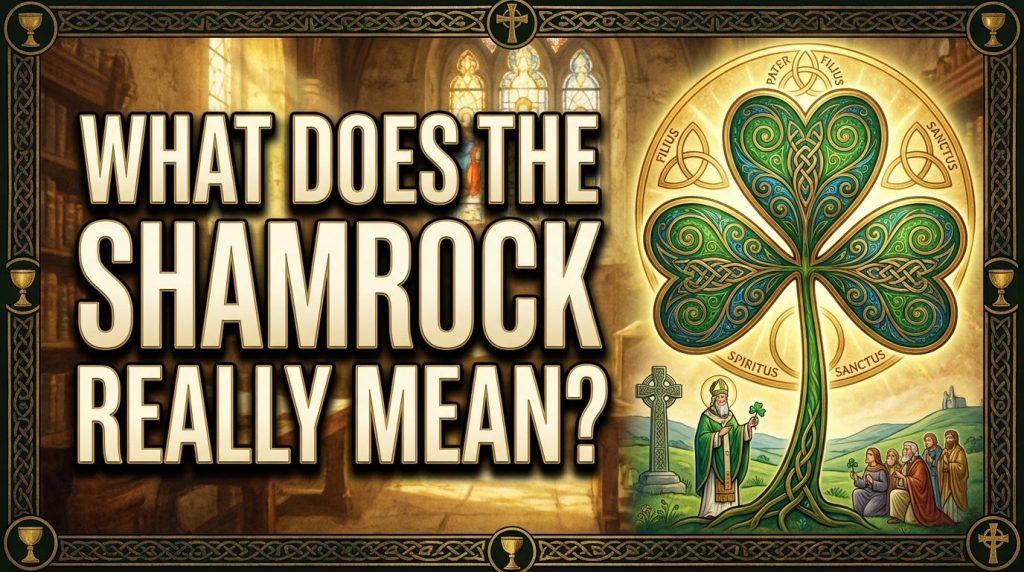
- The shamrock is a three-leafed plant that Saint Patrick supposedly used to explain the mystery of the Holy Trinity to the Irish people.
- The three leaves represent the Father, Son, and Holy Spirit, three distinct Persons sharing one divine nature.
- While the shamrock teaching story may be legendary rather than historically verified, it effectively illustrates a complex theological truth.
- The shamrock became strongly associated with Irish Catholic identity and Saint Patrick’s feast day celebrations.
- Understanding the shamrock helps Catholics appreciate how natural symbols can make abstract doctrines more accessible and memorable.
- The symbol demonstrates the value of using creation to point toward the Creator and spiritual realities.
Historical Background of the Shamrock Tradition
The association between Saint Patrick and the shamrock appears in written sources beginning in the eighteenth century, though oral tradition may preserve earlier connections. The earliest known reference to Patrick using the shamrock appears in writings from the 1700s rather than in ancient texts from Patrick’s own time in the fifth century. This late documentation does not necessarily mean the tradition is false, as many oral traditions existed long before being written down. However, it does mean historians cannot verify with certainty that Patrick actually used a shamrock to teach about the Trinity. The story may have developed over centuries as a way to remember and honor Patrick’s successful evangelization of Ireland.
Whether historically accurate or not, the shamrock teaching represents the kind of creative evangelization Patrick likely employed. Missionaries to pagan peoples often used familiar natural objects and cultural practices as bridges to Christian truth. Patrick almost certainly drew on Irish familiarity with nature, symbols, and storytelling to communicate the Gospel. The shamrock, a common plant in Ireland, would have been readily available and recognizable to everyone. Its three leaves on one stem provided a simple visual aid for explaining the Trinity’s three Persons in one God. This pedagogical approach made theological concepts accessible to people without formal education.
The shamrock’s adoption as a symbol of both Saint Patrick and Ireland more broadly occurred gradually. By the seventeenth century, the shamrock appeared in connection with Irish identity and Catholic resistance to Protestant English rule. Wearing the shamrock became a way to express Irish Catholic identity during times of persecution. The plant’s association with Patrick, Ireland’s patron saint, gave it religious and national significance simultaneously. This dual meaning has characterized the shamrock ever since, representing both theological truth about the Trinity and cultural identity for Irish Catholics worldwide.
The Trinity Doctrine
The doctrine of the Holy Trinity stands at the center of Christian faith and presents one of theology’s greatest mysteries. Christians believe in one God who exists eternally as three distinct Persons: Father, Son, and Holy Spirit. These three Persons are not three gods but one God sharing a single divine nature. Each Person is fully God, yet there are not three gods but one God. Human reason cannot fully comprehend this mystery, which God has revealed through Scripture and which the Church proclaims in creeds and teaches in catechesis (CCC 253-256).
The Old Testament hints at God’s plural nature in subtle ways, though it primarily emphasizes monotheism against the surrounding pagan cultures. The creation account in Genesis has God saying, “Let us make man in our image” (Genesis 1:26). The prophet Isaiah heard the seraphim proclaim God as “Holy, holy, holy,” a triple repetition that later Christian interpreters saw as pointing toward the Trinity (Isaiah 6:3). These and other texts prepared for the fuller revelation of the Trinity that came through Jesus Christ. The New Testament clearly presents the Father, Son, and Holy Spirit as distinct yet united in the Godhead.
Jesus revealed the Trinity most explicitly by speaking of His Father and promising to send the Holy Spirit. He taught His disciples to baptize “in the name of the Father, and of the Son, and of the holy Spirit” (Matthew 28:19). The singular “name” rather than “names” indicates the oneness of God, while the three distinct references point to the three Persons. Saint Paul blessed the Corinthians with “the grace of the Lord Jesus Christ and the love of God and the fellowship of the holy Spirit” (2 Corinthians 13:13). These Trinitarian formulas in Scripture provided the foundation for the Church’s developing understanding of God’s triune nature.
The Shamrock as Teaching Tool
Visual aids and concrete examples help people grasp abstract concepts, and religious education is no exception. The shamrock’s three leaves growing from one stem provides a simple image that makes the Trinity’s paradox more understandable. Children and adults alike can see how three distinct parts can belong to one whole. While the analogy is imperfect, as all analogies for divine mysteries must be, it serves as a starting point for understanding. The shamrock does not explain the Trinity completely but gives people something concrete to hold onto as they contemplate this profound mystery.
Using nature to teach spiritual truths has solid biblical precedent. Jesus constantly drew on natural imagery in His parables and teachings. He compared the kingdom of God to seeds, yeast, pearls, and fishing nets. He pointed to birds and flowers as examples of God’s providential care. He used bread and wine to represent His Body and Blood. These natural symbols helped people grasp supernatural realities. Patrick’s alleged use of the shamrock fits perfectly within this biblical pattern of seeing creation as revealing the Creator. The physical world provides windows into spiritual truth for those with eyes to see.
The shamrock’s effectiveness as a teaching tool partly stems from its availability and simplicity. Unlike rare or exotic plants, shamrocks grow abundantly in Ireland. Anyone could find one and use it to remember the Trinity. The plant requires no special knowledge to identify or use. A parent teaching a child about God could pick a shamrock and explain the Trinity using its three leaves. A priest preparing people for baptism could incorporate the shamrock into his instruction. This democratic accessibility made the shamrock ideal for spreading understanding of the Trinity throughout Irish culture.
Limitations of the Shamrock Analogy
While useful, the shamrock analogy has limits that need acknowledgment. The three leaves are parts of the plant, suggesting that Father, Son, and Spirit are parts of God rather than each being fully God. This misunderstanding leads to the heresy of partialism, which divides God into components. Catholic theology insists that each Person of the Trinity possesses the complete divine nature. The Father is not one-third of God but fully God. The Son is not one-third of God but fully God. The Spirit is not one-third of God but fully God. The shamrock cannot perfectly represent this reality.
Another limitation is that the three leaves exist in spatial separation from each other, while the three Persons of the Trinity interpenetrate each other in what theologians call perichoresis. The Father, Son, and Spirit are distinct but not separate. They exist in eternal mutual indwelling and communion. The shamrock’s separated leaves cannot adequately show this intimate union. Furthermore, the shamrock is a created thing subject to change and decay, while God is uncreated, eternal, and unchanging. Any created analogy for God will necessarily fall short of the divine reality.
Teachers using the shamrock should acknowledge these limitations while still appreciating the symbol’s value. The shamrock works as an introduction or memory aid but cannot replace proper theological instruction. After using the shamrock to introduce the Trinity concept, catechists should explain more fully what the Church teaches about the three Persons and one God. They should clarify that God is not like a shamrock in the sense of having parts, but that the shamrock can help us begin thinking about threeness and oneness together. This honest approach respects both the symbol’s utility and the mystery’s transcendence of all human concepts and images.
The Shamrock and Irish Catholic Identity
The shamrock’s association with Saint Patrick made it a natural symbol for Irish Catholics, especially during periods of persecution. When Catholics could not openly practice their faith under Protestant English rule, wearing the shamrock became a subtle way to declare one’s religious identity. The plant’s connection to Patrick and the Trinity meant that displaying it expressed both Catholic doctrine and Irish heritage. This double significance gave the shamrock power as a symbol of resistance and cultural survival. Irish Catholics maintained their identity partly through such symbols when more overt expressions were dangerous.
Saint Patrick’s Day celebrations on March 17 prominently feature shamrocks in decorations, clothing, and imagery. The feast honors Ireland’s patron saint and his successful evangelization of the island. Catholics attending Mass on this day often wear shamrocks as a sign of devotion to Patrick and connection to Irish heritage. Churches might incorporate shamrock decorations or use the symbol in homilies explaining the Trinity. Schools in Irish communities teach children about Patrick and the shamrock, passing cultural and religious knowledge to new generations. These annual celebrations keep the shamrock’s religious meaning alive.
Irish immigration spread shamrock symbolism worldwide. Irish Catholics in America, Australia, and other countries used the shamrock to maintain connection with their homeland and heritage. Saint Patrick’s Day parades and celebrations in diaspora communities featured shamrocks prominently. Church parishes founded by Irish immigrants often incorporated shamrock imagery in their buildings or materials. Over time, the shamrock became recognizable even to non-Irish people as a symbol of Irish identity. This cultural diffusion made the shamrock one of the most widely known religious symbols, though many who display it may not know its Trinitarian meaning.
Botanical Facts About Shamrocks
The shamrock is not actually a distinct plant species but a common name applied to several small clover-like plants. The most likely candidate for the traditional shamrock is white clover, known scientifically as Trifolium repens. Young white clover plants often have three leaflets, though mature plants may develop four, five, or more. Another possibility is lesser trefoil, Trifolium dubium, which also has three leaflets. Black medick, Medicago lupulina, represents yet another plant sometimes called shamrock. The uncertainty about which exact plant constitutes the “true” shamrock reflects the symbol’s folk origins rather than botanical precision.
All the plants called shamrock belong to the legume family and grow low to the ground with small leaves on short stems. They thrive in Ireland’s climate and are common in meadows, lawns, and roadsides. The leaves are actually leaflets, with three forming what looks like a single three-lobed leaf. This three-part structure provides the visual foundation for the Trinity symbolism. While four-leaf clovers are considered lucky in Irish folklore, they are mutations and not the traditional shamrock used to teach about the Trinity. The three-leafed version is essential for the theological symbolism to work.
The shamrock’s humble nature as a common weed rather than a rare or spectacular plant adds to its theological appropriateness. God often uses simple, ordinary things to reveal extraordinary truths. Jesus was born in a stable, not a palace. He called fishermen rather than scholars as His first disciples. He used bread and wine, everyday foods, for the Eucharist. The shamrock fits this pattern of divine humility and accessibility. God does not require rare or expensive things to make Himself known. A plant anyone can find serves perfectly well to teach the highest theological truth.
Alternative Trinity Analogies
Throughout Christian history, theologians and teachers have proposed various analogies for the Trinity, each with strengths and weaknesses. Saint Patrick of Ireland supposedly used the shamrock, but other teachers used different images. Some compared the Trinity to water’s three states: ice, liquid, and steam. This analogy shows one substance in three forms but fails because God is not one Person appearing in three modes. This mistake constitutes the heresy called modalism, which denies the real distinction between the Persons.
Others have compared the Trinity to a three-part object like an egg with shell, white, and yolk. This analogy shows three parts making one whole but suffers from the partialism problem. Each egg component is only part of the egg, not the full egg, whereas each Person of the Trinity is fully God. Some have used the sun with its heat, light, and substance as an analogy. This works better than some alternatives but still cannot capture the personal nature of the three divine Persons. The sun’s heat and light are not persons but attributes or emanations.
Mathematical formulas like 1x1x1=1 or 1+1+1=3 have been proposed to explain the Trinity’s arithmetic paradox. While interesting, these formulas reduce personal mystery to abstract calculation. The Trinity is not primarily a math problem to solve but a relationship of love to enter. The best approach acknowledges that all analogies fail ultimately and that the Trinity remains a mystery that exceeds human comprehension. We use analogies like the shamrock not to fully explain God but to give our minds and imaginations something to work with as we grow in understanding and worship.
The Shamrock in Catholic Art and Architecture
Irish Catholic churches often incorporate shamrock motifs in their decoration and design. Stained glass windows might feature shamrocks alongside images of Saint Patrick or Trinity symbols. Stone carving on capitals, doorways, or altars could include shamrock designs. These architectural elements create visual catechesis, teaching the faith through beauty and symbol. Visitors to Irish churches encounter shamrocks repeatedly, reinforcing the connection between this humble plant and the sublime mystery of the Trinity.
Liturgical items used in Irish Catholic worship sometimes feature shamrock decoration. Chalices, patens, and monstrances might be engraved with shamrocks. Vestments worn by priests could include embroidered shamrocks as part of their ornamentation. Altars and altar cloths might display the symbol. These liturgical uses connect the shamrock to the Church’s worship and sacramental life. When priests celebrate Mass using shamrock-decorated vessels, the symbol links to the eucharistic mystery where Christ becomes present under the signs of bread and wine.
Devotional objects like rosaries, medals, and holy cards frequently incorporate shamrock imagery, especially items produced in or for Irish Catholic communities. A rosary with shamrock-shaped beads or a medal showing Patrick holding a shamrock provides tangible connections to Irish Catholic spirituality. These objects travel with people who carry them in pockets or purses or display them in homes. The shamrock thus extends beyond church buildings into daily life, serving as a portable reminder of the Trinity and of Irish Catholic heritage.
Teaching the Trinity to Children
Religious educators face the challenge of explaining the Trinity to children in age-appropriate ways. The shamrock provides an accessible entry point for young minds. Teachers can show children an actual shamrock or pictures of one, asking them to count the leaves. When children identify three leaves, the teacher can explain that these three are all part of one plant. This simple observation introduces the Trinity concept of three Persons in one God. Children may not grasp the full theological depth, but they gain a basic framework that can be built upon as they mature.
Stories about Saint Patrick using the shamrock capture children’s imagination and make the doctrine memorable. Young children love stories, and a narrative about Patrick pulling a plant from the ground to teach Irish pagans sticks in memory better than abstract theological statements. Teachers can dramatize the story, perhaps having children pretend to be Patrick explaining the Trinity to Irish people. This active, story-based approach suits how children learn and helps them retain the information. The shamrock becomes not just a symbol but part of a larger narrative about faith and evangelization.
As children grow older, teachers should expand beyond the shamrock while still honoring its value. Older children can learn about the Trinity’s biblical foundations, the Church’s creedal formulations, and the Trinity’s importance for understanding God’s nature and the plan of salvation. They can discuss the shamrock’s limitations as an analogy while appreciating its helpfulness. This progressive education builds on the foundation laid by the shamrock introduction, moving from simple to complex understanding. The shamrock serves its purpose by opening a door that leads to deeper rooms of theological knowledge.
The Shamrock and Baptism
Baptism in the name of the Father, and of the Son, and of the Holy Spirit brings people into relationship with the triune God. The shamrock symbol can enrich understanding of what happens in this sacrament. When water is poured and the baptismal formula spoken, the person being baptized enters into communion with all three Persons of the Trinity. The Father adopts the baptized as His child. The Son shares His sonship with the new Christian. The Spirit comes to dwell within the baptized soul. The shamrock’s three leaves can help people visualize this Trinitarian dimension of baptism.
Some churches or families might incorporate shamrock imagery into baptismal celebrations, especially in Irish communities. Baptismal candles could be decorated with shamrocks. Baptismal certificates might feature the symbol. These uses connect baptism to Irish Catholic identity while emphasizing the Trinitarian reality of the sacrament. Parents and godparents could receive shamrock pins or cards as keepsakes from the baptism, objects that serve as reminders to teach the child about the Trinity as they grow.
The renewal of baptismal promises that occurs each Easter Vigil and on other occasions involves professing faith in the Trinity. Catholics renounce Satan and profess belief in God the Father, Jesus Christ the Son, and the Holy Spirit. The shamrock can serve as a visual reminder of these baptismal commitments. During Lent, when Catholics prepare for Easter and baptismal renewal, reflection on the shamrock and Trinity can deepen appreciation for the gift of baptism and the grace it confers.
Secular Appropriation and Commercialization
Saint Patrick’s Day has become highly commercialized, especially in countries with large Irish populations or tourism industries. Shamrocks appear on everything from beer advertisements to party decorations, often with little connection to their religious meaning. This secular appropriation concerns some Catholics who see the symbol’s sacred significance diluted or lost. When shamrocks become merely festive decorations associated with drinking and partying, their role as Trinity symbols fades from public consciousness. The commercialization of a religious symbol raises questions about maintaining sacred meaning in secular culture.
However, the shamrock’s secular popularity also creates evangelization opportunities. When people wear shamrocks or display them in homes and businesses, Catholics can use these occasions to explain the symbol’s religious meaning. A conversation about Saint Patrick’s Day can lead naturally to discussion of the Trinity and Christian faith. The shamrock’s visibility in secular contexts gives believers chances to share their faith in non-threatening ways. Rather than only lamenting secularization, Catholics can strategically use cultural interest in shamrocks as an opening for witness.
Maintaining the shamrock’s religious significance requires intentional effort in Catholic families and communities. Parents should teach children why they wear shamrocks on Saint Patrick’s Day and what the three leaves represent. Parishes should emphasize the feast’s religious character through Masses, processions, and educational programs. Schools can teach about Patrick’s life and mission alongside the shamrock tradition. When Catholics actively preserve and transmit the symbol’s meaning, it continues to function as a genuine religious symbol rather than merely a cultural decoration.
The Shamrock in Irish Catholic Spirituality
Beyond its specific Trinity symbolism, the shamrock represents broader themes in Irish Catholic spirituality. It reflects the Celtic Christian tradition’s attention to nature and creation as revealing God’s presence. Ancient Irish monasticism valued the natural world, seeing God’s hand in every created thing. Saint Columba, Saint Brendan, and other Irish saints composed prayers celebrating creation’s beauty and power. The shamrock tradition fits within this spirituality that finds God through the created world.
Irish Catholic spirituality often emphasizes God’s immanence alongside His transcendence. While God is infinitely beyond creation, He is also intimately present within it. Every plant, animal, stone, and stream can mediate divine presence for those who attend properly. The shamrock teaching exemplifies this sacramental imagination that sees the natural world as shot through with supernatural significance. For Irish Catholics formed in this tradition, using a plant to teach about God seems entirely natural and appropriate.
Contemporary Catholics can learn from Irish spirituality’s integration of nature and faith. In an age when many people feel disconnected from the natural world, the shamrock tradition reminds believers that creation itself preaches God’s glory. Taking time to observe plants, animals, and natural processes can become prayer and contemplation. The humble shamrock invites people to slow down, look closely, and see theological truth in a small green plant. This practice of attentive seeing can extend beyond shamrocks to all of creation, cultivating awareness of God’s presence everywhere.
Alternative Interpretations and Uses
While the Trinity meaning dominates shamrock symbolism, alternative interpretations exist. Some have seen the three leaves as representing faith, hope, and charity, the three theological virtues. This interpretation connects to the Trinity through the gifts that the triune God gives believers. Others have proposed that the leaves represent the unity of three lands: Ireland, Scotland, and Wales, all Celtic regions with shared heritage. This national or ethnic interpretation removes the religious dimension but maintains the unity-in-diversity theme.
In non-religious contexts, the shamrock simply symbolizes Ireland and Irish heritage without specific theological content. Irish sports teams, businesses, and cultural organizations use shamrocks in their logos and branding. People of Irish descent worldwide display shamrocks to express pride in their ancestry. This cultural use of the symbol differs from but does not necessarily contradict its religious meaning. Catholics of Irish heritage can appreciate both dimensions, seeing the shamrock as representing both their faith and their ethnic identity.
Some modern spiritual teachers have attempted to appropriate the shamrock for non-Christian religious purposes or for generic spirituality divorced from specific doctrines. These reinterpretations remove the symbol from its Christian context and assign it meanings foreign to its traditional usage. Catholics should be aware that not all shamrock symbolism retains Christian meaning. When encountering the symbol in various contexts, discernment helps determine whether it is being used authentically or appropriated for purposes incompatible with Catholic faith.
Ecumenical Dimensions
The Trinity doctrine stands as common ground among most Christian denominations. Catholics, Orthodox, and virtually all Protestants profess faith in the Trinity as revealed in Scripture and expressed in the Nicene Creed. The shamrock symbol, associated with Saint Patrick who lived before the Catholic-Orthodox split and long before the Reformation, can serve as a shared symbol for all Trinitarian Christians. When Christians from different traditions celebrate Saint Patrick together or use the shamrock to teach the Trinity, they express fundamental unity despite other disagreements.
However, not all groups claiming Christian identity accept Trinitarian doctrine. Unitarians, Jehovah’s Witnesses, and certain other groups reject the Trinity as unbiblical or incoherent. For these groups, the shamrock’s Trinity symbolism would be problematic or meaningless. This division over the Trinity represents one of the most fundamental theological splits within Christianity. The shamrock thus functions simultaneously as a symbol of ecumenical unity among Trinitarian Christians and as a marker of the boundary separating orthodox Christianity from heterodox movements.
Saint Patrick’s evangelization of Ireland occurred in a context of bringing the Gospel to pagans rather than engaging in intra-Christian disputes. His use of the shamrock, whether historical or legendary, shows the creativity needed to communicate Christian truth across cultural and religious barriers. Contemporary ecumenical and evangelistic efforts can learn from this approach. Finding common ground and using symbols that speak to people’s experience facilitates communication. The shamrock tradition encourages Christians to think creatively about how to share faith in ways that connect with people’s lives and understanding.
Conclusion and Ongoing Significance
The shamrock stands as a simple yet meaningful symbol in Catholic tradition. Whether or not Saint Patrick actually used it to teach about the Trinity, the story captures the spirit of creative evangelization that marked his mission. The three-leafed plant provides an accessible introduction to the profound mystery of the Trinity, helping people begin to grasp how God can be both one and three. While imperfect as all analogies must be, the shamrock serves its purpose of making abstract doctrine more concrete and memorable.
For Irish Catholics and their descendants worldwide, the shamrock represents both religious truth and cultural identity. It connects them to Saint Patrick, to Ireland’s Catholic heritage, and to the broader communion of faith. Wearing a shamrock on Saint Patrick’s Day can be simultaneously an act of cultural celebration and a profession of Trinitarian faith. The symbol’s dual significance enriches both dimensions, preventing faith from becoming merely intellectual or cultural identity from becoming merely secular.
The shamrock’s enduring popularity testifies to the power of simple symbols to carry profound meaning. In an age of complex theologies and elaborate explanations, the humble three-leafed plant still teaches truth effectively. Catholics who understand the shamrock’s meaning can use it to share faith with others, to teach children, and to renew their own appreciation for the Trinity. The symbol invites believers to see God’s revelation in creation and to allow natural objects to point them toward supernatural realities. Like the shamrock itself, faith should be both rooted in the earth and reaching toward heaven.
Disclaimer: This article presents Catholic teaching for educational purposes. For official Church teaching, consult the Catechism and magisterial documents. For personal spiritual guidance, consult your parish priest or spiritual director. Questions? Contact editor@catholicshare.com
Sign up for our Exclusive Newsletter
- 📌 Add CatholicShare as a Preferred Source on Google
- 🎁 Join us on Patreon for Premium Content
- 🎧 Check Out These Catholic Audiobooks
- 📿 Get Your FREE Rosary Book
- 📱 Follow Us on Flipboard
-

Recommended Catholic Books
Discover hidden wisdom in Catholic books — invaluable guides enriching faith and satisfying curiosity. #CommissionsEarned
- The Early Church Was the Catholic Church
- The Case for Catholicism - Answers to Classic and Contemporary Protestant Objections
- Meeting the Protestant Challenge: How to Answer 50 Biblical Objections to Catholic Beliefs
As an Amazon Associate, I earn from qualifying purchases. Thank you for your support.