
Brief Overview
- The rosary beads are a physical prayer tool consisting of a string of beads that Catholics use to count prayers while meditating on the mysteries of Christ’s life, death, and resurrection.
- The word “rosary” comes from the Latin “rosarium,” meaning rose garden, as each prayer is considered a spiritual rose offered to Mary.
- The standard rosary contains 59 beads arranged in five decades of ten beads each, with additional beads for introductory prayers and a crucifix.
- Saint Dominic is traditionally credited with receiving the rosary from Mary in a vision, though the devotion developed gradually over centuries.
- The rosary combines vocal prayer with meditation on Scripture, engaging both mind and heart in contemplation of salvation history.
- Praying the rosary with devotion brings numerous spiritual benefits including growth in virtue, deeper knowledge of Christ, and Mary’s powerful intercession.
The Physical Structure of the Rosary
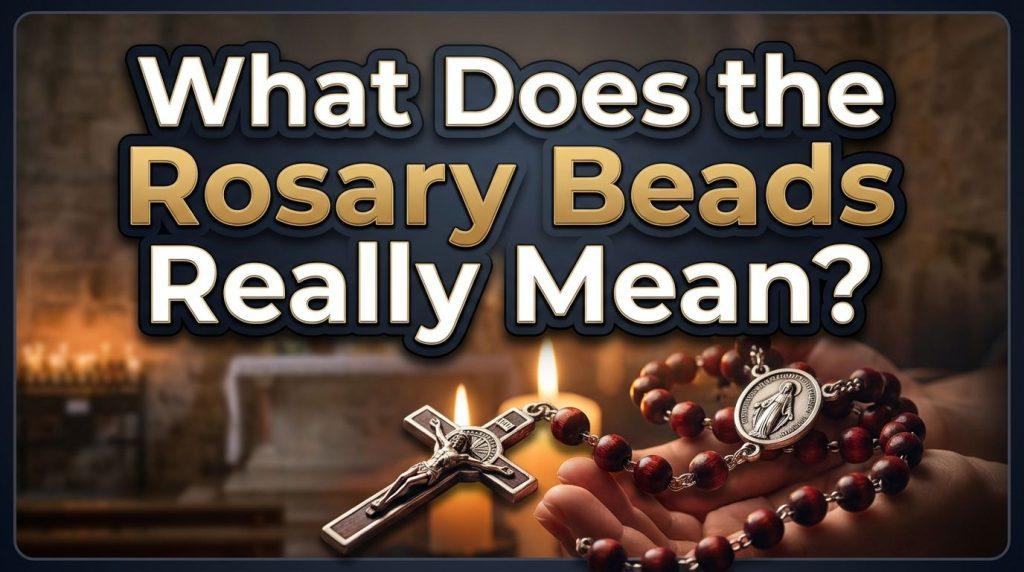
The rosary consists of beads organized in a specific pattern that facilitates the rhythm of prayers. A complete rosary contains 59 beads plus a crucifix and center medal. The main body of the rosary forms a circle with five groups of ten beads called decades. Between each decade sits a single bead separated slightly from the groups of ten. These single beads mark where the person prays the Our Father, while the ten beads in each decade mark the Hail Marys. The circle of decades connects to a short string called the pendant or stem. This pendant contains one bead, a center medal, three beads, and ends with a crucifix. The crucifix marks where prayer begins. The three beads on the pendant are for three Hail Marys prayed for the intentions of faith, hope, and charity. The single bead before them is for an Our Father. The center medal typically shows Mary on one side and Jesus or a saint on the other.
The beads can be made from various materials including wood, glass, stone, plastic, metal, or seeds. Simple wooden rosaries serve well for daily use. Precious stone rosaries may be family heirlooms or special gifts. Each material has advantages. Wood is lightweight and warm to touch. Glass beads catch light beautifully. Stone feels substantial. Seeds and natural materials connect prayer to creation. The material matters less than the use. A plastic rosary prayed faithfully has more value than a jeweled rosary gathering dust. However, beauty in the rosary can inspire devotion. People often take more care with objects they find beautiful. A well-made rosary can become a treasured possession passed through generations. The physical object serves as a tangible connection to family faith and personal prayer history.
Some rosaries include additional elements. Pocket rosaries fold into small cases for convenient carrying. Rosary rings fit on a finger with ten bumps representing a decade, allowing very discreet prayer. Wall rosaries hang as decorative reminders of devotion. Giant rosaries designed for group recitation allow multiple people to hold the same rosary. Cord rosaries tied from string are sometimes made by monks or devout Catholics. The Franciscan Crown rosary has seven decades instead of five, honoring the Seven Joys of Mary. Despite variations, the standard five-decade rosary remains most common. Its structure has proved ideal for the pattern of prayers Catholics have prayed for centuries. The physical form fits the spiritual function perfectly, making the rosary one of the most recognizable Catholic symbols worldwide.
Historical Development of the Rosary
The rosary as we know it today developed gradually over many centuries rather than appearing suddenly in final form. Early Christian monks in the desert prayed the 150 psalms regularly. Those who could not read or memorize all the psalms sought simpler alternatives. Some began praying 150 Our Fathers instead, using pebbles or knots on a cord to count. This practice of counting prayers on beads or knots spread throughout medieval Europe. Different regions developed different patterns and numbers. Some prayed 50 Ave Marias, others 150, still others various combinations. The prayer beads were not yet called rosaries but used the same basic principle of repetitive prayer counted physically. This practice existed across religions; Muslims used prayer beads for counting divine names, Buddhists for mantras, and Hindus for various prayers. The Christian version adapted this universal human tendency to use physical objects for counting spiritual practices.
The tradition attributes the rosary to Saint Dominic, who allegedly received it from Mary in a vision in 1214. She reportedly gave him the rosary as a weapon against the Albigensian heresy threatening southern France. Dominic taught the rosary to the people, and its power converted heretics and strengthened Catholics. However, historians note that this story first appears in writings from the 15th century, over 200 years after Dominic’s death. Contemporary accounts of Dominic’s life and writings by his companions make no mention of the rosary. This has led scholars to conclude that the rosary probably developed gradually during the 13th and 14th centuries, becoming more formalized in the 15th century. The connection to Dominic likely represents attributing to a beloved saint what was actually a collective development. Whether or not Dominic received the rosary in a vision, the Church has approved this devotion as powerful and effective for growing in holiness.
The modern form of the rosary crystallized in the 15th and 16th centuries. Blessed Alan de la Roche, a Dominican friar, promoted rosary devotion extensively and founded the first Rosary Confraternity. He developed the practice of meditating on mysteries while praying decades, transforming the rosary from simple vocal repetition into contemplative prayer. The addition of mysteries gave the rosary structure and content. Instead of merely repeating words, people now meditated on Scripture and salvation history. Pope Pius V officially established the rosary’s form in 1569 after the Christian victory at the Battle of Lepanto, which many attributed to rosary prayers. He designated October 7 as the Feast of Our Lady of the Rosary. Subsequent popes added to rosary theology and practice. Pope John Paul II added the Luminous Mysteries in 2002, expanding the traditional fifteen mysteries to twenty. This addition filled a gap by including mysteries from Christ’s public ministry between His childhood and passion.
The Mysteries of the Rosary
The rosary’s spiritual power comes primarily from meditating on the mysteries while praying. Each decade focuses on a specific event from Christ’s life or Mary’s life with Christ. The mysteries are divided into four sets. The Joyful Mysteries include the Annunciation, the Visitation, the Nativity, the Presentation in the Temple, and the Finding in the Temple. These mysteries cover events from Christ’s conception through His childhood. They focus on joy, but also hint at future suffering. Simeon’s prophecy at the Presentation foreshadows the sword that will pierce Mary’s heart. The Joyful Mysteries are traditionally prayed on Mondays and Saturdays. They teach about the Incarnation, humility, obedience, and joy in serving God’s will.
The Luminous Mysteries include Christ’s Baptism in the Jordan, the Wedding at Cana, the Proclamation of the Kingdom, the Transfiguration, and the Institution of the Eucharist. Pope John Paul II introduced these mysteries to provide more complete coverage of Christ’s public ministry. They focus on light, as Christ reveals His divine nature and mission. The Baptism shows the Trinity. Cana demonstrates His power and marks the beginning of His signs. The Proclamation teaches the Kingdom’s nature and demands conversion. The Transfiguration reveals His glory to chosen disciples. The Eucharist gives His Body and Blood as food for eternal life. The Luminous Mysteries are prayed on Thursdays. They teach about revelation, transformation, mission, and the sacramental life.
The Sorrowful Mysteries include the Agony in the Garden, the Scourging at the Pillar, the Crowning with Thorns, the Carrying of the Cross, and the Crucifixion. These mysteries meditate on Christ’s passion and death. They are the most painful to contemplate but also the most salvific. Christ’s suffering purchased our redemption. Each mystery shows a different aspect of His sacrifice. The Agony reveals His human fear and divine obedience. The Scourging and Crowning display brutal cruelty He endured. The Carrying shows His strength failing under the cross’s weight. The Crucifixion culminates His offering. The Sorrowful Mysteries are prayed on Tuesdays and Fridays. They teach about redemptive suffering, the cost of sin, Christ’s love, and how to endure trials.
The Glorious Mysteries include the Resurrection, the Ascension, the Descent of the Holy Spirit, the Assumption of Mary, and the Coronation of Mary as Queen of Heaven. These mysteries focus on triumph over death and the glory that awaits faithful believers. The Resurrection proves Christ’s victory and validates His claims. The Ascension shows Him returning to the Father. Pentecost sends the Spirit to animate the Church. The Assumption honors Mary’s preservation from corruption. The Coronation recognizes her queenly dignity. The Glorious Mysteries are prayed on Wednesdays and Sundays. They teach about hope, the reality of heaven, the power of the Holy Spirit, and Mary’s unique role in salvation history.
The Prayers of the Rosary
The rosary combines several traditional Catholic prayers in a specific pattern. Each decade includes one Our Father, ten Hail Marys, and one Glory Be. The Our Father, also called the Lord’s Prayer, was taught by Jesus Himself (Matthew 6:9-13). It addresses God as Father and makes seven petitions. The first three petitions focus on God’s glory: hallowing His name, establishing His kingdom, and doing His will. The second four petitions focus on human needs: daily bread, forgiveness, help in temptation, and deliverance from evil. This prayer places God’s concerns before ours and teaches proper order in prayer. Jesus told His followers to pray this way, making it the most important Christian prayer after the Mass itself. The Our Father appears at the beginning of each decade, marking the transition to a new mystery.
The Hail Mary consists of three parts. The first part comes directly from Scripture. The angel Gabriel greeted Mary with “Hail, full of grace, the Lord is with you” (Luke 1:28). Elizabeth’s greeting added “Blessed are you among women and blessed is the fruit of your womb” (Luke 1:42). These biblical greetings became the first half of the prayer. The Church added the name Jesus and the second half: “Holy Mary, Mother of God, pray for us sinners now and at the hour of our death.” This addition asks Mary’s intercession at the two most important moments: present life and death. The Hail Mary thus combines Scripture and Church tradition. It honors Mary with her biblical titles and requests her prayers. Praying this prayer ten times per decade creates a meditative rhythm that helps focus the mind on the mystery being contemplated.
The Glory Be, or doxology, gives praise to the Trinity. “Glory be to the Father, and to the Son, and to the Holy Spirit. As it was in the beginning, is now, and ever shall be, world without end. Amen.” This ancient Christian prayer concludes each decade, directing all honor to God. The rosary’s structure ensures that glory ultimately goes to God, not to Mary. Mary receives honor and requests for intercession, but praise and worship belong to God alone. Some rosary prayers include the Fatima Prayer added after each decade: “O my Jesus, forgive us our sins, save us from the fires of hell, and lead all souls to heaven, especially those in most need of your mercy.” This optional addition emphasizes mercy and concern for salvation of all souls, particularly the most endangered.
The complete rosary begins with the Apostles’ Creed prayed while holding the crucifix. This statement of faith professes belief in God, Christ, the Holy Spirit, and the Church’s essential doctrines. Beginning with the Creed grounds rosary prayer in Catholic faith, preventing it from becoming mere repetition. After the Creed comes an Our Father, three Hail Marys, and a Glory Be on the pendant beads. Then the person announces the first mystery, prays an Our Father, ten Hail Marys while meditating on the mystery, and a Glory Be. This pattern repeats for five decades. Many conclude with the Hail Holy Queen and a closing prayer. The entire sequence takes about twenty minutes when prayed at a moderate pace, making it accessible to most people’s schedules.
Spiritual Benefits of Praying the Rosary
The Church teaches that the rosary brings numerous spiritual benefits to those who pray it with devotion. First, it deepens knowledge of Christ and His mysteries. Regular meditation on the events of salvation history familiarizes believers with Scripture and Church teaching. The mysteries cover Christ’s entire life from conception to His mother’s coronation in heaven. Repeated contemplation of these events over years engraves them on the heart. The rosary becomes a form of Scripture meditation accessible even to those who struggle with formal biblical study. The mysteries teach everything essential about who Jesus is, what He did, and what He offers believers. This knowledge is not merely intellectual but experiential, gained through prayerful pondering rather than academic analysis.
Second, the rosary cultivates virtues by presenting models to imitate. The mysteries show Mary’s faith, humility, and obedience. They display Christ’s love, patience, and courage. They reveal the apostles’ growth from weakness to strength. Meditating on these examples inspires imitation. When facing trials, remembering Christ’s passion gives courage to endure. When tempted to pride, recalling Mary’s humility teaches proper perspective. The mysteries function as spiritual formation, shaping character through repeated exposure to virtue. Some spiritual writers assign specific virtues to each mystery, directing meditation toward particular growth areas. For example, the Annunciation teaches humility and trust, the Nativity poverty and simplicity, the Carrying of the Cross patience and resignation to God’s will.
Third, the rosary obtains grace through Mary’s intercession. Catholics believe Mary hears prayers and intercedes powerfully with her Son (CCC 969). She desires all people to be saved and uses her influence for that purpose. Countless testimonies throughout history describe conversions, healings, and deliverances obtained through rosary prayers. These accounts come from all social classes and cultures. Popes, saints, scholars, workers, and simple faithful all witness to the rosary’s power. While individual accounts cannot be verified, their sheer number and consistency suggest genuine experiences of grace. Those who pray the rosary faithfully report that it changes their lives, giving strength against temptation, peace in suffering, and growth in love. These effects prove the rosary’s efficacy more surely than any miraculous cure could.
The Rosary and Marian Devotion
The rosary is quintessentially Marian, centered on Mary even while focusing on Christ. This paradox reflects Catholic understanding of Mary’s role. She always points toward her Son, never drawing attention to herself for its own sake. The rosary honors Mary by addressing the Hail Mary to her repeatedly. Yet each decade meditates on Christ’s mysteries, not Mary’s achievements. The prayer asks Mary to pray for us but gives glory to God. This structure prevents confusion between honoring Mary and worshiping God. Those who pray the rosary rightly understand that Mary is creature, not Creator, and that her power comes from Christ’s grace. She deserves honor because God first honored her by choosing her as His mother. Catholics honor her because refusing to do so would contradict God’s own choice.
Mary’s apparitions at Lourdes and Fatima strongly promoted rosary devotion. At Lourdes in 1858, Mary appeared eighteen times to Bernadette Soubirous, holding a rosary and praying it with the girl. This simple action taught that even the Mother of God prays the rosary, validating its use at all levels of holiness. At Fatima in 1917, Mary appeared six times to three shepherd children, identifying herself as the Lady of the Rosary and requesting that people pray the rosary daily for world peace. She showed the children visions of hell to motivate prayer and penance. The Fatima messages included strong emphasis on the rosary as a spiritual weapon against evil. These apparitions, officially approved by the Church, gave the rosary renewed prominence in modern Catholicism. Millions of Catholics pray the rosary specifically because Mary asked for it at Fatima.
Mary’s relationship to the rosary reflects her relationship to Christ and to believers. She is the one who said yes to God’s plan, enabling the Incarnation. She bore Christ in her womb, raised Him, stood by Him at the cross, and was present at Pentecost. Her life intertwines completely with salvation history. The rosary mysteries tell her story as well as Christ’s. She is present at the Annunciation, Visitation, Nativity, Presentation, and Finding. She appears implicitly in the Luminous Mysteries. She stands at the cross during the Crucifixion. She is assumed and crowned in the Glorious Mysteries. The rosary thus honors Mary by recounting her participation in redemption. Yet every mystery ultimately reveals Christ, showing Mary’s role as always directing attention toward Him rather than toward herself.
Meditative Prayer Through Repetition
The rosary’s repetitive nature sometimes puzzles non-Catholics who associate repetition with the “vain repetitions” Jesus condemned (Matthew 6:7). However, Jesus was criticizing thoughtless babbling by pagans who believed long prayers would force gods to answer. He was not condemning all repetitive prayer. Jesus Himself prayed the same words three times in Gethsemane (Matthew 26:44). The psalms contain many repeated phrases and refrains. Jewish prayer includes repeated blessings and formulas. Repetition in prayer serves several purposes when done properly. First, it creates rhythm that helps quiet the mind and focus attention. The repeated words become like breathing, happening automatically while the mind contemplates deeper truths. Second, it expresses persistence in asking, showing earnestness rather than casual requesting.
The rosary’s repetition functions similarly to mantras in Christian mysticism, though with important differences. Eastern Christian hesychast tradition uses the Jesus Prayer repeated constantly. Western mystics recommend brief prayers repeated many times. These practices use repetition to still the mind and open it to God’s presence. The rosary operates this way. The vocal prayers provide structure and occupy the surface mind while the deeper consciousness meditates on the mysteries. The words are not vain because they express genuine devotion. They are not thoughtless because they accompany active meditation. The mouth prays the Hail Mary while the mind contemplates the Annunciation. The combination of vocal and mental prayer engages the whole person in an integrated act of worship.
This meditative quality makes the rosary suitable for all personality types and spiritual levels. Beginners appreciate the structure and simplicity. The prayers are few and simple to memorize. The decades provide natural stopping points, allowing people to pray just one or two decades if time is limited. Advanced practitioners appreciate the depth possible through contemplative engagement with mysteries. Some pray the rosary as pure contemplation, barely aware of the words as they sink into wordless union with God. The rosary thus scales from basic vocal prayer to mystical contemplation. It grows with the person, offering always something more to those who continue praying it throughout life. This flexibility explains its enduring popularity across very different types of Catholics.
The Rosary in Different Cultural Contexts
The rosary has spread to every continent and culture where Catholicism exists, adapting to local contexts while maintaining essential form. In Latin America, families gather for group rosary, often including sung responses and litanies. The rosary may take an hour or more with these additions. African Catholics incorporate local musical traditions, sometimes with drums and dancing. The prayers may be sung in call-and-response patterns familiar from indigenous culture. Asian Catholics pray the rosary in countless languages and dialects. Filipino Catholics pray the rosary in a distinctive sing-song tone that marks it as uniquely theirs. Vietnamese Catholics combine the rosary with traditional ancestor veneration practices in ways that honor both.
These cultural adaptations show the rosary’s flexibility and universality. The basic structure remains constant: five decades of ten Hail Marys with meditations on mysteries. Yet the expression varies enormously. Some cultures pray quickly, finishing the rosary in fifteen minutes. Others pray slowly and meditatively, taking forty-five minutes. Some sit quietly. Others walk, stand, kneel, or prostrate themselves. Some pray alone. Others gather in groups large enough to fill churches. The differences reflect local temperament, customs, and preferences. Yet all recognize that they are praying the same rosary Mary requested. This unity in diversity characterizes Catholic culture. The Church maintains essential unity while celebrating legitimate diversity. The rosary exemplifies this balance perfectly.
The rosary has become particularly important in cultures facing persecution or hardship. Polish Catholics prayed the rosary as resistance against Nazi and Communist oppression. Filipino Catholics prayed it against the Marcos dictatorship. Latin American Catholics use it in struggles for justice and peace. The rosary appears in protest movements, prison cells, and hospitals. People facing death often request the rosary as final comfort. This association with suffering connects to the Sorrowful Mysteries and to Mary’s presence at the cross. The rosary does not promise to prevent suffering but provides strength to endure it faithfully. Those who pray it regularly find it becomes second nature, available instantly in crisis. The words come automatically even when the mind is stressed or confused. This reliability makes the rosary particularly valuable in situations where complex prayer is impossible.
Common Obstacles and Misconceptions
Many people struggle to pray the rosary consistently despite desiring to do so. The main obstacle is distraction. The mind wanders during repetitive prayer, thinking about work, relationships, or random concerns. People finish a decade and realize they paid no attention to the mystery or even the words. This frustration discourages continued practice. However, spiritual directors teach that distraction is normal and does not invalidate prayer. The effort to return attention when it wanders is itself prayer. God sees the intention and values the struggle. Perfectionists who demand perfect concentration set an impossible standard. Better to pray an imperfect rosary than to stop praying because perfection eludes you. Regularity matters more than quality of each individual rosary.
Some find the rosary boring or tedious. Twenty minutes of repetitive prayer feels like punishment rather than devotion. This often indicates trying to pray without properly engaging the mysteries. The words alone are indeed repetitive. The mysteries provide the content that makes each decade different and interesting. Learning to meditate effectively on mysteries requires practice and patience. Some find reading about the mysteries beforehand helps. Others imagine themselves present at the events. Still others focus on specific virtues or lessons from each mystery. Finding what works takes experimentation. Different approaches may work for different mysteries or on different days. The key is recognizing that meditation is the rosary’s heart, not an optional addition.
Others question whether the rosary is biblical. They note that the prayer did not exist in the early Church and that the form comes from medieval tradition. However, the rosary’s content is thoroughly biblical. The Our Father comes directly from Jesus. The Hail Mary quotes Scripture. The mysteries recount Gospel events. Meditation on Scripture was practiced from Christianity’s beginning. The rosary simply provides a structured method for scriptural meditation that developed over centuries. Development of devotional practices does not make them invalid. The Church has authority to approve prayers and devotions that help believers grow in holiness. The rosary has proved its value across seven centuries of use. Millions of saints, scholars, and ordinary faithful testify to its power. This empirical evidence of effectiveness matters more than demands for explicit biblical warrant for the specific form.
Teaching Children to Pray the Rosary
Introducing children to the rosary requires age-appropriate approaches. Very young children cannot understand the mysteries or sit still for twenty minutes. Parents should start with single decades, perhaps one as bedtime prayer. The child can hold the rosary and feel the beads even if they cannot yet pray the words. This tactile connection creates positive associations. As children learn basic prayers, they can join in speaking them. A five-year-old might pray the Our Father while parents pray the Hail Marys. Gradually the child learns all the prayers and can participate fully. Making rosary prayer a normal part of family life teaches its importance without making it seem burdensome or strange.
Explaining the mysteries simply helps children understand what they are praying about. A parent might describe the Annunciation: “This is when the angel told Mary she would be Jesus’ mother, and she said yes.” The description need not be theologically complex. Children grasp basic narratives before they understand doctrinal nuances. Picture books about the rosary mysteries provide visual aids that engage young minds. Some families use rosary coloring books where children color a different mystery each day. Acting out mysteries through play helps kinesthetic learners. Dressing up as Mary, the shepherds, or the wise men makes the stories memorable. These creative approaches prevent the rosary from seeming like a boring obligation that parents force on unwilling children.
However, parents should not force the rosary on resistant teenagers. Adolescents often reject childhood practices as they establish independent identities. Forcing prayer creates resentment rather than devotion. Better to continue praying personally while inviting teens to join when they wish. Some teens abandon the rosary entirely for years but return to it as adults. The foundation laid in childhood remains even during periods of neglect. Parents should trust that seeds planted early will bear fruit eventually. They can share honestly how the rosary helps them personally without lecturing about what teens should do. Witnessing to genuine devotion influences more powerfully than rules and requirements. When prayer obviously matters to parents, children notice even if they do not immediately imitate.
The Rosary and Contemporary Life
Modern life presents challenges for traditional devotions like the rosary. Busy schedules, constant distractions, and secular culture make twenty minutes of repetitive prayer difficult. Yet many Catholics maintain rosary devotion despite obstacles. Some pray while commuting, turning travel time into prayer time. Others pray while exercising, walking, or doing housework. The rosary’s structure allows praying while doing other activities that do not require full mental attention. This portability is one of the rosary’s great advantages. It requires no book, special location, or particular posture. You need only beads and ten minutes of time. This accessibility has kept the rosary relevant across vast changes in how people live and work.
Technology offers both helps and hindrances for rosary prayer. Smartphone apps provide audio rosaries, allowing people to pray along with recordings. These apps track which mysteries to pray each day and can include images and explanations of mysteries. However, phones also create distractions. Notifications interrupt prayer. The temptation to check messages disrupts concentration. Some find that praying with physical beads works better than digital tools precisely because beads offer no distractions. Others appreciate technology’s assistance and use it fruitfully. As with most things, technology serves those who use it well and distracts those who let it control them. The rosary itself remains unchanged; only the tools we use to support the practice differ.
The rosary continues attracting new devotees even in secular societies. Young adults rediscovering faith often adopt the rosary as a concrete practice. Men’s rosary groups meet in parishes, providing fellowship and accountability. College students pray rosaries together. Military personnel carry rosaries and pray them in combat zones. These examples show that the rosary is not dying or becoming irrelevant. It persists because it meets real spiritual needs. People seeking peace, structure, and connection to tradition find all three in the rosary. Those wanting to honor Mary and deepen knowledge of Christ find the rosary ideal. The devotion has survived seven centuries of enormous cultural change. It will likely survive seven more because it addresses permanent human spiritual needs rather than temporary cultural fads.
Conclusion
The rosary beads are a physical prayer tool consisting of a structured set of beads that help Catholics count prayers while meditating on mysteries of Christ’s life. The standard rosary contains 59 beads arranged in five decades with a crucifix and pendant for introductory prayers. The devotion developed gradually over centuries, crystallizing in its current form during the 15th and 16th centuries. The mysteries include Joyful, Luminous, Sorrowful, and Glorious sets covering Christ’s life from conception to His mother’s coronation. The prayers combine the Our Father, Hail Mary, and Glory Be with meditation on biblical events. Praying the rosary brings spiritual benefits including deeper knowledge of Christ, growth in virtue, and Mary’s powerful intercession. The rosary is intensely Marian while ultimately focusing on Christ, reflecting Catholic understanding of Mary’s role always pointing toward her Son. The repetitive structure creates meditative rhythm that allows contemplative prayer accessible to believers at all levels. The rosary has adapted to every culture where Catholicism exists while maintaining essential unity. Common obstacles include distraction and boredom, overcome through patience and proper engagement with mysteries. Teaching children the rosary requires age-appropriate approaches that create positive associations without forcing devotion. Modern life presents challenges but the rosary remains relevant because it addresses permanent spiritual needs through portable, simple practice. The rosary is a time-tested devotion approved by the Church and practiced by countless saints. Those who pray it faithfully while meditating on the mysteries find it transforms their relationship with Christ and Mary, providing structure for prayer life and access to graces needed for growth in holiness.
Disclaimer: This article presents Catholic teaching for educational purposes. For official Church teaching, consult the Catechism and magisterial documents. For personal spiritual guidance, consult your parish priest or spiritual director. Questions? Contact editor@catholicshare.com
Sign up for our Exclusive Newsletter
- 📌 Add CatholicShare as a Preferred Source on Google
- 🎁 Join us on Patreon for Premium Content
- 🎧 Check Out These Catholic Audiobooks
- 📿 Get Your FREE Rosary Book
- 📱 Follow Us on Flipboard
-

Recommended Catholic Books
Discover hidden wisdom in Catholic books — invaluable guides enriching faith and satisfying curiosity. #CommissionsEarned
- The Early Church Was the Catholic Church
- The Case for Catholicism - Answers to Classic and Contemporary Protestant Objections
- Meeting the Protestant Challenge: How to Answer 50 Biblical Objections to Catholic Beliefs
As an Amazon Associate, I earn from qualifying purchases. Thank you for your support.