
Brief Overview
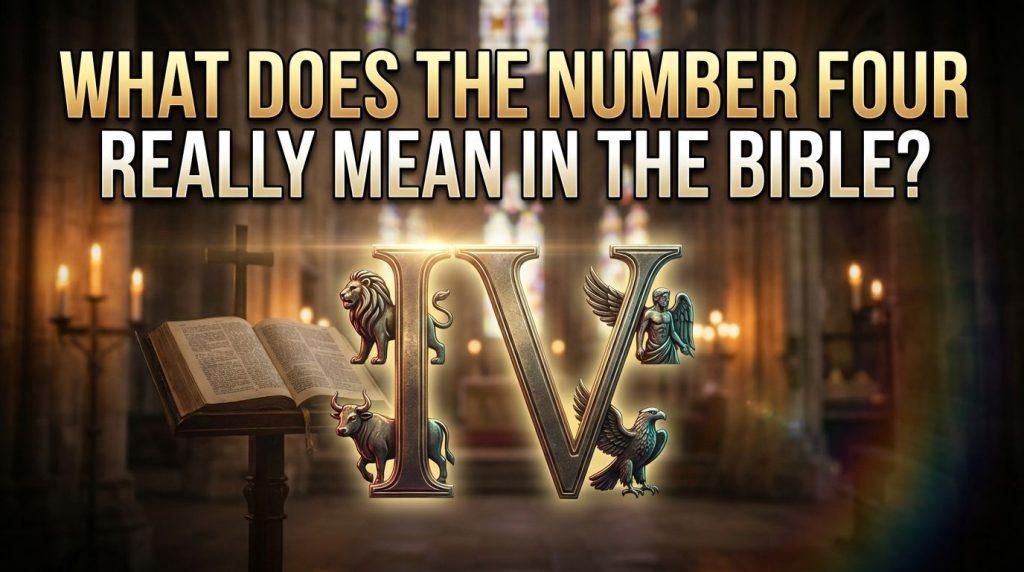
- The number four in Sacred Scripture represents universality, completeness in the created order, and the whole earth in its four directions.
- Biblical cosmology often describes the world through groups of four, including the four corners of the earth and the four winds of heaven.
- The four Gospels present a complete witness to Christ’s life and teaching, each offering a unique perspective on His identity and mission.
- Four living creatures appear in prophetic visions, representing all creation giving glory to God and proclaiming His holiness.
- God’s covenant promises extend to the four ends of the earth, encompassing all nations and peoples without exception.
- Understanding the biblical significance of four helps Catholics recognize how God’s plan embraces the entire created world and all humanity.
The Four Corners of the Earth
Scripture frequently refers to the four corners or ends of the earth when describing God’s universal reign and salvific will. Isaiah prophesies that the Lord will assemble the dispersed of Israel from the four corners of the earth. This expression does not imply that ancient Israelites believed in a flat earth but uses phenomenological language to describe the totality of geographical space. The four corners represent north, south, east, and west, covering every possible direction. No place falls outside God’s knowledge or power. The Book of Revelation uses similar imagery when describing angels standing at the four corners of the earth, holding back the four winds. This vision emphasizes God’s control over all natural forces and His ability to intervene anywhere in creation. The number four in these contexts signifies completeness and comprehensiveness. God’s actions affect the whole world, not just one region or people. His judgment reaches every corner of the earth, and His salvation extends to all nations. The prophets proclaimed that knowledge of the Lord would cover the earth as waters cover the sea, indicating universal spread of divine truth. Jesus commanded His disciples to make followers from all nations, fulfilling prophecies about light coming to the four corners of the earth. The early Church understood its mission as extending to the ends of the earth, wherever human beings lived. The number four reminds believers that Christianity is not a local or ethnic religion but a universal faith for all peoples (CCC 831).
Four Rivers of Paradise
The Genesis account describes four rivers flowing from Eden to water the garden and the surrounding lands. The Pishon, Gihon, Tigris, and Euphrates represent the fullness of God’s provision for creation. These four rivers brought life-giving water to different regions, sustaining plants, animals, and eventually human civilization. The number four suggests that God’s blessing extends in all directions from the center of His presence. Paradise was not a selfish hoarding of resources but a source of abundance overflowing to the world. Some Church Fathers interpreted the four rivers allegorically as representing the four Gospels that flow from Christ and bring spiritual life to all nations. This reading sees Eden as a type of the Church, from which streams of grace flow to refresh and renew humanity. Others connected the four rivers to the four cardinal virtues of prudence, justice, fortitude, and temperance. These moral strengths flow from God’s grace and enable people to live rightly in every direction of life. The literal meaning remains important as well, showing God’s care for material creation and physical sustenance. The four rivers demonstrate that spirituality does not despise or ignore bodily needs. God provides water for drinking, irrigation for crops, and transportation routes for commerce. The number four emphasizes the completeness of divine provision, meeting every genuine need from every angle.
Four Living Creatures
Ezekiel’s vision and the Book of Revelation both describe four living creatures surrounding God’s throne and ceaselessly worshiping Him. Each creature has a different face, representing distinct aspects of creation. One has the face of a lion, symbolizing wild animals and strength. Another bears the face of an ox, representing domestic animals and service. The third has a human face, standing for rational creatures and intelligence. The fourth displays an eagle’s face, signifying birds and transcendence. Together, these four creatures encompass all animate creation, from the strongest beasts to rational humans to soaring birds. Their constant worship shows that all creatures exist to glorify God, each in its own way. Early Christian tradition associated these four living creatures with the four Evangelists. Matthew’s Gospel emphasizes Christ’s humanity and kingship, corresponding to the human face. Mark presents Christ as the suffering servant, like the ox bearing burdens. Luke highlights Christ’s sacrifice and priestly role, connecting to the sacrificial ox as well. John’s Gospel soars to theological heights, depicting Christ’s divine nature like an eagle flying toward heaven. The number four in this symbolism indicates the completeness of the Gospel witness. Four perspectives provide a full portrait of Christ that one or two accounts could not achieve. Each Evangelist contributes essential elements to Christian understanding of Jesus’s identity and work.
Four Gospels
The Church has always maintained exactly four Gospels as canonical Scripture, rejecting both attempts to reduce them to one harmonized account and efforts to add other gospels. Matthew, Mark, Luke, and John each present Christ from a distinct angle while maintaining complete harmony on essential facts and teachings. Matthew wrote primarily for Jewish Christians, emphasizing how Jesus fulfilled Old Testament prophecies and represented the new Moses. Mark produced the shortest and most action-focused Gospel, probably based on Peter’s preaching. Luke, a companion of Paul, wrote a carefully researched account for Gentile believers, stressing Christ’s compassion for outsiders and sinners. John composed the most theological Gospel, explicitly stating his purpose to demonstrate that Jesus is the Christ, the Son of God. These four accounts complement rather than contradict each other. Apparent differences in detail reflect the authors’ different purposes, audiences, and sources. Ancient biographies commonly presented the same events from various perspectives to provide fuller understanding. The fourfold Gospel testifies to Christ more powerfully than any single narrative could. The number four establishes reliable witness beyond dispute while avoiding both the limitation of a single viewpoint and the confusion of too many conflicting versions. Saint Irenaeus argued that four Gospels are fitting because there are four regions of the world and four principal winds, and the Church is scattered throughout the world. The Gospel needed to reach the four corners of the earth, so God provided four accounts to accomplish this mission (CCC 126).
Four Elements of Ancient Cosmology
Ancient natural philosophy identified four basic elements composing all material things, earth, water, air, and fire. While modern chemistry has revealed far more complexity, this framework organized early scientific thinking and appears in biblical imagery. Earth represents solidity, stability, and foundation. Water signifies life, cleansing, and chaos requiring divine ordering. Air conveys breath, spirit, and the invisible forces sustaining existence. Fire embodies energy, transformation, and divine presence. Scripture uses all four elements in describing God’s actions and character. He laid the earth’s foundations and set boundaries for the seas. His breath gives life to all creatures, and His Spirit moves like wind. He appeared to Moses in a burning bush and descended on Sinai in fire. The four elements together represent the totality of physical creation. Nothing material exists outside their combination and interaction. This comprehensive view of nature suited biblical authors’ purposes when describing God’s universal sovereignty. The Psalmist praises God for making the winds His messengers and flames of fire His servants. Job describes how God controls rain, snow, lightning, and earthquakes. The prophets depict coming judgment through upheavals in all four elements. Peter writes that the present heavens and earth are reserved for fire, while new heavens and a new earth will replace them. The number four in this elemental framework emphasizes God’s lordship over all physical reality, not just spiritual matters.
Four Cardinal Virtues
Classical moral philosophy identified four cardinal virtues upon which all other virtues depend, prudence, justice, fortitude, and temperance. Catholic theology adopted and enriched this framework, seeing these four as natural virtues accessible through reason and strengthened by grace. Prudence is practical wisdom that judges rightly about what to do in specific situations. It enables people to discern good from evil and choose appropriate means to good ends. Justice gives each person their due, respecting rights and fulfilling obligations. It governs relationships between individuals and communities, ensuring fairness and equity. Fortitude provides courage to face dangers and endure hardships for the sake of what is right. It stands firm against fear and perseveres through difficulties. Temperance moderates attractions to pleasure, keeping desires under rational control. It prevents excess and maintains proper balance in the use of good things. These four virtues work together to form integrated moral character. A person cannot fully possess one without developing the others as well. Prudence without justice becomes cunning manipulation. Justice without fortitude collapses when tested. Fortitude without temperance turns to recklessness. Temperance without prudence becomes mere timidity. The number four indicates that moral life requires multiple strengths working in harmony. No single virtue suffices for living well, just as no single direction encompasses the whole compass (CCC 1805-1809).
Four Horsemen of the Apocalypse
The Book of Revelation presents a vision of four horsemen riding forth to bring God’s judgment upon the earth. The first rides a white horse and goes forth conquering, which some interpret as Christ or the proclamation of the Gospel. The second rides a red horse and takes peace from the earth, bringing war and violence. The third rides a black horse and carries scales, representing famine and economic devastation. The fourth rides a pale horse and is named Death, with Hades following him. These four horsemen symbolize comprehensive judgment affecting all aspects of human existence. Conquest disrupts political order and national security. War destroys communities and families through violence. Famine attacks the basic necessities of life and survival. Death claims the ultimate victory over all human pretensions. The number four emphasizes that no area of life escapes God’s righteous judgment when the time comes. The horsemen ride to the four corners of the earth, sparing no region or people. This apocalyptic imagery served to warn readers that unfaithfulness to God produces terrible consequences. It also assured persecuted Christians that evil would not triumph forever. God would vindicate His people and establish justice throughout the world. The four horsemen represent forces that have always afflicted humanity but will reach their climax in the end times. Understanding them as comprehensive judgment prevents both complacency and despair, motivating faithful endurance while maintaining hope in God’s ultimate victory.
Four Seasons of the Year
The natural cycle of four seasons demonstrates God’s faithfulness and the order He built into creation. Genesis records God’s promise that as long as earth endures, seedtime and harvest, cold and heat, summer and winter, day and night will never cease. This covenant with creation establishes reliable patterns that enable agriculture and sustain life. Spring brings renewal and growth as plants emerge from winter dormancy. Summer provides warmth and long days for crops to mature. Autumn yields harvest and preparation for the coming cold. Winter imposes rest on the land and tests the endurance of living things. These four seasons work together to maintain ecological balance and productivity. The Psalmist praises God for making the moon to mark the seasons and the sun that knows its time for setting. Ecclesiastes reflects on how there is a time for every purpose under heaven, with activities appropriate to different seasons. The four seasons remind believers that God governs time as well as space. He ordained rhythms of work and rest, activity and dormancy, that reflect His own creative pattern. The Church’s liturgical year mirrors natural seasons, celebrating Christ’s birth in winter, His death and resurrection in spring, and the coming of the Spirit in early summer. This integration of sacred time with natural cycles helps believers see all of life as gift and opportunity for encountering God. The number four in the seasonal pattern emphasizes completeness and the cyclical nature of earthly existence.
Four Kinds of Soil
Jesus’s parable of the sower describes four types of soil that receive the seed of God’s word with different results. The path represents hard hearts where Satan immediately snatches away the word before it can take root. Rocky ground depicts shallow enthusiasm that springs up quickly but withers when trials come. Thorny ground shows hearts where worldly concerns and wealth choke the growing word and prevent fruitfulness. Good soil symbolizes receptive hearts that hear, understand, and produce abundant harvest. This fourfold classification encompasses all possible responses to the Gospel. Some reject it immediately through hardness or indifference. Others accept it emotionally but lack depth for sustained commitment. Still others believe but allow competing loves to stifle spiritual growth. Only those who receive the word with prepared hearts and maintain it through difficulties bear lasting fruit. The number four indicates the completeness of this analysis. No fifth category exists beyond these four possibilities. Jesus used this parable to explain why His preaching produced varied responses. Not everyone who hears becomes a disciple, yet the fault lies not with the seed but with the soil. The same Gospel that saves some bounces off others or gets crowded out. The parable calls believers to examine their own receptivity and cultivate good soil through prayer, study, and removal of obstacles. It also prepares evangelists for mixed results, preventing discouragement when some reject the message they faithfully proclaim.
Four Watches of the Night
Ancient Jewish practice divided the night into four watches for purposes of guard duty and timekeeping. The first watch lasted from sunset to about 9 PM. The second watch ran from 9 PM to midnight. The third watch extended from midnight to 3 AM. The fourth watch covered 3 AM until sunrise. This fourfold division appears in Jesus’s teaching about watchfulness and readiness for His return. He warns that the Son of Man will come at an hour when people do not expect, whether in the evening or at midnight or when the rooster crows or at dawn. These times correspond to the four watches of the night. The parable emphasizes that no one knows when the master will return, so servants must stay alert through all four watches. Spiritual vigilance cannot be limited to convenient hours but must persist constantly. The Gospels record that Jesus came to His disciples walking on water during the fourth watch of the night. This timing suggests that divine help often arrives in the darkest hour when human strength is exhausted. Peter’s threefold denial occurred during the nighttime watches while Jesus was on trial. The disciples slept in Gethsemane when Jesus needed them to watch and pray. These failures warn against spiritual complacency and overconfidence in one’s own strength. The number four in the night watches represents the totality of time during which believers must maintain faithfulness, not just when conditions are comfortable or danger seems distant.
Four Generations
Biblical genealogies and prophecies sometimes mention four generations when describing the span of divine promises or judgments. God told Abraham that his descendants would be strangers in a foreign land for four hundred years, after which the fourth generation would return. This prophecy found fulfillment when Israel left Egypt and entered Canaan. The Exodus narrative explains that God waited four generations because the iniquity of the Amorites was not yet complete. Divine patience allows time for repentance before judgment falls. Four generations represent a complete human lifetime from great-grandparent to great-grandchild. A person might live to see four generations of their family, providing continuity and transmission of tradition. The commandment warns that God visits the iniquity of fathers on children to the third and fourth generation of those who hate Him. This does not mean innocent descendants suffer for ancestors’ sins but that sinful patterns and their consequences often persist through multiple generations until someone breaks the cycle. Conversely, God shows steadfast love to thousands of generations of those who love Him and keep His commandments. The contrast between four generations of judgment and thousands of generations of blessing highlights God’s preference for mercy over wrath. The number four here represents a complete but limited span of time, sufficient for both warning and opportunity but not extending to infinity. It assures believers that evil does not reign forever and that repentance can redirect family trajectories.
Four Levels of Biblical Interpretation
Medieval Christian scholars developed a fourfold method for interpreting Scripture that remained influential for centuries. The literal sense explains what the text actually says through grammar, context, and historical background. The allegorical sense reveals how Old Testament events and persons prefigure Christ and the Church. The moral sense draws ethical lessons for how believers should live. The anagogical sense points to eternal realities and the fulfillment of all things in heaven. These four senses work together to extract Scripture’s full meaning and application. A passage about Israel crossing the Red Sea has literal meaning as historical event. Allegorically, it represents baptism and deliverance from sin. Morally, it teaches trust in God’s power to save. Anagogically, it points to the final exodus from this world to eternal life. Not every passage yields equally rich meaning on all four levels, but the framework prevents narrow or one-dimensional reading. The literal sense provides the foundation and controls the other interpretations. Allegory must respect the literal meaning and biblical context rather than imposing arbitrary connections. Moral application should flow naturally from the text’s teaching. Anagogical reading sees earthly realities as signs of heavenly fulfillment without denying their immediate significance. The number four in this system represents comprehensive engagement with God’s word, using all appropriate tools and perspectives to understand divine revelation (CCC 115-117).
Four Types of Law
Thomas Aquinas distinguished four kinds of law that govern reality and human action. Eternal law is God’s wise ordering of all creation according to His purpose. It exists in the divine mind as the plan by which all things are directed to their proper ends. Natural law is the participation of rational creatures in eternal law through their ability to discern good and evil by reason. It includes basic moral principles accessible to all people regardless of special revelation. Divine law is God’s explicit commands given through Scripture and Church teaching to guide people to their supernatural destiny. It supplements natural law where human reason is clouded by sin or needs guidance about revealed truths. Human law consists of specific regulations made by legitimate authority to promote the common good in particular societies. These four types of law form a hierarchy descending from God’s eternal wisdom to concrete human ordinances. Each level depends on those above it for validity and authority. Human laws contradict natural law are unjust and need not be obeyed. Natural law derives its binding force from participation in God’s eternal law. Divine positive law reveals truths that reason alone could not discover with certainty. The number four represents the completeness of the legal framework governing creation. Together these laws ensure that moral order pervades all levels of reality from divine mind to human community. Understanding this fourfold distinction helps Catholics relate different authorities and resolve apparent conflicts between religious and civil obligations.
Four Marks of the Church
The Nicene Creed professes belief in one, holy, catholic, and apostolic Church. These four marks identify the true Church founded by Christ and distinguish it from human organizations or splinter groups. Unity means the Church is one because of her source in the Trinity, her founder in Christ, and her soul in the Holy Spirit. This unity does not require uniformity of customs or organization but demands communion in faith, sacraments, and hierarchical structure. Holiness indicates that the Church is set apart for God and possesses the means of sanctification through word and sacrament. Her holiness comes from Christ and the Holy Spirit, not from the perfection of her members. Catholicity signifies universality in time and space, embracing all peoples and ages. The Church is catholic because she possesses the fullness of Christ’s teaching and extends to all nations. Apostolicity means the Church continues the mission and teaching of the apostles through unbroken succession of bishops from Peter and the Twelve. These four marks work together to identify the Church Christ established. An institution lacking any of the four marks cannot claim to be the true Church. Protestant communities that broke apostolic succession lost one essential mark. Groups that reject defined doctrines sacrifice unity in faith. Organizations limited to one culture or rejecting earlier tradition lack catholicity. The number four emphasizes that full authenticity requires all these characteristics together, not just some subset (CCC 811-870).
Four Beasts of Daniel
Daniel’s vision describes four beasts rising from the sea, representing successive world empires that would dominate Israel. The first beast resembled a lion with eagle’s wings, generally identified with Babylon. The second looked like a bear, often associated with the Medo-Persian Empire. The third appeared as a leopard with four heads and four wings, representing Greece under Alexander and his successors. The fourth beast was terrifying and powerful with iron teeth and ten horns, symbolizing Rome. These four beasts demonstrate that earthly kingdoms, however mighty, remain subject to God’s sovereignty and eventual judgment. Each beast has its season of dominance but yields to the next in God’s appointed time. The vision culminates with the Ancient of Days taking His throne and the Son of Man receiving everlasting dominion. This sequence assures believers that human empires do not control history. God raises up kingdoms and brings them down according to His purposes. The four beasts encompass the complete succession of powers that would oppress God’s people before the final establishment of His kingdom. The number four indicates totality, suggesting that no additional beast will arise after the fourth. When the last earthly empire falls, God’s eternal kingdom will replace all human governments. This eschatological hope sustained Jews under foreign domination and later encouraged Christians under Roman persecution.
Four Evangelists’ Symbols
Christian art and iconography traditionally represent the four Evangelists through the symbols derived from the living creatures in Ezekiel and Revelation. Matthew is depicted as a man or angel because his Gospel begins with Jesus’s human genealogy. Mark appears as a lion, reflecting his Gospel’s emphasis on Christ’s royal power and resurrection victory. Luke is shown as an ox, symbolizing Christ’s priestly sacrifice that his Gospel highlights. John takes the eagle, representing the soaring theological vision of his Gospel. These four symbols appear together in church architecture, manuscript illumination, and liturgical art. They surround images of Christ in majesty, showing how the fourfold Gospel testifies to His glory. The symbols remind believers that approaching Christ requires multiple perspectives. His humanity makes Him approachable and relatable. His kingship demands allegiance and obedience. His priesthood provides mediation and reconciliation. His divinity invites worship and contemplation. No single image or narrative exhausts Christ’s reality. The four Evangelists together provide what each alone cannot, a complete portrait suitable for all people and circumstances. The number four in this symbolism emphasizes the adequacy of the Gospel witness. Four perspectives suffice to reveal Christ to the world, and the Church needs no additional gospels or revelations to supplement what the canonical four provide.
Four Corners of the Altar
The Old Testament altar of sacrifice had four horns projecting from its four corners. These horns served both practical and symbolic purposes. Practically, they secured animals during sacrifice and provided places to tie ropes. Symbolically, they represented power, protection, and the extension of the altar’s sanctity in four directions. Blood from sacrifices was applied to the four horns, sanctifying the entire altar. A person fleeing from avengers could grasp the horns and claim sanctuary. The four corners suggested that the altar’s atoning function extended to the four corners of the earth. Sacrifices offered there had universal significance, not just local or tribal meaning. The Book of Revelation describes the four corners of the altar in the heavenly temple, maintaining this symbolism in the eternal worship before God’s throne. Some interpreters see the four horns as prefiguring the four ends of Christ’s cross, which accomplished the ultimate sacrifice. The cross extends its saving power to north, south, east, and west, gathering people from every nation. The number four emphasizes the comprehensive nature of atonement. No sin falls outside the scope of Christ’s sacrifice. No sinner lies beyond the reach of His blood. The four corners proclaim that salvation is genuinely universal, available to all who approach God through the appointed means.
Four Living Creatures in Worship
The Book of Revelation repeatedly describes four living creatures leading worship before God’s throne. They never rest day or night but continually cry holy, holy, holy is the Lord God Almighty, who was and is and is to come. When they give glory and honor and thanks to God, the twenty-four elders fall down and worship. This pattern shows that all creation owes God perpetual worship and thanksgiving. The four creatures represent different aspects of creation, yet they worship in harmony without competition or discord. Their fourfold nature suggests that worship should engage all dimensions of human existence. Intellect offers rational praise. Will commits itself in service. Emotions express love and reverence. Body participates through posture and voice. Fragmentary worship using only one or two aspects falls short of what God deserves. The four creatures also model the content of worship, proclaiming God’s holiness, power, and eternal nature. Their ceaseless activity reminds believers that worship never becomes obsolete or unnecessary. As long as God is God and creatures are creatures, praise remains appropriate and required. The number four in this heavenly liturgy establishes the pattern for earthly worship. Christian liturgy aims to join the song of the four living creatures and all the heavenly host. When the Church celebrates the Eucharist, she participates in the eternal worship that surrounds God’s throne in every moment.
Four Directions of Divine Gathering
Prophetic texts frequently describe God gathering His scattered people from the four directions or four winds. Isaiah prophesies that the Lord will assemble the banished of Israel from the four corners of the earth. Zechariah envisions God spreading His people abroad like the four winds of heaven. Jesus speaks of angels gathering the elect from the four winds, from one end of heaven to the other. These promises assure believers that no distance or obstacle can prevent God from reclaiming His own. Political exile, geographical separation, and historical dispersion do not thwart His purposes. When the time comes, He will summon His people from every direction and gather them into one family. The four directions emphasize the universality of this ingathering. It includes Jews and Gentiles, rich and poor, educated and simple. Every tribe, language, people, and nation will contribute members to the assembled throng. The early Church saw Pentecost as a first fulfillment, with the Spirit drawing people from many nations to faith in Christ. The final fulfillment awaits the second coming when Christ will gather all the elect for the marriage supper of the Lamb. The number four gives assurance that this gathering will be complete, missing no one whom God has chosen and called. It also challenges believers to participate in the mission of proclamation, taking the Gospel to all four directions rather than keeping it in one place or culture.
Conclusion and Application
The biblical meaning of the number four encompasses universality, completeness in the created order, and God’s comprehensive plan for all humanity. The four corners of the earth represent every geographical direction and all nations. Four rivers flowed from Eden to bring God’s blessing in all directions. Four living creatures symbolize all animate creation worshiping God together. The four Gospels provide a complete witness to Christ from complementary perspectives. Four cardinal virtues form the foundation of moral life. Four horsemen represent comprehensive judgment affecting all aspects of existence. Four seasons demonstrate God’s faithfulness in ordering creation. Four kinds of soil describe all possible responses to God’s word. Four night watches call for constant vigilance. Four generations mark complete spans of blessing or judgment. Four levels of interpretation help believers understand Scripture fully. Four types of law govern reality from divine mind to human society. Four marks identify the true Church. Four beasts represent the succession of earthly empires under divine sovereignty. Four Evangelist symbols remind viewers that Christ requires multiple perspectives to understand. Four horns on the altar point to universal atonement. Four living creatures lead heavenly worship. Four directions describe God’s universal gathering of His people. The number four thus serves throughout Scripture to emphasize totality, especially regarding the created world and God’s plan to reach all nations. Catholics should recognize these patterns as revealing divine intention that salvation extend to everyone everywhere. The consistent use of four in cosmological and universal contexts teaches that God’s concern encompasses the whole earth and all its peoples. Understanding the number four deepens appreciation for the Church’s missionary mandate and the comprehensive scope of Christ’s redemption.
Disclaimer: This article presents Catholic teaching for educational purposes. For official Church teaching, consult the Catechism and magisterial documents. For personal spiritual guidance, consult your parish priest or spiritual director. Questions? Contact editor@catholicshare.com
Sign up for our Exclusive Newsletter
- 📌 Add CatholicShare as a Preferred Source on Google
- 🎁 Join us on Patreon for Premium Content
- 🎧 Check Out These Catholic Audiobooks
- 📿 Get Your FREE Rosary Book
- 📱 Follow Us on Flipboard
-

Recommended Catholic Books
Discover hidden wisdom in Catholic books — invaluable guides enriching faith and satisfying curiosity. #CommissionsEarned
- The Early Church Was the Catholic Church
- The Case for Catholicism - Answers to Classic and Contemporary Protestant Objections
- Meeting the Protestant Challenge: How to Answer 50 Biblical Objections to Catholic Beliefs
As an Amazon Associate, I earn from qualifying purchases. Thank you for your support.