
Brief Overview
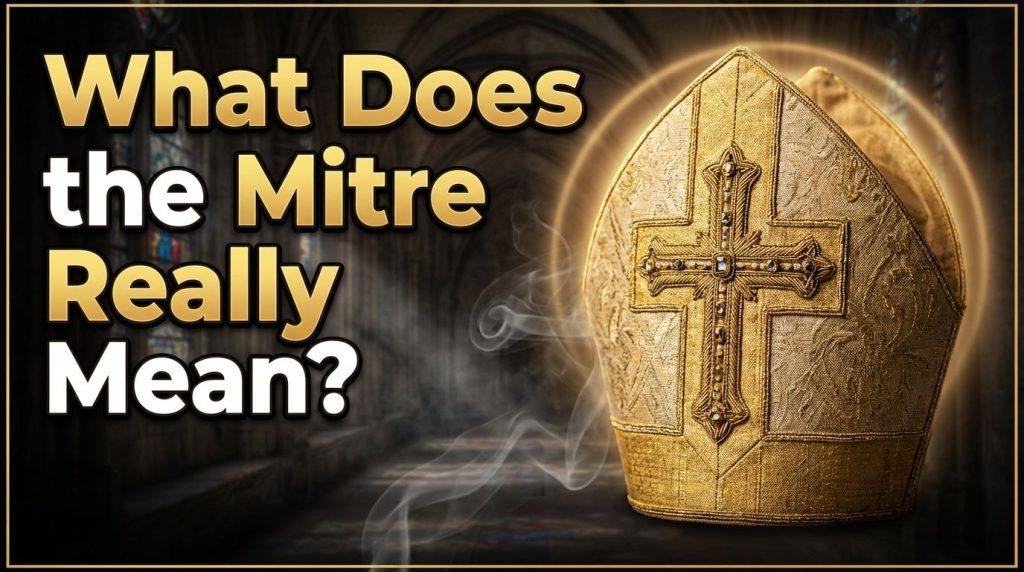
- The mitre is the distinctive ceremonial headwear worn by Catholic bishops as a visible sign of their episcopal dignity and teaching authority.
- The two peaks of the mitre symbolize the Old Testament and New Testament, representing the bishop’s responsibility to teach and guard both.
- The pointed shape of the mitre also recalls the tongues of fire that descended upon the apostles at Pentecost, linking bishops to apostolic succession.
- Catholic tradition recognizes three types of mitres used for different liturgical occasions: the mitra pretiosa, mitra auriphrygiata, and mitra simplex.
- The mitre has roots in ancient priestly traditions, with connections to the headwear worn by Aaron and the high priests of Israel.
- Bishops remove the mitre during prayers and the most sacred moments of the Mass to show reverence when directly addressing God.
The Historical Development of the Mitre
The mitre stands as one of the most recognizable symbols of Catholic episcopal authority and has a complex historical development spanning many centuries. The word mitre comes from the Greek word mitra, which originally meant a headband or diadem worn in ancient times. The use of distinctive headwear for religious leaders dates back to the Old Testament, where we read about the priestly turban worn by Aaron and his successors as high priests of Israel. In Exodus 29:6 and Leviticus 8:9, Scripture instructs that the high priest should wear a special head covering as part of his sacred vestments. This ancient practice established a pattern of using headwear to signify religious authority and sacred office. The early Christian Church initially did not adopt special headwear for bishops, as the focus was on simplicity and avoiding ostentation. However, as the Church’s liturgical life developed and became more elaborate, various vestments and insignia were introduced to visually represent the sacred duties and authority of ordained ministers.
The modern form of the mitre began to take shape during the 11th century, particularly during the period of church reform movements. Before this time, popes wore a non-liturgical head covering called the camelaucum, which was helmet-shaped, but this was not yet the distinctive two-peaked mitre we know today. The development from simpler headwear to the distinctive mitre happened gradually over several decades. By the 11th century, the mitre had emerged as a distinctive symbol first associated with the pope and only later extended to all bishops. Early mitres were quite different in appearance from modern ones, often being lower and rounder rather than tall and pointed. The transformation of the mitre’s shape occurred primarily between the 11th and 13th centuries, as the liturgical practices of the Western Church became more standardized and elaborate. During this medieval period, the mitre evolved from a simple cap to the distinctive two-peaked design that became universal.
The symbolic meaning attached to the mitre’s shape also developed during this medieval period. Church writers and theologians began to interpret the two peaks as representing various spiritual truths, with the most common interpretation being that they symbolize the Old and New Testaments. This interpretation emphasized the bishop’s role as a teacher who must understand and proclaim the fullness of divine revelation contained in Scripture. Another symbolic interpretation connected the mitre’s pointed shape to the tongues of fire that descended upon the apostles at Pentecost, as described in Acts 2:3. This connection emphasized the bishop’s role as a successor to the apostles, endowed with the Holy Spirit for the ministry of teaching and sanctifying God’s people. The use of the mitre gradually spread from Rome to bishops throughout the Western Church, and by the 12th century it had become a universal symbol of episcopal dignity. Eastern Christian traditions developed their own forms of episcopal headwear, often more crown-like in appearance, but the Western mitre became the standard in the Roman Catholic tradition.
The Three Types of Mitres
Catholic liturgical tradition distinguishes three different types of mitres, each used for specific occasions according to the solemnity of the celebration. This threefold classification reflects the Church’s attention to liturgical detail and the appropriate use of sacred vestments. The official ceremonial book, the Caeremoniale Romanum, formally distinguishes these three types and provides guidance on when each should be worn. The most elaborate is the mitra pretiosa, or precious mitre, which is decorated with jewels, gold embroidery, and other rich ornamentation. This mitre is worn on the greatest feast days of the liturgical year, such as Christmas, Easter, Pentecost, and other major solemnities. The precious mitre reflects the joy and glory of these celebrations and visually manifests the majesty of the mysteries being celebrated. Its rich decoration serves not to glorify the individual bishop but to honor the sacred liturgy itself and to express the Church’s desire to offer the very best to God in worship.
The second type is the mitra auriphrygiata, which is made of cloth of gold or white silk with gold embroidery and ornamentation. This mitre is less elaborate than the mitra pretiosa but still quite beautiful and festive. It is worn on important feast days and Sundays throughout the year when the liturgical celebration calls for solemnity but not the highest level of festivity. The golden mitre serves as an intermediate option between the simplest and most elaborate forms, allowing for appropriate gradation in liturgical vesture. The design of the auriphrygiata typically includes vertical and horizontal bands of gold embroidery, creating a cross pattern that emphasizes the centrality of Christ’s sacrifice. The use of gold in this mitre recalls the precious metals used in the Temple of Jerusalem and the general biblical association of gold with divine glory and kingship. The choice of which mitre to wear reflects both the liturgical season and the specific celebration, helping the faithful to understand through visual signs the relative importance of different feasts and seasons.
The simplest form is the mitra simplex, or simple mitre, made of plain white silk or linen without ornamentation. This mitre is worn during penitential seasons like Advent and Lent, at funerals, and on other occasions when liturgical simplicity is appropriate. The white color signifies purity and simplicity, and the lack of ornamentation reflects the penitential or somber character of these celebrations. Even in its simplest form, the mitre retains its essential symbolic shape and meaning, but the absence of decoration helps focus attention on the spiritual realities being celebrated rather than on external splendor. The simple mitre is also worn during certain parts of the liturgy when the bishop is performing less solemn functions, such as when he is seated listening to readings. The tradition of having three distinct types of mitres shows the Church’s careful attention to the principle that external signs should harmonize with and support the interior spiritual realities of the liturgy. This gradation in liturgical vesture helps the faithful to enter more fully into the various seasons and celebrations of the Church year.
Biblical and Theological Symbolism
The mitre carries rich biblical and theological symbolism that connects the bishop’s office to both Old and New Testament patterns of sacred ministry. The most fundamental connection is to the high priestly vestments described in the Book of Exodus. When God instructed Moses about the consecration of Aaron as high priest, specific garments were prescribed, including a head covering. Exodus 28:36-38 describes a plate of pure gold attached to the turban of the high priest, engraved with the words “Holy to the Lord.” This marked the high priest as consecrated for sacred service and as a mediator between God and his people. Catholic tradition sees a continuity between this Old Testament priesthood and the New Testament ministry of bishops, who are consecrated to offer the Eucharistic sacrifice and to shepherd God’s people. The mitre thus connects to an ancient tradition of sacred headwear that signifies consecration and separation for divine service. However, the Christian use of the mitre transforms and fulfills these Old Testament patterns in light of Christ’s high priesthood.
The New Testament understanding of the bishop’s role provides the deeper theological foundation for the mitre’s symbolism. According to the Catechism of the Catholic Church, bishops receive the fullness of the sacrament of Holy Orders and are constituted as true teachers, shepherds, and priests in the image of Christ himself (CCC 1558). The mitre visually represents this threefold office. The two peaks of the mitre symbolize the Old and New Testaments, signifying that the bishop must be thoroughly grounded in all of Scripture in order to teach the faith authentically. This interpretation emphasizes that bishops are not free to teach their own ideas but must faithfully transmit what has been handed down from the apostles. The bishop’s teaching authority is not autonomous but is rooted in Scripture and apostolic tradition. The pointed shape of the mitre serves as a constant reminder that the bishop’s ministry is directed upward toward God and must always point the faithful toward heavenly realities rather than merely earthly concerns.
The connection of the mitre to Pentecost provides another layer of theological meaning. The pointed shape of the mitre recalls the tongues of fire that appeared over the heads of the apostles when the Holy Spirit descended upon them on the day of Pentecost, as narrated in Acts 2:3-4. This event marked the birth of the Church and the empowerment of the apostles for their universal mission of preaching the Gospel. Bishops are successors of the apostles and share in this same apostolic mission and the same gift of the Holy Spirit received at ordination (CCC 1556). The mitre thus symbolizes the bishop’s participation in the apostolic office and his empowerment by the Holy Spirit for the ministry of sanctifying, teaching, and governing God’s people. The fire of Pentecost represents both the purifying action of the Holy Spirit and the fervor with which bishops should carry out their ministry. Just as fire gives light and warmth, so bishops are called to illuminate the darkness of error with the light of truth and to warm cold hearts with the fire of divine charity.
The mitre can also be understood in relation to Saint Paul’s image of the “helmet of salvation” mentioned in Ephesians 6:17 and 1 Thessalonians 5:8. In these passages, Paul uses military imagery to describe the spiritual armor that Christians must put on to resist evil and remain faithful to Christ. The helmet protects the head, which is the seat of reason and decision-making. Similarly, the mitre symbolically represents the bishop’s need for spiritual protection and divine wisdom in order to guard the faith and make sound judgments for the good of the Church. The bishop must protect his own mind from error and must also protect the minds of the faithful entrusted to his care. This protective symbolism is enhanced by the two peaks of the mitre, which can be understood as representing the two “horns” or powers of Scripture, the Old and New Testaments, with which the bishop defends the truth against falsehood. Medieval writers sometimes described the mitre as making the bishop “terrible to the opponents of truth,” not in a harsh sense but in the sense of being a formidable defender of orthodoxy.
The Mitre and Episcopal Office
The right to wear the mitre is intimately connected to the episcopal office itself and serves as one of the principal visible signs of a bishop’s authority and dignity. According to Church law and tradition, only the pope, cardinals, and bishops have the inherent right to wear the mitre. In some cases, special papal privileges have extended this right to certain abbots who govern important monasteries or to other prelates with quasi-episcopal jurisdiction. However, these exceptions are rare and always require explicit authorization. The mitre is not merely decorative but is an integral part of the episcopal insignia that includes the ring, crozier, and pectoral cross. Together, these items visually represent the bishop’s sacred office and his specific responsibilities within the Church. The giving of the mitre is part of the solemn rite of episcopal ordination, occurring near the conclusion of the ceremony. This presentation signifies the new bishop’s reception of the fullness of the priesthood and his entrance into the college of bishops, which collectively shares responsibility for the universal Church under the headship of the pope.
The mitre specifically symbolizes the bishop’s teaching office, which is one of his primary responsibilities. Bishops are authentic teachers of the faith, meaning they have the authority to teach in the name of Christ and with the assistance of the Holy Spirit (CCC 1558). This teaching office is not merely a matter of sharing opinions or personal insights but involves the solemn duty of preserving and transmitting the deposit of faith that has been handed down from the apostles. When a bishop wears the mitre during the homily at Mass, he visibly manifests his role as an authoritative teacher who speaks not on his own authority but in the person of Christ. The homily is a privileged moment when the bishop breaks open the Word of God for the faithful, helping them to understand its meaning and apply it to their lives. The mitre worn during this teaching moment serves as a visible reminder that the bishop’s words carry special authority because of his sacramental ordination and his place in apostolic succession.
The liturgical use of the mitre is carefully regulated by Church rubrics, which specify when the mitre should be worn and when it should be removed. These regulations are not arbitrary but reflect deeper theological truths about reverence and the nature of prayer. As a general principle, bishops wear the mitre when teaching or performing ceremonial functions but remove it when addressing God directly in prayer. This practice is rooted in Saint Paul’s instruction in 1 Corinthians 11:4, where he states that men should not cover their heads when praying. Following this apostolic guidance, bishops remove their mitres during the most sacred moments of the liturgy, particularly during the Eucharistic Prayer when they are offering the sacrifice in the person of Christ. The mitre is removed during the Gospel reading, during prayers such as the Collect, and during other moments when the bishop is acting primarily as a worshipper rather than as a teacher. This pattern of wearing and removing the mitre helps to distinguish between different liturgical roles and actions.
The symbolic significance of removing the mitre at key moments is important for understanding the bishop’s relationship with God and with the people. When the bishop wears the mitre, he stands before the people as Christ’s representative, teaching and governing with authority. When he removes the mitre, he acknowledges his own position as a servant and worshipper who must humble himself before God. This alternation between wearing and removing the mitre throughout the liturgy creates a visible rhythm that mirrors the dual nature of the bishop’s ministry. He is both a shepherd who leads the flock and a member of the flock who himself needs divine mercy and grace. The humility expressed by removing the mitre during prayer serves as an important reminder that all authority in the Church is ultimately from God and must be exercised in a spirit of service. The bishop’s willingness to uncover his head before God models the proper attitude of reverence and dependence that all Christians should have in their relationship with the Father.
The Lappets and Additional Features
The mitre includes several additional design features beyond its basic two-peaked shape, each carrying its own symbolism and practical function. The most noticeable of these features are the two lappets, which are bands of fabric that hang down from the back of the mitre. These lappets can vary in length and decoration depending on the type of mitre being worn. On the mitra pretiosa, the lappets are often richly embroidered with gold thread and may include jewels or other ornamentation. On the simpler mitres, the lappets are plain white fabric matching the body of the mitre. The origin of the lappets is somewhat unclear, but they may have developed from ribbons or ties that were originally used to secure the mitre to the bishop’s head. Over time, even as the functional need for these ties diminished, they were retained as decorative and symbolic elements. Some liturgical scholars suggest that the lappets recall the bands that ancient athletes would tie around their heads, connecting the bishop’s ministry to Saint Paul’s athletic imagery about running the race of faith.
The symbolic interpretation of the lappets varies in different sources, but a common understanding is that they represent the Old and New Testaments, complementing the symbolism of the two peaks. In this interpretation, the peaks represent the height and majesty of divine revelation, while the lappets hanging down represent the condescension of God’s Word in taking on human form and coming down to our level. Another interpretation sees the lappets as symbols of the bishop’s duty to remember both the spiritual and literal senses of Scripture. The spiritual sense points upward to heavenly mysteries, while the literal sense remains grounded in the concrete historical realities of salvation history. Yet another interpretation suggests that the lappets serve as reminders of obedience and humility, as they hang down behind the bishop and trail after him. This could symbolize that the bishop’s own will must be subordinate to God’s will and that he must follow where God leads rather than going his own way. These multiple layers of symbolism enrich the mitre’s meaning without requiring any single interpretation to be exclusively correct.
The interior construction of the mitre includes stiffening materials that help it maintain its distinctive shape. Historically, this stiffening was achieved through the use of cardboard, buckram, or similar materials sewn between layers of fabric. The precise construction methods have varied over centuries and across different regions, with some periods favoring taller mitres and others preferring lower, more modest designs. The front and back panels of the mitre are often slightly different in shape, with some variations being wider or taller than others. The seams where these panels join at the sides and top are typically covered with decorative trim or embroidery, which helps to finish the appearance and also reinforces the structure. On elaborate mitres, the decorative elements may include symbolic imagery such as crosses, Chi-Rho symbols, images of saints, or other religious motifs. These decorative choices allow for artistic expression while maintaining the fundamental shape and symbolism of the mitre as a whole.
The colors used in mitres generally follow the liturgical colors of the season or feast being celebrated. While white is the most common base color, especially for the mitra simplex, the decorative elements and embroidery may incorporate gold, red, green, purple, or other colors as appropriate. Some mitres are designed specifically for use during particular seasons, such as purple-trimmed mitres for Advent and Lent or red mitres for celebrations of martyrs. The coordination of the mitre with other liturgical vestments, particularly the chasuble, creates a unified visual presentation that supports the liturgy rather than distracting from it. The care and maintenance of mitres is the responsibility of the sacristy or those who care for liturgical vestments. Mitres must be stored carefully to prevent crushing or damage to their shape, often being kept in specially designed boxes. The reverence shown in caring for these sacred objects reflects the respect due to items set apart for divine worship.
The Mitre in the Life of the Church
The mitre functions not only as a liturgical object but also as a significant symbol within the broader life and identity of the Catholic Church. For the faithful, seeing a bishop wearing his mitre immediately identifies him as a successor of the apostles and a shepherd of the Church. This visual recognition helps to strengthen the bonds of communion between the bishop and the people of his diocese. Children especially can learn to recognize the bishop by his distinctive mitre, making this vestment a valuable catechetical tool. The mitre serves as a concrete, visible sign that helps to teach abstract theological truths about apostolic succession, the hierarchical structure of the Church, and the special role of bishops in maintaining unity and orthodoxy. Parents and catechists can use the mitre as a starting point for explaining to young people about the different roles within the Church and how Christ continues to shepherd his people through ordained ministers.
The presence of a bishop wearing his full pontifical vestments, including the mitre, lends special solemnity and importance to liturgical celebrations. When a bishop celebrates Mass or other sacraments in his cathedral or visits parishes within his diocese, the mitred bishop becomes a visible sign of the unity of the local church. The cathedral, as the church where the bishop’s chair or cathedra is located, is the mother church of the diocese, and celebrations there often include the full use of episcopal insignia. The mitre thus connects individual parishes to the broader diocesan and universal Church. It reminds the faithful that they are not isolated communities but are part of the one, holy, catholic, and apostolic Church that spans the world and reaches back through history to the apostles themselves. This visible connection to apostolic succession is especially important in an age when many Christians lack a sense of historical continuity and may not appreciate the unbroken chain of ordained ministry that links the present Church to Jesus Christ.
Throughout Church history, the mitre has appeared in countless works of sacred art, helping to identify bishops and other prelates in paintings, sculptures, stained glass windows, and other media. Artistic depictions of saint bishops almost always show them wearing the mitre, making this vestment part of their iconographic identity. Famous examples include artistic representations of Saint Augustine of Hippo, Saint Ambrose of Milan, Saint Thomas Becket, and countless other bishop saints. These artistic representations have helped to preserve and transmit the Church’s visual vocabulary and have made the mitre one of the most recognizable symbols of ecclesiastical authority. The consistency of this symbolism across centuries and cultures demonstrates the unifying power of liturgical tradition. A Catholic from medieval Europe and a Catholic from modern Asia, Africa, or America can both immediately recognize the significance of the mitre, despite vast differences in language, culture, and historical context.
The mitre also plays a role in ecumenical and interfaith contexts, where distinctive religious garb helps to identify leaders and foster respectful dialogue. When Catholic bishops meet with leaders from other Christian traditions, the Orthodox Churches, or other faiths, their distinctive vestments including the mitre help to make visible the various traditions represented. This visibility can facilitate understanding and respect for differences while also highlighting commonalities. In some ecumenical contexts, the shared use of similar vestments, such as mitres, helps to emphasize the historical connections between separated Christian communities. The Anglican Communion, some Lutheran churches, and other traditions with episcopal governance also use mitres for their bishops, reflecting shared liturgical heritage. However, differences in theological understanding of episcopal office remain, even where external signs appear similar. The Catholic understanding of the bishop’s role as a successor of the apostles with sacramental authority differs from some Protestant understandings, even when similar vestments are used.
The Mitre and Personal Holiness
While the mitre is a symbol of office and authority, it also serves as a constant reminder to the bishop himself of his responsibilities and his need for holiness. Wearing the mitre should inspire humility rather than pride, as it represents not personal achievement but a divine calling and the weight of sacred responsibility. The lives of holy bishops throughout Church history demonstrate that true episcopal authority must be rooted in personal sanctity, pastoral charity, and complete dedication to Christ and his Church. Saints such as Augustine, John Chrysostom, Francis de Sales, and Charles Borromeo wore the mitre not as a mark of worldly status but as a sign of their commitment to serve God’s people at the cost of personal comfort and safety. These holy bishops understood that the mitre calls its wearer to imitate Christ the Good Shepherd, who laid down his life for his sheep.
The two peaks of the mitre pointing upward serve as a visual reminder that the bishop’s gaze must always be directed toward heaven and eternal realities. This upward orientation is essential for spiritual leadership, as the bishop must help the faithful to keep their eyes fixed on Christ and the ultimate goal of salvation. The pressures and demands of episcopal ministry can sometimes create the temptation to focus excessively on administrative matters, financial concerns, or other earthly preoccupations. The mitre calls the bishop back to his primary identity as a man of prayer and a spiritual father. Before he can effectively teach others, he must himself be deeply rooted in prayer, Scripture, and the sacramental life of the Church. The symbolism of the Pentecost flames reminds the bishop that his ministry depends entirely on the power of the Holy Spirit working through him. Without the Spirit’s gifts of wisdom, understanding, counsel, fortitude, knowledge, piety, and fear of the Lord, the bishop cannot fulfill his mission.
The tradition of having three types of mitres for different occasions can also serve to remind the bishop of the varying demands and contexts of his ministry. The precious mitre worn on great feasts reminds him of the glory of God and the joy of celebrating the mysteries of salvation. The golden mitre used on Sundays and important feasts maintains a balance between festivity and sobriety, reflecting the rhythm of ordinary time punctuated by moments of special celebration. The simple white mitre worn during Advent, Lent, and other penitential times calls the bishop to embrace simplicity, self-denial, and focused preparation for the coming of Christ. This liturgical rhythm, expressed visibly through the changing vestments and mitres, helps to form the bishop’s spiritual life and keeps him attuned to the seasons of grace within the Church year. By conforming his own life to this rhythm, the bishop can better lead his people in their spiritual journeys.
Bishops also have the responsibility of cultivating new vocations to the priesthood and religious life, and the visible signs of their office, including the mitre, can play a role in this work. Young men considering a vocation to the priesthood may be inspired by seeing bishops celebrating Mass with dignity and reverence, wearing the sacred vestments that signify their office. The beauty and solemnity of well-celebrated liturgy can plant seeds of vocation that later bear fruit. At the same time, bishops must ensure that the use of elaborate vestments never becomes an occasion for vanity or a distraction from authentic worship. The Second Vatican Council called for a renewal of liturgical practice that would emphasize full, conscious, and active participation by all the faithful. This liturgical renewal does not require abandoning traditional vestments such as the mitre, but it does require that their use be integrated into celebrations that are genuinely prayerful and accessible to the people. The mitre and other sacred vestments should enhance worship rather than creating a sense of distance or inaccessibility between the bishop and the faithful.
The Mitre in Relation to Other Episcopal Insignia
The mitre must be understood in relation to the other principal episcopal insignia, particularly the crozier, ring, and pectoral cross, as together these items form a complete visual expression of the bishop’s office. The crozier or pastoral staff is shaped like a shepherd’s crook and symbolizes the bishop’s role as a shepherd who gathers and guides the flock entrusted to his care. Just as a shepherd uses his staff to gently guide sheep and to protect them from danger, so the bishop must guide his people with both firmness and gentleness. The crozier is typically carried during processions and at certain moments in the liturgy, while at other times it is held by a server or placed aside. The combination of the mitre on the bishop’s head and the crozier in his hand creates a powerful visual image of pastoral authority exercised in service of the people. The bishop uses his crozier not to drive the flock harshly but to lead them along the path to salvation.
The episcopal ring represents the bishop’s marriage to his diocese and his fidelity to the Church, which is the Bride of Christ. At episcopal ordination, the new bishop receives a ring that he wears as a permanent sign of his commitment. The ring is typically made of precious metal and often features a significant gemstone, usually purple or another liturgically appropriate color. Some episcopal rings include the coat of arms of the diocese or other symbolic imagery. The tradition of the episcopal ring draws on the biblical and sacramental understanding of spousal love and fidelity. Just as a married couple exchanges rings as signs of faithful love, so the bishop receives a ring signifying his permanent commitment to serve a particular portion of God’s people. The ring remains on the bishop’s finger at all times, including when he wears the mitre, creating a visible link between the teaching office symbolized by the mitre and the pastoral care symbolized by the ring.
The pectoral cross is a large cross worn on a chain or cord around the bishop’s neck, resting on his chest near his heart. The word pectoral comes from the Latin pectus, meaning breast or chest, and the placement of this cross signifies that the bishop must keep Christ crucified always close to his heart. The pectoral cross serves as a constant reminder that Christian ministry is rooted in the paschal mystery of Christ’s death and resurrection. Every bishop, like every Christian, must take up his cross and follow Christ, and the pectoral cross makes this commitment visible. Some pectoral crosses contain relics of saints or other sacred objects, further enriching their significance. When a bishop is fully vested with mitre, ring, pectoral cross, and crozier, these items together create a complete visual representation of his sacred office. The mitre crowns his head with the authority to teach, the crozier in his hand enables him to guide, the ring on his finger signifies his fidelity, and the cross on his chest reminds him that service must be rooted in self-giving love.
The zucchetto, a small skullcap worn by bishops under the mitre, represents yet another layer of episcopal vesture. The zucchetto is typically purple for bishops, red for cardinals, and white for the pope. When the bishop wears his mitre, the zucchetto is covered and invisible, but when the mitre is removed, the zucchetto remains on the head. The bishop removes even the zucchetto during the most sacred moments of the Eucharistic Prayer, particularly from the Preface until after Communion, as a sign of profound reverence. The layering of head coverings and their removal at specific moments creates a visible hierarchy of reverence that helps the faithful to recognize the varying degrees of solemnity within the liturgy. These traditions about when to wear and remove various items of vesture may seem complex, but they serve to focus attention and create moments of heightened awareness of the sacred mysteries being celebrated.
The Mitre and Sacramentals
The Catechism of the Catholic Church teaches that sacramentals are sacred signs instituted by the Church that bear resemblance to the sacraments and signify effects, particularly of a spiritual nature, obtained through the Church’s intercession (CCC 1667). Liturgical vestments, including the mitre, fall under the broader category of sacramentals. While the mitre itself does not confer grace in the way that sacraments do, it is nevertheless a blessed object set apart for sacred use and possessing spiritual significance. The blessing of new liturgical vestments, including mitres, is part of the Church’s sacramental system whereby material things are consecrated for divine worship. This blessing acknowledges that all creation ultimately belongs to God and can be used to glorify him and sanctify his people. The Church’s use of material signs and symbols reflects the incarnational principle that God enters into the material world and sanctifies it.
Sacramentals dispose people to receive the grace of the sacraments and sanctify various occasions in life (CCC 1668). The mitre functions in this way by helping to create a sacred atmosphere conducive to worship and by visibly manifesting the presence of apostolic authority. When the faithful see their bishop wearing his mitre and celebrating the sacred liturgy, they are reminded of the reality of the Church’s divine foundation and apostolic continuity. This visual reminder can strengthen faith and deepen appreciation for the sacraments. The reverence shown toward the mitre and other sacred vestments also teaches a broader lesson about the importance of treating all sacred things with respect. If even the external signs and symbols of faith deserve reverence, how much more should we revere the spiritual realities they represent. The careful storage, maintenance, and ceremonial use of the mitre models the kind of reverent attention that should characterize all aspects of Catholic worship.
The Church’s tradition of having distinct liturgical vestments for different ministries and occasions reflects a deep understanding of the power of visible signs to shape spiritual perception and understanding. Just as different cultures use clothing to signify various roles and statuses, so the Church uses vestments to make visible the different sacred offices and the varying degrees of solemnity in worship. The mitre specifically makes visible the episcopal office in a way that words alone could not accomplish. A lengthy explanation of apostolic succession and episcopal authority might not register with many people, but the sight of a bishop wearing his mitre communicates these realities immediately and powerfully. This is the genius of sacramental and symbolic communication; it works on multiple levels simultaneously and can speak to the mind, heart, and imagination all at once. Children too young to understand theological concepts can still learn to recognize and respect a bishop by his distinctive mitre.
The blessing and consecration of liturgical objects, including mitres, traditionally involves prayer that these items may serve their intended purpose of glorifying God and sanctifying his people. The prayers used in blessing vestments typically ask that those who wear these sacred garments may be protected from evil, strengthened in virtue, and enabled to carry out their ministries faithfully. This recognition that even material objects can be caught up in the spiritual battle between good and evil reflects a thoroughly Catholic worldview that refuses to divide the material and spiritual realms into separate compartments. Everything in creation is meant to glorify God, and the Church’s liturgical tradition demonstrates this by using the best of human artistry and craftsmanship in service of divine worship. The goldsmith, embroiderer, and seamstress who create beautiful mitres are themselves participating in the Church’s liturgical life by exercising their talents for sacred purposes. Their work contributes to the beauty of worship and helps to create the visual language through which the Church communicates spiritual truths.
Contemporary Significance and Challenges
In the contemporary Church, the use of traditional liturgical vestments including the mitre faces both appreciation and criticism from different quarters. Some Catholics value the continuity with historical tradition and appreciate the symbolic richness of traditional vesture. They see the mitre as an important connection to the Church’s long history and as a valuable tool for teaching the faith. Others question whether elaborate vestments are appropriate in an age of simplicity and egalitarian values. They wonder whether ornate mitres and other traditional items create unnecessary distance between clergy and laity or send messages inconsistent with the Gospel’s call to humility and service. These differing perspectives reflect broader questions about liturgical practice, inculturation, and the balance between tradition and adaptation. The Church’s liturgical documents since the Second Vatican Council have consistently affirmed the value of traditional vestments while also calling for authentic simplicity that avoids excessive ornamentation for its own sake.
The key principle is that liturgical vestments, including the mitre, should serve the liturgy rather than drawing attention to themselves or to the individuals wearing them. Well-designed and appropriately used vestments enhance worship by creating beauty, maintaining tradition, and making visible the structure and meaning of liturgical celebrations. Poorly designed or inappropriately used vestments can distract from worship, create confusion, or send unintended messages. Bishops and those who advise them on liturgical matters must exercise prudent judgment in choosing vestments that are both traditional in their essential form and appropriate for contemporary use. This may mean, for example, choosing mitres that maintain the traditional two-peaked shape and symbolic meaning but avoid excessive height or ostentatious decoration that could appear ridiculous or off-putting. The goal is noble simplicity combined with authentic beauty, creating an atmosphere that draws people into worship rather than creating barriers.
The Church’s missionary activity in diverse cultures around the world has raised questions about how traditional European liturgical practices, including the use of the mitre, should be adapted or maintained in non-European contexts. Some degree of cultural adaptation is both necessary and desirable, as the Gospel must be proclaimed in ways that respect and engage local cultures. However, certain elements of Catholic tradition, including the essential structure of the Mass and the use of sacramental signs including vestments, belong to the universal Church and should not be simply discarded in favor of local alternatives. The mitre, as a universal symbol of episcopal authority recognized throughout the Catholic world, helps to maintain visible unity amid cultural diversity. A Catholic from one continent can visit a church on another continent and immediately recognize familiar signs and symbols, creating a sense of belonging to a worldwide family of faith. This universality is valuable and should not be lightly abandoned.
At the same time, the materials, decorative motifs, and artistic styles used in creating mitres can legitimately vary to reflect local cultures and artistic traditions. African mitres might incorporate traditional patterns and techniques from African textile arts. Asian mitres might reflect artistic sensibilities shaped by local cultures. These adaptations can enrich the Church’s liturgical life without compromising the essential meaning and function of the mitre. The challenge is to distinguish between essential elements that must be preserved and accidental elements that can be adapted. The two-peaked shape of the mitre and its fundamental symbolism are essential and should be maintained. The specific decorative details, exact dimensions, and artistic techniques used are accidental and can vary. This distinction allows for both continuity with tradition and appropriate inculturation, respecting both the universal nature of the Church and the particular gifts of diverse cultures.
Practical Guidance for Understanding the Mitre
For Catholics seeking to deepen their understanding and appreciation of the mitre and other liturgical symbols, several practical steps can be helpful. First, take time to observe carefully during liturgical celebrations when bishops are present. Notice when the bishop wears the mitre and when he removes it. Pay attention to how the pattern of wearing and removing the mitre helps to structure the liturgy and highlight different moments. This attentive observation can lead to a deeper appreciation of how external signs serve the internal realities of worship. Many Catholics attend Mass regularly but never really look carefully at what is happening or consider the meaning of various gestures and symbols. Making a conscious effort to observe and reflect can transform one’s experience of the liturgy. Parents can help children to notice and understand these elements, turning the liturgy into an ongoing catechetical experience.
Second, read reliable sources about liturgical symbolism and Church tradition. The Catechism of the Catholic Church provides an excellent foundation for understanding the sacraments, the structure of the Church, and the meaning of liturgical celebrations. Additional reading from reputable Catholic publishers can deepen this foundation. Books about the saints, especially bishop saints, often include discussions of episcopal ministry and can help to show how holy bishops throughout history have understood their calling. Biographies of saints such as Augustine, Ambrose, Gregory the Great, and more recent figures such as Fulton Sheen can inspire and instruct. These holy men wore the mitre not as a mark of privilege but as a sign of responsibility, and their lives demonstrate what authentic episcopal ministry looks like. Learning from their examples can help contemporary Catholics to understand what the mitre truly represents.
Third, visit cathedrals and other significant churches where careful attention is given to liturgical celebrations. Many cathedrals offer tours that explain the architecture, art, and liturgical traditions of the particular church. These visits can provide valuable education about Catholic faith and practice. Stained glass windows often depict bishop saints wearing mitres, and other artistic elements may include symbolism related to episcopal ministry. Taking time to look carefully at these artistic elements and to read the provided explanations can deepen one’s understanding. Many cathedrals also offer opportunities to attend solemn liturgies, particularly on major feast days, where the full use of liturgical vestments and ceremonial can be observed. These celebrations offer a richer experience of the Church’s liturgical tradition than is typically available in smaller parish settings.
Fourth, foster an attitude of reverence and appreciation for sacred tradition. Contemporary culture often dismisses traditional practices as outdated or irrelevant, but the Church’s liturgical traditions have been refined over many centuries and embody deep wisdom. While not everything old is automatically good, and while legitimate development and adaptation are possible, the basic attitude should be one of respect for what has been handed down. The mitre has been part of Catholic episcopal vesture for more than a thousand years, and countless holy bishops have worn it while faithfully serving God’s people. This long tradition deserves respect and careful consideration before being modified or abandoned. At the same time, genuine reverence for tradition is not the same as rigid antiquarianism that refuses all change. The Church is a living tradition that develops organically while maintaining continuity with its past.
Conclusion and Reflection
The Catholic mitre stands as a visible sign of episcopal dignity, teaching authority, and apostolic succession that connects the present Church to its origins in Christ and the apostles. Through its distinctive two-peaked shape, its rich symbolic associations with Scripture and Pentecost, and its careful use according to liturgical norms, the mitre helps to make visible the invisible realities of grace and sacred office. Understanding the mitre requires placing it within the broader context of Catholic teaching about Holy Orders, apostolic succession, and the hierarchical structure of the Church (CCC 1554-1561). Bishops receive the fullness of the sacrament of Holy Orders and are configured to Christ the teacher, shepherd, and priest in a unique way. The mitre makes this sacred reality visible and accessible to the faithful, serving as a constant reminder of the bishop’s role and responsibilities. The distinction between the three types of mitres used for different occasions reflects the Church’s attention to the varying degrees of solemnity in worship and the principle that external signs should harmonize with internal realities.
The biblical foundations of the mitre, particularly its connections to Old Testament priesthood and to the Pentecost event, root this liturgical item in salvation history rather than merely in human tradition. The mitre points backward to the priestly ministry of Aaron and forward to the eschatological fulfillment when Christ will gather all things under his headship. In the present moment, it signifies the bishop’s role as a mediator between God and his people, teaching divine truth, sanctifying through the sacraments, and governing with pastoral charity. The proper use of the mitre, including the tradition of removing it during prayer and the most sacred moments of the Mass, models the humility that should characterize all Christian leadership. Authority in the Church is never an end in itself but is always ordered toward service and the salvation of souls. The bishop who wears the mitre must never forget that he does so as a servant of Christ and his Church, not as a worldly ruler seeking honor or prestige.
The ongoing relevance of the mitre in contemporary Catholic life demonstrates the enduring value of symbolic communication and sacramental theology. In an increasingly secular culture that often reduces reality to what can be measured and quantified, the Church’s use of rich symbolism offers an alternative way of perceiving and understanding truth. The mitre teaches through visual beauty rather than merely through verbal propositions, engaging the imagination and affections as well as the intellect. This holistic approach to truth and beauty reflects the Catholic conviction that human beings are not merely rational minds but embodied souls who perceive reality through all their faculties. The continuing use of traditional liturgical vestments in an age of rapid change also witnesses to the Church’s confidence in her divine foundation and her refusal to simply conform to every passing cultural trend. While appropriate adaptation and inculturation remain important, the Church maintains essential continuities that span centuries and cultures.
For individual Catholics, growing in understanding and appreciation of the mitre and other liturgical symbols can enrich their experience of worship and deepen their faith. The mitre invites meditation on themes of apostolic succession, teaching authority, the gifts of the Holy Spirit, and the nature of authentic Christian leadership. It reminds the faithful that the Church is not merely a human organization but is the Body of Christ, animated by the Holy Spirit and guided by shepherds who stand in continuity with the apostles. When Catholics see their bishop wearing his mitre, they should be reminded to pray for him, as his responsibilities are weighty and his ministry is essential to the life of the local church. The bishop needs the prayers, cooperation, and support of all the faithful to carry out his mission effectively. The mitre, far from separating the bishop from the people, should draw them together in mutual recognition of their shared calling to holiness and mission. The bishop and the people together form the local church, united under Christ the head and empowered by the Holy Spirit for witness and service in the world.
Disclaimer: This article presents Catholic teaching for educational purposes. For official Church teaching, consult the Catechism and magisterial documents. For personal spiritual guidance, consult your parish priest or spiritual director. Questions? Contact editor@catholicshare.com
Sign up for our Exclusive Newsletter
- 📌 Add CatholicShare as a Preferred Source on Google
- 🎁 Join us on Patreon for Premium Content
- 🎧 Check Out These Catholic Audiobooks
- 📿 Get Your FREE Rosary Book
- 📱 Follow Us on Flipboard
-

Recommended Catholic Books
Discover hidden wisdom in Catholic books — invaluable guides enriching faith and satisfying curiosity. #CommissionsEarned
- The Early Church Was the Catholic Church
- The Case for Catholicism - Answers to Classic and Contemporary Protestant Objections
- Meeting the Protestant Challenge: How to Answer 50 Biblical Objections to Catholic Beliefs
As an Amazon Associate, I earn from qualifying purchases. Thank you for your support.