
Brief Overview
- The lamb symbolizes Jesus Christ as the sacrificial victim who takes away the sins of the world through His death on the cross.
- This symbol has deep roots in the Old Testament Passover lamb whose blood protected Israelites from death in Egypt.
- John the Baptist identified Jesus as “the Lamb of God” when he saw Him coming to be baptized in the Jordan River.
- The Book of Revelation presents Christ as both the sacrificial Lamb and the triumphant Lamb who reigns in glory.
- The lamb appears frequently in Catholic liturgy, particularly in the Agnus Dei prayer before Communion at Mass.
- Understanding the lamb symbol helps Catholics appreciate the sacrificial nature of Christ’s redemption and the Mass.
Old Testament Foundations of the Lamb
The lamb symbol’s theological significance begins with the Passover narrative in the Book of Exodus. God commanded the Israelites in Egypt to slaughter an unblemished lamb and mark their doorposts with its blood. When the angel of death passed through Egypt striking down the firstborn, he would pass over houses marked with the lamb’s blood, sparing those inside (Exodus 12:1-13). This Passover lamb saved Israel from death and made possible their exodus from slavery to freedom. The lamb’s blood functioned as a sign of protection and a means of deliverance from God’s judgment. Every year afterward, Jews celebrated Passover by sacrificing a lamb and eating it in a ritual meal that commemorated their liberation.
The Passover regulations specified that the lamb must be without blemish, a year-old male. No bone of the lamb could be broken during its preparation or consumption (Exodus 12:5, 46). These details would later take on profound significance when applied to Christ. The requirement for an unblemished lamb pointed forward to Christ’s sinlessness and perfection. The prohibition against breaking the lamb’s bones found fulfillment when soldiers did not break Jesus’s legs as they did those of the criminals crucified with Him (John 19:33-36). The Gospel of John explicitly connects this detail to the Passover lamb, showing that the evangelist understood Jesus’s death as the new and ultimate Passover sacrifice.
Beyond the Passover, the Old Testament sacrificial system involved lambs in various offerings. The daily temple sacrifice included lambs offered morning and evening on behalf of the people. Sin offerings and guilt offerings sometimes required lambs. The prophet Isaiah’s description of the suffering servant who would bear the sins of many uses lamb imagery. Isaiah writes, “Like a lamb led to slaughter or a sheep silent before shearers, he did not open his mouth” (Isaiah 53:7). This passage, which Christians have always understood as prophesying Christ’s passion, associates the lamb with innocent suffering and vicarious atonement. The suffering servant takes upon himself the punishment deserved by others, just as sacrificial lambs bore symbolically the sins of those who offered them.
John the Baptist’s Proclamation
The Gospel of John records a pivotal moment when John the Baptist saw Jesus approaching and declared, “Behold, the Lamb of God, who takes away the sin of the world” (John 1:29). This statement identifies Jesus explicitly with the lamb imagery from Old Testament sacrifice and prophecy. John the Baptist, steeped in Israel’s scriptures and traditions, recognized Jesus as the fulfillment of what all those lambs had prefigured. The Baptist’s words also universalize the scope of Christ’s sacrifice. Earlier lambs dealt with the sins of Israel or of individual worshipers, but this Lamb takes away the sin of the world itself. No person or nation falls outside the reach of His saving work.
The Baptist’s proclamation occurs at the beginning of Jesus’s public ministry, before His passion and death. This timing shows that Jesus’s identity as the sacrificial Lamb was not an afterthought or interpretation imposed later by His followers. From the start, at least some people recognized that Jesus had come to offer Himself as a sacrifice for sin. The Baptist’s testimony prepared people to understand Jesus’s death not as a tragic accident or a defeat but as the very purpose for which He came. When Jesus later died on the cross, those who remembered the Baptist’s words could grasp the meaning of what they witnessed.
The phrase “Lamb of God” combines the image of the sacrificial lamb with direct reference to God. This lamb belongs to God in a unique way. God provides this lamb as He provided the ram for Abraham to sacrifice instead of Isaac (Genesis 22:13). Yet this Lamb is also God Himself, the second Person of the Trinity who became human to accomplish what animal sacrifices could never truly achieve. The title “Lamb of God” thus points to both Christ’s humanity, as a real victim who truly suffered and died, and His divinity, as the eternal Son who freely offered Himself. Only a victim who is both human and divine could truly take away the world’s sin.
The Lamb in the Book of Revelation
The Book of Revelation uses lamb imagery extensively, presenting Jesus as the Lamb in nearly thirty verses. The seer John weeps because no one is found worthy to open the scroll sealed with seven seals. Then one of the elders tells him, “Do not weep. Behold, the Lion of the tribe of Judah, the Root of David, has triumphed so as to open the scroll.” But when John looks, he sees not a lion but “a Lamb that seemed to have been slain” standing in the center of the throne (Revelation 5:5-6). This surprising shift from lion to lamb shows that Christ conquers through sacrifice rather than through violence or force. The lamb’s wounds remain visible even in heaven, eternally commemorating the price of redemption.
Throughout Revelation, the Lamb performs actions that demonstrate both His divinity and His authority. The Lamb opens the seven seals, revealing God’s judgments and plans for history. The Lamb receives worship from every creature in heaven and on earth. Twenty-four elders and four living creatures fall before the Lamb, singing “Worthy are you to receive the scroll and break open its seals, for you were slain and with your blood you purchased for God those from every tribe and tongue, people and nation” (Revelation 5:9). This worship directed to the Lamb proves His divine identity, since worship belongs to God alone. The connection between the Lamb’s worthiness and His sacrificial death shows that Christ’s redemptive work qualifies Him to reign over creation.
The book’s climactic vision presents the marriage supper of the Lamb, where the Lamb’s bride, the Church, is joined to Him in eternal union (Revelation 19:7-9). This nuptial imagery transforms the lamb symbol from purely sacrificial to also celebratory and relational. The Lamb who was slain becomes the bridegroom who celebrates with His beloved. The New Jerusalem has no temple because “the Lord God almighty and the Lamb are its temple,” and the city needs no sun because “the glory of God gave it light, and its lamp was the Lamb” (Revelation 21:22-23). These visions show that the Lamb’s sacrifice leads to restored relationship, joy, and perfect communion between God and His people. The lamb symbol thus encompasses both the cost of redemption and the blessedness of its fruit.
The Lamb and the Eucharist
Catholic theology sees profound connections between the lamb symbol and the Eucharist. At the Last Supper, celebrated as a Passover meal, Jesus instituted the Eucharist by identifying the bread and wine with His Body and Blood. He told the disciples, “This is my body, which will be given for you” and “This cup is the new covenant in my blood, which will be shed for you” (Luke 22:19-20). These words establish that Jesus is both the new Passover lamb and the high priest who offers the sacrifice. What He offered that night and on Calvary the next day continues to be offered in every Mass, made present through the Eucharistic mystery.
Saint Paul makes the connection between Christ and the Passover lamb explicit in his first letter to the Corinthians. He writes, “Christ our Passover has been sacrificed” (1 Corinthians 5:7). This identification means that just as the original Passover lamb’s death enabled Israel’s liberation from Egypt, Christ’s death as the true Passover Lamb liberates humanity from sin and death. The Eucharist is the Christian Passover meal in which believers consume the Lamb who was sacrificed for them. The Mass is not a new sacrifice but the same sacrifice of Calvary made present sacramentally. Catholics receive the Lamb of God in Holy Communion, participating intimately in His sacrifice and its benefits.
The priest elevates the consecrated host before Communion and says, “Behold the Lamb of God, behold him who takes away the sins of the world.” The congregation responds, “Lord, I am not worthy that you should enter under my roof, but only say the word and my soul shall be healed.” This dialogue directly quotes John the Baptist’s proclamation and a centurion’s words to Jesus (Matthew 8:8). The ritual highlights that what appears to be bread is truly the Lamb of God whom John announced. Catholics approach Communion not casually but with reverence and humility, recognizing that they receive the very one who offered Himself for their salvation. The lamb symbol thus shapes how believers understand and approach the Eucharist.
The Agnus Dei in the Liturgy
The Agnus Dei, Latin for “Lamb of God,” is an ancient prayer sung or recited during Mass just before the reception of Communion. The text comes directly from John the Baptist’s proclamation, repeated three times with slight variation. “Lamb of God, you take away the sins of the world, have mercy on us” is prayed twice. The third invocation changes the ending to “grant us peace.” This prayer has formed part of the Mass since at least the seventh century when Pope Sergius I introduced it into the Roman liturgy. Its placement immediately before Communion emphasizes that believers are about to receive the Lamb who takes away their sins.
The threefold repetition of the Agnus Dei serves multiple purposes. It provides time for the priest to break the consecrated host, an action that recalls Christ’s body being broken on the cross even though the Passover lamb’s bones were not broken. The breaking of the host for distribution among many communicants also symbolizes the unity of the Church, one body sharing one bread. The triple invocation mirrors other threefold prayers in the Mass like the Kyrie and the Holy Holy Holy. The number three has deep biblical resonance, appearing in Peter’s denial and Jesus’s question to Peter about love, among many other instances.
The petition for mercy in the Agnus Dei acknowledges human sinfulness and need for forgiveness. The congregation does not claim worthiness to receive the Lamb but asks for mercy despite unworthiness. This stance of humility and dependence on grace characterizes authentic Catholic spirituality. The request for peace in the final invocation connects to Jesus’s gift of peace to His disciples after the resurrection and to the peace that results from reconciliation with God through Christ’s sacrifice. The Agnus Dei thus combines acknowledgment of sin, plea for mercy, and hope for the peace that comes from forgiveness. These themes flow naturally from understanding Jesus as the Lamb of God.
Artistic Representations of the Lamb
Christian art throughout history has portrayed the lamb in various ways that teach theological truths. Early Christian art in the catacombs shows the Good Shepherd carrying a lamb on His shoulders, representing Christ’s care for lost souls. This image blends the lamb as symbol of Christ with the lamb as symbol of the individual soul whom Christ seeks and saves. The dual meaning enriches the symbolism and allows the image to speak to multiple aspects of Christian faith. Viewers could see themselves as the lamb carried by the Good Shepherd while also recognizing Christ as the Lamb who was sacrificed.
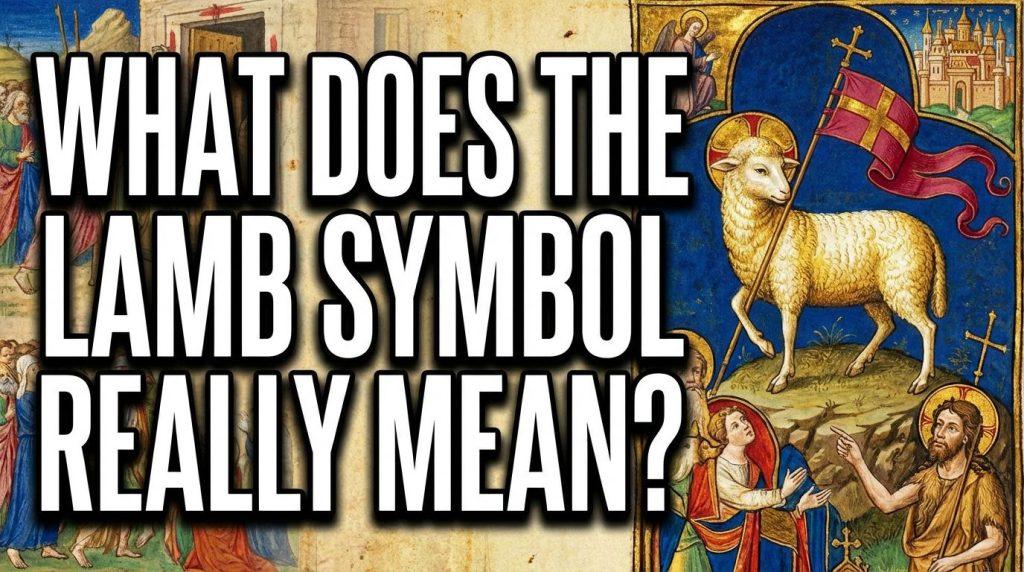
Medieval and Renaissance art often depicts the Lamb of God standing on an altar or on a book with seven seals, images drawn from Revelation. The lamb may hold a victory banner or flag, symbolizing Christ’s triumph over death. Blood sometimes flows from the lamb’s side into a chalice, explicitly connecting the lamb symbol to the Eucharist. The lamb may be surrounded by adoring angels or by the symbols of the four evangelists. These artistic choices combine multiple layers of meaning and invite viewers to contemplate various aspects of Christ’s identity and work. The visible wounds on the lamb remind observers that this victory came through suffering and death.
Modern church architecture and decoration continue using lamb imagery in various contexts. Stained glass windows might show the lamb at the center of heavenly worship as described in Revelation. Altar frontals or tabernacle doors might feature carved or embroidered lambs. Baptismal fonts sometimes include lamb imagery, connecting baptism to Christ’s sacrifice and to the believer’s participation in His death and resurrection. These artistic uses keep the lamb symbol visible to contemporary Catholics and provide opportunities for visual catechesis. The image’s power comes partly from its simplicity; even young children can recognize and remember a lamb.
The Lamb and Baptism
Saint Paul teaches that baptism unites believers to Christ’s death and resurrection. “Are you unaware that we who were baptized into Christ Jesus were baptized into his death?” (Romans 6:3). Through baptism, Christians participate in what the Lamb accomplished through His sacrifice. The old self dies with Christ, and a new self rises to new life. This transformation happens through sacramental union with the Lamb who was slain. Baptism applies to each individual what Christ achieved for all humanity on the cross. The lamb symbol helps believers understand that baptism is not merely symbolic but effects real spiritual change.
The white garment given to the newly baptized has connections to lamb imagery through the Book of Revelation. John sees “a great multitude, which no one could count, from every nation, race, people, and tongue” standing before the Lamb, “wearing white robes.” When asked who they are, he is told, “These are the ones who have survived the time of great distress; they have washed their robes and made them white in the blood of the Lamb” (Revelation 7:9, 14). The white baptismal garment symbolizes the purity that comes from being cleansed by the Lamb’s blood. This image combines cleansing and sacrifice in a way that might seem paradoxical but expresses the mystery of redemption.
Baptismal liturgy may include specific references to the Lamb of God and His sacrifice. Prayers ask that the newly baptized may share in Christ’s death and resurrection. The Easter Vigil, when many adults are baptized, emphasizes connections between the Passover lamb and Christ the new Passover. The Paschal candle, marked with the current year and lit from new fire, represents the risen Christ who conquered death. All these elements come together to show baptism as participation in the Lamb’s victory. Those baptized become part of the flock that belongs to the Good Shepherd and part of the assembly that worships the Lamb in glory.
The Lamb and Atonement Theology
The lamb symbol illuminates Catholic teaching about how Christ’s death saves humanity from sin. The doctrine of atonement addresses the question of how Christ’s sacrifice accomplishes redemption. Multiple models or theories have been proposed throughout Church history, each capturing some aspect of this profound mystery. The lamb imagery particularly supports the substitutionary and sacrificial understanding of the atonement. Christ took upon Himself the punishment that human sin deserves, just as the lamb in Old Testament sacrifice symbolically bore the sin of the offerer. He became the scapegoat driven into the wilderness carrying away the people’s sins (Leviticus 16:21-22).
The Catechism explains that “Jesus atoned for our faults and made satisfaction for our sins to the Father” (CCC 615). This satisfaction was possible because of Christ’s perfect obedience and the infinite value of His divine Person. An ordinary human’s death could not atone for all humanity’s sins because the debt was too great. But the Lamb of God, being divine, could offer a sacrifice of infinite value. His willing acceptance of death out of love for the Father and for humanity transforms what would otherwise be mere execution into redemptive sacrifice. The lamb symbol emphasizes both Christ’s innocence and His willing self-offering.
The connection between the Lamb and atonement also appears in the understanding that Christ’s sacrifice was both representative and participatory. He represented humanity before God, standing in for all people. Yet believers also participate in His sacrifice through baptism and the Eucharist, being united to His death so that His merit becomes theirs. The lamb imagery helps express this mystery of how Christ’s particular historical death has universal salvific effect. The Passover lamb saved all who sheltered under its blood. The Lamb of God saves all who are incorporated into Him through faith and sacraments.
The Lamb as Good Shepherd
While the Good Shepherd and the Lamb are distinct images, they both apply to Christ and complement each other in rich ways. Jesus calls Himself the Good Shepherd who lays down His life for the sheep (John 10:11). This self-description combines the shepherd and lamb themes; the shepherd becomes a lamb who is sacrificed. Jesus is both the shepherd who tends the flock and the lamb who dies for it. This dual identity shows that Christ’s saving work involves both His care throughout life and His ultimate sacrifice in death. He guides, protects, feeds, and heals as shepherd; He redeems through His blood as lamb.
The image of the Good Shepherd carrying the lost sheep connects to the parable Jesus told about the shepherd who leaves ninety-nine sheep to search for the one that wandered away (Luke 15:4-7). Christ seeks out sinners with persistent love, not willing that any should be lost. Yet to accomplish their rescue, He must become the lamb who is sacrificed. The shepherd and lamb images together present the full scope of Christ’s mission. He came to seek and save the lost, and He accomplished that salvation by giving His life as a ransom. Both images are necessary to understand the complete Gospel message.
Pastoral ministry in the Church draws on both shepherd and lamb imagery. Priests and bishops serve as under-shepherds, caring for the flock on behalf of Christ the chief Shepherd. Yet they also lead people to encounter Christ the Lamb, particularly in the Eucharist. The parish priest who feeds sheep through preaching and teaching also feeds them with the Lamb in Holy Communion. Church leaders exercise authority as shepherds but must also model the Lamb’s self-sacrificing love. The combination of these images provides a rich model for ministry that balances care, guidance, authority, and humble service.
The Lamb in Catholic Hymnody and Prayer
Catholic hymns and songs frequently invoke lamb imagery to worship Christ and teach theology. Traditional Latin hymns like “Agnus Dei” set the liturgical prayer to music, often in polyphonic settings of great beauty. Composers from Palestrina to Mozart to contemporary writers have created musical settings of this text. Singing the Agnus Dei engages both mind and heart in worship, making theological truth emotionally resonant. The music helps the text penetrate more deeply than words alone might do. Different musical styles make the ancient prayer accessible to various cultures and temperaments.
English-language hymns also draw on lamb symbolism. “Jesus Christ Is Risen Today” includes the line “Our triumphant holy day, who did once upon the cross suffer to redeem our loss.” While not using the word lamb explicitly, this text expresses the same theology of redemptive sacrifice. “At the Lamb’s High Feast We Sing” makes the connection explicit, celebrating Easter as the feast of the new Passover Lamb. “Crown Him with Many Crowns” calls Christ “the Lamb upon his throne.” These hymns teach the congregation doctrine while providing vehicles for praise and devotion.
Personal prayers to Christ often address Him as the Lamb of God, drawing on the rich biblical and theological tradition. The Divine Mercy chaplet, though focused on God’s mercy, can be understood in light of the Lamb’s sacrifice that makes mercy available. The Rosary’s sorrowful mysteries contemplate Christ’s passion, during which He acted as the silent lamb led to slaughter. Prayers before receiving Communion naturally invoke Christ as the Lamb of God whom the communicant is about to receive. These various prayer forms show how the lamb symbol shapes Catholic devotional life across different contexts and traditions.
The Lamb and Moral Life
The lamb symbol carries implications for how Christians should live. First Peter exhorts believers, “Realize that you were ransomed from your futile conduct, handed on by your ancestors, not with perishable things like silver or gold but with the precious blood of Christ as of a spotless unblemished lamb” (1 Peter 1:18-19). The recognition that redemption cost so dearly should motivate holy living. Christians cannot continue in sin without dishonoring the Lamb who died to free them from sin. Moral transformation is not optional but the proper response to redemption. The blood of the Lamb was too precious to be wasted on those who treat grace cheaply.
Jesus’s command that His disciples be innocent as doves and shrewd as serpents suggests that lamb-like innocence should characterize Christian conduct. Believers are called to be harmless, gentle, and pure in a world marked by violence, aggression, and corruption. This does not mean being naive or foolish but rather refusing to participate in evil even when it might seem advantageous. The Lamb’s victory through suffering rather than through violence provides the model. Christians conquer not by overpowering enemies but by loving them, not by inflicting death but by accepting it if necessary for faithfulness to Christ.
The call to follow the Lamb wherever He goes appears in Revelation’s description of the 144,000 who are with the Lamb on Mount Zion (Revelation 14:4). Following the Lamb means accepting the path of self-sacrifice and suffering for righteousness. It means standing with Christ even when doing so brings persecution or loss. The Lamb-like life does not seek suffering for its own sake but willingly embraces whatever cost faithfulness requires. This radical discipleship challenges cultural values of self-preservation, comfort, and success. The Lamb who was slain calls His followers to deny themselves, take up their crosses, and follow Him.
Contemporary Challenges to the Lamb Symbol
Modern sensibilities sometimes find the lamb imagery and its sacrificial theology difficult or even objectionable. The idea that God required a blood sacrifice seems primitive or even barbaric to some contemporary people. Questions arise about why a loving God would demand death as payment for sin. These concerns require thoughtful response that explains the lamb symbol’s meaning without either dismissing legitimate questions or compromising essential doctrine. The starting point must be that God did not demand something from humanity that humanity then provided. Rather, God Himself provided what was needed, giving His own Son as the Lamb.
Another challenge comes from animal rights perspectives that object to using an innocent creature’s death as a positive religious symbol. While this concern reflects admirable compassion for animals, it misunderstands the purpose of the symbolism. The lamb in Christian theology represents Christ Himself, not actual sheep. The Old Testament lambs that prefigured Christ’s sacrifice served a real but temporary purpose under the old covenant. Christ’s once-for-all sacrifice made animal sacrifice obsolete; Hebrews states that “it is impossible that the blood of bulls and goats take away sins” (Hebrews 10:4). The lamb symbol points to the reality that Christ’s human life was offered, not to ongoing animal sacrifice.
Some theological movements have attempted to reinterpret or abandon atonement theology centered on Christ’s sacrifice, viewing it as promoting violence or divine child abuse. These perspectives miss the voluntary nature of Christ’s self-offering and the Trinitarian unity in the plan of salvation. The Father did not force an unwilling Son to suffer; rather, Father and Son together, in the unity of the Holy Spirit, determined that this was the way to redeem humanity. The Lamb symbol, properly understood, reveals divine love rather than divine cruelty. It shows that God was willing to pay any cost, including the cross, to rescue humanity from sin and death.
The Lamb in Ecumenical Context
The lamb symbol enjoys broad recognition across different Christian traditions, providing common ground for ecumenical dialogue and cooperation. Orthodox, Catholic, and Protestant Christians all acknowledge Jesus as the Lamb of God who takes away the world’s sin. This shared confession, rooted in Scripture and ancient tradition, unites believers despite disagreements on other matters. When Christians from different traditions gather for worship or prayer, invoking Christ as the Lamb of God expresses their fundamental unity in the Gospel. The symbol transcends denominational boundaries because it stands at the very center of Christian faith.
Different traditions may emphasize various aspects of the lamb symbolism. Eastern Orthodox liturgy includes the Agnus Dei and rich lamb imagery in iconography and hymns. Protestant traditions that celebrate the Lord’s Supper or Communion often connect it to Christ’s sacrifice as the Passover Lamb. Catholic theology and practice integrate the lamb symbol throughout sacramental life, especially in the Mass. These various emphases complement rather than contradict each other. Together they provide a fuller appreciation of the lamb symbol’s significance than any single tradition might offer alone.
Ecumenical worship services can effectively use the Agnus Dei as a common prayer that all participants recognize and value. Singing or reciting this ancient text together, Christians from different backgrounds join in acknowledging their shared dependence on Christ’s sacrifice. This practical expression of unity through common prayer can build relationships and understanding across denominational lines. The lamb symbol thus serves not only theological and devotional purposes but also promotes Christian unity by focusing attention on the one Lord whom all confess.
The Lamb and Hope for Eternal Life
The lamb symbol points forward to the ultimate fulfillment of redemption in heaven. Revelation’s vision of the Lamb on the throne surrounded by worshipers from every nation provides hope that suffering and death do not have the final word. The Lamb who was slain lives and reigns, and those who belong to Him will share His victory. This eschatological dimension of the lamb symbol gives meaning to present trials and encourages perseverance. Christians can endure suffering because they know that the Lamb has conquered and will bring His followers through tribulation into eternal joy.
The marriage supper of the Lamb represents the consummation of salvation history when Christ and His Church are united forever. This nuptial imagery transforms the sacrificial lamb into the bridegroom who celebrates with His bride. The progression from slaughter to marriage, from death to wedding feast, expresses the Gospel’s movement from cross to resurrection. Christians await this final celebration when all tears will be wiped away and death will be no more. The hope of the marriage supper sustains believers through the present age and gives purpose to their labor and service.
The Lamb as light of the new Jerusalem shows that Christ’s sacrifice has cosmic significance. He does not merely save individual souls but renews all creation. The city that needs no sun because the Lamb is its light symbolizes a transformed reality where God dwells directly with His people without mediation. This vision of ultimate fulfillment shapes how Christians live now. They work for justice, peace, and renewal because they know these efforts participate in God’s plan to make all things new. The Lamb who was slain and now reigns assures them that their work is not in vain.
Conclusion and Lasting Significance
The lamb symbol carries profound meaning that has shaped Christian faith and worship for two millennia. From its Old Testament roots in the Passover through John the Baptist’s proclamation to its culmination in Revelation’s throne room, the lamb reveals Jesus Christ as the sacrificial victim who accomplishes redemption. This ancient symbol remains vitally relevant for contemporary Catholics who encounter Christ the Lamb especially in the Eucharist. Every Mass makes present the sacrifice of the Lamb and allows believers to participate in its benefits through Holy Communion. The symbol connects the historical event of Calvary to the sacramental present and the eschatological future.
Understanding the lamb symbol enriches Catholic life in multiple ways. It deepens appreciation for the Mass and the Eucharist. It provides a framework for understanding the atonement and how Christ’s death saves. It shapes moral life by calling believers to follow the Lamb in innocence and self-sacrifice. It offers comfort in suffering by pointing to the Lamb’s victory through His passion. It creates hope for eternal life in the presence of the Lamb who reigns on the throne. These various dimensions work together to form a comprehensive vision of Christian faith centered on Christ’s redemptive work.
As the Church continues her mission in the world, the lamb symbol reminds believers of the cost of their salvation and the love that motivated it. The Lamb of God who takes away the sin of the world continues to offer Himself in the Mass and to call people into relationship with Him through faith and sacraments. Catholics who grasp the depth of lamb symbolism will find their worship enriched, their understanding deepened, and their commitment strengthened. The Lamb who was slain is worthy to receive power, riches, wisdom, strength, honor, glory, and blessing forever. This confession of faith, drawn from Revelation, appropriately concludes reflection on what the lamb symbol truly means.
Disclaimer: This article presents Catholic teaching for educational purposes. For official Church teaching, consult the Catechism and magisterial documents. For personal spiritual guidance, consult your parish priest or spiritual director. Questions? Contact editor@catholicshare.com
Sign up for our Exclusive Newsletter
- 📌 Add CatholicShare as a Preferred Source on Google
- 🎁 Join us on Patreon for Premium Content
- 🎧 Check Out These Catholic Audiobooks
- 📿 Get Your FREE Rosary Book
- 📱 Follow Us on Flipboard
-

Recommended Catholic Books
Discover hidden wisdom in Catholic books — invaluable guides enriching faith and satisfying curiosity. #CommissionsEarned
- The Early Church Was the Catholic Church
- The Case for Catholicism - Answers to Classic and Contemporary Protestant Objections
- Meeting the Protestant Challenge: How to Answer 50 Biblical Objections to Catholic Beliefs
As an Amazon Associate, I earn from qualifying purchases. Thank you for your support.