
Brief Overview
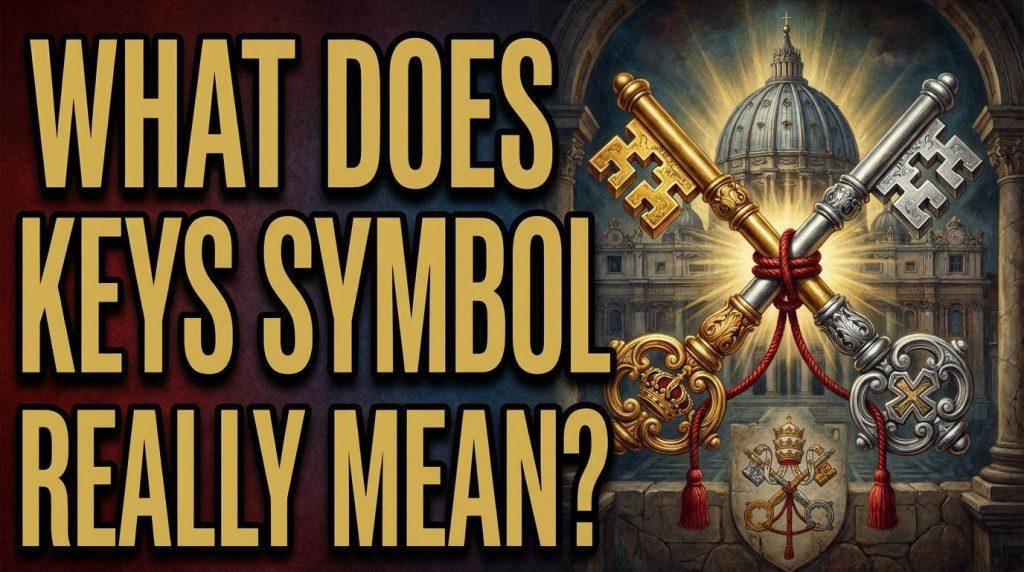
- The crossed keys symbolize the authority Jesus gave to Saint Peter and his successors to bind and loose, governing the Church on earth.
- Jesus promised Peter the keys of the kingdom of heaven, granting him special authority among the apostles.
- One key is typically gold representing spiritual authority in heaven, while the other is silver representing earthly authority.
- The keys appear prominently in the papal coat of arms and throughout Vatican imagery as symbols of the papacy.
- This symbol expresses the Catholic belief that the Pope holds unique authority to teach, govern, and sanctify in Christ’s name.
- Understanding the keys helps Catholics appreciate the structure of Church authority and the role of Peter’s successor.
Biblical Foundation of the Keys
The keys symbol finds its primary biblical source in Jesus’s words to Simon Peter recorded in Matthew’s Gospel. After Peter confessed that Jesus is the Christ, the Son of the living God, Jesus responded with a profound declaration. He told Peter, “I will give you the keys of the kingdom of heaven. Whatever you bind on earth shall be bound in heaven; and whatever you loose on earth shall be loosed in heaven” (Matthew 16:19). This promise establishes the foundation for understanding the keys as a symbol of authority. The power to bind and loose refers to the authority to make decisions that have heavenly validity. Peter received unique responsibility among the apostles to lead and guide the early Church.
The image of keys naturally suggests authority and access. In the ancient world, holding keys meant controlling entry to a building, city, or treasury. Stewards who managed households on behalf of wealthy owners carried keys as signs of their delegated authority. Isaiah prophesied about such a steward, describing how God would place “the key of the House of David on his shoulder” and what he opened no one could shut, and what he shut no one could open (Isaiah 22:22). This Old Testament background enriched the meaning of Jesus’s promise to Peter. The keys symbolize real power to admit or exclude, to permit or forbid, to make authoritative decisions binding on the community.
Jesus’s choice of Peter as the recipient of the keys shows divine intention in establishing Church structure. Peter did not claim this authority for himself nor did the other apostles elect him to primacy. Jesus freely chose to build His Church on Peter, the rock, and to give him the keys. This divine appointment distinguishes Peter’s role from merely human organizational arrangements. The keys represent authority that flows from Christ Himself rather than from the Christian community. Understanding this helps Catholics see the papacy not as a human invention but as part of Christ’s plan for His Church. The symbol of the keys expresses this God-given authority visually and memorably.
Historical Development of the Keys Symbol
Early Christian art began depicting keys in connection with Peter within the first few centuries after Christ. Catacomb paintings and sarcophagus carvings show Peter holding keys, often paired with Paul holding a scroll or book. These artistic representations helped teach the faith to Christians who could not read or who did not have access to Scripture. The visual symbol communicated Peter’s special role and authority in a way that transcended language barriers. As Christianity spread throughout the Roman Empire and beyond, the image of Peter with keys became widely recognized and understood.
The specific design of two crossed keys developed gradually during the medieval period. Early representations sometimes showed Peter holding a single key. Later, two keys became standard, often crossed in an X pattern behind a papal tiara or coat of arms. The choice of two keys rather than one emphasized the fullness of the authority granted. Medieval theologians explained that the two keys represented different aspects of papal power or different modes of its exercise. Some interpretations saw one key as representing knowledge or discernment and the other representing the power to judge and absolve. These theological elaborations added layers of meaning to the basic symbol.
The colors assigned to the keys also developed through tradition. Gold or yellow for one key and silver or white for the other became the standard papal heraldic convention. Various explanations arose for this color choice. Some saw gold as representing heavenly or spiritual authority and silver as representing earthly or temporal power. Others connected the colors to different aspects of the power to bind and loose. Still others simply viewed the two-color scheme as aesthetically pleasing and heraldically appropriate. Whatever the original reasoning, the gold and silver crossed keys became instantly recognizable as symbols of the papacy throughout Catholic Christendom.
The Keys in Papal Heraldry
The papal coat of arms features the crossed keys prominently as its central element. Above the keys appears the papal tiara, though recent popes have replaced the tiara with a bishop’s miter to emphasize their pastoral rather than monarchical role. The keys remain constant regardless of such modifications because they represent the office itself rather than any individual pope’s preferences. Each new pope’s personal coat of arms is combined with the traditional papal symbols of keys and tiara or miter. This combination expresses both the pope’s individual identity and his assumption of the Petrine office with its unique authority.
The Vatican flag displays the crossed keys and papal tiara on a yellow and white background. These colors echo the gold and silver of the keys themselves. The flag flies over Vatican buildings and appears in various Vatican contexts as a symbol of papal authority and Vatican City’s status as an independent state. Catholic institutions around the world sometimes incorporate the crossed keys into their emblems to indicate their connection to or approval by the Holy See. Schools, hospitals, and charitable organizations founded or supported by the Vatican may display the keys to show their relationship to the papal office.
Individual popes throughout history have used the keys in their personal arms and seals. Papal documents bear the image of crossed keys, and the fisherman’s ring worn by each pope features Saint Peter in a boat with keys nearby. These various uses reinforce the connection between the current pope and Saint Peter, showing continuity across two millennia. The keys in papal heraldry do not merely decorate but communicate theological truth about the nature of papal authority. They testify that the pope governs not by his own power but by the authority Christ gave to Peter and his successors.
The Power to Bind and Loose
Jesus’s words about binding and loosing carry specific meaning in the context of first-century Judaism. Rabbis used the terms “bind” and “loose” to describe making authoritative interpretations of Jewish law. To bind meant to forbid something, while to loose meant to permit it. Teachers who could bind and loose had authority to make decisions about how the law applied to particular situations. Jesus gave Peter and the apostles this rabbinical authority, but with a crucial difference. Their binding and loosing would have heavenly validity, not merely human authority. What they decided on earth would be confirmed in heaven.
The Catholic Church has understood this power in several related ways. First, it includes the authority to forgive sins or retain them. Jesus explicitly gave this power to the apostles when He appeared to them after His resurrection and said, “Receive the holy Spirit. Whose sins you forgive are forgiven them, and whose sins you retain are retained” (John 20:22-23). The power of the keys thus connects to the sacrament of reconciliation, where priests acting in Christ’s name absolve penitents from sin. This sacramental power flows through the apostolic succession from Peter and the Twelve.
Second, the power to bind and loose includes teaching authority. The pope and bishops in communion with him can make authoritative declarations about faith and morals that bind the consciences of Catholics. The keys symbolize this magisterial authority to interpret Scripture and tradition, to distinguish truth from error, and to define doctrine when necessary. The Church’s teaching office, guided by the Holy Spirit, exercises the power of the keys when it proclaims what must be believed and practiced. This teaching authority prevents the Church from falling into error on essential matters of faith.
Third, the power of the keys includes legislative and judicial authority in the Church. The pope can establish laws that govern Catholic life, create or suppress dioceses and religious orders, appoint bishops, and make other administrative decisions. He can also judge disputes and controversies that arise within the Church. This governmental aspect of the keys may seem less spiritual than sacramental or teaching dimensions, but it serves the Church’s mission by maintaining good order and unity. The keys represent the full scope of papal authority in all these interconnected areas.
Peter’s Primacy Among the Apostles
The Gospels present Peter in a prominent role among the Twelve from the beginning of Jesus’s public ministry. Jesus called Peter and his brother Andrew first among the apostles. Peter regularly served as spokesman for the group, asking questions and making declarations on behalf of the others. He appears first in all biblical lists of the apostles. These details show that Peter held a special position even before Jesus explicitly promised him the keys. The keys formalized and defined an authority that was already becoming apparent through Peter’s emerging leadership.
Peter’s confession of faith at Caesarea Philippi marked a turning point in his relationship with Jesus and his role among the disciples. When Jesus asked who people said He was and then who the disciples themselves believed Him to be, Peter answered, “You are the Messiah, the Son of the living God” (Matthew 16:16). Jesus declared this confession a revelation from the Father and immediately promised to build His Church on Peter the rock and to give him the keys. The connection between Peter’s faith confession and the promise of keys suggests that authority in the Church relates to maintaining and proclaiming true faith in Christ.
After the resurrection and ascension, Peter exercised the leadership Jesus had given him. The Acts of the Apostles shows Peter taking charge of replacing Judas among the Twelve, preaching the first sermon on Pentecost, performing the first miracle in Jesus’s name, and defending the apostles before Jewish authorities. When questions arose about admitting Gentiles to the Church, Peter’s decision at the Council of Jerusalem proved decisive. Paul recognized Peter’s unique role even while maintaining his own apostolic authority. These New Testament examples demonstrate that the early Church understood Peter’s primacy as real and operative, not merely honorary or symbolic.
Apostolic Succession and the Keys
Catholic theology teaches that the authority Jesus gave to Peter continues in his successors, the bishops of Rome. This doctrine of apostolic succession means that the keys passed from Peter to subsequent popes through an unbroken chain. Each pope receives the same authority to bind and loose that Jesus promised to Peter. The symbol of crossed keys appears in every age because the office and its authority persist regardless of the individual who holds it. Personal holiness or ability varies among popes, but the office itself carries the authority Christ established.
The basis for believing that Peter’s authority transfers to successors lies partly in the nature of the Church as a perpetual institution. Jesus founded the Church to last until the end of time, and He promised that the gates of hell would not prevail against it (Matthew 16:18). If the Church needs a visible head with authority to maintain unity and settle disputes, that need does not end with Peter’s death. The Church in every age requires the service that the keys represent. Apostolic succession ensures that Christ’s provision for His Church continues across generations and changing circumstances.
Historical evidence supports the early Church’s belief in Roman primacy. Church fathers from the first centuries acknowledged the special authority of the Roman bishop. When disputes arose in the Church, appeal to Rome for resolution was common practice. This early recognition of papal authority suggests that the doctrine did not develop centuries later but existed from apostolic times. The keys symbol in art and theology throughout Church history testifies to this continuous belief. Each generation of Catholics has understood that Peter’s successor holds the keys Jesus promised.
The Keys and Church Unity
One crucial function of papal authority symbolized by the keys is maintaining Church unity. Jesus prayed that His followers would be one so that the world might believe (John 17:21). Visible unity among Christians requires some principle of unity, some way to settle disputes and prevent fragmentation. The Catholic Church has understood the papacy as Christ’s provision for this unity. The pope, holding Peter’s keys, serves as a center of communion for bishops and faithful worldwide. Unity with the successor of Peter defines Catholic communion.
Throughout Church history, the keys have functioned to preserve unity during controversies and schisms. When theological disputes threatened to divide the Church, appeal to papal authority often resolved the issue. Ecumenical councils gained their authority partly from papal confirmation. Bishops exercised their teaching office in communion with Rome. This structure, with the keys symbolizing papal authority at its center, prevented the Church from splintering into countless independent groups. The visible unity of Catholics around the world testifies to the effectiveness of this Christ-given structure.
Challenges to papal authority have sometimes resulted in divisions that the keys symbol helps Catholics understand and address. The Orthodox churches of the East separated from Rome partly over questions of papal authority. Protestant Reformers rejected the papacy and the keys it symbolizes. From the Catholic perspective, these separations represent wounds to the unity Christ desires for His Church. Ecumenical dialogue aims at healing these divisions, and the question of papal authority remains central to such discussions. The keys symbol stands at the heart of these conversations about unity and authority.
The Keys in Catholic Architecture
Churches throughout the Catholic world incorporate keys imagery in their architecture and decoration. Cathedrals may feature keys carved in stone above doorways or worked into decorative elements. The symbol identifies the building as Catholic and under papal authority. Some churches display the papal coat of arms with its crossed keys on exterior walls or in prominent interior locations. These architectural uses make the keys visible to all who enter and serve as silent teaching about Church structure and authority.
Altars and altar furnishings sometimes include keys decoration. The connection makes sense because the altar is where the priest exercises sacramental authority derived ultimately from Christ through Peter. Tabernacles holding the Blessed Sacrament may feature keys in their design. Pulpits from which God’s word is preached might incorporate the symbol. These liturgical contexts for keys imagery remind worshipers that all legitimate authority in the Church flows from Christ through the structures He established.
Baptismal fonts occasionally display keys symbols, connecting baptism to the Church’s authority. Through baptism, people enter the Church that Christ founded on Peter and receive access to the kingdom whose keys Peter holds. Confessionals where the sacrament of reconciliation is celebrated appropriately feature keys since the power to forgive sins relates directly to the binding and loosing authority Jesus promised. These architectural and liturgical uses of the keys symbol create a visual catechesis about Catholic ecclesiology and sacramental theology.
The Keys and the Sacrament of Reconciliation
The power of the keys finds particular expression in the sacrament of reconciliation, where priests absolve penitents from sin. Jesus gave the apostles authority to forgive sins, and this power continues through priestly ordination in apostolic succession. When a priest says the words of absolution, he exercises the power of the keys on behalf of Christ and His Church. The keys symbolize this sacramental authority to bind and loose, to retain sins or forgive them. Catholics believe that the forgiveness they receive in confession is real and effective because of the authority represented by the keys.
The tribunal of penance, as reconciliation has sometimes been called, operates under the authority of the keys. The priest serves as judge, but his judgment is not arbitrary or merely human. He acts in Christ’s person and with the authority Christ gave to Peter and the apostles. The penitent’s sins are truly forgiven when the priest pronounces absolution, not because of the priest’s personal holiness but because of the office he holds and the authority it carries. The keys symbol helps Catholics understand that sacramental confession is not merely therapeutic conversation but a real encounter with God’s mercy mediated through the Church.
Church law governs how the sacrament of reconciliation must be celebrated, specifying what sins must be confessed, what constitutes adequate contrition, and what satisfaction the priest may impose. These regulations flow from the Church’s authority to bind and loose. The pope, holding the keys, can modify these laws or grant special faculties for hearing confessions. Bishops derive their authority to regulate sacramental practice in their dioceses from communion with the pope. The whole sacramental system operates under the authority symbolized by Peter’s keys.
Misunderstandings and Clarifications
Some people misunderstand the keys symbol as suggesting that popes have arbitrary or unlimited power. This misconception needs correction. The pope exercises authority as a steward or servant, not as an absolute monarch answerable to no one. He holds the keys on behalf of Christ and must use them according to Christ’s will. Scripture, tradition, and natural law all limit how papal authority can properly be exercised. The keys represent genuine authority but not tyrannical power.
Another misunderstanding imagines Peter literally standing at heaven’s gate admitting or excluding souls based on his personal judgment. This popular image appears in jokes and cartoons but misrepresents Catholic teaching. The keys symbolize Peter’s authority on earth to govern the Church and administer the sacraments. God alone judges souls and determines eternal destiny. Peter’s power to bind and loose operates in this life, affecting people’s relationship with the Church and access to grace through the sacraments. The keys point to ecclesial authority, not Peter’s role in the afterlife.
Some critics accuse the Catholic Church of overemphasizing papal authority at the expense of other bishops or the priesthood of all believers. Catholic teaching actually maintains important distinctions while upholding papal primacy. All bishops share in apostolic authority and possess the fullness of sacramental priesthood. The whole People of God participates in Christ’s priestly, prophetic, and kingly offices through baptism. The keys do not negate these truths but show how Christ structured authority in His Church to serve unity and truth. Properly understood, the symbol enriches rather than diminishes appreciation for all aspects of Church life.
The Keys and Infallibility
The doctrine of papal infallibility connects closely to the symbolism of the keys. When the pope speaks ex cathedra, from the chair of Peter, defining a doctrine of faith or morals, Catholics believe he cannot err. This charism of infallibility relates to the power of the keys because it concerns the authority to teach binding truth. The Holy Spirit guides the successor of Peter in such solemn teaching, preventing him from leading the Church into error on essential matters. The keys thus symbolize not only juridical authority but also the gift of unfailing truth in formal doctrinal declarations.
Understanding infallibility requires knowing its proper limits. The pope does not receive personal inspiration or new revelation. He cannot change defined doctrine or contradict Scripture and tradition. Infallibility applies only when specific conditions are met: the pope must intend to define a doctrine, he must speak as universal pastor to the whole Church, and he must address faith or morals. Most papal statements do not meet these conditions and are not considered infallible. The charism serves the Church by providing certainty on crucial questions while leaving much room for theological discussion and development.
The keys symbol reminds Catholics that papal infallibility exists for the Church’s benefit, not the pope’s aggrandizement. Christ gave Peter authority to confirm his brethren in faith. The gift of infallibility serves this purpose by ensuring that the Church’s faith remains pure and apostolic. When properly understood, the doctrine inspires confidence rather than fear. Catholics can trust that what the Church solemnly teaches as definitive truth comes from God and will not mislead them. The keys represent this trustworthy authority that Christ promised to His Church.
The Keys in Liturgy and Worship
The feast of Saints Peter and Paul on June 29 provides special opportunities for reflection on the keys and what they represent. Liturgical texts for this solemnity emphasize Peter’s confession of faith, Jesus’s promise of the keys, and Peter’s role in the early Church. Homilies often explain the symbolism and theological significance of the keys. Churches dedicated to Saint Peter naturally feature keys imagery prominently. Celebrating Peter and Paul together honors both apostles while acknowledging Peter’s unique role symbolized by the keys.
Prayers in the Roman Rite sometimes reference Peter and his authority. The Litany of Saints invokes Peter first among the apostles. Some prayers for the pope ask God to strengthen him in his ministry of confirming the brethren and feeding Christ’s flock. These liturgical texts connect to the keys implicitly by recalling the special mission Jesus gave to Peter. When Catholics pray for the pope, they pray for the one who holds the keys and exercises the authority they represent.
Music and hymns celebrating Peter often mention the keys. Traditional Catholic hymnody includes songs about Peter the rock on whom Christ built the Church and to whom He gave the keys. These hymns teach doctrine while inspiring devotion. Contemporary liturgical music may be less likely to reference the keys explicitly, but the underlying theology of Petrine authority continues to shape Catholic understanding of Church structure. Whether through visual symbols in church architecture, references in prayers, or themes in sacred music, the keys remain part of Catholic liturgical consciousness.
The Keys and Vatican II
The Second Vatican Council’s teaching on the Church included significant reflection on papal authority and its relationship to episcopal collegiality. The council affirmed that the pope holds supreme authority as Peter’s successor and possesses the keys of the kingdom. At the same time, the council emphasized that bishops also succeed the apostles and exercise real authority in their dioceses. The keys symbol, while specifically associated with Peter and his successors, exists within this broader context of shared apostolic ministry.
Lumen Gentium, the council’s document on the Church, carefully explained how papal primacy and episcopal collegiality work together. The pope can act alone in exercising his supreme authority. The bishops can also act collegially, as in ecumenical councils, though their collegial actions require papal confirmation. This complex relationship ensures both unity under one visible head and appropriate participation by all bishops in governing the Church. The keys symbolize the unity principle while not negating legitimate diversity in the exercise of authority.
Vatican II’s ecclesiology enriched understanding of what the keys represent without contradicting traditional teaching. The council presented the Church as the People of God, the Body of Christ, and the Temple of the Holy Spirit. Within this multifaceted understanding, the pope serves as visible principle and foundation of unity. The keys he holds are not personal possessions but instruments of service to the Church’s mission. This servant dimension of papal authority, though always part of Catholic theology, received new emphasis from the council and from subsequent popes.
Contemporary Challenges and Relevance
Modern secular culture often reacts negatively to claims of religious authority, making the keys symbol and what it represents difficult for some people to accept. Democratic and egalitarian sensibilities resist the idea of one person holding unique authority. Contemporary Catholics living in democratic societies may struggle to understand how divinely instituted hierarchy fits with their political values. The Church must help believers see that ecclesiastical authority differs from political power and serves supernatural rather than merely natural purposes.
Scandals involving Church leaders have damaged confidence in institutional authority and made some Catholics question the value of structures represented by the keys. When popes, bishops, or priests abuse their authority or fail in moral leadership, people naturally wonder whether the system itself is flawed. The Church must acknowledge failures while also insisting that human sin does not invalidate Christ’s promises. The keys symbolize an authority that remains even when individuals prove unworthy of the office they hold. Reform and accountability are necessary, but abandoning the structure Christ established would not solve the problem.
The keys remain relevant for contemporary Catholics because the needs they address persist. The Church still requires a visible principle of unity, authoritative teaching that can resolve disputes, and sacramental ministry that connects believers to Christ. The specific challenges facing the Church today differ from those of earlier centuries, but the fundamental need for the authority symbolized by the keys continues. Catholics can approach this symbol with both healthy questions and confident faith, trusting that Christ will guide His Church through whatever challenges arise.
Ecumenical Dimensions
Protestant Christians generally reject papal authority and therefore give very different meanings to Matthew 16 and the keys symbol. Most Protestants believe Jesus was speaking metaphorically or that Peter’s confession of faith, rather than Peter himself, is the rock on which the Church is built. They interpret the keys as representing the Gospel message or the authority all believers share to proclaim forgiveness. These alternative readings reflect deeper disagreements about Church structure and authority that have divided Christians since the Reformation.
Orthodox churches accept Petrine primacy in some sense but reject papal supremacy as it developed in the West. They believe the bishop of Rome holds a primacy of honor but not of jurisdiction. Orthodox Christians therefore approach the keys symbol differently than Catholics do. They might see Peter as first among equals without the unique authority Catholics ascribe to him. These differences in ecclesiology remain among the most challenging issues in Catholic-Orthodox dialogue, with the keys representing a key point of disagreement.
Ecumenical progress on these questions requires both honest acknowledgment of real differences and charitable effort to understand different perspectives. Catholics cannot simply abandon belief in papal primacy since it forms part of defined doctrine. However, Catholics can explore how the keys have been understood and exercised in different ways throughout history. Recent popes have expressed openness to discussing how the Petrine ministry might be exercised in ways that serve Christian unity. The keys symbol, while a point of division, might also become part of the path toward greater unity as churches engage these questions seriously.
The Keys and Personal Faith
Individual Catholics relate to the keys symbol in various ways depending on their spirituality and theological understanding. For some, the keys represent reassurance that the Church Christ founded continues under reliable leadership. They find comfort in papal authority and appreciate having someone who can answer difficult questions definitively. The keys symbolize the Church as a visible, structured community rather than merely a spiritual fellowship. This sacramental understanding values the human instruments God uses to communicate grace.
Others may feel tension with aspects of institutional authority while still accepting papal primacy as part of Catholic faith. They might question particular papal decisions or wish for more consultation and collaboration in Church governance. Yet they recognize that their personal preferences do not determine Church structure. The keys remind such Catholics that the Church is not a democracy where majority opinion rules but a hierarchical communion where authority flows from Christ through designated ministers. Learning to accept this can be part of spiritual growth in humility and obedience.
Devotion to Saint Peter provides one way for Catholics to engage personally with the keys symbol. Prayers to Saint Peter ask for his intercession and express trust in his continuing care for the Church he leads from heaven. Visiting sites associated with Peter, particularly Saint Peter’s Basilica in Rome built over his tomb, can deepen appreciation for the historical reality of Petrine ministry. Understanding the keys not merely as abstract symbols but as connected to a real person who knew and loved Jesus makes the theology more concrete and relatable.
Conclusion and Ongoing Significance
The crossed keys stand as one of Catholicism’s most important and recognizable symbols. They represent the authority Jesus gave to Saint Peter and his successors to govern the Church, teach authoritatively, and administer the sacraments. This authority, promised in Matthew 16 and exercised throughout Church history, ensures the unity and orthodoxy that Christ desires for His people. The keys appear throughout Catholic art, architecture, and official imagery, constantly reminding believers of the structure Christ established for His Church.
Understanding the keys symbol helps Catholics appreciate both the gift and the challenge of visible Church authority. On one hand, having a successor of Peter to lead the Church provides clarity and unity that would otherwise be impossible. On the other hand, submitting to authority requires humility and trust that do not come easily to fallen human nature. The keys call Catholics to recognize that the Church is Christ’s creation structured according to His will rather than merely a human organization arranged for convenience. This recognition shapes how believers relate to the pope, bishops, and the institutional Church.
As the Church faces contemporary challenges and looks toward the future, the keys retain their significance as symbols of enduring realities. Christ’s promise to build His Church on Peter and to give him the keys was not limited to the first century. Each generation must understand and live out what the keys represent. The authority they symbolize exists to serve the Church’s mission of proclaiming the Gospel and bringing people to salvation. When properly exercised and faithfully received, the power of the keys helps fulfill Christ’s prayer that all His followers would be one, united in truth and love until He returns in glory.
Disclaimer: This article presents Catholic teaching for educational purposes. For official Church teaching, consult the Catechism and magisterial documents. For personal spiritual guidance, consult your parish priest or spiritual director. Questions? Contact editor@catholicshare.com
Sign up for our Exclusive Newsletter
- 📌 Add CatholicShare as a Preferred Source on Google
- 🎁 Join us on Patreon for Premium Content
- 🎧 Check Out These Catholic Audiobooks
- 📿 Get Your FREE Rosary Book
- 📱 Follow Us on Flipboard
-

Recommended Catholic Books
Discover hidden wisdom in Catholic books — invaluable guides enriching faith and satisfying curiosity. #CommissionsEarned
- The Early Church Was the Catholic Church
- The Case for Catholicism - Answers to Classic and Contemporary Protestant Objections
- Meeting the Protestant Challenge: How to Answer 50 Biblical Objections to Catholic Beliefs
As an Amazon Associate, I earn from qualifying purchases. Thank you for your support.