
Brief Overview
- The Host in Catholic art represents the consecrated bread that becomes the Body of Christ through transubstantiation during Mass.
- Artists depict the Host to express faith in Real Presence and to teach Eucharistic theology through visual means.
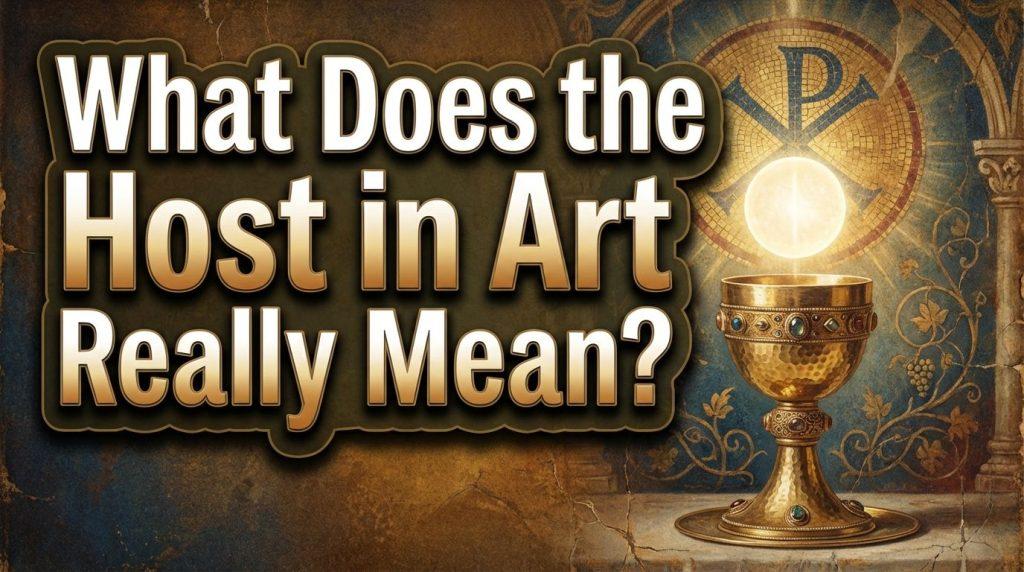
- Common artistic representations show the Host as a white circular wafer, often radiating light or surrounded by angels in adoration.
- Eucharistic miracles where the Host visibly transforms into flesh have inspired numerous artworks throughout Church history.
- The Host appears in paintings of saints in adoration, Last Supper scenes, and representations of Mass and Communion.
- Understanding Host imagery helps Catholics appreciate how sacred art communicates the central mystery of the Eucharist.
Biblical and Theological Foundation
The Host represents the fulfillment of Jesus’s promise at the Last Supper to give His Body as food for eternal life. John’s Gospel records Jesus’s teaching that His flesh is true food and His blood is true drink (John 6:55). This teaching shocked many listeners who could not accept such seemingly impossible words. Yet Jesus insisted that unless people eat His flesh and drink His blood, they have no life in them. This discourse in John 6 provides theological foundation for Catholic belief in Real Presence that artistic depictions of the Host express visually.
The term “host” comes from the Latin word hostia, meaning victim or sacrifice. This etymology connects the consecrated bread to Christ’s sacrificial death. The white wafer of unleavened bread appears insignificant, yet it contains the Lord of Glory once the words of consecration are spoken. This paradox of humble appearance containing infinite reality challenges human understanding. Artists attempting to represent this mystery face the difficulty of showing the invisible and expressing the inexpressible. How does one paint divine presence under the appearance of bread? Sacred art addresses this challenge through various symbolic conventions and visual strategies.
Catholic doctrine teaches that through transubstantiation, the substance of bread changes completely into the substance of Christ’s Body while the appearances remain unchanged (CCC 1373-1377). The Host looks like bread, tastes like bread, and has bread’s physical properties, yet is no longer bread. It is Christ Himself, Body, Blood, Soul, and Divinity. This teaching distinguishes Catholic belief from symbolic interpretations that see communion bread as merely representing Christ rather than being Him. Artists depicting the Host must somehow communicate this ontological change that the senses cannot detect. Sacred art thus relies on symbolic visual language to express what empirical observation cannot perceive.
Early Christian Representations
Early Christian art avoided direct representation of the Eucharist for several reasons. The discipline of the secret, which protected sacred mysteries from profanation and persecution, discouraged explicit depictions. Christians also respected the commandment against making graven images, though they interpreted this as forbidding idolatry rather than all religious art. When early Christians did represent the Eucharist, they used symbolic rather than literal imagery. Fish and bread together suggested the Eucharist because of multiplication miracle associations. Baskets of bread appeared in catacomb paintings as eucharistic references.
The Last Supper provided the most common context for early eucharistic imagery. Fresco paintings in Roman catacombs show Jesus and His disciples reclining at table with bread and fish or bread and wine visible. These meal scenes communicated eucharistic meaning to initiated Christians while remaining obscure to outsiders. The bread in such paintings was ordinary bread in appearance but carried sacramental significance for believers who understood the references. This layered meaning characterized early Christian art that needed to speak simultaneously to different audiences.
As Christianity gained legal status and then imperial favor, artistic representations became more explicit and elaborate. Byzantine mosaics in churches like San Vitale in Ravenna showed eucharistic themes with greater detail and theological sophistication. The bread in these works began taking on characteristics associated with the consecrated Host rather than ordinary bread. Artists developed visual conventions for representing sacred realities that would influence Christian art for centuries. The transition from symbol to more direct representation reflected the Church’s changed social position and its desire to teach the faithful through beauty and imagery.
Medieval Eucharistic Art
Medieval period saw tremendous growth in eucharistic devotion and corresponding artistic production. The Fourth Lateran Council in 1215 formally defined transubstantiation, giving theological precision to what Christians had always believed about Real Presence. This doctrinal clarity inspired artistic representations that made the teaching visible and accessible. Artists began showing the consecrated Host with distinctive features: perfectly round, pure white, and often emitting rays of light suggesting divine glory. These visual conventions communicated that this was no ordinary bread but the very Body of Christ.
Scenes of Mass became common in medieval manuscripts and church decoration. These depictions showed priests elevating the Host at the consecration while angels appeared around the altar in adoration. The angels’ presence taught that heaven participates in the eucharistic liturgy and that the Host deserves angelic worship. Some medieval images showed Christ Himself appearing above or within the Host, making explicit what faith perceived beneath the sacramental veil. These representations helped believers understand that receiving Communion meant receiving Christ, not merely a symbol or memorial.
Eucharistic miracles received extensive artistic treatment in medieval art. The most famous, the Miracle of Bolsena in 1263, shows drops of blood falling from the Host onto the corporal during Mass. This miracle prompted Pope Urban IV to establish the feast of Corpus Christi. Artists created numerous paintings and frescoes depicting this and similar miracles. These images served apologetic purposes by providing visible evidence for Real Presence. They also inspired devotion by showing dramatically what faith professes: that the Host truly is Christ’s flesh and blood. The emotional impact of such images strengthened believers’ eucharistic faith.
Renaissance and Baroque Developments
Renaissance artists brought new naturalism and emotional depth to eucharistic imagery. Leonardo da Vinci’s Last Supper, while focusing on the moment of betrayal, includes the bread that Jesus would bless and distribute. Raphael painted numerous scenes showing Mass, Communion, and eucharistic devotion with characteristic grace and beauty. These Renaissance masters employed perspective, light, and anatomical accuracy to create compelling visual narratives about the Eucharist. Their technical skill served theological teaching by making sacred stories accessible and engaging.
Baroque art’s dramatic emotionalism particularly suited eucharistic subjects. Artists like Rubens, Caravaggio, and others created powerful images of saints adoring the Blessed Sacrament. The Host often appeared suspended in mid-air, glowing with supernatural light, while saints knelt in ecstatic prayer. These theatrical compositions invited viewers to share the saints’ devotion and to recognize the Host’s divine nature. Baroque churches featured elaborate altarpieces centered on the tabernacle where the Host was reserved. The entire artistic program directed attention toward the Real Presence dwelling in the church.
The Counter-Reformation used eucharistic art as part of its response to Protestant denials of Real Presence. Catholic artists created magnificent works emphasizing transubstantiation and the Mass’s sacrificial nature. The Host appeared in images defending Catholic doctrine against heresy. Paintings showed crowds adoring the exposed Blessed Sacrament in monstrances. These propagandistic yet beautiful works served the Church’s need to maintain and strengthen Catholic identity in contested religious territory. Art became a weapon in theological warfare, though a weapon of beauty and persuasion rather than violence.
Eucharistic Miracles in Art
Throughout Church history, reported eucharistic miracles have inspired artistic representation. Beyond the Bolsena miracle, other famous examples include Lanciano where the Host turned to flesh and wine to blood in the eighth century. Siena’s miracle involving consecrated Hosts that remained incorrupt for centuries provided another subject. Artists painted these events both at the time they occurred and in subsequent centuries. The miraculous transformations that made visible what normally remains hidden under sacramental appearances proved irresistible subjects for religious art.
These miracle paintings serve multiple functions in Catholic visual culture. They document events the Church has investigated and authenticated. They provide evidence for skeptics and strengthen believers’ faith. They teach that God sometimes breaks through the veil of appearances to show divine reality. The artistic depictions often include witnesses showing various reactions: wonder, fear, adoration, or conversion. These human responses model appropriate reactions to the Eucharist and invite viewers to examine their own faith and devotion.
Contemporary Catholics encounter these historical miracle images in churches, books, and online media. Modern reproductions and new artistic interpretations of ancient miracles continue the tradition. Pilgrim sites where miracles occurred display paintings or other artworks depicting the events. These images maintain living connection between past and present, between the original miracle witnesses and current believers. The art extends the miracle’s impact across time, allowing each generation to benefit from these tangible demonstrations of Real Presence.
Saints in Eucharistic Adoration
Catholic art frequently shows saints kneeling before the exposed Blessed Sacrament. Saint Francis of Assisi, known for eucharistic devotion, appears in numerous paintings adoring the Host. Saint Thomas Aquinas, author of eucharistic hymns and doctor of the Church, receives similar artistic treatment. Saint Clare of Assisi who defended her convent by exposing the Blessed Sacrament to invading soldiers appears in art holding a monstrance. These saintly examples teach believers how to approach the Eucharist with proper reverence and love.
Women mystics who experienced eucharistic visions provided rich material for artistic representation. Saint Catherine of Siena receiving Communion from Christ Himself rather than from priestly hands appears in multiple artworks. Saint Juliana of Liège whose visions led to establishing Corpus Christi feast inspired paintings and sculptures. These images of female sanctity centered on eucharistic devotion show that deep relationship with Christ in the sacrament is open to all, not only to ordained ministers. The art democratizes eucharistic spirituality while honoring those whose devotion was exceptional.
Modern and contemporary art continues depicting saints in eucharistic contexts. Images of Saint Thérèse of Lisieux, Saint Maximilian Kolbe, Saint Teresa of Calcutta, and other recent saints show them with Hosts or in adoration. These contemporary representations maintain tradition while employing current artistic styles. They demonstrate that eucharistic devotion remains vital in the Church and that each era produces saints whose lives center on the Blessed Sacrament. The continuity of such imagery across centuries testifies to the Eucharist’s permanent place at the heart of Catholic faith.
Symbolic Elements in Host Imagery
Artists developed various symbolic elements to enhance Host depictions and communicate theological truths. Rays of light emanating from the Host suggest divine glory and Christ’s identity as Light of the World. These rays often form cruciform patterns, connecting the Eucharist to Christ’s sacrifice. Angels surrounding the Host indicate heavenly participation in earthly worship and the sacrament’s worthiness of angelic adoration. These symbolic additions help viewers understand that the simple white wafer contains infinite divine reality.
Blood drops appearing from the Host in miracle depictions make explicit the teaching that Christ’s Blood is present under the appearance of bread. The Host suspended in air without visible support suggests supernatural power transcending natural laws. A dove representing the Holy Spirit near the Host teaches that the Spirit effects transubstantiation through the priest’s words. These various symbolic elements work together to create rich visual theology that instructs through imagery rather than words.
Color symbolism matters in Host depictions. The Host’s pure white represents Christ’s sinlessness and purity. Gold rays surrounding it suggest divine nature and glory. Red when present indicates Christ’s Blood or His sacrifice. Blue might appear suggesting Mary’s connection to Christ or heaven’s involvement in the Eucharist. These color choices are not arbitrary but follow traditional symbolic meanings that educated viewers learned to read. The visual language communicated complex theology to people unable to read texts but fluent in artistic symbolism.
The Host in Contemporary Catholic Art
Modern Catholic artists continue exploring Host imagery while employing contemporary styles and media. Abstract representations reduce the Host to essential geometric forms, often circles with radiating lines. These minimalist versions maintain recognizability while avoiding naturalistic detail. Other contemporary artists create photorealistic images that emphasize the mundane appearance of the Host to highlight the paradox of divine presence in ordinary form. Both approaches engage current aesthetic sensibilities while addressing ancient mysteries.
Digital media opens new possibilities for depicting the Host. Animated images can show light emanating from the Host in dynamic ways impossible in static traditional media. Video art can create immersive experiences of eucharistic adoration. Social media graphics employ Host imagery to communicate Catholic identity and faith. These technological adaptations demonstrate the symbol’s continuing vitality and its capacity to speak to contemporary audiences through new channels.
Challenges arise when contemporary Host imagery aims for relevance but loses connection to tradition or theological accuracy. Some modern attempts at fresh visual expression inadvertently suggest problematic theology or fail to communicate what they intend. The Church must discern which contemporary artistic approaches authentically serve faith and which confuse or mislead. This ongoing discernment process balances tradition with innovation, maintaining orthodoxy while allowing artistic creativity. Not every new approach succeeds, but experimentation itself shows vigorous engagement with eucharistic mystery.
Didactic Function of Host Art
Throughout Catholic history, art depicting the Host has served crucial educational purposes. For centuries most believers were illiterate. They learned theology primarily through preaching and through seeing sacred art. Images of the Host taught Real Presence, explained Mass, and modeled proper devotion. These visual catechisms made abstract doctrines concrete and accessible. The Host in art functioned as a visual textbook that believers studied every time they attended church.
Specific didactic images explained elements of Mass and proper reception of Communion. Series of pictures might show the consecration sequence: priest speaking words over bread, the substance changing, elevation for adoration, distribution to communicants. These step-by-step visual explanations helped believers understand what occurred at each moment. Other images showed proper postures and attitudes: kneeling, folding hands, opening mouth to receive. These instructional pictures shaped liturgical practice by establishing visual norms that believers emulated.
Contemporary religious education continues using Host imagery though now alongside text and other teaching methods. Children’s catechesis materials include pictures of Hosts to teach about First Communion. Classroom posters show the Host to reinforce lessons about Real Presence. Online catechetical resources employ Host graphics. This ongoing didactic use maintains the ancient tradition of teaching through images while adapting to current educational contexts. The Host in art remains pedagogically valuable even in highly literate societies because visual learning complements verbal teaching.
The Host and Popular Catholic Devotion
Holy cards and prayer cards frequently feature Host imagery. These small devotional items believers carry in wallets or prayer books provide portable reminders of the Eucharist. A simple image of a white Host with rays might occupy the front of a card with a eucharistic prayer on the reverse. Such cards serve private devotion, allowing believers to make acts of spiritual communion throughout the day. The Host image focuses attention and provides a visual reference point for prayer.
Medals, rosaries, and other devotional objects sometimes incorporate Host designs. A rosary center might show a Host rather than the more common Marian images. Medals commemorating First Communion or important anniversaries feature Hosts. These tangible objects that believers handle during prayer keep eucharistic awareness alive. The physical contact with Host imagery creates kinesthetic reinforcement of cognitive belief. Touch, sight, and thought work together to deepen devotion.
Home decor for Catholic households often includes Host imagery. Framed pictures or prints showing the Host hang in dining rooms or prayer corners. Some families display Last Supper images that prominently feature the bread Jesus blessed. These domestic uses of Host imagery sanctify living spaces and provide constant visual reminders of faith. Children growing up surrounded by such images absorb eucharistic awareness through daily exposure. The Host in home art extends liturgical worship into everyday domestic life.
Ecumenical Considerations
Not all Christians accept Catholic Real Presence doctrine that Host imagery expresses. Protestant traditions generally lack comparable artistic traditions around communion elements because they understand communion differently. Some see the bread as symbolic memorial rather than Christ’s actual Body. Others affirm real presence but define it differently than transubstantiation describes. These theological differences mean Host imagery in Catholic art can be misunderstood or rejected by other Christians.
However, some ecumenical common ground exists. Most Christians acknowledge that Jesus instituted communion at the Last Supper and commanded its continuation. Images of the Last Supper itself therefore communicate across denominational lines even if subsequent theological developments divided Christians. The bread Jesus blessed is acknowledged by all as having special significance even when Christians disagree about its precise nature after consecration. Artistic depictions of that shared starting point facilitate conversation.
Catholic artists and teachers should be aware of these differences when Host imagery might be encountered by non-Catholic audiences. Explaining what Catholics believe and why can foster understanding without requiring agreement. The art itself becomes an evangelization tool or at least a basis for dialogue. Host imagery declares Catholic faith visibly and invites questions from those unfamiliar with eucharistic theology. These teaching moments use art as common ground for exploring differences with charity and clarity.
Conclusion and Continuing Significance
The Host in Catholic art represents the Church’s most profound mystery and greatest treasure. From early symbolic references through medieval devotional images to contemporary artistic expressions, believers have attempted to make visible the invisible reality of Christ’s sacramental presence. These artistic efforts serve worship, teaching, devotion, and evangelization. They proclaim faith in Real Presence while acknowledging the limits of human representation of divine mysteries.
Contemporary Catholics inherit rich artistic patrimony showing the Host in countless forms and styles. Encountering these images in churches, museums, books, and media provides opportunities for reflection on the Eucharist. Learning the history and symbolism of Host imagery deepens appreciation for both art and theology. Supporting contemporary Catholic artists who continue this tradition ensures its vitality for future generations. These engagements keep the visual proclamation of eucharistic faith alive and relevant.
The Host in art ultimately serves the Host itself, directing attention toward the reality rather than the representation. When Catholics see artistic depictions of the consecrated bread, they should think of actual Masses where that transformation occurs. The images should inspire desire to attend Mass, receive Communion worthily, and spend time in eucharistic adoration. If Host imagery accomplishes these ends, it fulfills its purpose. The art exists not for its own sake but to facilitate encounter with Christ truly present in the Blessed Sacrament that every image represents.
Disclaimer: This article presents Catholic teaching for educational purposes. For official Church teaching, consult the Catechism and magisterial documents. For personal spiritual guidance, consult your parish priest or spiritual director. Questions? Contact editor@catholicshare.com
Sign up for our Exclusive Newsletter
- 📌 Add CatholicShare as a Preferred Source on Google
- 🎁 Join us on Patreon for Premium Content
- 🎧 Check Out These Catholic Audiobooks
- 📿 Get Your FREE Rosary Book
- 📱 Follow Us on Flipboard
-

Recommended Catholic Books
Discover hidden wisdom in Catholic books — invaluable guides enriching faith and satisfying curiosity. #CommissionsEarned
- The Early Church Was the Catholic Church
- The Case for Catholicism - Answers to Classic and Contemporary Protestant Objections
- Meeting the Protestant Challenge: How to Answer 50 Biblical Objections to Catholic Beliefs
As an Amazon Associate, I earn from qualifying purchases. Thank you for your support.