
Brief Overview
- The Tau is a T-shaped cross that represents the last letter of the Hebrew alphabet and serves as a powerful symbol of salvation and protection in both Jewish and Christian tradition.
- Saint Francis of Assisi adopted the Tau as his personal signature and seal after hearing Pope Innocent III preach about it at the Fourth Lateran Council in 1215.
- The symbol originates from the Book of Ezekiel, where God commanded that faithful servants be marked on their foreheads with the Hebrew letter Tau to spare them from destruction.
- For Franciscans, the Tau represents lifelong commitment to the crucified Christ and serves as a call to continual conversion and reform of life.
- Members of the Franciscan family wear the Tau as a visible sign of their dedication to living the Gospel through poverty, chastity, and obedience.
- The Tau reminds all believers of God’s protection, the saving power of Christ’s cross, and the call to begin again each day in faith and humility.
The Biblical Foundation of the Tau
The Tau cross holds its deepest roots in the Hebrew Scriptures, specifically in the prophetic vision recorded in the Book of Ezekiel. In the ninth chapter of this prophetic book, God shows Ezekiel a vision of Jerusalem before its destruction. The Lord commands an angel dressed in linen to pass through the city and mark the foreheads of those who grieve over the abominations being committed within the holy city. This mark, specified in the original Hebrew text, was the letter Tau, the final letter of the Hebrew alphabet. The marked individuals received divine protection while judgment fell upon the unfaithful. This ancient symbol carried enormous weight in Jewish tradition, representing completion, fulfillment, and the seal of God’s covenant with His people. The Hebrew letter Tau was written in ancient times as an X or a cross shape, though it evolved into the T shape familiar today. Early Christians recognized this prophetic sign as a prefigurement of the cross of Christ. The connection between the Tau and salvation became clear when believers understood that just as the marked ones in Ezekiel’s vision were spared, so too would those marked with the sign of Christ’s cross receive eternal salvation. The Tau thus bridges the Old and New Testaments, showing how God’s plan of redemption was present throughout salvation history.
The Book of Ezekiel presents the Tau as more than just a protective mark. It represents a call to righteousness and moral accountability before God. Those who received the mark were not passive recipients but active mourners over sin. They grieved the corruption and idolatry that had infiltrated Jerusalem, showing that they remained faithful to God’s covenant. This detail reveals an important truth about the Tau symbol. It does not simply confer automatic protection but identifies those who have turned their hearts toward God in repentance and faithfulness. The mark distinguished the righteous from the wicked, the faithful from the idolatrous, those who cared about holiness from those who had abandoned it. For the Jewish people, the Tau came to symbolize the fulfillment of Torah, as it was the final letter of the Hebrew alphabet and the first letter of the word Torah itself. This dual significance made the Tau a fitting symbol for those who lived according to God’s law and waited for His promises to be fulfilled. When Christians later embraced this symbol, they saw in it the completion of all God’s promises through Jesus Christ, who fulfilled the law and the prophets through His death on the cross.
The New Testament also contains echoes of this protective marking. In the Book of Revelation, Saint John describes servants of God being sealed on their foreheads before the great tribulations begin. This sealing in Revelation mirrors the marking described in Ezekiel, creating a continuity of divine protection from the Old Testament to the final apocalyptic vision. The early Church Fathers recognized these parallels and understood the mark on the forehead as a reference to baptism and the sign of the cross. Christians have always marked themselves with the sign of the cross, tracing it on their foreheads as a profession of faith and a claim to divine protection. The Tau became a natural symbol for this practice because it visually resembled the cross while maintaining its ancient biblical pedigree. Church tradition holds that the cross-shaped Tau was the form of cross upon which Christ was crucified, though this remains a matter of theological reflection rather than historical certainty. What matters more is the spiritual truth the Tau conveys about identification with Christ. To bear the Tau is to bear the mark of belonging to God, to claim the protection offered through Christ’s sacrifice, and to commit oneself to the way of the cross in daily life.
Pope Innocent III and the Fourth Lateran Council
The Tau cross took on renewed significance for the medieval Church when Pope Innocent III convened the Fourth Lateran Council in November 1215. This ecumenical council addressed numerous issues facing the Church, including doctrinal clarifications, liturgical reforms, and moral challenges among clergy and laity. Pope Innocent III opened the council with a sermon based on the passage from Ezekiel about the Tau marking. He declared that the Church must undergo a profound reform and that those who commit themselves to this reform would be marked with the sign of the Tau. The Pope presented the Tau as a symbol of conversion, calling all Christians to turn away from sin and embrace a life of authentic Gospel witness. This sermon had a significant impact on the Church’s understanding of Christian identity and mission. The Tau became associated with the reform movement that Pope Innocent III championed, representing a return to the simplicity and purity of early Christian life. Those who took up the Tau were declaring their commitment to living as true disciples of Christ in a world that had grown comfortable with mediocrity and compromise.
Saint Francis of Assisi attended the Fourth Lateran Council, and tradition holds that he heard Pope Innocent III’s sermon about the Tau. Francis was already living a life of radical Gospel poverty and had gathered a small community of brothers who shared his vision. When he heard the Pope speak about the Tau as a sign of conversion and reform, Francis immediately adopted it as his personal emblem. The simple T-shaped cross perfectly embodied everything Francis believed and taught. It represented humility, as it lacked the triumphant extensions of a traditional Latin cross. It signified conversion, as Francis constantly urged his brothers and himself to begin again in following Christ. It pointed to the crucified Savior, whom Francis loved with overwhelming devotion. From that moment forward, Francis used the Tau to sign his letters and blessings. He painted or carved the Tau on walls, ceilings, and any surface where he wished to leave a mark of God’s presence. For Francis, the Tau was not merely a symbol but a living reminder of his mission to rebuild the Church through radical adherence to the Gospel.
The Fourth Lateran Council’s emphasis on reform through the Tau created a spiritual movement that extended beyond Francis and his followers. Many religious communities and reform movements adopted the Tau as their symbol. The Hospital Brothers of Saint Anthony, who cared for the sick and the poor, wore the Tau on their habits. Crusaders and pilgrims carried Tau crosses as signs of protection. The symbol became associated with mercy, healing, conversion, and dedication to Christ. However, over time, the Tau became most closely identified with the Franciscan movement because of Francis’s passionate embrace of it and his use of it as a signature element of Franciscan spirituality. The Tau represented everything Francis stood for in his call to repair the Church. It was a symbol of humility because it lacked the top extension of a traditional cross. It was a symbol of poverty because it was simple and unadorned. It was a symbol of obedience because it reflected submission to God’s will as expressed in the crucifixion. Most importantly, it was a symbol of love because it pointed to Christ’s ultimate act of love on the cross.
Saint Francis and His Love for the Tau
Saint Francis of Assisi’s relationship with the Tau cross went far deeper than simply adopting a religious symbol. For Francis, the Tau embodied his entire spiritual life and mission. His love for the Tau stemmed from his profound devotion to the crucified Christ, which was the center of his spirituality. Francis meditated constantly on Christ’s passion and sought to conform his life completely to the suffering Savior. The Tau, with its simple cross shape, reminded him daily of Christ’s sacrifice and called him to take up his own cross in following Jesus. Francis saw the Tau as a personal signature that identified him as a servant of Christ and a follower of the crucified Lord. He did not merely wear the Tau as an ornament but lived it as a commitment. Every time he traced the Tau with his hand or saw it marked on a wall, Francis renewed his dedication to Gospel life. The Tau became for him what a wedding ring is for a married person, a constant reminder of a sacred commitment made before God.
Francis used the Tau in his letters and blessings as a seal of authenticity and a sign of divine favor. When he wrote to his brothers or blessed individuals who came to him for guidance, he would conclude with the mark of the Tau. This practice reflected the ancient biblical tradition of marking the faithful for protection and blessing. Francis understood that his words and blessings carried spiritual weight, and the Tau served as a visible sign of God’s presence in those communications. The most famous example of Francis’s use of the Tau appears on the Blessing of Brother Leo, a small parchment that Francis wrote in his own hand. On this parchment, Francis composed a blessing based on the priestly blessing from the Book of Numbers, asking God to bless, keep, and show His face to Brother Leo. At the end of the blessing, Francis drew a large Tau, marking the document with his spiritual signature. This parchment still exists today and remains one of the most treasured relics of Franciscan history. The Tau on this blessing shows how Francis used the symbol not as a mere decoration but as a powerful invocation of divine protection and grace.
Francis painted and carved Tau symbols wherever he went, leaving behind traces of his presence and his prayer. When he stayed in hermitages or visited churches, he would often mark the walls with the Tau as a blessing upon that place. These markings served multiple purposes in Francis’s spiritual practice. They sanctified the spaces where he prayed, turning ordinary rooms into sacred spaces. They reminded him and others of God’s presence and protection. They expressed his hope that everyone who entered those places would be marked by God’s grace just as the faithful in Ezekiel’s vision were marked for salvation. Francis’s practice of marking places with the Tau reflects a deeply incarnational spirituality that sees the material world as capable of bearing spiritual meaning. For Francis, the Tau was not an abstract concept but a concrete reality that could be seen, touched, and encountered in daily life. This physical, tangible quality of the Tau made it an ideal symbol for a saint who believed that God’s love should be visible and concrete in the world.
The Tau also represented Francis’s call to continual conversion. One of his most famous sayings was, “Let us begin again, brothers, for up to now we have done nothing.” Francis never saw himself or his brothers as having arrived at perfection but always as pilgrims on the way. The Tau, as the last letter of the Hebrew alphabet, symbolized completion and fulfillment, yet for Francis it also meant the constant need to return to the beginning and start again. Each day brought a new opportunity to take up the cross and follow Christ more faithfully. The Tau reminded Francis that conversion is not a one-time event but a lifelong process. This understanding of conversion as an ongoing commitment to Gospel life became a hallmark of Franciscan spirituality. The Tau calls every believer to examine their life daily, to repent of failures, and to begin again with renewed dedication to Christ. This spirit of beginning again gives hope to those who struggle and fail in their spiritual lives. The Tau assures believers that God’s mercy is always available and that each day offers a fresh start in following Jesus.
The Theological Meaning of the Tau
The Tau cross carries rich theological meaning that extends beyond its historical and personal significance for Saint Francis. As a symbol of the cross, the Tau points directly to the paschal mystery, the suffering, death, and resurrection of Jesus Christ. Catholic theology teaches that Christ’s death on the cross is the source of human salvation and the means by which God reconciles humanity to Himself. The cross transforms from an instrument of torture and death into a sign of victory over sin and death. The Tau, as a form of the cross, participates in this transformative power. When believers embrace the Tau, they are claiming the victory of Christ over evil and asserting their faith in the redemptive power of His sacrifice. The Tau thus becomes a proclamation of faith, a visible declaration that the wearer believes in Christ crucified and risen. This proclamation is not passive but active, calling the believer to participate in Christ’s death and resurrection through daily dying to self and rising to new life in grace.
The Tau also represents the fulfillment of God’s promises throughout salvation history. As the last letter of the Hebrew alphabet, the Tau symbolizes completion and perfection. In Christ, all of God’s promises find their fulfillment. The Old Testament prepares for Christ, and the New Testament reveals Him as the one who completes God’s plan of salvation. The Tau bridges these two testaments, showing how the God who marked the faithful in Ezekiel’s time is the same God who saves through Christ’s cross. This continuity emphasizes the unity of Scripture and the faithfulness of God to His covenant. Catholics believe that Christ did not abolish the Old Testament but fulfilled it, bringing to completion everything that was promised and prefigured. The Tau visually represents this fulfillment by connecting the ancient Hebrew letter with the Christian cross. When believers meditate on the Tau, they are reminded that they stand in a long line of faithful people who have waited for and received God’s salvation.
The Tau carries implications for how Christians understand their baptismal identity. Baptism marks believers as belonging to Christ, incorporating them into His death and resurrection. The early Church Fathers often spoke of baptism as a sealing or marking of the Christian, drawing parallels with the mark of Tau in Ezekiel. This theological connection suggests that the Tau is fundamentally a baptismal symbol. To wear or display the Tau is to remember and renew one’s baptismal commitment. It serves as a reminder that Christians are set apart for God, marked as His own, and called to live according to their baptismal dignity. This understanding gives the Tau profound sacramental significance. It is not merely a pious decoration but a symbol that points to the transforming grace received in baptism and the ongoing call to live that grace faithfully. The Tau thus functions as a form of sacramental, a sacred sign that disposes believers to receive grace and reminds them of their identity in Christ.
The Tau invites reflection on the nature of Christian discipleship and the call to take up one’s cross. Jesus explicitly tells His disciples that they must take up their cross daily and follow Him, as recorded in Luke 9:23. The Tau makes this teaching concrete and visible. It reminds believers that following Christ involves suffering, sacrifice, and self-denial. The Christian life is not a comfortable accommodation to worldly values but a radical commitment to Gospel values that may bring persecution and hardship. The Tau symbolizes this willingness to embrace suffering for the sake of Christ. At the same time, the Tau offers hope because it points to the resurrection that follows the cross. Christians who embrace their crosses do so in the confidence that suffering united with Christ leads to glory. The Tau thus balances the sober reality of discipleship’s cost with the joyful hope of resurrection and eternal life. This balance keeps Christian spirituality from becoming either triumphalistic or despairing, maintaining the tension between suffering and hope that characterizes authentic Gospel faith.
The Tau in Franciscan Life and Practice
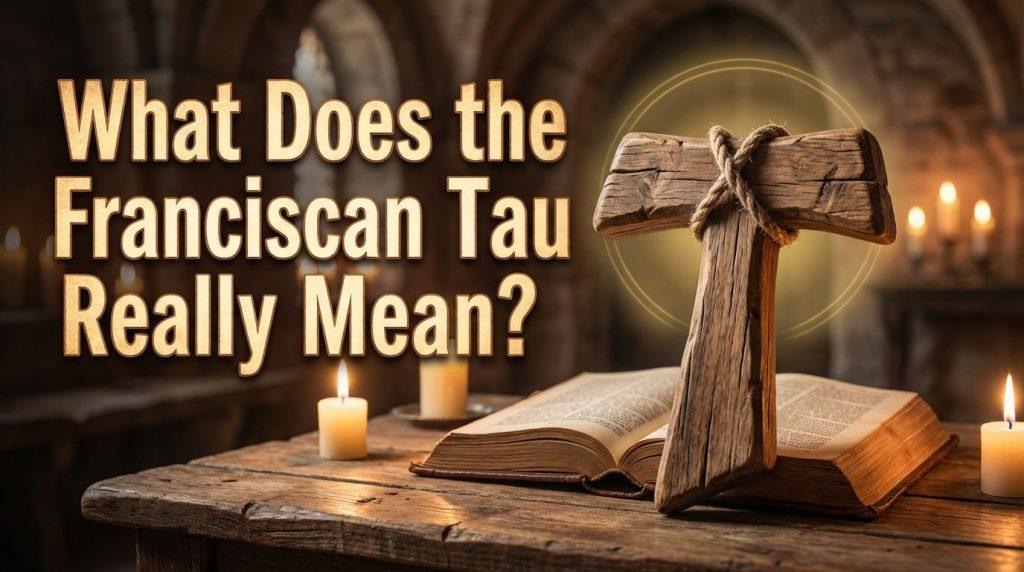
For members of the Franciscan family, including Franciscan friars, sisters, and members of the Secular Franciscan Order, the Tau serves as the distinctive habit and sign of their vocation. Unlike religious orders that wear elaborate habits, Secular Franciscans, who live in the world as laypeople, wear the simple Tau as their identifying mark. This practice reflects the Franciscan emphasis on simplicity and humility. The Tau is typically made of wood, though it can also be crafted from metal or other materials, and is worn on a cord around the neck. The cord often features three knots, representing the three evangelical counsels that guide Franciscan life: poverty, chastity, and obedience. These vows, taken solemnly by religious Franciscans and promised by Secular Franciscans, shape the entire orientation of Franciscan spirituality toward Gospel living. The Tau, combined with the three-knotted cord, becomes a comprehensive symbol of Franciscan identity and commitment.
Wearing the Tau is not meant to draw attention to oneself but to serve as a personal reminder and a witness to others. For Franciscans, the Tau calls them back to their commitment when they face temptations or difficulties. It reminds them of Saint Francis’s example and his call to live the Gospel without compromise. When others see the Tau, it can prompt questions and provide opportunities for evangelization and witness. The Tau worn visibly becomes a form of silent preaching, communicating through symbol what words might struggle to convey. Franciscans are encouraged to wear the Tau with humility, not as a badge of superiority but as a sign of their own need for continual conversion. The Tau marks them as pilgrims on the way, not as those who have arrived. This humble approach to wearing the Tau reflects Francis’s own spirit, as he never considered himself better than others but always saw himself as the least of all.
The Tau features prominently in Franciscan liturgy and prayer. Franciscan churches and chapels often display the Tau prominently, and it appears in Franciscan artwork, manuscripts, and devotional objects. During Franciscan profession ceremonies, when members make their formal commitment to the Franciscan way of life, the Tau plays a central role. Candidates may receive a Tau as part of their profession, symbolizing their acceptance into the Franciscan family and their commitment to live according to the Rule and Gospel. This ritual moment makes concrete the spiritual reality of Franciscan vocation, giving candidates a tangible sign of their new identity. Throughout their Franciscan life, members return to the Tau in prayer and meditation. They may kiss the Tau as an act of devotion, hold it during prayer, or contemplate its meaning as part of their spiritual reflection. These practices help keep the Tau alive as a living symbol rather than allowing it to become a mere ornament.
Franciscan spirituality emphasizes that the Tau is not exclusive to Franciscans. Anyone can wear or display the Tau as a sign of devotion to Christ and commitment to Gospel living. Many Catholics who are not formally part of the Franciscan family wear Tau crosses as expressions of their faith and their admiration for Saint Francis. The Church welcomes this broader use of the Tau because it serves the same purpose for all believers that it serves for Franciscans: it calls them to conversion, reminds them of Christ’s love, and encourages them to live the Gospel faithfully. Non-Franciscans who wear the Tau are not appropriating something that belongs exclusively to one group but participating in a universal Christian symbol that has particular resonance within the Franciscan tradition. This openness reflects the inclusive spirit of Saint Francis, who welcomed all people and saw all creation as reflecting God’s goodness and love.
The Tau as a Call to Conversion and Peace
One of the most important meanings of the Tau in Franciscan spirituality is its identification as a sign of conversion. Conversion, in Catholic teaching, means turning away from sin and turning toward God. It involves a fundamental reorientation of one’s life toward Christ and His Gospel. Conversion is not a single moment but a lifelong process of growth in holiness and conformity to Christ. The Tau symbolizes this ongoing conversion because it reminds believers of their baptismal commitment and their need to live that commitment faithfully each day. When Pope Innocent III preached about the Tau at the Fourth Lateran Council, he specifically called it a sign of conversion, linking it to the biblical image of marking those who grieve over sin and commit to righteousness. For Saint Francis, conversion meant radical transformation of life, leaving behind worldly security and embracing the poverty and humility of Christ. The Tau became the visible sign of this conversion, marking those who had chosen the Gospel way.
Conversion in the Franciscan sense involves both interior and exterior transformation. Interior conversion means changing one’s heart, attitudes, and values to align with Christ’s teachings. It requires humility, recognizing one’s sinfulness and need for God’s mercy. It involves developing virtues such as charity, patience, forgiveness, and compassion. Exterior conversion means changing one’s actions and lifestyle to reflect Gospel values. For Francis, this meant literally giving away his possessions, embracing poverty, caring for lepers, and preaching peace. For modern Franciscans and others inspired by Francis, exterior conversion might mean simplifying one’s lifestyle, being generous to the poor, working for justice, and promoting peace. The Tau calls believers to both dimensions of conversion, interior and exterior, heart and life. It challenges comfortable Christianity that accommodates itself to worldly values while claiming to follow Christ. The Tau demands authenticity and integrity, a life that matches one’s profession of faith.
The Tau is also closely associated with the Franciscan commitment to peace. Saint Francis greeted everyone with the words, “Peace and all good,” and he worked tirelessly to bring peace between warring factions. The famous story of Francis preaching to the Sultan during the Crusades shows his commitment to dialogue and peace even in the midst of conflict. Francis understood that peace is not merely the absence of conflict but the presence of right relationships rooted in justice and love. The Tau, as a symbol of Christ’s cross, points to the ultimate source of peace. Christ’s death reconciled humanity with God and made possible reconciliation between human beings. The cross, and therefore the Tau, is the instrument and sign of peace. Christians who wear the Tau commit themselves to being peacemakers in their families, communities, and world. This commitment involves actively seeking reconciliation, forgiving offenses, promoting justice, and working to heal divisions. The Tau challenges believers to ask themselves whether they are instruments of peace or sources of conflict.
Making peace requires courage and sacrifice, virtues symbolized by the cross. True peace often demands that believers stand against injustice, speak truth to power, and endure misunderstanding and opposition. Jesus Himself said He came to bring not peace but a sword, meaning that faithfulness to the Gospel sometimes creates conflict with those who reject it. The Tau reminds Christians that pursuing authentic peace may require bearing the cross of rejection and persecution. At the same time, the Tau assures believers that this suffering is not meaningless but participates in Christ’s redemptive work. Those who suffer for peace and justice are blessed, as Jesus teaches in Matthew 5:9-10. The Tau thus inspires both the commitment to peace and the courage to endure the cost of that commitment. It balances the gentle spirit of peacemaking with the strong resolve needed to pursue peace in a broken world.
The Tau and Creation Spirituality
Saint Francis is renowned for his love of creation and his recognition of all creatures as brothers and sisters. His famous Canticle of the Creatures praises God for Brother Sun, Sister Moon, Brother Wind, and Sister Water, among others. Francis saw all creation as a reflection of God’s goodness and a cause for praise. This creation spirituality is deeply connected to the Tau cross. The Tau, as the last letter of the Hebrew alphabet, represents completion and fulfillment. In the biblical account of creation in Genesis, God completes His work on the seventh day and declares it all very good. Creation itself is a Tau, a completed work of God that manifests His glory. When Francis embraced the Tau, he was embracing not only Christ crucified but also God as Creator and all creation as God’s beloved handiwork. The Tau reminds believers that caring for creation is a Gospel imperative, not merely an environmental preference. Christians are called to be stewards of God’s creation, treating it with respect and gratitude.
The connection between the Tau and creation has become increasingly relevant in contemporary times as environmental degradation threatens the planet. Pope Francis’s encyclical Laudato Si’ calls Catholics to recognize their responsibility for caring for our common home. The Tau can serve as a symbol of this ecological conversion, reminding believers that the same love that led Christ to die on the cross also created and sustains the natural world. Franciscan spirituality insists that there is no dichotomy between caring for the poor and caring for the earth. Both flow from the same Gospel mandate to love as Christ loved. The Tau challenges Christians to examine how their lifestyles impact creation and to make changes that honor God’s creative work. This might include reducing consumption, avoiding waste, supporting sustainable practices, and advocating for policies that protect the environment. The Tau calls believers to see themselves as part of creation, not above it, and to recognize their kinship with all creatures.
Francis’s love for creation was not sentimental but deeply theological. He saw in every creature a word of God, a revelation of divine truth. The sun proclaims God’s power and generosity. The moon reflects God’s gentle beauty. The birds trust in God’s providence. When Francis preached to the birds or blessed the wolf of Gubbio, he was not being eccentric but recognizing the spiritual reality that all creatures are connected in God’s love. The Tau symbolizes this interconnectedness. Just as the cross connects heaven and earth, the vertical beam pointing upward and the horizontal beam extending outward, so the Tau reminds believers of their connection to God and to all creation. This understanding has practical implications for how Christians live. It calls for gratitude for creation’s gifts, restraint in using resources, and joy in the beauty of the natural world. The Tau invites believers to practice Franciscan simplicity, living with less so that others, including other creatures, might have enough.
The Tau also points to the redemption of all creation. Catholic theology teaches that Christ’s death and resurrection have cosmic significance. Saint Paul writes in his letter to the Colossians that through Christ all things in heaven and on earth are reconciled to God. Creation itself, groaning in labor pains according to Romans 8:22, awaits its liberation and transformation. The Tau, as a symbol of Christ’s redeeming work, encompasses not only human salvation but the renewal of all creation. Christians who wear the Tau commit themselves to participating in this renewal. They work for a world where justice and peace prevail, where the poor are lifted up, where creation flourishes, and where God’s kingdom is manifested. This vision gives hope and purpose to Christian life. The Tau reminds believers that their small acts of love, justice, and care contribute to the cosmic work of redemption that Christ has begun and will complete. This hope sustains believers in the face of overwhelming challenges and inspires them to keep working for God’s kingdom.
How to Live the Meaning of the Tau
Understanding the meaning of the Tau is only the beginning; the real challenge is living it. For those who wear the Tau or who are inspired by its symbolism, several practical implications follow. First, the Tau calls for daily conversion. Each morning offers an opportunity to begin again, as Saint Francis taught. Believers can start their day by making the sign of the cross and renewing their commitment to follow Christ faithfully that day. They can examine their consciences regularly, acknowledging failures and asking for God’s mercy. The Sacrament of Reconciliation provides a powerful means of ongoing conversion, allowing Catholics to confess their sins and receive God’s forgiveness. The Tau reminds believers not to become discouraged by their failures but to trust in God’s mercy and begin again. This spirit of beginning again creates a healthy spiritual life characterized by humility and hope rather than by pride or despair.
Second, the Tau calls for simplicity of life. Francis embraced radical poverty, but not all Christians are called to his extreme example. However, all Christians are called to simplicity, which means living with what is sufficient rather than accumulating excess. Simplicity involves examining one’s lifestyle and asking whether it reflects Gospel values or worldly values. It means being content with less, sharing generously with others, and avoiding the trap of consumerism that defines worth by possessions. Simplicity also applies to one’s interior life, letting go of complicated schemes and anxieties and trusting simply in God’s providence. The Tau, with its unadorned simplicity, models this approach to life. Living simply allows believers to focus on what truly matters: loving God and neighbor, growing in virtue, and serving those in need. Simplicity brings freedom because it releases believers from the burden of maintaining and protecting possessions and allows them to live with open hands and hearts.
Third, the Tau calls for peacemaking in all relationships. Christians who embrace the Tau commit themselves to being instruments of peace in their families, workplaces, parishes, and communities. This commitment begins with small, everyday acts: speaking kindly, listening attentively, forgiving quickly, and seeking to understand before being understood. Peacemaking requires humility, the willingness to admit one’s own faults rather than focusing on others’ shortcomings. It means choosing reconciliation over being right, unity over division, love over judgment. In a world marked by polarization and conflict, Christians who wear the Tau should be recognizable as people who build bridges rather than walls. This does not mean avoiding necessary conflicts or remaining silent in the face of injustice. Rather, it means engaging conflicts constructively, speaking truth with love, and always seeking the good of the other. The Tau reminds believers that they follow a Lord who made peace through His blood shed on the cross, and they are called to continue His peacemaking work.
Fourth, the Tau calls for care of creation. Believers who embrace Franciscan spirituality recognize their responsibility to care for the earth and all its creatures. This care expresses itself in practical ways: reducing waste, recycling, conserving energy and water, supporting sustainable agriculture, and advocating for environmental protection. It also expresses itself in spiritual practices: spending time in nature, praying outdoors, thanking God for creation’s gifts, and cultivating wonder at the beauty and complexity of the natural world. Teaching children to love and respect creation forms the next generation of environmental stewards. The Tau reminds believers that the earth is not merely a resource to be exploited but God’s creation to be cherished and protected. This ecological awareness connects naturally with concern for the poor, as environmental degradation often harms the most vulnerable. The Tau thus integrates care for people and care for the planet into a unified Gospel vision.
Fifth, the Tau calls for joy and gratitude. Despite its association with the cross and suffering, the Tau ultimately points to hope and resurrection. Saint Francis was known for his joy, his singing, and his praise of God. He found joy not in comfortable circumstances but in trusting God’s goodness and recognizing God’s presence in all things. The Tau reminds believers that Christian life, though demanding, is fundamentally joyful because it rests on the good news of salvation. Cultivating gratitude transforms one’s perspective on life. Instead of focusing on what is lacking, believers who practice gratitude notice and appreciate what they have received. Gratitude combats the anxiety and discontent that plague modern life. The Tau, as a symbol of God’s great gift of salvation, naturally inspires gratitude. Believers can practice gratitude by keeping a gratitude journal, thanking God daily for specific blessings, expressing appreciation to others, and choosing to see difficulties as opportunities for growth rather than as burdens. This grateful, joyful spirit attracts others to the faith and gives powerful witness to the Gospel.
The Tau in Contemporary Catholic Life
In contemporary Catholic life, the Tau continues to serve as a powerful symbol with relevance for all believers, not only Franciscans. Many Catholics wear Tau crosses as necklaces or display them in their homes as reminders of their faith and their baptismal commitment. The Tau has become particularly popular in recent decades as interest in Franciscan spirituality has grown. Pope Francis, though he is a Jesuit and not a Franciscan, chose the name Francis and has promoted many themes central to Franciscan spirituality, including care for the poor, simplicity of life, and environmental stewardship. His papal coat of arms features the Jesuit emblem, but his ministry embodies much that the Tau represents. Catholics who wear the Tau in this era find in it a symbol that connects them to both ancient biblical traditions and contemporary calls for renewal and reform in the Church. The Tau serves as a reminder that the Gospel message remains constant across centuries while always calling for fresh commitment in each generation.
The Tau also appears in various Catholic devotional practices. Some Catholics begin their day by blessing themselves with the Tau, tracing it on their foreheads as a renewal of their baptismal consecration. Others use the Tau as a focus for meditation, contemplating its meaning and asking how they are called to live it more faithfully. Parishes sometimes use the Tau in catechesis, teaching children and adults about its biblical origins and Franciscan significance. Retreats and spiritual formation programs often incorporate reflection on the Tau as a way to deepen participants’ understanding of discipleship and conversion. The symbol’s simplicity makes it accessible to people of all ages and backgrounds. Its rich layers of meaning reward deeper study and reflection. The Tau thus functions as an excellent catechetical tool that can introduce people to Scripture, Church history, the lives of the saints, and practical Christian living.
Many Catholic institutions, particularly those with Franciscan connections, use the Tau in their logos and branding. Schools, hospitals, parishes, and social service agencies incorporate the Tau into their visual identity as a way of expressing their values and mission. This use of the Tau in institutional contexts reminds members of these communities that they are called to embody Gospel values in their work and relationships. A Franciscan school that displays the Tau is declaring its commitment to educating students in the spirit of Saint Francis, with emphasis on simplicity, service, peace, and care for creation. A hospital with the Tau in its logo is affirming its dedication to healing ministry in the tradition of Francis, who cared for lepers and saw Christ in the sick. These institutional uses of the Tau help connect organizational mission with spiritual foundations, keeping the focus on Gospel values rather than merely institutional success.
The Tau has also become a symbol of Christian unity and ecumenical dialogue. While it has particular significance in Catholic and Franciscan contexts, Protestant Christians also appreciate the Tau’s biblical roots and its emphasis on the cross. Some Anglican and Lutheran communities with Franciscan Third Orders use the Tau as their symbol. This shared embrace of the Tau across denominational lines shows how certain symbols can unite Christians around common commitments to Gospel living. The Tau’s emphasis on conversion, peace, simplicity, and care for creation resonates with Christians from various traditions who seek to live their faith authentically. In an age of ecumenical dialogue and cooperation, the Tau serves as a reminder of what Christians share rather than what divides them. Its focus on the cross of Christ, the central mystery of Christian faith, provides common ground for unity. Catholics who wear the Tau can see it as a sign not only of their own Catholic identity but also of their connection to all Christians who look to Christ crucified as their hope of salvation.
Living the Tau Through Service and Witness
The Tau ultimately calls believers to serve others, particularly the poor and marginalized. Saint Francis’s love for the Tau was inseparable from his love for the poor. He saw Christ in every poor person and treated them with the dignity befitting Christ Himself. Francis’s dramatic conversion began when he embraced a leper, overcoming his disgust to show love to someone society rejected. This embrace was Francis’s way of embracing the cross, accepting the suffering and challenge of truly loving as Christ loved. The Tau reminds believers that authentic faith expresses itself in concrete acts of charity. It is not enough to wear a religious symbol; one must live what it represents. James writes in his epistle that faith without works is dead. The Tau challenges believers to examine whether their faith produces the works of mercy that demonstrate genuine love. These works include feeding the hungry, giving drink to the thirsty, welcoming the stranger, clothing the naked, caring for the sick, and visiting the imprisoned, as Jesus teaches in Matthew 25:31-46.
Service to the poor takes many forms in contemporary Catholic life. It can mean volunteering at a food bank or homeless shelter, supporting organizations that serve those in need, advocating for just policies that address poverty’s root causes, or simply being attentive to the needs of individuals one encounters. The Tau reminds believers that every act of service, no matter how small, has value when done with love. Mother Teresa often spoke of doing small things with great love, and this Franciscan spirit transforms ordinary acts into powerful expressions of Gospel charity. The Tau worn around one’s neck should inspire the question: Am I serving as Francis served? Am I seeing Christ in the poor and responding with love? These questions keep faith honest and prevent it from becoming merely sentimental or theoretical. The Tau makes concrete and practical the call to discipleship, grounding it in the real needs of real people.
Witness is another crucial dimension of living the Tau. Christians are called to be light to the world and salt of the earth, as Jesus teaches in Matthew 5:13-16. This means living in such a way that others can see the Gospel’s transformative power. The Tau worn visibly serves as a form of witness, but far more important is the witness of one’s life. Do others see in believers the joy, peace, love, and integrity that characterize Gospel living? Are Christians recognizable as followers of Jesus by their actions and attitudes? Saint Francis said that brothers should preach always and use words if necessary, a saying that emphasizes the priority of witness over mere verbal proclamation. The Tau challenges believers to let their lives preach the Gospel, demonstrating through their choices and behaviors what it means to follow Christ. This witness is especially powerful in a secular age when many people are skeptical of religious claims but remain open to authentic examples of lived faith.
Living the Tau requires courage because it often means going against cultural norms and expectations. A culture that values accumulation, individualism, and self-promotion stands in stark contrast to the simplicity, community, and humility that the Tau represents. Christians who seriously embrace the Tau will find themselves making countercultural choices that may puzzle or challenge others. They may choose smaller homes, less lucrative careers, more time with family, and less time pursuing status or wealth. They may prioritize relationships over achievements, giving over accumulating, and being over having. These choices flow naturally from the Tau’s call to take up the cross and follow Christ. They require faith to believe that the Gospel’s way truly leads to life and that worldly wisdom leads to emptiness. The Tau strengthens believers in making these choices by reminding them that they are not alone. They stand in a long tradition of Christians who have chosen the narrow way, and they are accompanied by Christ who walks with them and gives them the grace to persevere.
Conclusion and Ongoing Reflection
The Franciscan Tau is far more than a simple religious symbol. It is a living tradition that connects believers to biblical prophecy, Church history, the life of Saint Francis, and the ongoing call to Gospel living. Understanding what the Tau means requires engaging with Scripture, particularly the Book of Ezekiel where the mark appears as a sign of God’s protection for the faithful. It requires knowing the historical context of the Fourth Lateran Council and Pope Innocent III’s call for Church reform. It requires learning about Saint Francis and his passionate embrace of the cross as the center of Christian life. Most importantly, understanding the Tau requires personal commitment to living its meaning through conversion, simplicity, peacemaking, care for creation, and service to others. The Tau is not a passive symbol but an active call that demands a response. Those who wear it or display it are declaring their willingness to answer that call and to let the Tau shape their lives.
The beauty of the Tau lies in its simplicity and its depth. Its simple T shape makes it immediately recognizable and easy to reproduce. Children can draw it, artists can create beautiful versions of it, and craftspeople can fashion it from various materials. Yet this simple symbol contains layers of meaning that reward a lifetime of reflection and study. Each time believers contemplate the Tau, they can discover new insights into its significance. They can connect it to different Scripture passages, see it in relation to different aspects of Church teaching, or find it speaking to particular situations in their lives. The Tau remains fresh and relevant across centuries because it points to timeless truths about God’s love, human need for salvation, and the call to follow Christ. Its simplicity prevents it from becoming dated or obscure, while its depth prevents it from becoming shallow or trivial.
For those considering whether to embrace the Tau as a personal symbol, the decision should be made prayerfully and seriously. Wearing the Tau is not merely a fashion choice or a way to express admiration for Saint Francis. It is a commitment to a way of life. Before adopting the Tau, believers should reflect on whether they are willing to let it challenge and change them. Are they ready to simplify their lives, to serve the poor, to work for peace, to care for creation, and to embrace the cross? Are they willing to begin again each day, confessing their failures and trusting in God’s mercy? Are they prepared to witness to the Gospel through their choices and behaviors? If the answer to these questions is yes, then the Tau can become a powerful companion on the spiritual journey. It will serve as a constant reminder of commitments made and grace received. It will connect the wearer to a global community of Franciscans and other Christians who share similar values and commitments.
The Tau also invites ongoing formation and deepening understanding. Those who embrace it should continue to learn about Franciscan spirituality, reading the writings of Francis and Clare and exploring how contemporary Franciscans live out their vocation. Many resources exist for Franciscan formation, including books, websites, retreat centers, and local Franciscan fraternities that welcome inquirers and members. Engaging with these resources helps prevent the Tau from becoming a mere ornament and keeps it alive as a living symbol. Regular reflection on the Tau’s meaning, perhaps during prayer or examination of conscience, helps maintain its relevance and power in one’s spiritual life. The Tau should never become so familiar that it loses its ability to challenge and inspire. It should always call believers to deeper conversion and more authentic Gospel living.
In conclusion, the Franciscan Tau is a symbol rich with biblical, historical, theological, and spiritual significance. From its origins in the Book of Ezekiel as a mark of divine protection, through its embrace by Saint Francis as his personal signature and mission symbol, to its contemporary use by Franciscans and other Catholics as a sign of commitment to Gospel living, the Tau speaks powerfully to believers about what it means to follow Christ. The Tau points to the cross where salvation was accomplished and calls believers to take up their own crosses daily. It reminds them of the need for continual conversion, the importance of simplicity and poverty of spirit, the obligation to make peace and care for creation, and the joy of living in God’s love. The Tau is not exclusive to one group but welcomes all who wish to walk the Gospel path that Francis walked. May all who encounter the Tau be inspired by its meaning and empowered by God’s grace to live faithfully as disciples of Jesus Christ, marked by the cross and committed to love and service in His name.
Disclaimer: This article presents Catholic teaching for educational purposes. For official Church teaching, consult the Catechism and magisterial documents. For personal spiritual guidance, consult your parish priest or spiritual director. Questions? Contact editor@catholicshare.com
Sign up for our Exclusive Newsletter
- 📌 Add CatholicShare as a Preferred Source on Google
- 🎁 Join us on Patreon for Premium Content
- 🎧 Check Out These Catholic Audiobooks
- 📿 Get Your FREE Rosary Book
- 📱 Follow Us on Flipboard
-

Recommended Catholic Books
Discover hidden wisdom in Catholic books — invaluable guides enriching faith and satisfying curiosity. #CommissionsEarned
- The Early Church Was the Catholic Church
- The Case for Catholicism - Answers to Classic and Contemporary Protestant Objections
- Meeting the Protestant Challenge: How to Answer 50 Biblical Objections to Catholic Beliefs
As an Amazon Associate, I earn from qualifying purchases. Thank you for your support.