
Brief Overview
- The fish symbol, known as the ichthys, served as a secret sign of Christian identity during the early centuries of persecution.
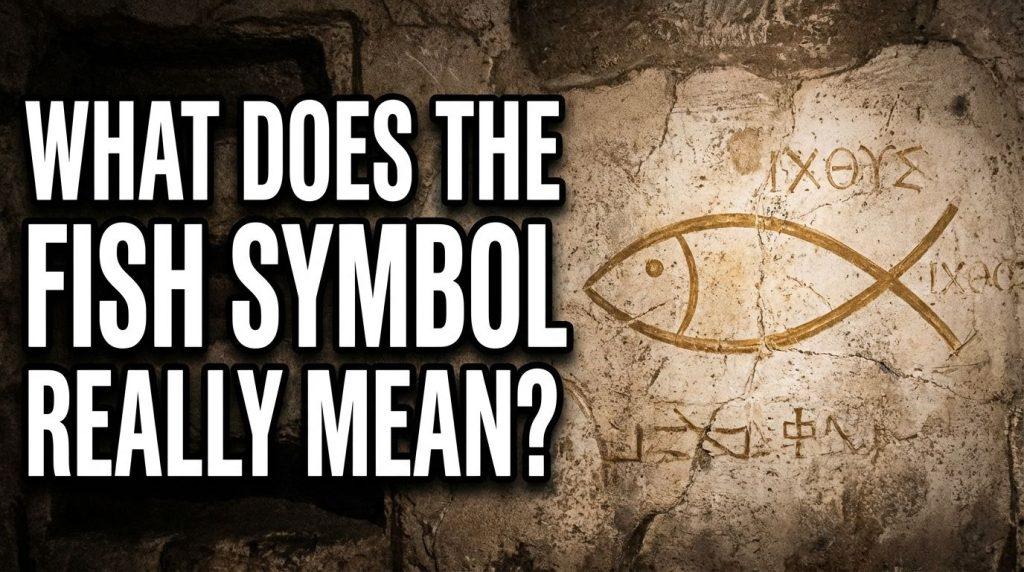
- The Greek word for fish, ICHTHYS, forms an acrostic for “Jesus Christ, God’s Son, Savior” in Greek.
- Early Christians used the fish to identify fellow believers and mark meeting places without attracting hostile attention.
- The symbol has biblical roots in Jesus calling disciples to be fishers of men and miracles involving fish.
- The fish appears extensively in early Christian art, particularly in catacombs and on funerary monuments.
- Understanding the fish symbol helps Catholics appreciate how the early Church expressed faith under persecution and maintained continuity with biblical imagery.
The Greek Acrostic ICHTHYS
The fish symbol’s primary meaning comes from the Greek word for fish, ICHTHYS, which early Christians recognized as an acrostic containing a profound confession of faith. The first letter, Iota, stands for Iesous, Jesus in Greek. The second letter, Chi, represents Christos, meaning Christ or the Anointed One. The third letter, Theta, stands for Theou, meaning “of God” or “God’s.” The fourth letter, Upsilon, represents Huios, which means Son. The final letter, Sigma, stands for Soter, meaning Savior. Together these five letters spell out the complete statement: “Jesus Christ, God’s Son, Savior.” This compact creed summarizes the essential Christian proclamation in a form that could be written, spoken, or symbolized by a simple fish drawing.
The genius of this acrostic lies in its dual function as both ordinary word and theological statement. In normal conversation or writing, ichthys simply meant fish, a common topic in a Mediterranean culture where fishing provided livelihood for many. Yet for Christians who knew the secret, the word simultaneously proclaimed their faith in Jesus as divine Savior. This double meaning allowed believers to use the term or symbol openly without immediately revealing their religious identity to potential persecutors. The fish could be drawn on walls, carved on stones, or mentioned in conversation with apparent innocence while conveying deep meaning to those initiated into its significance.
Each element of the ICHTHYS confession carries important theological weight. Calling Jesus “Christ” identifies Him as the promised Messiah of Israel, the one anointed by God to bring salvation. The designation “God’s Son” asserts Jesus’s divine nature and unique relationship with the Father, a claim that distinguishes Christianity from other monotheistic religions. The title “Savior” emphasizes Jesus’s role in accomplishing human redemption through His death and resurrection. This brief formula thus encapsulates core Christian beliefs about Jesus’s identity and mission. The fish symbol, by representing this acrostic, became a portable creed that Christians could display or invoke in any situation.
Biblical Foundations of Fish Symbolism
The fish symbol gained additional power from its strong connections to Jesus’s ministry and teachings recorded in the Gospels. Jesus called several of His first disciples from among fishermen working on the Sea of Galilee. According to Matthew’s Gospel, Jesus saw Simon Peter and his brother Andrew casting nets into the sea and said, “Come after me, and I will make you fishers of men” (Matthew 4:19). This calling transformed the disciples’ occupation into a metaphor for evangelization. Catching fish became an image for bringing people into God’s kingdom, establishing fishing as central to Christian mission and identity from the very beginning.
Jesus performed multiple miracles involving fish that demonstrated His divine power and care for His followers. The feeding of the five thousand, recorded in all four Gospels, shows Jesus multiplying five loaves and two fish to feed a massive crowd with abundant leftovers. This miracle revealed Jesus’s ability to provide for human needs and prefigured the Eucharistic feast that would sustain the Church. After His resurrection, Jesus appeared to the disciples by the Sea of Galilee and directed them to a miraculous catch of fish so abundant they could hardly haul in the net (John 21:1-14). This post-resurrection miracle demonstrated Jesus’s continued presence and power even after His death.
The parable of the net in Matthew’s Gospel uses fishing imagery to describe the kingdom of heaven. Jesus compared the kingdom to a net thrown into the sea that catches fish of every kind, which are then sorted with the good kept and the bad thrown away (Matthew 13:47-48). This parable connected fishing to final judgment and the gathering of God’s people. Additional fish references appear throughout the Gospels, creating a rich symbolic vocabulary around this common element of daily life. Early Christians who adopted the fish symbol thus drew on a deep well of biblical imagery that spoke to Jesus’s identity, His miracles, His mission, and His teaching about the kingdom.
The Fish in Early Christian Persecution
Christianity emerged in the Roman Empire where it faced periodic waves of intense persecution. Roman authorities viewed Christian monotheism and refusal to participate in emperor worship as threats to social order and political stability. Christians needed ways to identify each other and communicate without attracting unwanted attention from informants or officials. The fish symbol served this protective function perfectly. Two strangers meeting could test whether both were Christian by one drawing an arc in the dirt or sand. If the other person completed the fish shape by drawing a second arc, both knew they were fellow believers. This simple gesture required no words and could be dismissed as meaningless doodling if observed by hostile witnesses.
The fish symbol’s effectiveness as a secret sign stemmed from its everyday familiarity in Mediterranean culture. Fish were common in diet, economy, and daily life throughout the Roman Empire. Images of fish appeared in various contexts as decorative elements or practical symbols related to fishing and commerce. A fish carved on a building, drawn on a wall, or displayed in artwork would not immediately identify someone as Christian to uninitiated observers. Only those who knew the secret meaning would recognize it as a Christian symbol. This dual nature provided both concealment from enemies and recognition among friends, allowing Christians to build community while maintaining security.
Historical accounts and archaeological evidence confirm that early Christians did use the fish symbol during times of persecution. The symbol appears in catacomb paintings, on tombstones, and carved into various objects from the first centuries of Christianity. Church fathers and early Christian writers occasionally reference the fish symbol, though not always explicitly explaining its meaning. This reticence about publicizing the symbol’s significance makes sense given its function as a secret sign. The less widely known the meaning, the more effective the symbol as a covert identifier. Only as Christianity gained tolerance and eventual imperial favor did the fish symbol’s meaning become more openly discussed and documented.
The Fish in Catacomb Art
The catacombs of Rome and other cities contain extensive examples of early Christian art, including numerous representations of fish. These underground burial chambers provided spaces where Christians could gather for worship and commemoration of the dead relatively safe from persecution. Artists decorated catacomb walls with frescoes showing biblical scenes, symbolic images, and inscriptions. Fish appear frequently in this catacomb art, sometimes alone and sometimes combined with other Christian symbols like anchors, doves, or the chi-rho monogram. The fish in funerary contexts expressed hope in Christ the Savior who conquered death and promised resurrection to believers.
One particularly significant catacomb image shows fish and bread together, referencing both the multiplication of loaves and fish and the Eucharist. This combination emphasized Christ’s provision of physical and spiritual food. The fish in such contexts represents not only Christ Himself but also the community of believers who feed on Him in the sacrament. Some catacomb inscriptions include the word ICHTHYS or variations, making the acrostic meaning explicit. These textual references confirm that early Christians understood the fish symbol’s connection to the confession of faith and used it intentionally to express their beliefs.
The artistic style of catacomb fish ranges from simple line drawings to more elaborate depictions. Some show realistic fish while others use highly stylized forms. The variety suggests that the symbol was used across different communities and artistic traditions, adapting to local preferences while maintaining its essential meaning. Fish often appear in eucharistic contexts in catacomb art, near depictions of bread and wine or scenes of communal meals. This connection reinforces the symbol’s link to Christ who feeds believers and to the Church’s sacramental life centered on the Eucharist.
The Fish and Baptism
Early Christian understanding connected the fish symbol to baptism through multiple associations. Just as fish live in water, Christians are born to new life through the water of baptism. Tertullian, an early Church father writing around 200 AD, explicitly made this connection when he wrote that Christians are “little fish” following Christ the great fish, born in water and preserved only by remaining in water. This imagery linked baptism to Christian identity in a way that the fish symbol could represent visually. Being a Christian meant being a fish who lives in the waters of baptism.
The connection between fish and baptism appears in some early baptismal fonts and baptistry decorations. Mosaics in ancient baptistries sometimes included fish swimming in water, symbolizing the newly baptized entering into life in Christ. The fish imagery helped catechumens understand that baptism was not merely ritual washing but transformation into a new kind of being, creatures who live in the element of grace represented by baptismal waters. This understanding added another layer of meaning to the fish symbol beyond its function as a secret identifier or acrostic.
The fish symbol’s baptismal associations strengthen its connection to Christian community. All who are baptized become part of the body of believers, the school of fish following Christ. The symbol thus represents both individual identity as a Christian and membership in the larger Church. When early Christians saw or used the fish symbol, they were reminded of their baptismal identity and their unity with all other believers. This communal dimension made the fish particularly appropriate for marking Christian gathering places and cemeteries where the community assembled.
The Development of Christian Symbols
The fish was not the only symbol early Christians used, but it was among the most widespread and enduring. Other early Christian symbols included the anchor, representing hope; the dove, symbolizing the Holy Spirit; the ship, representing the Church; and the Good Shepherd, depicting Christ’s care for souls. The chi-rho monogram formed from the first two letters of Christ’s name in Greek became prominent after Constantine’s conversion in the fourth century. These various symbols worked together to create a rich visual vocabulary that communicated Christian truths without relying on written text.
The fish maintained its importance even as other symbols gained prominence. While the cross eventually became Christianity’s primary symbol, the fish never disappeared from Christian use. It continued to appear in art, architecture, and devotional objects throughout the medieval period and beyond. The symbol’s biblical roots and connection to the ICHTHYS acrostic gave it permanent value in Christian iconography. Different symbols served different purposes and appealed to different sensibilities, but the fish remained part of the standard repertoire.
The coexistence of multiple symbols reflects Christianity’s adaptation to diverse cultural contexts and its ability to communicate through various media. Visual symbols transcended language barriers, allowing the faith to spread across the multilingual Roman Empire. They also provided access to Christian teaching for illiterate believers who could not read Scripture or theological texts. The fish and other symbols functioned as a visual catechism, teaching doctrine through images that people encountered in churches, homes, and public spaces. This symbolic language formed part of how Christianity transmitted its faith from generation to generation.
The Fish Symbol’s Modern Revival
The fish symbol experienced a significant revival in the twentieth century, particularly among evangelical and Protestant Christians. Car decals featuring the fish outline became common in the United States and other countries, allowing Christians to identify themselves to others and express their faith publicly. This modern use mirrors the ancient function of the symbol as a marker of Christian identity, though in vastly different circumstances. Contemporary Christians generally do not face persecution requiring secret signs, so the fish now functions more as public witness than covert identification. The widespread recognition of the fish as a Christian symbol means that displaying it communicates one’s faith to believers and non-believers alike.
Catholic use of the fish symbol in modern times has been more restrained than in some Protestant contexts, but the symbol appears in Catholic contexts nevertheless. Catholic bookstores and gift shops sell items decorated with fish symbols. Some Catholic schools, parishes, and organizations incorporate the ichthys into their logos or materials. The symbol’s ancient pedigree and biblical connections make it appropriate for Catholic use, though it may be less prominent than distinctively Catholic symbols like the crucifix, the Sacred Heart, or images of Mary and the saints.
The modern revival of the fish symbol has sparked some creative variations and responses. Secular parodies include fish symbols with legs labeled “Darwin” or other non-religious messages. These variations acknowledge the fish’s association with Christianity while either mocking it or appropriating the design for other purposes. Christians have responded with additional variations attempting to reclaim or expand the symbol’s meaning. Despite these contemporary adaptations and controversies, the basic fish outline remains recognizable as a Christian symbol with roots in the early Church.
The Fish and Eucharistic Symbolism
Beyond its connection to the ICHTHYS acrostic and baptism, the fish symbol acquired eucharistic associations in early Christianity. Several Gospel accounts show Jesus eating fish with His disciples, particularly after the resurrection. When Jesus appeared to the apostles in Jerusalem, He ate broiled fish in their presence to demonstrate that He was not a ghost but had truly risen bodily (Luke 24:42-43). This resurrection meal created connections between fish, Christ’s real presence, and communal eating that early Christians recognized.
Early Christian art sometimes depicts fish alongside bread in eucharistic contexts, recalling the multiplication miracle while also pointing to the Eucharist. The fish in such images can represent Christ Himself who is consumed in Holy Communion. Just as the crowd ate the multiplied fish and bread, Christians feed on Christ in the sacrament. This eucharistic interpretation adds another dimension to the fish symbol’s meaning. The symbol could simultaneously represent Christ, Christian identity, baptism, and the Eucharist, all interconnected aspects of Christian life.
Some early Christian funerary inscriptions include the word ICHTHYS in contexts clearly referring to eucharistic communion. These texts express hope that the deceased now shares in the heavenly banquet, the fulfillment of earthly Eucharist. The fish symbol in cemeteries thus points forward to resurrection and eternal life in communion with Christ. This eschatological dimension enriches the symbol’s meaning, connecting present sacramental life to future glory.
Theological Depth of the Fish Symbol
The fish symbol encapsulates essential Christian theology in a remarkably compact form. Through the ICHTHYS acrostic, it proclaims Jesus’s identity as Christ and God’s Son, His mission as Savior, and His divine nature. These doctrines form the foundation of Christian faith and distinguish Christianity from other religious movements. The symbol’s use in persecution contexts demonstrates that early Christians considered these truths worth risking their lives to profess and preserve. The fish represented not peripheral opinions but core convictions defining Christian identity.
The Christological content of the fish symbol addresses the question of Jesus’s identity that stands at Christianity’s center. Is Jesus merely a human teacher and prophet, or is He the divine Son of God incarnate for human salvation? The ICHTHYS confession clearly affirms the latter, placing Jesus in unique relationship to God as His Son and ascribing to Him the saving work that belongs to God alone. This high Christology, expressed through the fish symbol, reflects the faith of the early Church as recorded in the New Testament and formalized in the creeds.
The symbol’s connection to baptism and Eucharist links Christological doctrine to sacramental practice. Correct belief about Jesus naturally leads to participation in the sacramental life He instituted. The fish reminds believers that theology and worship belong together, that what Christians believe about Christ shapes how they relate to Him through the Church’s sacraments. This integration of doctrine and practice, symbolized in one simple image, characterizes authentic Catholic Christianity.
The Fish in Contemporary Catholic Practice
While less prominent than in some Protestant circles, the fish symbol remains available and meaningful for contemporary Catholic use. Understanding its history and theological significance can enrich Catholic appreciation for this ancient Christian image. Catholics who display fish symbols connect themselves to the early Church’s witness and proclamation of faith. Using the symbol becomes an act of solidarity with persecuted Christians past and present, a reminder that professing Christ has always involved risk and requires courage.
Catholic educators can teach about the fish symbol as part of instruction on Church history and Christian symbols. Learning about the ICHTHYS acrostic provides an accessible entry into both Greek language and systematic theology. Students can memorize the five words that form the acrostic, gaining a compact statement of faith they can carry with them. The fish symbol’s story of Christians under persecution can inspire contemporary believers facing more subtle forms of opposition or social pressure. Teaching about ancient symbols like the fish connects Catholics to their heritage and deepens sense of belonging to a Church that spans centuries.
Personal devotion can incorporate the fish symbol in various ways. Catholics might wear fish jewelry or display fish imagery in homes as reminders of Christian identity and baptismal commitment. The symbol can serve as a focus for brief prayers throughout the day or as a prompt for acts of faith. When Catholics encounter fish symbols in various contexts, whether religious or secular, they can use these moments to renew their own faith in Jesus Christ, God’s Son and Savior. The ancient symbol thus continues to function in contemporary spirituality much as it did in the early Church.
The Fish and Evangelization
The fish symbol’s original context in evangelization during the early Church’s expansion makes it particularly appropriate for contemporary missionary and evangelistic efforts. Just as the first disciples became fishers of men, contemporary Catholics are called to share the Gospel and draw people to Christ. The fish symbol reminds believers of this evangelical mission that belongs to every Christian, not only priests and religious. Understanding that the symbol originally helped Christians identify each other and build community in hostile environments encourages contemporary believers facing resistance or indifference to their faith.
The symbol’s simplicity and recognizability make it useful for initial evangelization. Someone who sees a fish symbol and asks about its meaning receives an opportunity to hear the Gospel. The ICHTHYS acrostic provides a natural structure for explaining who Jesus is and what He accomplished. Starting with the fish symbol, evangelizers can unfold the full Christian message, moving from simple identification to deeper catechesis. This pattern of beginning with symbols and images before advancing to fuller teaching follows sound pedagogical principles and honors how many people learn.
Catholic evangelization in the twenty-first century faces challenges both similar to and different from those the early Church confronted. Secularization, religious pluralism, and active hostility to Christianity create environments where witnessing to faith requires courage and creativity. The fish symbol and its history provide resources for contemporary evangelization. It demonstrates that Christianity survived and grew despite persecution. It shows that symbols and signs can communicate effectively when direct proclamation might be dangerous or ineffective. It reminds believers that every generation must find ways to profess and transmit the faith in its own context while remaining faithful to apostolic teaching.
Artistic Interpretations Across History
Christian artists throughout history have created countless representations of fish in various media and styles. Early catacomb paintings show simple fish outlines. Byzantine mosaics include elaborate fish among other symbols and scenes. Medieval manuscripts illuminate fish in decorative borders and illustrations. Renaissance and Baroque artists incorporated fish into narrative biblical scenes and still life paintings. Each artistic period brought its own aesthetic to fish imagery while maintaining the symbol’s essential meaning and recognizability.
The fish appears in church architecture both as decorative element and as theological symbol. Stone carvings might feature fish in various locations within a church building. Stained glass windows sometimes include fish among other Christian symbols. Baptismal fonts occasionally feature fish designs, connecting to the symbol’s baptismal associations. These architectural uses make the fish visible to worshipers and visitors, creating opportunities for visual catechesis and contemplation. Even people unfamiliar with the symbol’s history can appreciate its aesthetic contribution while those who know its meaning find deeper significance.
Contemporary Christian artists continue to find fresh ways to represent the ancient fish symbol. Modern designs range from minimalist outlines to detailed realistic depictions to abstract interpretations. Digital media allow for new artistic expressions of traditional symbols. The fish’s basic form is simple enough that even amateur artists can reproduce it, yet sophisticated enough that professional artists can create complex variations. This accessibility combined with depth ensures the symbol’s continued vitality in Christian visual culture.
Ecumenical Value of the Fish Symbol
The fish symbol enjoys recognition across most Christian traditions, providing common ground among Catholics, Orthodox, and Protestants. All these groups trace their origins to the early Church that created and used the fish symbol. The ICHTHYS confession of Jesus as Christ, God’s Son, and Savior represents beliefs shared across denominational lines despite disagreements on other matters. Using the fish symbol in ecumenical contexts emphasizes what unites Christians rather than what divides them. The symbol points to the one Lord whom all confess even when they differ on church structure, sacramental theology, or liturgical practice.
Ecumenical worship services and gatherings can appropriately feature the fish symbol as representing common faith in Christ. Unlike some symbols that carry distinctively Catholic, Orthodox, or Protestant associations, the fish belongs to the shared heritage of all Christians. Displaying it in ecumenical contexts reminds participants of their fundamental unity in Christ. Conversations about Christian unity can use the fish symbol and the early Church’s undivided witness as reference points for discussing how to overcome later divisions.
The fish symbol’s ancient origins place it before the major schisms that fragmented Christianity. Orthodox and Catholic Christians separated in 1054. Protestants broke from Rome in the sixteenth century. But the fish symbol dates to the first centuries when the Church was visibly one. This historical priority gives the symbol special value for ecumenical efforts. It witnesses to a time when Christians were united and points toward the future unity for which Jesus prayed. The fish thus serves both as reminder of lost unity and as sign of hope for restoration.
Challenges to Using the Fish Symbol
Some contemporary Catholics may hesitate to use the fish symbol because of its strong association with evangelical Protestantism in recent decades. The car decal phenomenon made the fish primarily identified with a particular expression of Christianity that emphasizes personal conversion and biblical literalism over sacramental life and tradition. Catholics uncomfortable with aspects of evangelical theology or culture may avoid the fish symbol to prevent being associated with those movements. This concern reflects how symbols can acquire cultural baggage that affects their usefulness in other contexts.
The commercialization and trivialization of the fish symbol presents another challenge. When the ancient Christian sign becomes merely a consumer product or a target for secular parody, its sacred significance risks being lost. Catholics who value the symbol’s historical and theological depth may object to its reduction to a marketing tool or cultural identifier divorced from genuine faith. This tension between preserving sacred meaning and engaging popular culture characterizes many aspects of contemporary religious life.
Despite these challenges, Catholics need not abandon the fish symbol but can reclaim and use it with full awareness of its rich Christian heritage. Teaching the symbol’s history and meaning helps people appreciate it as more than a cultural marker or commercial product. When Catholics display or reference the fish symbol with understanding of the ICHTHYS acrostic, the biblical foundations, and the early Church’s witness, they honor the symbol’s authentic Christian significance. Thoughtful use that respects tradition while engaging contemporary culture allows the fish to continue functioning as a meaningful Christian symbol.
Conclusion and Continuing Relevance
The fish symbol stands as one of Christianity’s oldest and most meaningful images. From its origins in the ICHTHYS acrostic confessing Jesus Christ as God’s Son and Savior through its use by persecuted Christians to its appearance in catacomb art and baptismal contexts, the fish has served the Church across two millennia. Its biblical roots in Jesus’s ministry and teaching give it permanent theological validity. Its simplicity makes it accessible to all people regardless of education or social status. Its rich layers of meaning reward contemplation and study.
Contemporary Catholics who understand the fish symbol gain appreciation for how the early Church expressed and transmitted faith under difficult circumstances. The symbol reminds believers that Christianity has always faced opposition and that professing Christ requires courage in every age. It connects modern Catholics to their ancestors in faith who used this same symbol to identify themselves and encourage each other. The fish witnesses to Christianity’s continuity across vast changes in culture, language, and political circumstances. What early Christians confessed through the ICHTHYS acrostic remains what Catholics profess today.
As the Church continues her mission in the world, the fish symbol retains relevance as a sign of Christian identity and a summary of essential faith. Whether displayed visibly or held in memory, whether used in evangelization or personal devotion, the fish points to Jesus Christ who called disciples to follow Him, who feeds believers with His Body and Blood, and who offers salvation to all who trust in Him. The ancient symbol speaks to contemporary needs because the God it represents and the Gospel it proclaims remain eternally true and always new.
Disclaimer: This article presents Catholic teaching for educational purposes. For official Church teaching, consult the Catechism and magisterial documents. For personal spiritual guidance, consult your parish priest or spiritual director. Questions? Contact editor@catholicshare.com
Sign up for our Exclusive Newsletter
- 📌 Add CatholicShare as a Preferred Source on Google
- 🎁 Join us on Patreon for Premium Content
- 🎧 Check Out These Catholic Audiobooks
- 📿 Get Your FREE Rosary Book
- 📱 Follow Us on Flipboard
-

Recommended Catholic Books
Discover hidden wisdom in Catholic books — invaluable guides enriching faith and satisfying curiosity. #CommissionsEarned
- The Early Church Was the Catholic Church
- The Case for Catholicism - Answers to Classic and Contemporary Protestant Objections
- Meeting the Protestant Challenge: How to Answer 50 Biblical Objections to Catholic Beliefs
As an Amazon Associate, I earn from qualifying purchases. Thank you for your support.