
Brief Overview
- The Cross and M symbol represents the close connection between Mary and Jesus in the work of salvation.
- The letter M stands for Mary, while the Cross represents Christ’s sacrifice for humanity.
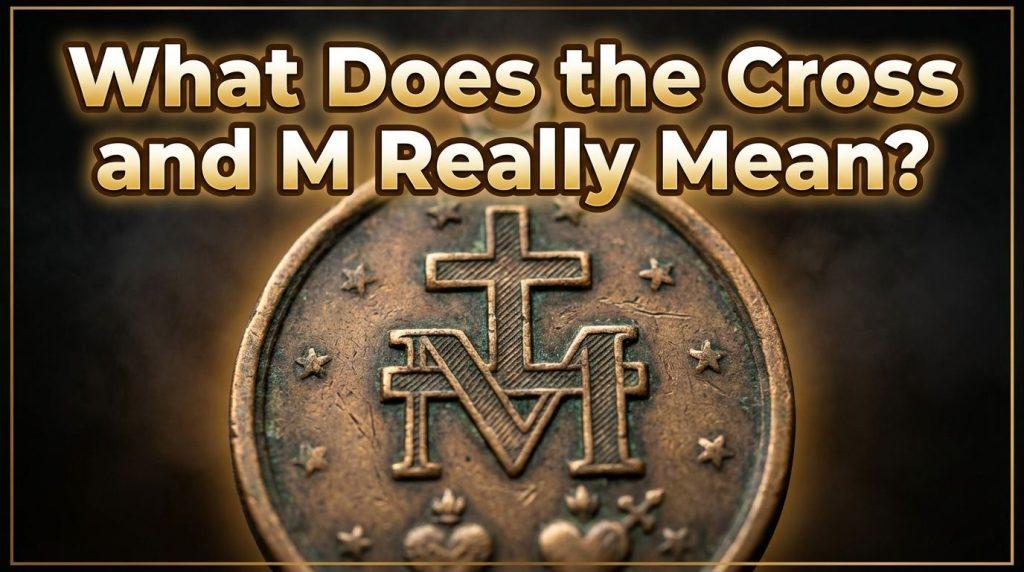
- This symbol appears most famously on the Miraculous Medal, revealed to Saint Catherine Labouré in 1830.
- The intertwining of these two symbols shows Mary’s presence at the foot of the Cross during Christ’s crucifixion.
- Catholic teaching emphasizes that Mary’s role flows from her union with Christ and depends entirely on his redemptive work.
- The symbol reminds Catholics that devotion to Mary always leads back to her son, Jesus Christ.
The Historical Origins of the Symbol
The Cross and M symbol has its roots in Catholic tradition stretching back centuries, yet it gained particular prominence through the Miraculous Medal apparitions in nineteenth-century France. Saint Catherine Labouré, a young sister of the Daughters of Charity, received a series of visions of the Blessed Virgin Mary in 1830. During the apparition on November 27, 1830, Mary appeared standing on a globe with rays of light streaming from her hands. She instructed Catherine to have a medal struck according to the pattern shown in the vision. On the reverse side of this medal appeared the letter M intertwined with a cross, two hearts below, and twelve stars forming a crown around the design. This specific configuration carries deep theological meaning that Catholics have studied and treasured for nearly two centuries. The medal itself became known as the Miraculous Medal because of the numerous spiritual and physical favors reported by those who wore it with faith. Within just a few years of the first medals being struck in 1832, millions of copies had been distributed throughout France and beyond. The symbol of the Cross and M thus entered Catholic devotional life in a powerful way through this Marian apparition.
The arrangement of these symbols on the medal was not arbitrary but reflected careful theological truths. The cross rises from the letter M, showing that Mary’s role in salvation history cannot be separated from the redemptive work of Christ. The bar beneath the cross represents the earth, indicating that Christ’s sacrifice extends to all of humanity. The placement of Mary’s initial beneath and supporting the cross illustrates her position as the one who stood faithfully at Calvary, never wavering in her commitment to God’s plan. This visual representation captures what the Church teaches about Mary’s unique cooperation in the work of redemption. The symbol communicates through simple imagery what would require many words to explain fully. Catholics who wear or display this symbol carry a reminder of the inseparable bond between the Mother and her divine son. They also affirm their belief in Mary’s continued maternal care for all believers.
Beyond the Miraculous Medal, variations of the Cross and M symbol appear throughout Catholic churches, religious art, and devotional objects. Some versions show a single M with a small cross positioned above or through it. Other representations feature the letters A and M intertwined, forming what is known as the Auspice Maria symbol, which means “Under the Protection of Mary” in Latin. These variations all point to the same fundamental truth about Mary’s relationship with Christ and her role in the spiritual lives of believers. The widespread use of this symbol across different cultures and time periods demonstrates its enduring significance in Catholic spirituality. Whether carved into church altars, embroidered on liturgical vestments, or worn as jewelry, the Cross and M serves as a compact theological statement. It proclaims that true devotion to Mary cannot be separated from devotion to Christ, and that approaching Jesus through his Mother follows the pattern established by God himself.
Mary’s Presence at the Foot of the Cross
The Gospel of John provides the scriptural foundation for understanding the Cross and M symbol. In John 19:25-27, we read that standing by the cross of Jesus were his mother, his mother’s sister, Mary the wife of Clopas, and Mary Magdalene. While others had fled in fear, Mary remained faithful to her son even in his darkest hour. The Catechism of the Catholic Church describes this scene as showing Mary’s union with her son in the work of salvation, which was made manifest from the time of Christ’s virginal conception up to his death (CCC 964). She stood at Calvary according to the divine plan, enduring with her only begotten son the intensity of his suffering. Her presence there was not passive but involved joining herself with his sacrifice in her mother’s heart and lovingly consenting to the immolation of this victim who was born of her. This act of standing at the cross represents the culmination of Mary’s lifelong “yes” to God, which began at the Annunciation.
The ancient hymn “Stabat Mater” captures the emotional and spiritual reality of Mary’s experience at the cross. The Latin title means “The Mother Was Standing,” referring to Mary’s steadfast presence during the crucifixion. This hymn, which has been set to music by countless composers over the centuries, meditates on Mary’s sorrow as she watched her son suffer and die. Yet it also recognizes that her suffering was not meaningless but had redemptive value when united with Christ’s sacrifice. Catholic theology teaches that Mary’s sorrows at the cross were prophesied by Simeon when he told her that a sword would pierce her own soul (see Luke 2:35). This prophecy found its fulfillment at Calvary, where Mary experienced the deepest possible maternal grief. Her willingness to stand there despite this anguish shows her heroic virtue and complete trust in God’s plan. The Cross and M symbol thus encapsulates this moment when Mary’s cooperation in salvation reached its highest intensity.
When Jesus saw his mother and the disciple whom he loved standing nearby, he said to his mother, “Woman, behold your son,” and to the disciple, “Behold your mother” (see John 19:26-27). In this exchange, Catholic tradition sees Jesus giving his mother to all believers as their spiritual mother. Saint John represents the entire Church, and in receiving Mary into his home, he models the relationship all Christians are invited to have with her. This moment at the cross establishes Mary’s ongoing maternal role in the life of the Church. The Cross and M symbol reminds Catholics of this gift that Jesus gave even while dying. Mary’s motherhood, which began physically with Jesus, extends spiritually to all who are members of Christ’s mystical body. Her presence at the cross was not just historical but continues in a spiritual way as she intercedes for believers. The symbol serves as a visual reminder that Christians are never alone; they have a mother in heaven who cares for them with the same love she showed at Calvary.
The Theological Meaning of the Intertwined Symbols
The intertwining of the M and the cross expresses several important theological truths that Catholics hold dear. First, it shows that Mary’s role in salvation history is inseparable from Christ’s redemptive work. The Catechism teaches that Mary’s role in the Church is inseparable from her union with Christ and flows directly from it (CCC 964). She cannot be understood apart from her son, and her greatness derives entirely from her relationship with him. The visual connection between the M and the cross prevents any misunderstanding that might suggest Mary operates independently of Christ. Instead, the symbol makes clear that her cooperation with God’s plan always serves the purpose of bringing people to Jesus. When Catholics honor Mary, they do so because she points them toward her son and aids them in following him more faithfully.
Second, the symbol illustrates Mary’s unique cooperation in the work of redemption. While Christ alone is the Redeemer, Mary cooperated in a singular way through her obedience, faith, hope, and burning charity (CCC 968). Her “yes” at the Annunciation made the Incarnation possible, as God chose to enter the world through her free consent. Throughout Jesus’s life, Mary supported his mission and shared in his sorrows. At the cross, she united her maternal suffering with his redemptive sacrifice. This cooperation does not mean Mary is equal to Christ or that his work was insufficient; rather, it shows how God chose to involve a human being intimately in his plan of salvation. The Cross and M symbol captures this cooperative relationship in a single image. The cross remains central and primary, while the M indicates Mary’s supporting role. This arrangement reflects the proper understanding of Mary’s place in Catholic theology.
Third, the symbol points to Mary’s continued motherhood in the order of grace. The Catechism states that this motherhood continues uninterruptedly from the consent she gave at the Annunciation, which she sustained without wavering beneath the cross, until the eternal fulfillment of all the elect (CCC 969). Even now in heaven, Mary exercises her maternal role on behalf of Christ’s members. She is invoked under the titles of Advocate, Helper, Benefactress, and Mediatrix. These titles might sound exalted, but the Church is careful to explain that Mary’s influence flows from the superabundance of Christ’s merits, rests on his mediation, depends entirely on it, and draws all its power from it (CCC 970). The Cross and M symbol thus represents not just a historical moment at Calvary but an ongoing spiritual reality. Mary continues to stand at the foot of the cross in a mystical sense, interceding for believers and helping them draw closer to her son.
The Miraculous Medal and Its Symbolism
The Miraculous Medal deserves special attention as the primary means through which the Cross and M symbol entered modern Catholic devotion. When the Blessed Virgin Mary appeared to Saint Catherine Labouré, she specifically requested that a medal be made according to the vision shown. The front of the medal depicts Mary standing on a globe with rays of light streaming from her hands toward the earth. Around the edge appears the prayer: “O Mary, conceived without sin, pray for us who have recourse to thee.” This prayer affirms the dogma of the Immaculate Conception, which would not be formally defined until 1854, twenty-four years after the apparition. The back of the medal features the intertwined M and cross, along with the Sacred Heart of Jesus crowned with thorns and the Immaculate Heart of Mary pierced with a sword. Twelve stars surround these symbols, representing the twelve apostles and the Church. Each element of the medal’s design carries spiritual meaning and invites meditation on different aspects of Catholic faith.
The rays of light streaming from Mary’s hands in the vision represent the graces she obtains for those who ask her intercession. However, Catherine noticed that some of the rings on Mary’s fingers did not emit light. When she asked about this, Mary explained that these represented graces that people fail to request through prayer. This detail emphasizes the importance of asking Mary for help and trusting in her maternal care. The globe beneath Mary’s feet shows her queenship over all creation and recalls the woman clothed with the sun described in Revelation 12:1. The serpent under her feet refers to the prophecy in Genesis 3:15 about enmity between the woman and the serpent. Catholic tradition sees this as a foreshadowing of Mary’s role in the battle against evil. All these elements work together to present a comprehensive picture of Marian theology in visual form.
The distribution of the Miraculous Medal has been a significant part of Catholic evangelization and devotion since its creation. Pope Gregory XVI approved the medal in 1836, and devotion to it spread rapidly throughout the Catholic world. Countless stories of conversions, healings, and spiritual favors have been attributed to wearing the medal with faith and devotion. The medal is not a good luck charm or magical object; rather, it serves as a sacramental that disposes the wearer to receive God’s grace through Mary’s intercession. The Cross and M on the reverse side reminds wearers of the source of all grace in Christ’s sacrifice and Mary’s cooperation with it. When Catholics wear this medal, they place themselves under Mary’s protection and express their trust in her maternal care. They also make a public statement of faith in the truths the medal represents. The symbol thus functions as both a personal devotional aid and a means of witness to others.
Biblical Foundations for Marian Devotion
While the Cross and M symbol itself is not found in Scripture, the theological truths it represents have firm biblical foundations. The relationship between Mary and the cross begins in the Old Testament with prophecies that Christians see as pointing toward both Christ and his mother. The prophet Isaiah spoke of a virgin conceiving and bearing a son (Isaiah 7:14), which the Gospel of Matthew applies to Mary. The book of Genesis contains the protoevangelium, or first gospel, in which God declares enmity between the woman’s offspring and the serpent (Genesis 3:15). Catholic interpretation sees this woman as prefiguring Mary, whose son would crush the serpent’s head through his death and resurrection. These Old Testament texts provide the background for understanding Mary’s role in salvation history.
The Gospels present Mary as the model disciple who always responds to God’s will with faith and obedience. At the Annunciation, she questions how she can conceive a child while remaining a virgin, yet she ultimately surrenders to God’s plan with the words, “Behold, I am the handmaid of the Lord; let it be to me according to your word” (Luke 1:38). This “fiat,” or “let it be,” opens the door for the Incarnation to occur. Mary’s visit to her cousin Elizabeth prompts the beautiful Magnificat, in which Mary praises God for the great things he has done for her (Luke 1:46-55). Throughout Jesus’s public ministry, Mary appears at key moments, such as the wedding at Cana where she prompts Jesus to perform his first miracle (John 2:1-11). Her presence at the cross, as recorded in John’s Gospel, represents the culmination of her earthly cooperation with Christ’s mission.
The Book of Revelation provides another important biblical image connected to Mary and the cross. Chapter 12 describes a woman clothed with the sun, with the moon under her feet and a crown of twelve stars on her head. She gives birth to a male child who will rule all nations with an iron rod, while a dragon seeks to devour the child. Catholic tradition has long seen this woman as representing both the Church and Mary, who gave birth to Christ and shares in his battle against evil. The Cross and M symbol can be understood as a simplified representation of this apocalyptic vision. The M stands for Mary, the woman of Revelation 12, while the cross represents her son who conquered death through his sacrifice. The twelve stars surrounding the symbols on the Miraculous Medal echo the crown of stars in John’s vision. These biblical images show that devotion to Mary and recognition of her role in salvation have roots in Scripture itself, even if the specific symbol developed later in Church tradition.
Mary’s Cooperation in Salvation
The concept of Mary’s cooperation in salvation, sometimes expressed by the theological term cooperation in redemption, requires careful explanation to avoid misunderstanding. The Catholic Church teaches that Jesus Christ is the sole Redeemer of humanity; no other person can claim this title or share in it as an equal. Christ’s sacrifice on the cross was sufficient, perfect, and complete. Nothing needs to be added to what he accomplished through his passion, death, and resurrection. When Catholics speak of Mary’s cooperation, they refer to her unique participation in God’s plan of salvation as the mother of the Redeemer. She cooperated by giving her free consent to the Incarnation, by raising and nurturing Jesus, by supporting his public ministry, and by standing at the cross in faithful love. This cooperation was real and involved genuine choices on Mary’s part, yet it always remained subordinate to and dependent upon Christ’s redemptive work.
The Church teaches that by her complete adherence to the Father’s will, to his son’s redemptive work, and to every prompting of the Holy Spirit, Mary is the Church’s model of faith and charity (CCC 967). She is a preeminent and wholly unique member of the Church, serving as the exemplary realization of what the Church is called to be. Her role in relation to the Church and to all humanity goes further than simply being an example; in a wholly singular way she cooperated by her obedience, faith, hope, and burning charity in the Savior’s work of restoring supernatural life to souls (CCC 968). For this reason, she is a mother to us in the order of grace. This means that Mary’s motherhood extends beyond her physical relationship with Jesus to include a spiritual motherhood toward all believers. She cares for each person with maternal love and assists them in growing closer to her son.
The Cross and M symbol visually represents this cooperative relationship. The cross stands for Christ’s objective redemption, the actual sacrifice that atoned for human sin and opened the gates of heaven. The M represents Mary’s subjective cooperation, her willing participation in God’s plan through her prayers, sufferings, and constant fidelity. These two elements cannot be separated because God chose to work through Mary in accomplishing redemption. He did not need to involve her in this way; he could have become incarnate through some other means. Yet in his wisdom and love, God chose to ask for Mary’s consent and to make her an active participant in salvation history. By honoring Mary and recognizing her cooperation, Catholics do not diminish Christ’s glory but rather marvel at how he chose to share his work with a human person. The symbol reminds believers that God works through human cooperation, inviting each person to participate in his saving work according to their particular vocation.
The Meaning of Auspice Maria
Related to the Cross and M symbol is another Marian monogram known as Auspice Maria, which features the letters A and M intertwined. This Latin phrase means “Under the Protection of Mary” or “Under Mary’s Guidance,” and it appears frequently in Catholic churches, religious art, and devotional objects. The concept behind Auspice Maria reflects the same theological truths as the Cross and M symbol but emphasizes a slightly different aspect of Marian devotion. While the Cross and M focuses on Mary’s relationship with Christ at Calvary, Auspice Maria emphasizes her ongoing protective role in the lives of believers. Both symbols remind Catholics that Mary serves as a spiritual mother who guides, protects, and intercedes for her children. The use of these intertwined letters creates a visual reminder of the protection Mary offers to those who seek her help.
The phrase “under the protection of Mary” echoes the Sub Tuum Praesidium, considered the oldest known Marian prayer, dating back to at least the third century. This ancient prayer begins with the words “We fly to thy protection, O holy Mother of God,” acknowledging Mary’s role as protector and advocate. Throughout Christian history, believers have turned to Mary in times of danger, illness, spiritual struggle, and need. They do so not because Mary has power independent of God but because she is the Mother of God who has unique access to her son’s mercy. Her prayers are powerful because of her closeness to Christ and her perfect conformity to God’s will. When Catholics place themselves under Mary’s protection through prayers and devotion to symbols like Auspice Maria, they acknowledge their need for spiritual help and trust in Mary’s maternal care.
The Auspice Maria symbol often appears at the entrances to churches, on altars, and in other prominent locations within Catholic spaces. Its placement serves as a reminder that the faithful enter under Mary’s protection and guidance. Some religious communities, such as the Congregation of Holy Cross, have adopted Auspice Maria as their motto, expressing their collective commitment to living under Mary’s care. The symbol also appears on religious jewelry, medals, and prayer cards used by individual Catholics in their personal devotions. Whether displayed publicly in churches or worn privately as a reminder of Mary’s protection, Auspice Maria functions similarly to the Cross and M symbol. Both visual representations communicate profound theological truths in simple, memorable images. They help Catholics maintain awareness of Mary’s presence in their lives and encourage them to seek her intercession regularly.
The Hearts of Jesus and Mary
On the Miraculous Medal, below the intertwined M and cross, appear two hearts: the Sacred Heart of Jesus crowned with thorns and the Immaculate Heart of Mary pierced with a sword. These images complement the Cross and M symbol and deepen its meaning. The Sacred Heart of Jesus represents his burning love for humanity, a love so intense that he willingly suffered and died to save us from sin. The crown of thorns around his heart recalls his passion and the mockery he endured. Catholic devotion to the Sacred Heart emphasizes Jesus’s divine and human love, inviting believers to respond with love and reparation for sins. The thorns also remind Catholics that sin wounds the heart of Christ, causing him sorrow. By contemplating the Sacred Heart, believers grow in awareness of how much they are loved and how seriously God takes sin.
The Immaculate Heart of Mary represents her perfect love for God and for all people. The sword piercing her heart refers to Simeon’s prophecy that a sword would pierce Mary’s soul (Luke 2:35), which was fulfilled as she watched her son die on the cross. Mary’s heart shares in Jesus’s suffering because of her deep love for him and for the souls he came to save. Her sorrows are not separate from Christ’s passion but intimately connected to it. Catholic devotion to the Immaculate Heart of Mary emphasizes her maternal love, her purity, and her desire to lead all people to her son. The pierced heart also represents Mary’s compassion, her ability to understand and share in human suffering. Because she experienced the deepest sorrow at the cross, she can comfort those who suffer and help them unite their sufferings with Christ’s redemptive passion.
The placement of these two hearts together on the medal shows their inseparable connection. The love of Jesus and the love of Mary cannot be separated because Mary’s love flows from and leads back to Christ’s love. When Catholics honor Mary’s Immaculate Heart, they ultimately honor the Sacred Heart of Jesus, from whom all grace and love flow. The Cross and M symbol above the two hearts ties all these elements together. The cross represents the culmination of Jesus’s love in his sacrifice, while the M represents Mary’s loving cooperation in that sacrifice. The hearts below show the interior reality behind the external events of Calvary. Together, these symbols on the Miraculous Medal present a complete picture of the mystery of redemption, involving both divine love and human cooperation. They invite Catholics to respond with their own love, offering their hearts to Jesus through Mary and asking these two hearts to transform their lives.
Practical Applications for Catholic Life
The Cross and M symbol offers Catholics practical guidance for living their faith in daily life. First, it reminds believers to maintain the proper relationship between devotion to Mary and devotion to Christ. Some critics of Catholicism claim that Marian devotion distracts from or replaces devotion to Jesus, but the Cross and M symbol shows this concern to be unfounded. True Marian devotion always leads to deeper love for Christ because Mary’s entire purpose is to bring souls to her son. When Catholics pray the Rosary, for example, they meditate on the mysteries of Christ’s life, death, and resurrection, even while addressing prayers to Mary. When they ask Mary’s intercession, they do so trusting that she will bring their petitions to Jesus. The symbol serves as a visual reminder that all roads through Mary lead to the cross of Christ.
Second, the symbol encourages Catholics to imitate Mary’s example of faith and obedience. Just as Mary stood faithfully at the foot of the cross despite her immense suffering, believers are called to remain faithful to Christ in their own trials and crosses. The spiritual life involves suffering, sacrifice, and the death of selfishness; these are not obstacles to holiness but necessary means of growing closer to God. Mary models how to accept suffering with grace, trust, and love. She never questioned God’s goodness even when his plan involved her greatest sorrow. Catholics who contemplate the Cross and M symbol can draw strength from Mary’s example when facing their own difficulties. They can ask her to help them say “yes” to God’s will even when that yes is costly. They can trust that just as Mary’s suffering at the cross led to the joy of resurrection, their own sufferings will ultimately lead to greater good if united with Christ’s redemptive passion.
Third, the symbol reminds Catholics of their identity as members of Mary’s spiritual family. At the cross, Jesus gave his mother to all believers, making them her children. This relationship is not merely symbolic but real and active. Mary truly cares for each Catholic as a mother cares for her children. She prays for them, protects them from spiritual harm, and guides them toward holiness. Catholics can cultivate this relationship with Mary through regular prayer, particularly the Rosary and the Memorare. They can consciously place themselves under her protection by wearing the Miraculous Medal or other Marian symbols. They can learn about her life and virtues to better imitate her example. They can honor her on her feast days and include her in their family prayers. The Cross and M symbol, whether seen on a medal, in a church, or elsewhere, can serve as a prompt to remember this maternal relationship and to turn to Mary for help throughout the day.
The Symbol in Church Architecture and Art
Throughout Catholic churches and institutions, the Cross and M symbol appears in various artistic forms, serving as a constant reminder of Mary’s role in salvation history. Architects and artists incorporate this symbol into church designs, placing it on altars, above doorways, in stained glass windows, and on liturgical furnishings. The symbol’s simple yet profound design makes it suitable for many different artistic treatments. Some churches feature the Cross and M in elaborate metalwork, with gold or silver letters intertwined in intricate patterns. Others incorporate the symbol into mosaic work, using colored tiles to create striking visual representations. Still others carve the symbol into wood or stone, giving it a three-dimensional presence. Regardless of the medium, the symbol’s placement in churches serves multiple purposes.
First, the symbol in church architecture teaches theology to those who see it. Not everyone can read complex theological texts or follow sophisticated arguments about Mary’s role in salvation, but almost anyone can understand the basic message of the Cross and M symbol. The visual nature of the symbol makes it accessible to people of all ages and educational backgrounds. Children can grasp that the M stands for Mary and the cross stands for Jesus. Adults can appreciate the deeper implications of their intertwining. The symbol thus serves an catechetical function, silently teaching important truths about the faith. Churches that display this symbol prominently declare their commitment to proper Marian devotion and their understanding of Mary’s relationship to Christ. They also remind parishioners of these truths each time they gather for Mass or prayer.
Second, the symbol creates a sense of being under Mary’s protection and care. When Catholics enter a church and see the Cross and M symbol, they are reminded that they come to this sacred space under Mary’s maternal guidance. This can provide comfort and encouragement, especially for those struggling with difficult situations. Knowing that Mary, who stood faithfully at the cross, now watches over them can give believers courage to face their own crosses. The symbol’s presence in the church building extends Mary’s spiritual presence to all who gather there. It also connects individual parishes to the broader Catholic tradition of Marian devotion, showing that local communities share in the universal Church’s love for and trust in Mary. When Catholics visit different churches and see variations of this symbol, they recognize a common thread of faith that binds them together regardless of geographical or cultural differences.
Devotional Practices Centered on the Symbol
Several devotional practices in the Catholic tradition center on or incorporate the Cross and M symbol. The wearing of the Miraculous Medal represents the most widespread practice connected to this symbol. Catholics wear this medal as an expression of their devotion to Mary and their trust in her intercession. The Church teaches that sacramentals like the Miraculous Medal, when used with faith, can dispose people to receive God’s grace. The medal itself has no magical power, but it serves as a reminder of spiritual truths and a sign of one’s commitment to seeking Mary’s help. Many Catholics report experiencing strengthened faith, answered prayers, and protection from spiritual and physical dangers through their devotion to the Miraculous Medal. These experiences testify to the power of Mary’s intercession when people approach her with sincere faith.
Another devotional practice involves meditating on Mary’s presence at the foot of the cross. Catholics can make this meditation during the praying of the Sorrowful Mysteries of the Rosary, particularly the Fifth Sorrowful Mystery, the Crucifixion. As they contemplate Jesus’s suffering and death, they can also picture Mary standing nearby, united with her son in his passion. This meditation helps believers understand that Mary shares intimately in the mystery of redemption. It also provides a model for how to suffer with faith and love rather than bitterness and despair. Some Catholics make this meditation by praying the Stabat Mater, the ancient hymn that reflects on Mary’s sorrows at the cross. This prayer asks Mary to help believers weep with her, to share in Christ’s sufferings, and to carry their own crosses faithfully. By regularly meditating on Mary at the foot of the cross, Catholics deepen their appreciation for the Cross and M symbol’s meaning.
A third devotional practice involves the act of consecration to Mary, particularly consecration to her Immaculate Heart. This practice, promoted by various saints and popes, involves formally entrusting oneself entirely to Mary’s care and guidance. Those who make this consecration place themselves under Mary’s protection, symbolized by the Auspice Maria monogram. They ask her to guide their lives, to help them grow in holiness, and to bring them closer to Jesus. The Cross and M symbol can serve as a reminder of this consecration, a visual representation of the relationship established through the consecration prayers. Some methods of Marian consecration include a preparation period during which one studies Mary’s life and virtues, followed by a formal act of consecration on a significant Marian feast day. After making the consecration, Catholics strive to live as Mary’s children, imitating her virtues and seeking her help in all circumstances. The Cross and M symbol becomes a personal emblem for those who have consecrated themselves to Mary.
The Symbol’s Ecumenical Significance
While the Cross and M symbol and the devotions associated with it are distinctly Catholic practices, they also have implications for ecumenical dialogue with other Christian traditions. Many Protestant Christians express concern about Catholic Marian devotion, viewing it as potentially idolatrous or as detracting from the sole mediatorship of Christ. The Cross and M symbol, properly understood, can help address these concerns by clearly showing that Catholic Marian devotion is Christ-centered. The cross remains the central element of the symbol, with Mary’s initial beneath or intertwined with it. This visual arrangement makes clear that Mary’s role is subordinate to and dependent on Christ’s sacrifice. She does not replace Christ or stand as an alternative path to salvation; rather, she points believers to her son and helps them follow him more faithfully.
Orthodox Christians share many Catholic beliefs about Mary, including her perpetual virginity, her title as Theotokos, and her powerful intercession. However, Orthodox theology and practice express these beliefs somewhat differently than Catholicism does. The Cross and M symbol, while not traditional in Orthodox iconography, represents theological truths that Orthodox Christians would largely affirm. They would agree that Mary’s relationship with Christ is unique and inseparable, that she played a crucial role in salvation history, and that her prayers are powerful. Dialogue between Catholics and Orthodox Christians about Marian devotion can benefit from visual symbols like the Cross and M that express shared beliefs in accessible ways. While differences remain in how the two traditions articulate and practice Marian devotion, symbols can sometimes bridge gaps that words struggle to cross.
Even for Christians who do not practice Marian devotion, the Cross and M symbol offers a reminder of Mary’s important role in the Gospel story. All Christians can agree that Mary was the mother of Jesus, that she accepted God’s will at the Annunciation, and that she remained faithful during her son’s crucifixion when many others fled. These facts are recorded in Scripture and form part of the Christian narrative regardless of denominational affiliation. The symbol honors these historical realities while also expressing Catholic beliefs about Mary’s ongoing spiritual motherhood. In ecumenical discussions, Catholics can use the Cross and M symbol to explain their devotion to Mary in ways that emphasize its biblical foundations and Christocentric nature. They can show that honoring Mary actually enhances rather than diminishes devotion to Christ, just as honoring one’s earthly mother does not detract from honoring one’s father. Such conversations, approached with respect and charity, can help reduce misunderstandings and build greater unity among Christians.
The Symbol and Personal Holiness
The Cross and M symbol offers Catholics a visual representation of the path to holiness. Christian perfection involves conforming oneself to Christ, taking up one’s cross daily, and following him faithfully. Mary provides the perfect model of this conformity to Christ. From the Annunciation through the crucifixion and beyond, Mary’s life was completely oriented toward God’s will. She held nothing back, gave everything to God, and trusted him even when his plan was mysterious or painful. Catholics who wish to grow in holiness can look to Mary as their guide and ask her to help them imitate her example. The Cross and M symbol reminds believers that the way to holiness passes through the cross; there is no path to resurrection that bypasses crucifixion. Mary understood this truth and lived it fully, making her the ideal companion for those seeking to follow Christ radically.
The symbol also illustrates the proper relationship between grace and human cooperation. Catholic theology teaches that salvation is entirely God’s gift, received through faith, yet God invites human beings to cooperate with his grace through their choices and actions. Mary exemplifies this cooperation perfectly. She received immense grace from God, being preserved from original sin from the moment of her conception. Yet she also freely chose to cooperate with that grace at every moment of her life. Her “yes” at the Annunciation was a genuine choice, not a predetermined response. Her faithfulness at the cross required courage and trust. Throughout her life, Mary shows how grace and human freedom work together in the process of salvation. The Cross represents the grace flowing from Christ’s sacrifice, while the M represents Mary’s cooperation with that grace. Together, they show Catholics that holiness requires both receiving God’s gifts and actively responding to them.
Growing in personal holiness also involves developing a deeper prayer life, and Mary can help Catholics in this area as well. The traditional Catholic practice of praying the Rosary combines meditation on the mysteries of Christ’s life with repeated prayers to Mary. This practice trains believers to contemplate Scripture and to turn naturally to Mary for help. The Cross and M symbol can serve as a prompt for prayer throughout the day. When Catholics see this symbol on a medal they wear, in a church they visit, or in religious art in their homes, they can take a moment to offer a brief prayer to Mary or to Jesus. They can remember their baptismal identity as children of God and children of Mary. They can renew their commitment to living faithfully despite difficulties. These brief moments of prayer and remembrance, prompted by the symbol, can help maintain spiritual awareness and connection with God throughout the busy activities of daily life. Over time, such practices contribute to the growth in holiness that all Catholics are called to pursue.
The Symbol in Times of Suffering
The Cross and M symbol carries particular meaning for Catholics experiencing suffering, whether physical, emotional, or spiritual. The cross has always been Christianity’s central symbol precisely because it represents the means by which Christ redeemed humanity. Yet the cross is not merely a symbol of past events; it also represents the ongoing reality that following Christ involves sacrifice and suffering. Jesus told his disciples that those who wish to come after him must take up their cross daily and follow him (see Luke 9:23). This means that suffering is not an aberration in the Christian life but an expected part of it. The question is not whether believers will face crosses but how they will respond to them. The Cross and M symbol provides guidance for this response by showing how Mary faced the ultimate cross, the crucifixion of her son.
Mary’s example at Calvary offers several lessons for those who suffer. First, she teaches that faithful presence matters even when one cannot change the situation. Mary could not stop the crucifixion or ease her son’s physical pain, yet her presence at the foot of the cross had immense value. Her loving support mattered to Jesus, and her willingness to stand there despite her own anguish demonstrated heroic love. Catholics facing difficult situations can learn from this example. They may not be able to cure a loved one’s illness, solve a family member’s problems, or change painful circumstances. However, they can remain faithfully present, offering their prayers, love, and support. This faithful presence has spiritual value even when its practical effects seem limited. Mary’s example encourages believers not to flee from difficult situations but to stand firm in love.
Second, Mary shows how to suffer without losing faith or hope. Although her heart was pierced with sorrow as she watched Jesus die, she never doubted God’s goodness or power. She trusted that God’s plan was ultimately for good even when it involved terrible suffering. This trust did not eliminate her pain but prevented it from becoming despair. Catholics who face their own crosses can ask Mary to help them maintain faith and hope in the midst of suffering. They can unite their sufferings with Christ’s passion, recognizing that pain endured with love has redemptive value. The Cross and M symbol reminds them that they do not suffer alone; Christ has gone before them on the way of the cross, and Mary accompanies them as she accompanied Jesus. This awareness can transform suffering from a meaningless burden into a participation in the mystery of redemption. It cannot remove the pain, but it can give it meaning and purpose, making it easier to bear.
Contemporary Relevance of the Symbol
In contemporary Catholic life, the Cross and M symbol continues to hold significant meaning despite the many changes in society and culture. The symbol’s simplicity and clarity make it effective in communicating core theological truths even in an age of information overload and short attention spans. A quick glance at the intertwined M and cross conveys the essential message about Mary’s relationship with Christ and her role in salvation. This visual efficiency serves the Church’s mission to evangelize and catechize in an increasingly secularized world. Young Catholics who might struggle to read lengthy theological explanations can grasp the basic meaning of the Cross and M symbol and build their understanding from there. The symbol also appears naturally in contemporary media, being easily reproducible in digital formats and shareable through social media platforms.
The symbol addresses particular needs of Catholics living in the twenty-first century. Many contemporary believers struggle with feelings of isolation, anxiety, and purposelessness. The Cross and M symbol offers a remedy by reminding them of their connection to a spiritual family headed by Mary. It assures them that they have a mother in heaven who cares for them personally and intercedes on their behalf. This message of maternal love and protection speaks powerfully to people who feel alone or overwhelmed by life’s challenges. The symbol also counters the cultural emphasis on individual autonomy by presenting Mary as a model of receptivity to God’s will. In a society that often celebrates self-assertion and independence above all else, Mary’s “yes” to God represents an alternative path to fulfillment. The Cross and M symbol thus offers Catholics a countercultural message that resonates with those seeking deeper meaning beyond material success.
The symbol also connects contemporary Catholics to the long tradition of the faith. When they wear a Miraculous Medal or see the Cross and M in their parish church, they participate in devotional practices that have nourished believers for generations. This connection to tradition provides stability and continuity in a rapidly changing world. It reminds Catholics that they belong to something larger than themselves, a community of faith that spans centuries and continents. At the same time, the symbol remains fresh and relevant because the truths it represents are timeless. Mary’s cooperation with Christ’s redemptive work, her maternal care for believers, and her model of faithfulness speak to every generation. The Cross and M symbol serves as a bridge between past and present, helping contemporary Catholics maintain living contact with the Church’s rich spiritual heritage while addressing current needs and questions.
Teaching Children About the Symbol
Parents and catechists have a responsibility to teach children about Catholic symbols and their meanings, and the Cross and M symbol offers an excellent teaching opportunity. Its visual simplicity makes it accessible to even young children, while its theological depth provides material for ongoing instruction as children mature. When introducing this symbol to children, teachers can begin with the basic explanation that M stands for Mary, Jesus’s mother, and the cross stands for Jesus’s sacrifice for us. Children can easily understand that Mary loved Jesus very much and stayed with him even when he was suffering on the cross. This simple explanation plants seeds of understanding that can grow as children develop greater capacity for abstract thinking.
As children grow older, catechists can expand on this basic explanation, gradually introducing more sophisticated theological concepts. Elementary-age children can learn about the Miraculous Medal and the story of Saint Catherine Labouré’s visions. They can understand that Mary continues to care for all people as a mother cares for her children. They can begin to appreciate that the intertwining of the M and cross shows how Mary and Jesus work together for our salvation. Pre-adolescents and teenagers can explore deeper questions about Mary’s role in salvation history, the meaning of her cooperation with Christ’s redemptive work, and the relationship between Marian devotion and devotion to Christ. They can study relevant Scripture passages and Catechism sections to develop a more mature understanding of Catholic Marian theology.
Effective teaching about the Cross and M symbol involves not just intellectual instruction but also the modeling of devotion. When children see their parents or teachers wearing the Miraculous Medal, praying to Mary regularly, and showing reverence for Marian images and symbols, they absorb powerful lessons about the importance of Mary in Catholic life. Parents can incorporate brief explanations of the symbol into family prayer time, perhaps while praying a decade of the Rosary together. They can point out the symbol when they see it in church and discuss its meaning. They can give children their own Miraculous Medals and explain the significance of wearing this sacramental. These informal teaching moments often prove more effective than formal instruction because they occur in the context of lived faith. Children learn that the Cross and M symbol is not just an abstract concept to study but a living reality that shapes how Catholics pray, worship, and understand their relationship with God.
Conclusion and Final Reflections
The Cross and M symbol, whether appearing on the Miraculous Medal, in church architecture, or in various forms of Catholic art, serves as a powerful reminder of central truths of the faith. It shows the inseparable connection between Christ and his mother in the work of salvation. It illustrates Mary’s unique cooperation with God’s redemptive plan, from her “yes” at the Annunciation through her faithful presence at Calvary. It represents her ongoing maternal care for all believers as they make their own journeys to holiness. The symbol’s simplicity belies its profound theological content, making it an effective tool for teaching, evangelization, and personal devotion. Catholics who understand and appreciate this symbol gain insight into proper Marian devotion and its essential place in the spiritual life.
The historical development of the Cross and M symbol, particularly through the Miraculous Medal apparitions, demonstrates how God continues to work in the Church through private revelations approved by competent authority. While such revelations do not add to the deposit of faith closed with the death of the last apostle, they can help believers better understand and live the faith that has been handed down. The Miraculous Medal and its symbols have inspired countless conversions, strengthened faith in times of trial, and fostered devotion to Mary across the Catholic world. This historical track record provides evidence of the symbol’s spiritual fruitfulness and its value for Catholic devotional life. Contemporary Catholics do well to embrace this symbol and the devotions associated with it, trusting in Mary’s intercession and protection.
Looking forward, the Cross and M symbol will continue to serve the Church’s mission in future generations. As long as Catholics need reminders of Mary’s maternal love, as long as believers struggle to understand the mystery of redemption, and as long as the faithful seek models of cooperation with God’s grace, this symbol will remain relevant and meaningful. It may appear in new artistic forms and media, adapting to changing cultural contexts while maintaining its essential message. The core truths it represents remain unchanged: Christ is the Redeemer who saved humanity through his sacrifice on the cross, and Mary cooperated uniquely in this redemption through her faith, obedience, and maternal love. These truths form the heart of Catholic faith and devotion, worthy of constant meditation and lived response. The Cross and M symbol invites all Catholics to stand with Mary at the foot of the cross, to unite their lives with Christ’s sacrifice, and to trust in the maternal care of the woman who gave the world its Savior.
Disclaimer: This article presents Catholic teaching for educational purposes. For official Church teaching, consult the Catechism and magisterial documents. For personal spiritual guidance, consult your parish priest or spiritual director. Questions? Contact editor@catholicshare.com
Sign up for our Exclusive Newsletter
- 📌 Add CatholicShare as a Preferred Source on Google
- 🎁 Join us on Patreon for Premium Content
- 🎧 Check Out These Catholic Audiobooks
- 📿 Get Your FREE Rosary Book
- 📱 Follow Us on Flipboard
-

Recommended Catholic Books
Discover hidden wisdom in Catholic books — invaluable guides enriching faith and satisfying curiosity. #CommissionsEarned
- The Early Church Was the Catholic Church
- The Case for Catholicism - Answers to Classic and Contemporary Protestant Objections
- Meeting the Protestant Challenge: How to Answer 50 Biblical Objections to Catholic Beliefs
As an Amazon Associate, I earn from qualifying purchases. Thank you for your support.