
Brief Overview
- The ciborium is a sacred vessel used in Catholic worship to hold the consecrated hosts during Mass and to reserve the Blessed Sacrament in the tabernacle.
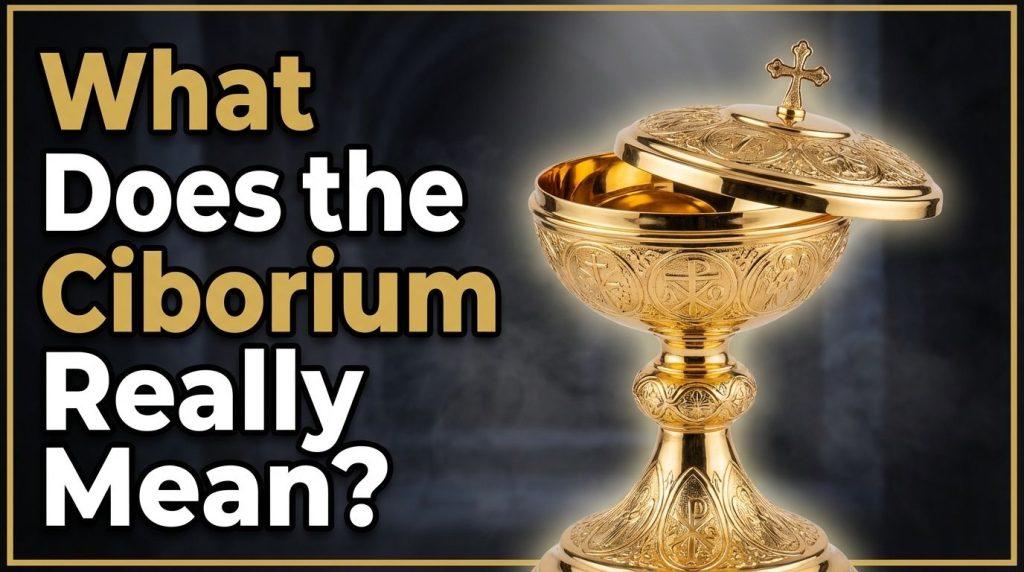
- This vessel resembles a chalice with a distinctive lid, typically crafted from precious metals like gold or silver to reflect the sacred nature of what it contains.
- The word ciborium derives from the Greek word kiborion, which refers to a cup-shaped vessel, reflecting its ancient roots in Christian liturgical tradition.
- The ciborium serves both a practical purpose in distributing Holy Communion and a theological purpose in safeguarding the Real Presence of Christ in the Eucharist.
- Church law requires that sacred vessels like the ciborium be made from worthy materials and treated with special reverence due to their contact with the Body of Christ.
- Understanding the meaning of the ciborium helps Catholics appreciate the depth of reverence the Church shows toward the Eucharist and the ongoing presence of Christ among His people.
The Sacred Vessel and Its Purpose
The ciborium stands as one of the most recognizable sacred vessels in Catholic churches, yet many faithful pass by it without fully understanding its profound significance. This vessel serves as the container that holds the consecrated hosts, the true Body of Christ, both during the celebration of Mass and when the Blessed Sacrament is reserved in the tabernacle. The ciborium functions as more than a simple container. It acts as a throne for the Eucharistic Lord, a protective vessel that guards the sacred species from any indignity or harm. When a priest or deacon opens the ciborium during Mass, he handles it with careful reverence, recognizing that what appears to be bread has been transformed through the power of the Holy Spirit into the actual Body of Christ. The Church has established specific guidelines for the construction and use of this vessel precisely because of the sacred contents it holds. The General Instruction of the Roman Missal specifies that sacred vessels must be made from materials that are solid and dignified, suitable for their holy purpose. The interior of the ciborium must be gilded or made of gold to prevent any absorption of particles of the consecrated hosts. This attention to detail reveals the Church’s unwavering belief in the Real Presence of Christ in the Eucharist, as affirmed in the Catechism (CCC 1374-1377).
The design of the ciborium reflects centuries of liturgical tradition and theological understanding. The vessel typically features a bowl-shaped body that sits atop a sturdy base, with a secure lid that fits tightly over the top. This lid serves a crucial function in protecting the consecrated hosts from contamination, dust, or accidental spillage. When the ciborium is placed in the tabernacle, a white silk veil often covers it, adding an additional layer of reverence and protection. The shape of the ciborium calls to mind the chalice used for the Precious Blood, creating a visual connection between the two forms in which Christ becomes present at Mass. The rounded bowl can symbolize the bread of life, while the elevated design suggests the transcendent nature of what it contains. Many ciboria feature religious imagery, crosses, or other sacred symbols engraved or embossed on their surfaces, serving as visual reminders of the mystery they hold. The craftsmanship involved in creating these vessels often represents the finest work of liturgical artists, who understand that they are fashioning containers for the King of Kings. The beauty of a well-made ciborium does not exist for its own sake but rather points beyond itself to the even greater beauty of the Eucharistic presence it guards.
Historical Development and Origins
The history of the ciborium stretches back to the early centuries of Christianity, though its form and use have evolved over time. In the ancient Church, the reserved Sacrament was sometimes kept in containers shaped like doves, suspended above the altar or stored in special niches in the church walls. These containers reflected the symbolism of the Holy Spirit descending like a dove, as described in the Gospels. As the practice of reserving the Blessed Sacrament became more standardized, the Church developed more uniform vessels for this purpose. The term ciborium itself originally referred to the architectural canopy that stood over the altar in early Christian basilicas, a structure supported by columns that marked the altar as the sacred center of worship. Over time, this word came to designate the covered vessel used to hold the consecrated hosts, perhaps because both the canopy and the vessel served to honor and protect what was most sacred. The evolution in terminology reflects the Church’s developing understanding of how to give proper honor to the Eucharistic presence. Medieval craftsmen began creating ciboria with the cup-and-lid design that remains familiar today, often decorating them with enamel work, precious stones, and intricate metalwork. These vessels became treasured possessions of churches, sometimes listed in inventories alongside other valuable liturgical items.
The Reformation period brought significant changes to how different Christian communities understood and treated the Eucharist, and these theological differences manifested in the treatment of sacred vessels. The Catholic Church, reaffirming its belief in transubstantiation at the Council of Trent, emphasized the need for proper vessels to contain the Blessed Sacrament. Church legislation became more specific about the materials and construction of ciboria, requiring that they be made of noble materials and properly blessed before use. The tabernacle, which houses the ciborium, became a standard feature in Catholic churches, typically placed in a position of honor and marked by a sanctuary lamp that burns continuously. This practice of reserving the Blessed Sacrament developed not only for the practical purpose of bringing Communion to the sick but also to encourage adoration of Christ present in the Eucharist. The ciborium thus became essential to both the liturgical and devotional life of the Church. Different regions developed their own styles of ciborium design, reflecting local artistic traditions while maintaining the essential features required by Church law. Some featured Gothic spires and pinnacles, while others showed Renaissance or Baroque influences. Despite these variations in style, the fundamental purpose remained constant across centuries and cultures.
Biblical and Theological Foundations
The meaning of the ciborium connects deeply to biblical themes of sacred vessels and the divine presence among God’s people. In the Old Testament, specific vessels were designated for use in the Temple, and these could only be handled by priests who had been consecrated for this purpose. The bread of the Presence, also called showbread, was placed in the Temple as a sign of God’s covenant with Israel, and this bread could only be eaten by the priests in a holy place. This practice foreshadowed the Eucharist, where Christ becomes the true Bread of Life, the perfect fulfillment of all the Old Testament types and shadows. The Ark of the Covenant, which contained the tablets of the Law, a jar of manna, and Aaron’s staff, was treated with extraordinary reverence because it represented God’s presence among His people. Similarly, the ciborium contains what Catholics believe to be not merely a symbol but the actual Body of Christ, making it a vessel of unparalleled sacredness. The New Testament builds on these themes, particularly in the words of Christ at the Last Supper when He took bread, blessed it, broke it, and gave it to His disciples saying, “This is my body” as recorded in Matthew 26:26, Mark 14:22, and Luke 22:19. The early Church understood these words literally, believing that the bread truly became Christ’s Body through the power of His word and the action of the Holy Spirit.
The theological foundation for the reverence shown to the ciborium rests on the doctrine of the Real Presence, which the Catholic Church has consistently taught from apostolic times. The Catechism affirms that “the mode of Christ’s presence under the Eucharistic species is unique” and that “in the most blessed sacrament of the Eucharist the body and blood, together with the soul and divinity, of our Lord Jesus Christ and, therefore, the whole Christ is truly, really, and substantially contained” (CCC 1374). This teaching necessitates that any vessel which comes into contact with the consecrated hosts must be treated with the highest reverence. The ciborium is not merely a functional container but a sacred object set apart for divine use. When the priest elevates the host during the consecration at Mass, the substance of the bread changes into the substance of Christ’s Body while the appearances of bread remain; this change, called transubstantiation, is the reason the Church requires special vessels for the Eucharist. The teaching on transubstantiation was formally defined at the Fourth Lateran Council in 1215 and reaffirmed at the Council of Trent in the sixteenth century. This doctrine explains why the Church insists on specific materials, proper blessing, and reverent handling of the ciborium. The vessel participates, in a sense, in the holiness of what it contains, not through any inherent quality but through its consecration to divine service.
The Ciborium in the Celebration of Mass
During the celebration of Mass, the ciborium plays a central role in the liturgy of the Eucharist. Before Mass begins, the ciborium containing unconsecrated hosts is typically placed on the credence table, a small side table in the sanctuary that holds the vessels and linens needed for the celebration. When the time comes for the preparation of the gifts, the ciborium is brought to the altar along with the chalice, paten, and cruets of water and wine. If the number of communicants is large, multiple ciboria may be used to hold all the hosts that will be consecrated. The priest places these vessels on the corporal, a square white linen cloth that protects the altar and catches any fragments of the consecrated hosts. During the Eucharistic Prayer, the priest extends his hands over the gifts, invoking the Holy Spirit to transform them into the Body and Blood of Christ. At the moment of consecration, when the priest speaks the words of Christ over the bread, all the hosts in the ciborium become the Body of Christ. This moment is marked by the ringing of bells and the genuflection of the priest, acknowledging the Real Presence now on the altar. The hosts remain in the ciborium until the time of Communion, when the priest or other ministers distribute them to the faithful. The careful choreography of the Mass ensures that the Blessed Sacrament is treated with constant reverence from the moment of consecration.
After the faithful have received Communion, any consecrated hosts that remain are returned to the ciborium, which is then covered with its lid. The priest or deacon purifies the vessels, ensuring that no particles of the hosts are lost or treated carelessly. The ciborium containing the remaining consecrated hosts is then placed in the tabernacle, where it will be reserved for adoration, for distribution to the sick and homebound, and for Communion services when Mass is not celebrated. The General Instruction of the Roman Missal provides detailed instructions for this process, reflecting the Church’s concern that every aspect of handling the Eucharist be done with proper reverence. The purification of the ciborium involves consuming any particles that may have adhered to its interior, recognizing that even the smallest fragment contains the whole Christ. This practice connects to the early Church’s scrupulous care for the Eucharist, as witnessed in the writings of the Church Fathers. The treatment of the ciborium during Mass thus serves both a practical function and a catechetical one, teaching the faithful through visible actions about the sacred reality of the Eucharist. The reverence shown by the priest and other ministers models for the congregation the proper attitude toward the Blessed Sacrament.
Materials and Construction Requirements
The Church has established specific requirements for the materials used in constructing sacred vessels like the ciborium, rooted in the principle that what touches the Body of Christ must be worthy and dignified. According to the General Instruction of the Roman Missal, sacred vessels should ideally be made from precious metals, particularly gold, which has been the traditional material throughout Church history. Gold resists corrosion, maintains its purity over time, and represents the highest value humans can attribute to material things, making it fitting for contact with the Eucharist. When vessels are made from other metals, the interior must be gilded to provide a proper surface that will not absorb particles or deteriorate. In the dioceses of the United States, Church law permits the use of other solid materials that are considered precious or noble in the local culture, including certain hardwoods, provided they are suitable for sacred use and durable. This adaptation recognizes legitimate cultural differences while maintaining the principle that vessels must be dignified and appropriate. The ciborium must have a secure lid that fits tightly, preventing any accidental spillage or contamination of the consecrated hosts. The base must be stable enough to prevent tipping, and the overall design should allow for easy handling by the priest or minister without risk of dropping it.
Before a ciborium can be used in liturgical celebrations, it must be blessed by a bishop or priest according to the rite prescribed in the Book of Blessings. This blessing sets the vessel apart for sacred use, dedicating it exclusively to its holy purpose. Once blessed, a ciborium should not be used for any secular purpose or even for storing unconsecrated hosts if consecrated ones are available. The vessel becomes, through this blessing, a permanent part of the church’s sacred furnishings. If a ciborium becomes damaged or unsuitable for use, it cannot simply be discarded or sold. Church law requires that such vessels be either repaired if possible or disposed of in a reverent manner, often by melting down the metal and using it for other sacred purposes. Some broken sacred vessels are buried in the church cemetery or in a special location on church property, ensuring they never return to profane use. These regulations may seem elaborate, but they flow from the Church’s unwavering conviction that the Eucharist is not a symbol but truly the Body of Christ. The care taken in creating, blessing, and maintaining the ciborium reflects and reinforces this belief. Parishes often commission ciboria from specialized liturgical artists who understand both the technical requirements and the spiritual significance of what they are creating. A well-crafted ciborium can serve a parish community for generations, becoming a familiar sight that helps form the faith of successive generations of Catholics.
The Ciborium and Eucharistic Reservation
One of the most important functions of the ciborium is its role in the reservation of the Blessed Sacrament in the tabernacle. The practice of reserving consecrated hosts developed in the early Church primarily for the purpose of bringing Communion to the sick and dying, but it soon gave rise to the practice of Eucharistic adoration as well. The Catechism teaches that the tabernacle was initially intended for the reservation of the Eucharist in a worthy place so it could be brought to those unable to attend Mass (CCC 1379). Over time, as faith in the Real Presence deepened, the Church became conscious of the value of silent adoration before the Lord present under the Eucharistic species. The ciborium thus serves as the immediate container of the reserved Sacrament, while the tabernacle provides the secure, dignified outer housing. The tabernacle itself is typically made of solid, opaque material, fixed in an immovable position, and secured with a lock to prevent sacrilege or theft. A sanctuary lamp burns near the tabernacle day and night, signaling to all who enter the church that Christ is truly present there. When the faithful genuflect toward the tabernacle, they are acknowledging not merely a sacred space but the personal presence of the Lord. The ciborium inside the tabernacle holds this presence, making it the most precious object in the church building.
The reservation of the Blessed Sacrament in the ciborium allows for several important pastoral practices. Priests and extraordinary ministers of Holy Communion can bring the Eucharist from the tabernacle to those confined to homes, hospitals, or nursing facilities, ensuring that illness does not separate the faithful from reception of the sacraments. This practice reflects the Church’s pastoral care for all her members, especially the most vulnerable. The reserved Sacrament also makes possible visits to the church for prayer before the Blessed Sacrament, a devotional practice that has enriched Catholic spirituality for centuries. Many Catholics make brief visits to church during the week, spending time in silent prayer before the tabernacle. These visits provide an opportunity for intimate conversation with the Lord, spiritual consolation in times of difficulty, and growth in union with Christ. Some parishes offer extended periods of exposition, when the ciborium or a monstrance containing a large host is placed on the altar for public adoration. Perpetual adoration chapels, where the Blessed Sacrament is exposed twenty-four hours a day, have become increasingly common in recent decades. In these settings, the ciborium may remain in the tabernacle between scheduled times of exposition, but its contents are regularly brought forth for the adoration of the faithful. The ciborium thus connects the public worship of the Mass with the private devotion of individuals, serving as a bridge between liturgy and personal prayer.
Symbolism and Spiritual Meaning
The ciborium carries rich symbolic meaning that helps the faithful understand deeper truths about the Eucharist and the nature of the Church. The cup shape recalls the chalice used at the Last Supper, connecting the ciborium to that original moment when Christ instituted this sacrament. The lid covering the vessel suggests hiddenness and mystery, reminding us that Christ’s presence in the Eucharist is veiled under the appearances of bread. Faith is required to recognize what the eyes alone cannot see. The precious metal from which the ciborium is made speaks of value and dignity, expressing the Church’s conviction that what the vessel contains is beyond all earthly price. Gold does not tarnish or corrupt, symbolizing the incorruptible body of the risen Christ. The secure lid also suggests protection and safeguarding, as the Church guards the sacred deposit of faith entrusted to her. Just as the ciborium protects the consecrated hosts from physical harm, the Church protects the faithful from spiritual harm through her teaching and sacramental ministry. The vessel’s presence in the tabernacle, hidden from casual view, reminds us that the spiritual life requires interior depth rather than external show. The ciborium teaches through its very form and function, wordlessly catechizing those who have eyes to see.
The relationship between the ciborium and the tabernacle also carries theological significance. The word tabernacle comes from the Latin tabernaculum, meaning tent, and it recalls the Tent of Meeting where God dwelt among the Israelites in the wilderness. God’s presence in that tent was indicated by a cloud by day and fire by night, and Moses would enter to speak with the Lord face to face. Now, in the new covenant, Christ dwells in the tabernacle of the church in an even more intimate way, not under the signs of cloud and fire but under the humble appearances of bread. The ciborium within the tabernacle can be seen as analogous to the Ark of the Covenant within the Holy of Holies, both containing the divine presence. Where the Ark held the tablets of the Law, the manna, and Aaron’s rod, the ciborium holds Christ Himself, the fulfillment of the Law, the true Bread from Heaven, and the eternal High Priest. This connection between old and new covenant helps Catholics understand how the liturgy of the Church continues and perfects the worship of ancient Israel. The ciborium also points to Mary, who was the first tabernacle of Christ when she carried Him in her womb. The Church honors Mary as the model of Eucharistic faith because she believed the word spoken to her and allowed Christ to dwell within her physically. In a sense, every ciborium echoes Mary’s role as God-bearer, holding Christ’s Body for the nourishment of the faithful.
Practical Considerations and Reverent Use
The proper handling of the ciborium requires training and careful attention to rubrics. Only those who are authorized may touch sacred vessels that contain the consecrated hosts, specifically ordained ministers and properly instituted acolytes. Extraordinary ministers of Holy Communion may handle the ciborium during the distribution of Communion when they have been commissioned for this ministry and are serving in that capacity. When anyone handles the ciborium, they should do so with deliberate care, avoiding any sudden movements that might spill the contents. The vessel should be carried with both hands when possible, especially when it contains consecrated hosts, and it should never be set down on an unsuitable surface. During Mass, the ciborium is placed only on the corporal spread on the altar or on the corporal at the credence table. These liturgical linens catch any particles that might fall, ensuring that nothing is lost. After Communion, when the ciborium is returned to the tabernacle, the minister should genuflect before opening the tabernacle door, place the ciborium inside, close and lock the door, and genuflect again. These simple gestures express profound theological truths about the Real Presence. The faithful in the congregation learn reverence for the Eucharist partly through observing how ministers handle the sacred vessels.
Churches must also attend to the proper care and cleaning of the ciborium. After the vessels have been purified following Mass, they should be thoroughly cleaned and dried before being stored or used again. This cleaning is typically the responsibility of the sacristan or altar guild members who understand the proper procedures. Regular inspection ensures that the ciborium remains in good condition, with no dents, cracks, or other damage that might make it unsuitable for use. The interior gilding should be checked periodically, and if it shows signs of wear, the vessel should be re-gilded by a qualified craftsperson. When a ciborium is being cleaned, any particles found inside must be dissolved in water and consumed or poured into the sacrarium, a special sink that drains directly into the ground rather than into the sewer system. This practice ensures that even the smallest fragment of the consecrated hosts is treated with respect. Some parishes maintain multiple ciboria of different sizes to accommodate varying numbers of communicants at different Masses. Sunday Masses with large congregations might require several ciboria, while weekday Masses might need only one. Having appropriately sized vessels prevents the need to consecrate excessive numbers of hosts while ensuring an adequate supply for all who wish to receive. The practical aspects of using the ciborium, while seemingly mundane, actually serve the deeper purpose of maintaining reverence and proper order in the liturgy.
The Ciborium and Catholic Identity
The ciborium serves as a distinctive marker of Catholic identity and belief. Its very existence in the church building proclaims the Catholic doctrine of the Real Presence and the practice of reserving the Blessed Sacrament. When visitors enter a Catholic church, the presence of the tabernacle and the sanctuary lamp alerts them that this space houses the Eucharistic Lord. The ciborium within the tabernacle holds the physical reality that makes a Catholic church different from a mere meeting hall or community center; it contains the actual presence of Christ. This understanding shapes how Catholics behave in church, maintaining a spirit of reverence and quiet even outside the times of formal worship. Children learn from an early age to genuflect before the tabernacle, to speak quietly in church, and to recognize that this space is sacred because of who dwells there. The ciborium, though hidden from view inside the tabernacle most of the time, is central to this formation in Catholic identity. When people see the priest handle the ciborium with such care, when they observe the locking of the tabernacle and the burning of the sanctuary lamp, they absorb lessons about the nature of Catholic worship that go beyond words. The material culture of Catholicism teaches theology through objects and actions, making abstract doctrines tangible and memorable.
The care given to the ciborium also reflects broader Catholic principles about the relationship between matter and spirit. Catholicism does not separate the material and spiritual realms into hostile opposites but sees the material world as capable of bearing spiritual meaning and reality. The Incarnation of Christ, God becoming flesh, sanctified matter and made it a worthy vehicle for divine presence. The sacramental system extends this principle, using physical elements like water, oil, bread, and wine as channels of grace. The ciborium, fashioned from gold or silver by human hands, becomes through blessing and use a bearer of the divine presence. This sacramental worldview shapes Catholic approaches to art, architecture, music, and all the material elements of worship. The beauty of a finely crafted ciborium is not opposed to spirituality but serves it, helping to lift the minds and hearts of the faithful toward the transcendent reality present under humble appearances. Catholics understand that God, who created the material universe, can use material things to accomplish spiritual purposes. The ciborium thus becomes a small but significant example of the Catholic vision of reality as charged with divine presence and possibility. It reminds the faithful that every aspect of life can be offered to God and transformed by His grace.
Distinguishing the Ciborium from Other Vessels
Understanding the ciborium requires distinguishing it from other sacred vessels used in Catholic worship. The chalice, perhaps the most familiar liturgical vessel, differs from the ciborium in both form and function. The chalice is designed to hold the Precious Blood and typically has a bowl-shaped cup without a lid, a stem, and a base. Its interior must be gilded or made of gold, but its exterior design can vary widely. The paten, a small plate used to hold the priest’s host during Mass, also differs from the ciborium. Patens are generally flat or slightly concave, without sides high enough to hold multiple hosts securely. A large paten may be used to hold hosts for distribution to the faithful during Mass, but it lacks the lid necessary for reservation of the Sacrament. The monstrance represents another distinct vessel, specifically designed for the exposition and adoration of the Blessed Sacrament. A monstrance features a glass or crystal window, called a lunette, which holds a large consecrated host and allows it to be visible to the faithful during periods of exposition. Unlike the ciborium, which covers and conceals the Sacrament, the monstrance displays it for adoration. Some monstrances are ornate works of art, featuring rays emanating from the central host like sunbeams, symbolizing Christ as the light of the world.
The pyx represents another related but distinct vessel, used specifically for carrying Holy Communion to the sick. A pyx is typically much smaller than a ciborium, designed to be portable and to hold only one or a few hosts. Priests or extraordinary ministers carry the pyx in a special burse or pouch when bringing the Sacrament to those unable to come to church. While both the ciborium and pyx serve the purpose of holding consecrated hosts, their different sizes and portability distinguish their respective uses. Some older churches may have different styles of ciboria for different purposes, such as a larger vessel for the main Sunday Mass and smaller ones for weekday use or for reservation in the tabernacle. In monasteries and religious houses with perpetual adoration, the community might use a ciborium specifically designated for the hosts kept in the adoration chapel. These distinctions in vessels reflect the Church’s careful attention to the proper celebration of the liturgy and the respectful treatment of the Eucharist. Each vessel has been developed to serve a particular purpose within the larger framework of Catholic worship. Understanding these differences helps the faithful appreciate the richness and complexity of the Church’s liturgical tradition. The ciborium occupies a central place among these vessels because of its dual function at Mass and in the tabernacle, making it perhaps the most frequently used sacred vessel after the chalice.
The Ciborium in Different Catholic Traditions
While the essential purpose and reverence for the ciborium remain constant across the Catholic Church, different ritual traditions within Catholicism may have variations in design or use. The Latin Rite, which represents the vast majority of Catholics worldwide, uses the ciborium in the manner described throughout this article. Eastern Catholic Churches, which are in full communion with Rome but maintain their own liturgical traditions, also reserve the Blessed Sacrament, though their vessels and practices may differ in some details. Some Eastern traditions use a vessel called an artophorion, which serves a function similar to a tabernacle and ciborium combined. Byzantine Catholic churches might have the reserved Sacrament in a vessel on the altar itself rather than in a separate tabernacle, reflecting a different architectural and liturgical approach. Despite these variations, the fundamental truth remains the same across all Catholic traditions; the vessels that contain the consecrated Eucharist must be treated with utmost reverence because they hold the Body of Christ. The Second Vatican Council reaffirmed the legitimate diversity of liturgical traditions within the unity of faith, allowing these different approaches to coexist while maintaining essential Catholic doctrine.
Even within the Latin Rite, the ciborium has undergone stylistic changes throughout history while maintaining its essential features. Medieval ciboria often featured elaborate Gothic architecture in miniature, with pointed arches and delicate tracery echoing the design of the great cathedrals. Renaissance ciboria might incorporate classical elements like columns and pediments, reflecting the artistic sensibilities of that era. Baroque examples could be ornate and dramatic, decorated with cherubs, clouds, and rays of glory. Modern ciboria tend toward simpler, more streamlined designs that emphasize noble materials and clean lines rather than elaborate decoration. The Second Vatican Council’s Constitution on the Sacred Liturgy called for noble simplicity in sacred art rather than mere ornamentation, influencing contemporary designs. Regardless of style, all these vessels share the common purpose of holding the Eucharist with dignity and reverence. Some contemporary liturgical artists have created innovative designs that respect tradition while speaking to modern aesthetic sensibilities. A ciborium might feature abstract patterns, symbolic imagery from scripture, or designs inspired by the natural world, all executed in precious materials appropriate for sacred use. The ongoing creativity in ciborium design demonstrates that the Church’s liturgical tradition is living and developing, not static, while remaining faithful to essential principles established over centuries.
Common Misunderstandings and Clarifications
Several common misunderstandings about the ciborium deserve clarification to help the faithful better appreciate this sacred vessel. Some people mistakenly refer to the ciborium as a chalice, but as explained earlier, these are distinct vessels serving different purposes. While both are cup-shaped and used at Mass, the chalice holds the Precious Blood while the ciborium holds the consecrated hosts. The presence of a lid on the ciborium provides an easy visual distinction. Another misunderstanding involves thinking that any container can be used to hold hosts, whether consecrated or unconsecrated. Church law specifies that vessels coming into contact with the Blessed Sacrament must meet certain standards of materials and construction. Even unconsecrated hosts should be stored in appropriate containers that maintain their freshness and treat them with respect as elements intended for the Eucharist. Some people wonder whether the ciborium itself becomes holy through contact with the Blessed Sacrament. While the vessel does not become intrinsically holy in the same way a relic might be considered holy, it is set apart for sacred use through blessing and should never be used for profane purposes. This distinction matters because it clarifies that the holiness resides primarily in the Blessed Sacrament itself, not in the container, though the container participates in that holiness through its designated purpose.
Another area of confusion involves who may touch or handle the ciborium. Some faithful mistakenly believe that no one except a priest may touch sacred vessels, but Church law actually permits deacons, instituted acolytes, and properly commissioned extraordinary ministers of Holy Communion to handle the ciborium when serving in their liturgical roles. Outside of liturgical functions, however, only those authorized should handle vessels containing consecrated hosts. An empty ciborium that has been properly purified may be handled by sacristans and altar guild members for cleaning and storage. The question sometimes arises about what happens if a ciborium is dropped or the consecrated hosts are accidentally spilled. The Church has procedures for such situations, which generally involve the priest being notified immediately, careful collection of all visible fragments, and proper purification of the area. Any hosts that have not been contaminated are returned to the ciborium, while damaged hosts are consumed if possible or dissolved in water. These practical guidelines reflect the Church’s pastoral wisdom in addressing real situations that may arise despite everyone’s best intentions. Understanding these clarifications helps the faithful participate more knowledgeably in the liturgy and avoid unnecessary anxiety or scrupulosity about sacred vessels and their proper use.
Formation and Education About the Ciborium
Teaching Catholics, especially young people preparing for First Holy Communion, about the ciborium forms part of broader catechesis on the Eucharist. Children need to understand not just the doctrine of the Real Presence but also the practical ways the Church expresses that belief through reverent use of sacred vessels. Catechists might explain that the beautiful gold vessel the priest uses at Mass is called a ciborium, and it holds what will become Jesus truly present under the appearance of bread. This instruction connects the visible elements of the liturgy to the invisible spiritual realities they signify. Field trips to the church building, separate from Mass times, allow for explanation of various liturgical objects including the ciborium, tabernacle, and sanctuary lamp. When children can see these objects up close and learn about their purposes, the lessons become more concrete and memorable. Some parishes create displays or posters identifying and explaining sacred vessels, helping the entire parish community deepen their liturgical knowledge. Adult education programs might include sessions on the liturgy that cover the history, symbolism, and proper use of vessels like the ciborium. Converts to Catholicism particularly benefit from this instruction, as they may come from Christian traditions that do not use such vessels or understand the Eucharist in the same way.
Seminary formation includes extensive instruction on the proper handling and care of sacred vessels, preparing future priests to celebrate Mass with appropriate reverence and to teach their future parishioners about these matters. Deacons in formation receive similar instruction appropriate to their role in the liturgy. Those training to serve as extraordinary ministers of Holy Communion must be taught the proper way to handle the ciborium, how to distribute Communion reverently, and what to do if any irregular situations arise. This formation should not be merely technical but should communicate the theological reasons behind the Church’s liturgical practices. When ministers understand why they perform certain actions, they can do so with greater intentionality and reverence rather than simply following rules mechanically. Ongoing formation for liturgical ministers, sacristans, and altar guild members helps maintain high standards of liturgical practice in the parish. The Church’s rich liturgical heritage deserves to be passed on to each new generation, and teaching about objects like the ciborium plays a role in that essential transmission. In an age when many Catholics have only limited knowledge of their faith, intentional instruction in liturgical matters contributes to a more informed and engaged community of believers.
The Ciborium and Eucharistic Devotion
The ciborium plays an essential role in various forms of Eucharistic devotion beyond the Mass itself. When the faithful make visits to church to pray before the Blessed Sacrament, they are praying before the Lord present in the ciborium housed within the tabernacle. This simple act of presence before the Eucharistic Lord has nourished the spiritual lives of countless saints and ordinary faithful throughout the centuries. The Catechism teaches that worship of the Eucharist outside Mass is of inestimable value for the life of the Church, and Catholics are encouraged to visit the Blessed Sacrament for adoration (CCC 1378-1381). These visits might be brief stops during a busy day or extended periods of quiet prayer and contemplation. The sanctuary lamp burning near the tabernacle reminds visitors that Christ is truly present there, waiting to receive their prayers and pour out His grace. Some parishes designate specific hours for quiet prayer before the tabernacle, while others keep the church open throughout the day for individual visits. The physical presence of the ciborium in the tabernacle makes these encounters with Christ possible, providing a focal point for prayer and devotion that connects the faithful directly with the Eucharistic Lord.
During periods of exposition and Benediction, the ciborium may be used or a consecrated host may be transferred to a monstrance for more solemn adoration. The rite of Benediction includes specific prayers, incensing of the Blessed Sacrament, and the blessing of the people with the monstrance or ciborium containing the consecrated host. This devotion developed during the Middle Ages and remains popular in many parishes today. Forty Hours devotion, an extended period of Eucharistic adoration spread over three days, traces its origins to sixteenth-century Italy and has been practiced in various forms ever since. During such devotions, the Blessed Sacrament may be exposed continuously, with the faithful taking turns keeping watch before the Lord. The ciborium makes these devotions possible by providing a reverent means of reserving and displaying the consecrated hosts. Some religious communities practice perpetual adoration, maintaining an unbroken prayer vigil before the Blessed Sacrament twenty-four hours a day, every day of the year. This remarkable witness to faith in the Real Presence depends on the proper reservation of the Sacrament in the ciborium and tabernacle. In recent decades, perpetual adoration has experienced a resurgence in many dioceses, with new adoration chapels opening and established ones experiencing renewed participation. The ciborium, though it may seem like a simple object, enables all these rich forms of Eucharistic devotion that help the faithful encounter Christ and grow in holiness.
Conclusion and Continuing Significance
The ciborium represents far more than a functional container; it serves as a visible expression of the Catholic Church’s unwavering faith in the Real Presence of Christ in the Eucharist. Every aspect of this sacred vessel, from its precious materials to its careful handling, proclaims the truth that what appears to be bread is truly the Body of the Lord. Understanding the meaning and purpose of the ciborium helps Catholics participate more fully in the liturgy and appreciate the depth of the Church’s Eucharistic theology. The vessel connects past and present, linking contemporary worship with centuries of Christian tradition stretching back to the earliest days of the Church. When Catholics see the priest elevate the ciborium during the Lamb of God or watch as he places it reverently in the tabernacle after Mass, they witness actions heavy with meaning, practices refined over generations to give proper honor to the Blessed Sacrament. The ciborium also points toward the future, toward the heavenly banquet when all the faithful will feast at the wedding supper of the Lamb. The Eucharist, which the ciborium guards and carries, is the pledge of future glory, the food that prepares believers for eternal life. In this sense, the humble vessel participates in the mystery of salvation itself, serving an essential role in the divine plan to nourish and sanctify God’s people.
The enduring significance of the ciborium lies in its connection to the central mystery of Catholic faith. The Church has faced countless challenges and changes throughout her history, but her commitment to the Real Presence has remained constant. The careful preservation of this belief through proper liturgical vessels demonstrates that the Church takes seriously her responsibility to guard the deposit of faith entrusted to her by Christ. As long as Catholics continue to believe in transubstantiation and to reserve the Blessed Sacrament, the ciborium will maintain its place of honor in churches worldwide. Teaching each new generation about this sacred vessel contributes to the transmission of Catholic faith and identity. When children learn to recognize the ciborium and understand its purpose, they absorb lessons about reverence, about the sacred, and about the unique presence of Christ in the Eucharist. These lessons shape their understanding of worship and their relationship with God. The ciborium, therefore, is not merely an artifact of religious culture but a living part of the Church’s ongoing mission to sanctify humanity. Its continued use in the liturgy and its honored place in the tabernacle remind all believers that Christ has not left His Church orphaned but remains truly present, body and blood, soul and divinity, offering Himself as spiritual food and strengthening believers for their earthly pilgrimage toward the Father’s house.
Disclaimer: This article presents Catholic teaching for educational purposes. For official Church teaching, consult the Catechism and magisterial documents. For personal spiritual guidance, consult your parish priest or spiritual director. Questions? Contact editor@catholicshare.com
Sign up for our Exclusive Newsletter
- 📌 Add CatholicShare as a Preferred Source on Google
- 🎁 Join us on Patreon for Premium Content
- 🎧 Check Out These Catholic Audiobooks
- 📿 Get Your FREE Rosary Book
- 📱 Follow Us on Flipboard
-

Recommended Catholic Books
Discover hidden wisdom in Catholic books — invaluable guides enriching faith and satisfying curiosity. #CommissionsEarned
- The Early Church Was the Catholic Church
- The Case for Catholicism - Answers to Classic and Contemporary Protestant Objections
- Meeting the Protestant Challenge: How to Answer 50 Biblical Objections to Catholic Beliefs
As an Amazon Associate, I earn from qualifying purchases. Thank you for your support.