
Brief Overview
- ICHTHUS is a Greek word meaning “fish” that became one of the earliest Christian symbols during the Roman persecutions.
- Each letter in ICHTHUS forms an acronym representing a profound statement of faith: Jesus Christ, God’s Son, Savior.
- Early Christians used the fish symbol as a secret sign to identify fellow believers in times of danger.
- The symbol connects to multiple Gospel accounts where Jesus called fishermen as disciples and performed miracles involving fish.
- Understanding ICHTHUS helps Catholics appreciate how the early Church expressed and protected their faith under persecution.
- The fish symbol remains relevant today as a reminder of Christian identity and the call to evangelize.
The Greek Word and Its Meaning
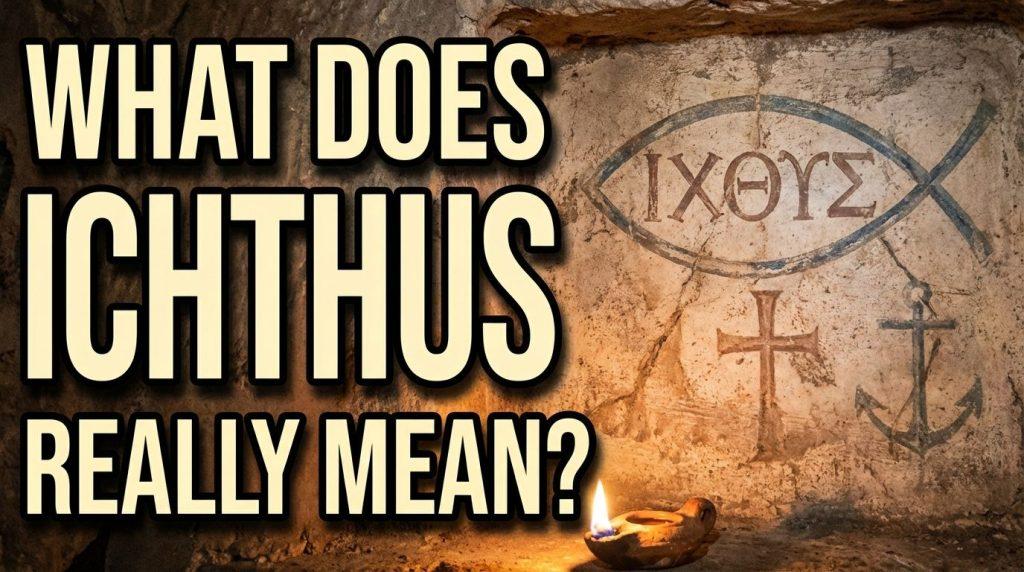
ICHTHUS is the Greek word for fish, written as ΙΧΘΥΣ in the Greek alphabet. This simple word became one of the most recognizable symbols of early Christianity, carrying meaning far beyond its literal definition. The choice of a fish as a Christian symbol was not arbitrary but deeply rooted in both practical necessity and theological significance. During the first three centuries of Christianity, believers faced periodic waves of persecution from Roman authorities who viewed their monotheistic faith as a threat to the empire’s religious and political unity. In this context, Christians needed ways to identify themselves to one another without attracting unwanted attention from those who might report them to authorities. The fish symbol served this purpose perfectly because it appeared innocent to outsiders while carrying profound meaning for those who understood its significance.
The word ICHTHUS functions as an acrostic, with each Greek letter standing for a word in a longer phrase. The first letter, Iota (Ι), represents “Iesous,” which is Jesus in Greek. The second letter, Chi (Χ), stands for “Christos,” meaning Christ or the Anointed One. The third letter, Theta (Θ), represents “Theou,” which translates as “of God” or “God’s.” The fourth letter, Upsilon (Υ), stands for “Huios,” meaning Son. The final letter, Sigma (Σ), represents “Soter,” which means Savior. When combined, these five letters spell out the complete confession: “Jesus Christ, God’s Son, Savior.” This compact statement of faith encapsulates the central beliefs of Christianity in just five Greek letters, making it easy to remember and share among believers who faced constant danger.
The selection of this particular acrostic was brilliant in its simplicity and comprehensiveness. It affirms Jesus’s identity as both fully human and fully divine, acknowledging His role as the promised Messiah while also declaring His unique relationship with God the Father. The phrase captures the essential Gospel message that Jesus, the Christ anointed by God, is the divine Son who came to save humanity from sin. This theological summary corresponds with the teachings found throughout the New Testament and aligns with the core doctrines that the early Church councils would later formalize. The beauty of the ICHTHUS acrostic lies in its ability to communicate complex theological truths in a form that even illiterate Christians could learn and recognize, ensuring that the faith could spread across all social classes and educational backgrounds.
Historical Context of Early Christian Persecution
The early Christian community existed in a hostile environment where professing faith in Christ could result in imprisonment, torture, or execution. Roman authorities demanded that citizens participate in emperor worship and offer sacrifices to Roman gods as signs of loyalty to the empire. Christians refused these practices because they contradicted their monotheistic beliefs and their exclusive worship of the one true God. This refusal was interpreted as treason and disloyalty, making Christians targets of suspicion and periodic persecution. The persecution was not constant but occurred in waves, with some periods of relative tolerance followed by intense crackdowns. During the worst persecutions, Christians were arrested, their property was confiscated, and many were killed in brutal public spectacles designed to intimidate others into abandoning their faith.
In this dangerous context, Christians developed various methods of secret communication and identification. They needed to recognize fellow believers without revealing themselves to informants or hostile authorities. The fish symbol served as one of these covert identification methods. According to historical accounts, when two strangers met and suspected each other might be Christian, one person would draw an arc in the sand or dirt. If the other person was a Christian, they would complete the fish symbol by drawing a second arc to form the recognizable fish shape. This simple gesture allowed Christians to identify one another safely without using words that might be overheard or misunderstood. The exchange happened quickly and could be easily dismissed as meaningless doodling if questioned by suspicious onlookers.
The effectiveness of the fish symbol as a secret sign stemmed from its everyday familiarity in the ancient Mediterranean world. Fish were common in the diet, economy, and daily life of people throughout the Roman Empire. Drawings or symbols of fish appeared in various contexts without raising suspicion. A fish carved on a building, drawn on a wall, or worn as jewelry would not immediately identify someone as Christian to the uninitiated. Only those who knew the secret meaning behind the symbol would recognize it as a sign of Christian identity and fellowship. This dual nature made the fish symbol perfect for its purpose, providing both concealment from enemies and recognition among friends. The symbol could be displayed openly while remaining hidden in plain sight, protecting Christians while still allowing them to build community and support networks.
Biblical Connections to Fish and Fishing
The fish symbol carried additional layers of meaning because of its strong connections to Jesus’s ministry and teachings in the Gospels. Jesus called several of His first disciples from among fishermen working on the Sea of Galilee. According to Matthew 4:18-19, Jesus saw Simon Peter and Andrew casting nets into the sea and said, “Come after me, and I will make you fishers of men.” This call to discipleship established fishing as a metaphor for evangelization and the work of spreading the Gospel. The image of catching fish became synonymous with bringing people into the kingdom of God, giving the fish symbol an evangelistic dimension that resonated with the early Church’s missionary identity.
Multiple Gospel accounts record miracles involving fish that demonstrated Jesus’s divine power and care for His followers. The feeding of the five thousand, recorded in all four Gospels, shows Jesus multiplying five loaves and two fish to feed a massive crowd with abundant leftovers. This miracle revealed Jesus’s ability to provide for human needs and foreshadowed the Eucharistic feast that would sustain the Church. Another significant fish miracle occurred after the Resurrection when Jesus appeared to the disciples by the Sea of Galilee. According to John 21:1-14, the disciples had fished all night without catching anything, but when Jesus told them to cast their nets on the right side of the boat, they caught so many fish that they could hardly haul in the net. This miraculous catch demonstrated Jesus’s continued presence with His disciples even after His death and Resurrection.
The symbolism of fish extends to other Gospel passages that early Christians would have found meaningful. Jesus spoke of the kingdom of heaven as being like a net that catches fish of every kind, which are then sorted with the good kept and the bad thrown away, as recorded in Matthew 13:47-48. This parable connected fishing to the final judgment and the gathering of God’s people. The association between fish and Christian identity grew stronger when considering how Jesus compared His death and Resurrection to the sign of Jonah, who spent three days in the belly of a great fish before being released. These biblical connections meant that the fish symbol was not merely a convenient code but a image rich with theological and scriptural significance that spoke to multiple aspects of Christian belief and practice.
Theological Significance of the ICHTHUS Confession
The confession “Jesus Christ, God’s Son, Savior” contained in the ICHTHUS acrostic represents a complete summary of essential Christian doctrine. Each element of this short phrase addresses crucial theological truths that distinguish Christianity from other religious movements of the ancient world. The name “Jesus” affirms the historical reality of God’s incarnation in a specific person who lived, taught, suffered, and died at a particular time and place. This emphasis on Jesus’s real human existence countered early heresies that tried to separate Christ’s divinity from His humanity or to reduce Him to a mere spiritual being without true flesh and blood. The Church has always insisted that Jesus was fully human, experiencing all the limitations and sufferings of human nature while remaining sinless.
The title “Christ” declares that Jesus is the Messiah promised throughout the Old Testament scriptures. This identification connects Jesus to centuries of Jewish prophetic expectation and shows that His coming fulfills God’s plan of salvation that began with Abraham and continued through the prophets. Calling Jesus “Christ” means acknowledging that He is the anointed king descended from David who establishes God’s eternal kingdom. The early Church saw Jesus as the culmination of all God’s promises to Israel, the one who brings the covenant relationship between God and humanity to its intended completion. This messianic identity was central to apostolic preaching and remains fundamental to Catholic understanding of who Jesus is and why He matters for human salvation.
The phrase “God’s Son” affirms Jesus’s unique divine nature and His eternal relationship with God the Father. This element of the ICHTHUS confession addresses one of the most profound mysteries of Christian faith: that Jesus is both fully God and fully human, one divine person with two natures. The title “Son of God” appears frequently in the Gospels and expresses the intimate communion between Jesus and the Father that He revealed during His earthly ministry. When Christians call Jesus the Son of God, they are not suggesting that God physically fathered a child but rather expressing the eternal relationship within the Trinity that exists before all creation. This doctrine would later be formally defined at the Council of Nicaea and other early councils, but the confession was already present in the ICHTHUS formula used by persecuted Christians.
The final word “Savior” summarizes the purpose of Jesus’s incarnation, death, and Resurrection. Jesus came not merely to teach or inspire but to accomplish the salvation of humanity through His sacrifice on the cross. The title “Savior” acknowledges that human beings cannot save themselves from sin and death but need God’s intervention to be reconciled to Him and receive eternal life. This salvation is not earned by human effort but is a gift freely offered by God through Christ’s redemptive work. The early Christians who used the ICHTHUS symbol were proclaiming their belief that Jesus alone provides the way to salvation, a claim that put them at odds with Roman religion and philosophy. The confession “Jesus Christ, God’s Son, Savior” thus encapsulates the entire Gospel message in a form that could be expressed through a simple fish symbol.
Archaeological and Historical Evidence
Archaeological discoveries have confirmed the widespread use of the fish symbol among early Christian communities throughout the Roman Empire. Fish symbols have been found carved on tombs, painted on catacomb walls, etched into pottery and lamps, and incorporated into early Christian art and inscriptions. The catacombs of Rome, where Christians buried their dead and sometimes gathered for worship during times of persecution, contain numerous examples of fish imagery alongside other Christian symbols like anchors, ships, and doves. These underground burial chambers provide a glimpse into how early Christians expressed their faith through visual symbols that conveyed meaning to the initiated while remaining obscure to outsiders. The fish appears in various artistic styles and contexts, sometimes alone and sometimes combined with other symbols to create more complex messages.
One particularly significant archaeological find is the “Tomb of the Fish” in the catacomb of Callixtus in Rome, dating to the third century. This burial chamber features a prominent fish symbol painted on its walls, demonstrating the importance of this image in early Christian funeral practices. The presence of the fish symbol in burial contexts reflects the hope of resurrection and eternal life that Christians found in Jesus Christ, the Savior whom the symbol represented. Other catacombs show fish symbols accompanying inscriptions that mention the names of the deceased and prayers for their souls, indicating that the fish was understood as a sign of Christian identity even in death. The artistic style of these fish varies from simple line drawings to more elaborate depictions, showing that the symbol was used across different social classes and artistic traditions.
Ancient Christian writings also reference the fish symbol and its meaning, providing textual evidence that complements the archaeological record. Church fathers like Tertullian and Clement of Alexandria mention the fish in their writings, sometimes using it as a teaching tool to explain Christian doctrine. The epitaph of Abercius, a Christian bishop from the second century, contains cryptic references to fish that scholars interpret as coded Christian symbolism. These literary references help confirm that the fish symbol was not just a decorative motif but carried specific theological meaning related to Christ and Christian identity. The combination of archaeological and textual evidence establishes beyond doubt that the fish was among the most important symbols of early Christianity, used for identification, instruction, and the expression of faith in dangerous times.
The Fish Symbol in Early Christian Art and Liturgy
Early Christian art incorporated fish imagery in various contexts that revealed the symbol’s multiple layers of meaning. Fish appear in frescoes depicting biblical scenes, particularly those showing Jesus’s miracles of multiplication or the disciples’ miraculous catch. These artistic representations helped illiterate Christians learn and remember Gospel stories while also reinforcing the connection between the fish symbol and Jesus’s ministry. Artists sometimes depicted Jesus as a fisherman or surrounded by fish, visual representations that communicated His identity as the one who calls disciples to be fishers of men. The fish became part of a broader visual vocabulary that early Christians used to teach the faith and create sacred spaces for worship even in humble or hidden locations.
Eucharistic imagery in early Christian art frequently includes fish alongside bread, referencing both the miracle of loaves and fish and the sacred meal that Christians celebrated in remembrance of Jesus. Some ancient depictions show fish on a table or platter, symbolizing the spiritual food that Christ provides to His followers. This connection between fish and the Eucharist added another dimension to the symbol’s meaning, linking it to the most important sacramental practice of Christian worship. The fish could thus represent not only Christ Himself but also the nourishment He provides through the sacraments. Early Christians viewing these images would understand multiple levels of meaning simultaneously, seeing in the simple fish a reference to Christ’s identity, His ministry, His saving work, and His continued presence in the Eucharistic celebration.
The use of fish in Christian liturgical practices extended beyond visual art into other aspects of worship and community life. Some early Christian communities observed special fasting practices on Fridays that included eating fish instead of meat, a tradition that continues in various forms today. This practice connected the symbol to lived religious experience and daily discipline. Communities gathering for worship might use fish symbols to mark their meeting places or to identify objects used in liturgical celebrations. The fish carved on a cup or plate would signal that the object was for Christian use, setting it apart for sacred purposes. Through these various uses, the fish symbol became woven into the fabric of early Christian life, appearing in contexts ranging from secret identification signs to public expressions of faith as Christianity gradually gained more acceptance.
The Development of Other Early Christian Symbols
While the fish was perhaps the most widespread early Christian symbol, it existed alongside other images that believers used to express their faith. The anchor appears frequently in catacomb art and on Christian tombstones, symbolizing the hope that believers have in Christ as expressed in Hebrews 6:19. The anchor could also be drawn to resemble a cross without making the connection too obvious, providing another layer of concealment during times of persecution. The dove represented the Holy Spirit and appears in scenes of Jesus’s baptism, while also symbolizing peace and the soul’s journey to heaven. The ship represented the Church itself, carrying believers through the storms of life toward their eternal destination. These various symbols worked together to create a rich visual language that communicated Christian truths without relying on written text.
The Chi-Rho symbol, formed by superimposing the Greek letters X (chi) and P (rho), the first two letters of “Christos,” became increasingly common after the conversion of Constantine in the fourth century. This monogram represented Christ’s name and appeared on military standards, coins, and buildings as Christianity moved from being a persecuted minority faith to the official religion of the Roman Empire. The Chi-Rho marked a shift in how Christians could express their identity, moving from concealment to public proclamation. Other symbols like the Good Shepherd, the lamb, and the peacock also carried Christian meaning, each drawing on biblical or theological themes to communicate aspects of faith. The Good Shepherd image depicted Jesus as the caring protector of His flock, based on passages like John 10:11-15.
The development and use of these various symbols show how early Christians created multiple ways to express and transmit their faith in both hostile and friendly environments. Each symbol could function differently depending on context, with some better suited for public display and others more appropriate for secret communication. The fish maintained its importance even as other symbols gained prominence because of its strong biblical connections and its association with the foundational confession of faith contained in the ICHTHUS acrostic. Early Christians understood that symbols could teach, inspire, identify, and protect, making them essential tools for a community that valued both the public proclamation of truth and the protection of believers from harm. The rich symbolic vocabulary that developed in the early Church continues to inform Christian art and worship today.
Modern Use and Relevance of the ICHTHUS Symbol
The fish symbol experienced a revival in popularity during the twentieth century, particularly among evangelical and Protestant Christians who adopted it as a badge of identity and faith. Car decals featuring the fish outline became common, allowing Christians to identify themselves to others and to express their faith publicly. This modern use mirrors the original purpose of the symbol as a marker of Christian identity, though in vastly different circumstances. Contemporary Christians generally do not face the threat of persecution that made secrecy necessary for early believers, so the fish symbol now functions more as a proclamation than as a concealment. The widespread recognition of the fish as a Christian symbol means that displaying it communicates one’s faith to both believers and non-believers alike.
Catholic use of the ICHTHUS symbol has been more restrained than in some Protestant contexts, but the fish appears in Catholic art, jewelry, and devotional items. Catholic schools and parishes sometimes incorporate fish imagery into their logos or decorations, particularly when emphasizing themes of evangelization or mission. The symbol’s connection to the papacy through Peter, the fisherman called by Jesus, gives it special resonance in Catholic contexts. The Vatican’s imagery and symbolism often include references to fishing and fish, acknowledging the Church’s mission to be “fishers of men” as Jesus commanded. Modern Catholic catechesis sometimes uses the ICHTHUS acrostic as a teaching tool to help students learn the core confession of Christian faith in a memorable way.
The enduring appeal of the ICHTHUS symbol lies in its simplicity and its connection to the early Church’s witness of faith under persecution. When contemporary Christians use this ancient symbol, they are connecting themselves to the courage and devotion of believers who risked their lives to follow Christ. The fish reminds modern Catholics that faith is not merely a private opinion or personal preference but a commitment worth standing for even when it costs something. In an age of increasing secularization in many parts of the world, the fish symbol can serve as a gentle but clear statement of Christian identity and values. It witnesses to the continuity of faith across twenty centuries, from the persecuted Christians of Rome to believers today who continue to profess that Jesus Christ is God’s Son and Savior.
The ICHTHUS Formula and the Apostles’ Creed
The confession contained in ICHTHUS closely parallels the structure and content of the Apostles’ Creed, the ancient baptismal formula that summarizes essential Christian beliefs. Both the ICHTHUS acrostic and the Creed affirm Jesus’s divine sonship, His messianic identity, and His role as Savior. The Creed expands on these themes by including additional details about Jesus’s birth, suffering, death, and Resurrection, but the core content overlaps significantly. This parallel is not coincidental but reflects the early Church’s understanding of what beliefs were essential for Christian identity. When catechumens prepared for baptism, they learned to confess faith in Jesus Christ as Lord and Savior, using formulas similar to the ICHTHUS statement. The connection between the fish symbol and baptismal confession may explain why fish appear so frequently in baptismal contexts in early Christian art.
The development of the Apostles’ Creed and other early creeds shows how the Church formalized and expanded the basic confession found in ICHTHUS. As theological disputes arose and various heresies threatened to distort Christian teaching, the Church needed more detailed statements of faith that could distinguish orthodox belief from error. The great councils of Nicaea and Constantinople produced expanded creeds that addressed specific theological questions about Christ’s nature and His relationship to the Father. These conciliar creeds built upon the foundation already present in simple formulas like ICHTHUS, making explicit what was implicit in the earlier confession. The relationship between symbol and creed demonstrates how Christian doctrine develops organically from the apostolic teaching, maintaining continuity while articulating truth more precisely.
Catholics today who understand the meaning of ICHTHUS can see how this ancient symbol connects to the faith they profess at every Mass. When the congregation recites the Creed, they are making the same essential confession that early Christians encoded in the fish symbol: that Jesus Christ is God’s Son and humanity’s Savior. This continuity of faith across centuries provides assurance that the Catholic Church maintains the authentic teaching of the apostles. The fish symbol serves as a tangible link to the early Church, reminding Catholics that they belong to a community of faith that extends back through history to the first disciples. Understanding this connection can deepen appreciation for both the symbol and the Creed, seeing them as different expressions of the same fundamental faith in Jesus Christ.
Teaching the ICHTHUS Symbol to New Generations
Catholic educators and catechists can effectively use the ICHTHUS symbol to teach children and converts about Christian identity and doctrine. The fish shape is simple enough for young children to draw and recognize, making it an accessible entry point into discussions about faith and symbolism. Teachers can explain how each letter in ICHTHUS represents a word, helping students learn both the Greek language connection and the theological content. This approach combines language learning, history, and theology in a way that engages different learning styles and interests. Children who learn the ICHTHUS formula often remember it for life, giving them a compact statement of faith they can recall in any situation.
The story of how early Christians used the fish symbol during persecution captivates young people’s imagination and teaches important lessons about courage and faithfulness. Students can learn that faith sometimes requires bravery and that Christians throughout history have faced challenges for believing in Jesus. This historical context helps contemporary Catholics, especially young people, understand that their faith is not just a cultural tradition but a commitment that has demanded sacrifice from previous generations. Teachers might use the fish symbol as a starting point for discussing modern challenges to faith, helping students think about how they can witness to Christ in their own contexts. The comparison between secret signs in the Roman Empire and public profession of faith today can generate meaningful conversations about religious freedom and the responsibilities that come with it.
Families can incorporate the ICHTHUS symbol into home religious practice by explaining its meaning during prayer time or displaying it as a reminder of Christian identity. Parents might teach their children to trace a fish shape as part of morning or evening prayers, connecting the simple gesture to the profound confession it represents. Family discussions about the symbol can reinforce catechesis received in school or parish programs, creating connections between different contexts where children learn about faith. The fish symbol can also facilitate conversations about saints and martyrs who died for their faith, helping children understand the cost of discipleship. By making the ICHTHUS symbol part of regular family life, parents help their children develop a strong sense of Christian identity rooted in the Church’s ancient traditions.
The Fish Symbol and Catholic Social Teaching
The ICHTHUS confession that Jesus is Savior has direct implications for how Catholics understand and engage with social issues. If Jesus truly saves, then His salvation must address the whole person, including material needs, social relationships, and structures of justice. Catholic social teaching insists that faith in Christ cannot be separated from concern for the poor, the oppressed, and the marginalized. The fish symbol’s connection to Jesus’s miracle of feeding the multitude reminds believers that Christ cares about hunger and physical need, not only spiritual matters. This biblical connection supports the Church’s emphasis on corporal works of mercy and social justice as integral parts of Christian discipleship rather than optional add-ons.
The image of fishing for people, which Jesus used when calling His first disciples, implies that evangelization must include concern for people’s total well-being. Catholic missionaries throughout history have understood that preaching the Gospel requires also addressing poverty, disease, ignorance, and injustice. The fish symbol can thus represent the Church’s comprehensive mission to bring Christ’s salvation to every dimension of human life. When Catholics work for justice, peace, and human dignity, they are living out the implications of confessing Jesus as Savior. The ICHTHUS formula reminds believers that salvation is not individualistic or purely spiritual but involves the redemption of all creation and the establishment of right relationships in every sphere of life.
Contemporary Catholics can draw on the ICHTHUS symbol’s meaning when engaging in social action and advocacy. Recognizing Jesus as God’s Son and Savior provides the theological foundation for defending human dignity and rights. If every person is created in God’s image and redeemed by Christ, then every person deserves to be treated with respect and justice. The fish symbol can serve as a reminder that social engagement flows from core Christian beliefs rather than from secular ideologies. Catholic approaches to social issues should always be grounded in the confession of faith that ICHTHUS represents, ensuring that practical action remains connected to its theological source. This connection prevents social ministry from becoming merely humanitarian work and maintains its character as a form of Christian witness and discipleship.
Ecumenical Dimensions of the ICHTHUS Symbol
The ICHTHUS symbol enjoys widespread recognition across different Christian traditions, making it one of the few images that can serve as a point of unity among divided Christians. Catholics, Orthodox, and Protestants all acknowledge the fish as an authentic early Christian symbol with solid biblical and historical roots. The confession of faith contained in the ICHTHUS acrostic represents beliefs that virtually all Christians share, despite disagreements on other theological points. This common ground makes the fish symbol particularly valuable in ecumenical contexts where Christians from different traditions come together for prayer, service, or dialogue. Using the ICHTHUS symbol in ecumenical settings can emphasize what unites Christians rather than what divides them.
The simplicity of the ICHTHUS confession also highlights the core beliefs that form the basis for Christian unity. When Christians of different traditions confess together that Jesus Christ is God’s Son and Savior, they are acknowledging their fundamental unity in Christ despite differences in church structure, sacramental theology, or liturgical practice. This shared confession can serve as a starting point for deeper dialogue and cooperation on issues where Christian witness is needed. The fish symbol reminds all Christians that they belong to a faith community that extends beyond their particular denomination, connecting them to the worldwide Church and to twenty centuries of Christian history. This broader perspective can help overcome the narrow denominationalism that sometimes characterizes Christian communities.
Catholics engaging in ecumenical dialogue can point to the ICHTHUS symbol as evidence that early Christianity possessed a basic unity of faith before later divisions occurred. The fact that Christians across the Roman Empire used the same symbol and made the same basic confession suggests that the early Church, while diverse in some ways, maintained substantial agreement on essential doctrines. This historical reality supports Catholic claims about the importance of visible unity and shared confession while also acknowledging the legitimate diversity that can exist within the bounds of orthodoxy. The ICHTHUS symbol thus serves both as a reminder of past unity and as a call to work toward greater unity in the present, fulfilling Jesus’s prayer that His followers would be one.
The Fish Symbol in Contemporary Catholic Spirituality
Modern Catholics can incorporate the ICHTHUS symbol into their personal spiritual practices as a focus for meditation and prayer. Tracing the fish shape while slowly reflecting on each letter of the acrostic creates a simple prayer practice that combines bodily action with mental focus. This type of prayer engages both body and mind, helping people whose thoughts tend to wander during purely mental prayer. The ICHTHUS meditation can be particularly useful in brief moments of prayer throughout the day, providing a quick way to center oneself on Christ and renew one’s faith commitment. The physical act of drawing or tracing the symbol can help make abstract theological truths feel more concrete and personal.
The content of the ICHTHUS confession offers rich material for meditation on the person and work of Jesus Christ. Reflecting on Jesus’s human name reminds believers of His real incarnation and His solidarity with human experience. Contemplating the title “Christ” leads to consideration of how Jesus fulfills Old Testament prophecies and brings God’s kingdom. Meditating on Jesus as God’s Son opens up the mystery of the Trinity and the eternal love between Father and Son. Finally, dwelling on Jesus as Savior invites reflection on one’s own need for salvation and gratitude for God’s mercy. Each element of the ICHTHUS formula can serve as a doorway into deeper prayer and contemplation of Christian mysteries.
Spiritual directors and retreat leaders can use the ICHTHUS symbol as a structure for prayer exercises or retreat themes. A five-day retreat might devote each day to one letter of the acrostic, exploring through scripture, teaching, and prayer what that particular aspect of Jesus’s identity means for Christian life. Group prayer using the ICHTHUS structure can help communities reflect together on their shared faith and commitment to Christ. The symbol’s ancient origins add depth to contemporary spiritual practices by connecting modern believers to the prayer and witness of early Christians. Using traditional symbols and formulas helps Catholics avoid the temptation to treat faith as something novel or invented, reminding them that they are part of a living tradition that spans centuries.
The ICHTHUS Symbol and the New Evangelization
The Catholic Church’s call for a “new evangelization” in traditionally Christian regions that have experienced secularization makes the ICHTHUS symbol particularly relevant. Just as early Christians needed symbols and signs to identify themselves and communicate their faith in a hostile environment, contemporary Catholics face challenges in expressing and sharing their faith in increasingly secular cultures. The fish symbol can serve as a gentle conversation starter that allows Catholics to witness to their faith without being aggressive or off-putting. Someone who displays a fish symbol on their car or jewelry creates opportunities for others to ask about its meaning, opening natural possibilities for sharing the Gospel.
The content of the ICHTHUS confession provides a clear and concise summary of the essential Christian message that can guide evangelization efforts. When Catholics share their faith with others, they need to communicate who Jesus is and why He matters, which is exactly what the ICHTHUS formula accomplishes. Using this ancient structure can help modern evangelizers avoid getting lost in secondary issues or peripheral concerns, keeping the focus on the core proclamation that Jesus Christ is God’s Son and Savior. The simplicity of the confession makes it accessible to people who might be intimidated by complex theological explanations, while still conveying the full weight of Christian claims about Jesus.
The example of early Christians who risked persecution to maintain their faith provides inspiration and encouragement for contemporary Catholics who face more subtle forms of resistance to Christian belief. While most Catholics today do not face physical persecution, many encounter social pressure, mockery, or professional disadvantages because of their faith. The ICHTHUS symbol reminds believers that following Christ has always required courage and that the Church has survived and grown despite opposition. This historical perspective can strengthen contemporary Catholics’ resolve to witness to their faith even when it costs them popularity or acceptance. The fish symbol thus serves both as an evangelistic tool and as a source of encouragement for those who use it to proclaim their Christian identity.
Conclusion and Continued Relevance
The ICHTHUS symbol carries meaning that extends far beyond its simple fish shape, encapsulating essential Christian doctrine in a form that has served believers for nearly two thousand years. From its origins as a secret sign among persecuted Christians to its contemporary use as a public declaration of faith, the fish has remained a powerful expression of Christian identity. The acrostic “Jesus Christ, God’s Son, Savior” provides a complete confession of faith that addresses the fundamental questions of who Jesus is and what He accomplishes for humanity. Catholics who understand this symbol gain appreciation for how the early Church expressed and protected its faith under difficult circumstances.
The biblical connections between fish and Jesus’s ministry give the symbol layers of meaning that reward continued reflection and study. The fish points to Jesus’s call to discipleship, His miracles of provision, His Resurrection appearances, and His commission to evangelize. These multiple dimensions ensure that the ICHTHUS symbol remains spiritually rich rather than becoming a merely historical curiosity. Modern Catholics can draw on this richness as they seek to live out their faith in contemporary contexts, finding in the ancient symbol both instruction and inspiration. The fish reminds believers that their faith connects them to a vast community that spans time and space, united in the confession that Jesus is Lord.
As the Catholic Church continues its mission of evangelization in the twenty-first century, the ICHTHUS symbol offers resources for both teaching the faith and witnessing to it publicly. The symbol’s combination of simplicity and depth makes it effective for catechesis across age groups and cultural contexts. Its ecumenical acceptance provides opportunities for cooperation and dialogue among Christians of different traditions. Most importantly, the fish keeps the focus on Jesus Christ Himself, the center of Christian faith and the source of salvation. Catholics who embrace the ICHTHUS symbol as part of their spiritual practice and public witness will find it a valuable tool for maintaining and sharing faith in an age that desperately needs to hear the Gospel message that Jesus Christ is God’s Son and Savior.
Disclaimer: This article presents Catholic teaching for educational purposes. For official Church teaching, consult the Catechism and magisterial documents. For personal spiritual guidance, consult your parish priest or spiritual director. Questions? Contact editor@catholicshare.com
Sign up for our Exclusive Newsletter
- 📌 Add CatholicShare as a Preferred Source on Google
- 🎁 Join us on Patreon for Premium Content
- 🎧 Check Out These Catholic Audiobooks
- 📿 Get Your FREE Rosary Book
- 📱 Follow Us on Flipboard
-

Recommended Catholic Books
Discover hidden wisdom in Catholic books — invaluable guides enriching faith and satisfying curiosity. #CommissionsEarned
- The Early Church Was the Catholic Church
- The Case for Catholicism - Answers to Classic and Contemporary Protestant Objections
- Meeting the Protestant Challenge: How to Answer 50 Biblical Objections to Catholic Beliefs
As an Amazon Associate, I earn from qualifying purchases. Thank you for your support.