
Brief Overview
- The Anointing of the Sick is a genuine sacrament instituted by Christ, not a symbolic gesture or a final formality invented by the medieval Church.
- Many Catholics wait too long to ask for this sacrament, mistakenly believing it is reserved only for those who are moments away from death.
- This sacrament can forgive sins, strengthen the soul, and, if it is God’s will, contribute to physical healing, making it one of the most practically significant sacraments a Catholic can receive.
- Receiving the sacrament does not guarantee physical recovery, and approaching it with that expectation alone will leave you unprepared for what it actually offers.
This Is Not “Last Rites” Anymore
For generations, most Catholics heard the phrase “last rites” and pictured a priest arriving at a deathbed in the final minutes of life. That image stuck. It shaped how entire families handle illness, often waiting until a loved one is unconscious or actively dying before calling the priest. By then, the person receiving the sacrament cannot participate meaningfully, cannot make an act of faith, and cannot even be aware of what is happening.
The Church corrected this misunderstanding formally at the Second Vatican Council and in Pope Paul VI’s 1972 apostolic constitution, Sacram unctionem infirmorum. The Catechism now states plainly that the sacrament is not restricted to those at the point of death; the fitting time to receive it is when a member of the faithful begins to be in danger of death from sickness or old age (CCC 1514). Serious illness, major surgery, advanced age, and significant frailty all qualify. Waiting for the final hour is not piety. It is a habit that deprives the sick person of everything this sacrament was designed to give while they are still conscious and able to receive it fully.
Who Actually Qualifies to Receive It
The Church draws a careful line here, and both sides of that line matter. You do not need to be dying. You do need to be seriously ill or facing a condition that genuinely endangers your life or health. A cold does not qualify. Pre-op anxiety for a minor procedure does not qualify. But cancer, heart disease, a serious surgical intervention, debilitating neurological conditions, or the general frailty of old age all meet the standard.
Children who have reached the age of reason and are seriously ill may receive this sacrament. Catholics who have lost consciousness may still receive it, provided there is reasonable presumption that they would have wanted it. A person in a persistent vegetative state can receive the sacrament. Each time a person falls seriously ill, even if they have already received this anointing before, they may receive it again. If the same illness worsens after the person has been anointed, the sacrament can be repeated (CCC 1515). This is not a one-time rite. It follows the Christian through serious suffering repeatedly across a lifetime.
What This Sacrament Actually Does
The Catechism identifies four distinct effects of the Anointing of the Sick, and most Catholics know only one of them. The first and primary effect is a particular gift of the Holy Spirit that brings strengthening, peace, and courage to face the serious difficulties of illness or old age (CCC 1520). This is not a vague spiritual comfort. It is an actual grace directed at the specific struggles illness creates: the fear of death, the temptation to despair, the feeling of abandonment, and the spiritual exhaustion that comes with prolonged suffering.
The second effect is the forgiveness of sins. If the sick person is unable to receive the sacrament of Penance before being anointed, the Anointing of the Sick can supply that forgiveness, provided the person has contrition (CCC 1520). This is not a loophole. It is mercy built into the structure of the sacrament for precisely those moments when a confessor cannot be reached in time. Third, the sacrament unites the suffering person with the Passion of Christ, giving their pain a redemptive meaning and connecting it to the work of salvation (CCC 1521). Fourth, if it is God’s will, physical healing may accompany the sacrament. The Church has always prayed for this. She has never promised it.
The Part Nobody Warns You About
Physical healing does not always come. This is the reality that can shake a person’s faith if they receive the sacrament expecting it to cure them, and then they die or continue to suffer. St. Paul himself asked God three times to remove his affliction, and God’s answer was not healing but grace: “My grace is sufficient for you, for my power is made perfect in weakness” (2 Corinthians 12:9). The Church does not teach that faith strong enough or sacraments received soon enough will produce bodily recovery. She teaches that every grace the sacrament offers is ordered to salvation, not to physical survival.
Families need to hear this before the priest arrives, not after. If you bring a loved one to be anointed with the expectation that they will get out of the hospital bed next week, and they do not, the sacrament did not fail. You misunderstood what it promised. The sacrament always delivers its spiritual effects when received in proper dispositions. Whether those effects include physical healing is God’s decision, not ours.
How to Prepare and What to Expect During the Rite
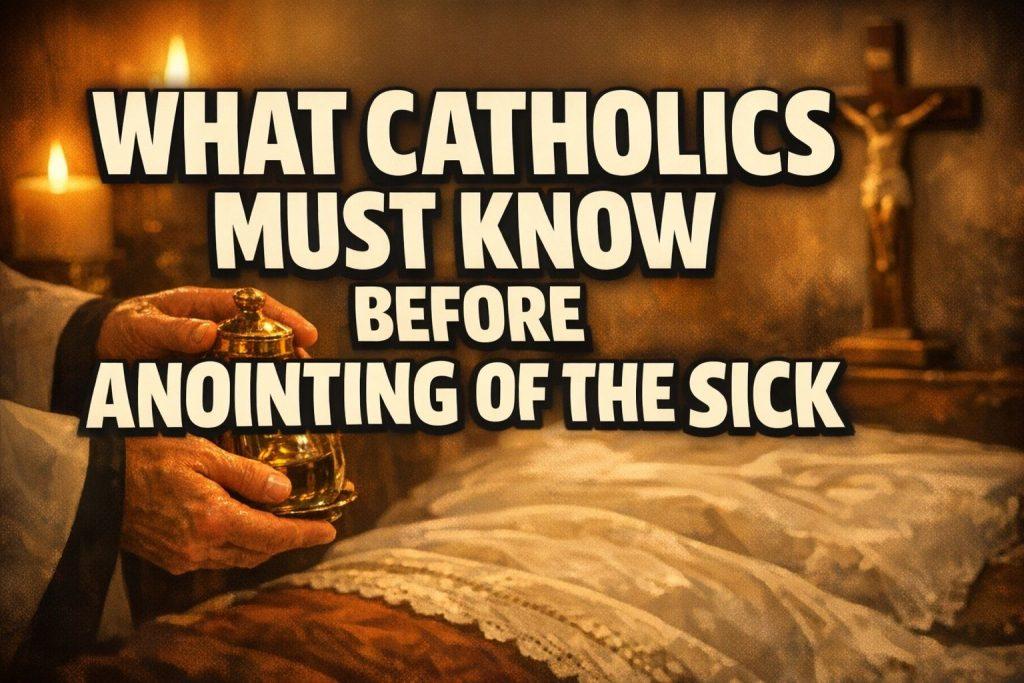
Only a priest or bishop can administer this sacrament (CCC 1516). A deacon, a family member, or a lay minister cannot anoint the sick in this sacramental sense, regardless of their good intentions. The rite itself is simple. The priest lays hands on the sick person in silence, then anoints the forehead and hands with blessed oil while praying the Church’s prayer of healing. The celebration ideally includes Scripture, an act of repentance, and may be followed by the Eucharist.
The sick person benefits from some preparation. If confession is possible beforehand, receive it. Ask the priest to take his time. The sacrament celebrated with awareness and participation is far richer than one administered hastily in a corridor. Invite family members to be present. The Church describes this sacrament as a communal act, not a private transaction between priest and patient.
So, Is This a Sacrament You Should Be Seeking?
If you are seriously ill, preparing for significant surgery, or watching a loved one face a grave medical condition, the answer is yes, and you should not wait. The sacrament of the Anointing of the Sick is one of the Church’s most misused and most neglected gifts, often avoided out of superstition, fear, or simple ignorance. James 5:14-15 commands the faithful to call for the elders of the Church when someone is sick. That command exists because Christ knew what illness does to a person spiritually, and he did not leave us without a direct response to it.
Receiving this sacrament is not admitting defeat. It is not inviting death. It is placing yourself or your loved one directly into the hands of Christ the physician, who healed the sick throughout his ministry and gave his Church the authority to continue that healing work. The sacrament may restore your body. It will strengthen your soul, forgive your sins if needed, unite your suffering to his, and prepare you for whatever God’s will holds. That is not a small thing. That is the whole shape of Christian life under pressure, and the Church built a sacrament around it precisely because none of us should face serious illness alone.
Disclaimer: This article presents Catholic teaching for educational purposes. For official Church teaching, consult the Catechism and magisterial documents. For personal spiritual guidance, consult your parish priest or spiritual director. Questions? Contact editor@catholicshare.com
Sign up for our Exclusive Newsletter
- 📌 Add CatholicShare as a Preferred Source on Google
- 🎁 Join us on Patreon for Premium Content
- 🎧 Check Out These Catholic Audiobooks
- 📿 Get Your FREE Rosary Book
- 📱 Follow Us on Flipboard
-

Recommended Catholic Books
Discover hidden wisdom in Catholic books — invaluable guides enriching faith and satisfying curiosity. #CommissionsEarned
- The Early Church Was the Catholic Church
- The Case for Catholicism - Answers to Classic and Contemporary Protestant Objections
- Meeting the Protestant Challenge: How to Answer 50 Biblical Objections to Catholic Beliefs
As an Amazon Associate, I earn from qualifying purchases. Thank you for your support.