
Brief Overview
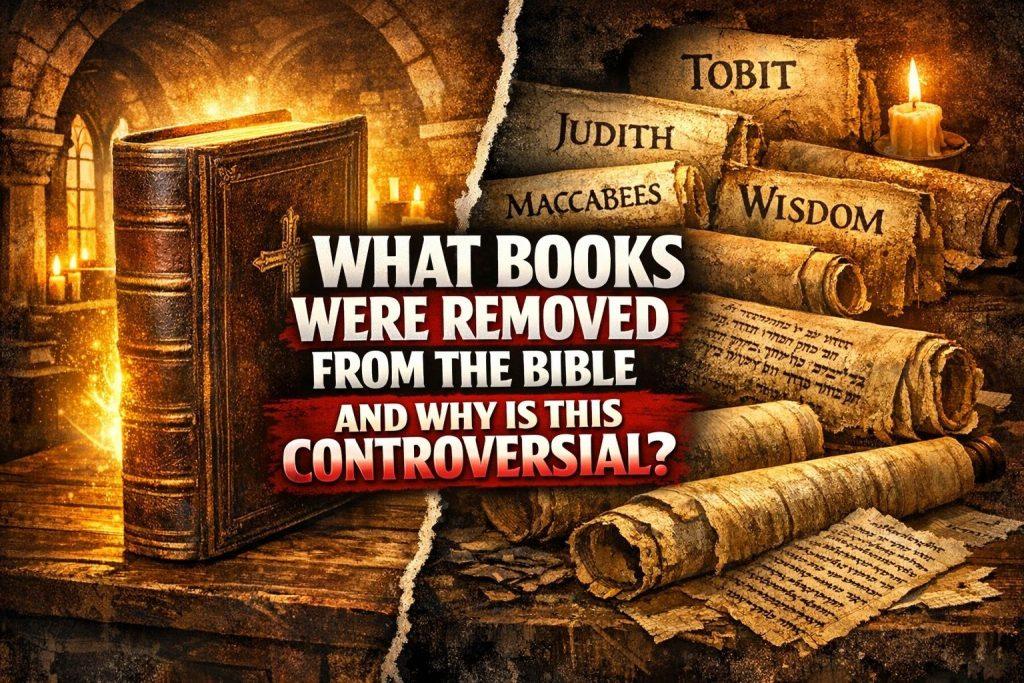
- The Catholic Church recognizes seventy-three books in the biblical canon, while many Protestant churches recognize sixty-six books, with seven books and portions of two others considered deuterocanonical or apocryphal by Protestants.
- Several ancient texts existed in the early Christian period but were not included in the final biblical canon, including the Book of Enoch, the Gospel of Thomas, and the Acts of Peter.
- The controversy surrounding removed books stems from differences in how the Catholic Church and Protestant denominations define which texts are divinely inspired and authoritative.
- Early church leaders used specific criteria to determine canonicity, including apostolic authorship, consistency with established Christian teaching, and widespread acceptance by Christian communities.
- Different Christian traditions maintain varying positions on the status of deuterocanonical books, with Catholics and Orthodox Christians accepting them as scriptural while most Protestants do not.
- Understanding why certain books were excluded helps Catholics appreciate the careful discernment the Church applied to establish the biblical canon and maintain doctrinal unity.
The Development of the Biblical Canon
The biblical canon did not emerge suddenly or all at once; rather, the Church developed it gradually over the first several centuries of Christianity. Early Christians possessed various writings that claimed religious authority, including gospels, letters, and prophetic texts. The apostles and their successors used these writings in worship, teaching, and pastoral care. However, not every writing that claimed Christian origin received universal acceptance or equal status. The Church recognized that it needed to distinguish between texts that truly expressed apostolic teaching and those that did not. By the end of the second century, most Christian communities had reached substantial agreement about which books were authoritative. The process of formal canonization continued through ecumenical councils, particularly the Council of Hippo in 393 and the Council of Carthage in 397 and 419. These councils did not create the canon so much as they formally recognized what the Church had already accepted through centuries of practice and discernment. The development of the canon reflects the Church’s commitment to preserving authentic apostolic teaching for future generations. Understanding this gradual process helps Catholics see that the Bible’s structure resulted from careful theological reflection rather than arbitrary decisions. The Church’s approach to canonization established principles that remain important for how Catholics read and interpret Scripture today.
Criteria for Including Books in the Canon
The early Church applied specific standards when determining which books belonged in the biblical canon, and these criteria shaped which texts were accepted and which were excluded. First among these criteria was apostolic authorship or connection, meaning the book needed to be written by an apostle or someone closely associated with apostolic authority. Second, the book had to demonstrate consistency with the teachings already established as authentic Christian doctrine. Third, the text needed widespread acceptance and use among Christian communities, particularly in important centers of the early Church. Fourth, the Church considered whether the book possessed spiritual power and edified believers in their faith. Fifth, the text needed to exhibit marks of genuine inspiration and not show signs of forgery or late composition. Sixth, the book had to be ancient and traceable to the apostolic period rather than a later invention. These criteria were not rigid formulas applied mechanically but rather principles that guided the Church’s discernment. When a text met these standards consistently, the Church accepted it as canonical. When writings failed several of these criteria, they were designated as apocryphal or non-canonical.
The Deuterocanonical Books and Catholic Acceptance
The Catholic Church accepts seven additional Old Testament books and portions of two others that many Protestant denominations do not include in their biblical canon, and these texts are known as the deuterocanonical books. The complete list includes Tobit, Judith, Wisdom, Sirach, Baruch, and First and Second Maccabees, along with additions to Esther and Daniel. The word deuterocanonical comes from Greek and means “second canon,” indicating that these books were accepted into the canon somewhat later than others. Catholic and Orthodox Christians recognize these books as fully scriptural and divinely inspired, while most Protestant traditions view them as valuable historical and religious texts but not authoritative scripture. The Council of Trent formally declared these books canonical in 1546, confirming the Church’s long-standing practice of accepting them. The Catholic acceptance of these books reflects confidence in the early Church’s judgment and the historical evidence supporting their apostolic value. These books appear in the oldest biblical manuscripts, particularly the Septuagint, the Greek translation of the Hebrew scriptures used by early Christians. The presence of these texts in ancient Christian Bibles indicates their early acceptance and use in Christian communities. Many of these books contain important theological teaching relevant to Catholic doctrine. The inclusion of the deuterocanonical books distinguishes Catholic and Orthodox biblical interpretation from many Protestant approaches.
The Gospel of Thomas and Non-Canonical Gospels
Among the texts excluded from the biblical canon, the Gospel of Thomas stands as one of the most studied and discussed, and its existence raises important questions about why certain gospels were rejected. The Gospel of Thomas consists primarily of sayings attributed to Jesus without narrative context or discussion of his passion, resurrection, or redemptive work. This text was lost for many centuries until a complete copy was discovered among the Nag Hammadi library in Egypt in 1945. Scholars debate whether the Gospel of Thomas contains some authentic sayings of Jesus or whether it represents later theological development divorced from historical tradition. The early Church rejected the Gospel of Thomas because it lacks the apostolic connection claimed by the four canonical gospels and because its content diverges significantly from established Christian teaching. The Gospel of Thomas emphasizes secret knowledge or gnosis rather than the salvation through Christ’s death and resurrection central to Christian faith. Additionally, the Gospel of Thomas was not widely used or recognized by the early Church leadership. Other non-canonical gospels like the Gospel of Peter and the Infancy Gospel of Thomas faced similar rejection for comparable reasons. The Church’s decision to exclude these gospels demonstrates its commitment to texts that reflect apostolic tradition and authentic Christian teaching. Modern interest in these excluded gospels sometimes leads people to speculate that the Church suppressed important information, but careful historical analysis shows the Church made thoughtful decisions based on sound theological principles.
The Acts of Peter and Other Apocryphal Writings
The Acts of Peter represents one category of early Christian writings that claimed apostolic authority but failed to meet the Church’s standards for canonicity and inclusion in scripture. This text describes Peter’s activities in Rome, his conflicts with Simon Magus, and the circumstances of his martyrdom. While the Acts of Peter contains some historical traditions that may reflect actual events, it also includes legendary material and theological teachings that diverge from apostolic doctrine. The Church rejected the Acts of Peter as canonical because it was not universally accepted, its authorship could not be established as apostolic, and some of its teachings contradicted established Christian doctrine. Similar apocryphal acts attributed to other apostles were also excluded from the canon for comparable reasons. These texts include the Acts of John, the Acts of Paul, and the Acts of Andrew. The Church recognized that while these writings possessed historical interest and some edifying content, they did not carry the apostolic authority necessary for scripture. Some of these texts were preserved and influenced Christian thought, particularly in some Eastern Christian communities. The survival of these texts in ancient manuscripts confirms that early Christians knew about them and sometimes valued them. However, the Church’s refusal to include them in the canon reflects confidence in the Church’s ability to distinguish authentic apostolic writing from later pious elaborations.
The Book of Enoch and Other Jewish Literature
The Book of Enoch presents an interesting case because this text was maintained as scripture by the Ethiopian Orthodox Church while being rejected as canonical by the Catholic Church and most other Christian traditions. The Book of Enoch contains visions attributed to Enoch, the great-grandfather of Noah, and includes apocalyptic prophecies and descriptions of divine judgment. This book was composed over several centuries, with different sections dating from various periods in Jewish history. The earliest portions date to the second century before Christ, while later sections were added after that time. The text was known to early Christians and is quoted in the New Testament book of Jude. Despite this New Testament reference, the Church did not grant the Book of Enoch full canonical status. The Church recognized that while the book contains valuable religious teaching, its composite nature and unclear authorship made it unsuitable for the biblical canon. Additionally, much of the Book of Enoch addresses issues relevant to Jewish apocalyptic literature that did not directly relate to Christian doctrine in the same way as other scriptures. The survival of the Book of Enoch in various Christian communities, particularly in Ethiopia, demonstrates how different Christian traditions preserved different collections of sacred texts. The Ethiopian Orthodox Church’s acceptance of Enoch shows that views on canonicity could vary among Christian communities. This variation in canonical acceptance reflects legitimate theological differences without suggesting that any community was acting improperly or suppressing information.
Differences Between Catholic and Protestant Canons
The distinction between the Catholic and Protestant biblical canons represents one of the most significant divisions resulting from the Protestant Reformation, and understanding this difference helps clarify why books were removed from certain Protestant Bible versions. When Protestant reformers like Martin Luther and John Calvin examined the biblical canon, they questioned the status of the deuterocanonical books. These reformers noted that these seven books were not found in the Hebrew biblical tradition as it existed in the late medieval period. They argued that the Church should restrict the canon to books originally written in Hebrew and recognized as authoritative by the Jewish community. The Council of Trent responded in 1546 by formally affirming the deuterocanonical books as fully canonical, defending the Church’s long-standing acceptance of these texts. The Catholic position rested on the recognition that early Christians used the Septuagint, a Greek translation that included these books, and that the ancient Christian church had accepted them. The Septuagint had been the scripture of most early Christians who spoke Greek rather than Hebrew. Removing these books from the canon would mean rejecting the biblical version used by the apostles and early Christian communities. The Protestant decision to exclude these books resulted in some Protestant Bibles printed without these texts, often relegated to a separate section called the Apocrypha. This division, created in the sixteenth century, reflects different approaches to the nature of biblical authority and the Church’s role in determining scripture. Catholics maintain that the Church’s traditional acceptance of these books provides sufficient warrant for their canonical status.
The Role of the Septuagint in Canonicity Questions
The Septuagint, the Greek translation of the Hebrew scriptures, played a crucial role in discussions about which books should be included in the biblical canon, and understanding this role illuminates why Catholics include books that some other Christian traditions exclude. The Septuagint was created in the third and second centuries before Christ when many Jews lived in Greek-speaking regions and needed scripture in their own language. This translation included not only books found in the Hebrew scriptures but also additional texts written originally in Greek or preserved in Greek when Hebrew versions were lost. Early Christians, many of whom spoke Greek, used the Septuagint as their Old Testament scripture. When New Testament writers quoted the Old Testament, they often used Septuagint readings rather than Hebrew texts. The apostles and their immediate successors read and taught from the Septuagint. The early church councils that formally recognized the biblical canon took the Septuagint’s content seriously in making their decisions. Early church fathers like Augustine accepted the deuterocanonical books because they appeared in the Septuagint that the Church used liturgically and theologically. When the Church was establishing the canon, it recognized that the early Christian community had used and valued these books. The inclusion of these books in the ancient Christian biblical manuscripts provided strong evidence for their canonical status. The reliance on the Septuagint demonstrates that the Catholic canon reflects the actual practice and belief of the early Church. Modern historical scholarship continues to confirm that the Septuagint’s expanded collection represented genuine Christian practice.
Why Some Ancient Texts Were Never Considered for Inclusion
Many ancient Christian writings were never seriously considered as candidates for biblical canonicity because they failed to meet basic requirements for apostolic authority and theological consistency. Texts like the Didache, a first or early second-century instruction manual for Christian communities, contained valuable teachings but were never claimed to be apostolic in origin. The author of the Didache did not claim to write apostolic doctrine but rather presented practical guidelines for Christian life based on teaching already accepted by the Church. Similarly, the Epistle of Barnabas, a second-century letter addressing Jewish and Christian identity questions, was sometimes valued but never treated as scripture by the Church. These texts were respected as edifying and historically significant without being accorded canonical status. The distinction between helpful and authoritative texts was clear in the early Church’s thinking. Some texts like the Shepherd of Hermas possessed such clear non-apostolic authorship that they could never have been canonical. The author of Hermas explicitly claimed no apostolic connection and presented his work as a personal vision rather than apostolic teaching. The Church read these texts, appreciated their value, and preserved them in some contexts without considering them scripture. This careful distinction shows that the Church understood the significance of apostolic authority for canonicity. Refusing to call helpful texts scripture did not diminish their value or usefulness for Christian formation.
Theological Concerns Behind Excluding Certain Texts
The Church’s decision to exclude specific texts from the biblical canon involved serious theological concerns about preserving authentic Christian doctrine and protecting believers from misleading teachings. Some texts that claimed Christian authority actually contradicted essential truths about Christ and salvation that the Church had received from the apostles. For example, some gnostic texts denied the reality of Christ’s physical body or his genuine human experience, contradicting the incarnational theology central to Christianity. Other apocryphal texts promoted dualistic views that saw the material world as evil and opposed to divine goodness, a teaching foreign to Christian faith. Still other writings emphasized secret knowledge available only to spiritual elites, contrary to the gospel message that salvation was offered to all. The Church recognized that including such texts in scripture would introduce confusion about foundational Christian truths. Protecting the integrity of Christian teaching required excluding texts that promoted false understandings of God, Christ, and salvation. The Church also had pastoral concerns about texts that presented Jesus as authorizing magical practices or claiming special secret wisdom. These theological and pastoral concerns show that the Church’s canonicity decisions involved much more than simply choosing between different historical accounts. The Church was actively protecting Christian orthodoxy and the salvation of believers. Modern Catholics can trust that the Church’s careful discernment successfully preserved texts that truly represent apostolic faith and excluded texts that would mislead the faithful.
The Question of Historical Accuracy and Lost Information
A common concern raised in discussions of removed books involves whether the Church’s decision to exclude certain texts meant that important historical information about Jesus or the apostles was lost or suppressed. This question deserves careful consideration because it relates to legitimate historical inquiry about what sources we possess. The four canonical gospels together provide a substantial historical record of Jesus’s ministry and teachings. Matthew, Mark, Luke, and John offer different perspectives and emphases while maintaining basic consistency about Jesus’s central teachings and actions. The information in these gospels was passed down through the apostolic community and recognized as trustworthy. Non-canonical gospels like the Gospel of Thomas provide almost no historical narrative material and consist mainly of isolated sayings without context. The Gospel of Thomas simply does not provide the kind of historical information that would fill gaps in the canonical gospels. Other apocryphal texts include legendary material about post-resurrection appearances or miracles that cannot be verified. The point is not that these texts deliberately conceal true history but rather that they do not provide reliable historical information. Modern historical scholarship recognizes that the canonical gospels represent the best ancient sources for information about Jesus. While some scholars debate particular sayings or events, serious historical researchers work primarily from the canonical gospels because they demonstrate better historical grounding. The Church’s confidence in the canonical gospels was not misplaced from a historical perspective. Catholics can accept the Church’s canonical decisions without fearing that crucial historical truths remain hidden in excluded texts.
Different Christian Traditions and Their Canons
Different Christian traditions maintain somewhat different biblical canons reflecting their historical development and theological judgments about scripture, and recognizing these differences helps Catholics understand the broader context of canonicity debates. The Roman Catholic Church recognizes seventy-three books in its biblical canon as established at the Council of Trent. The Eastern Orthodox Church similarly accepts these books though it may also include additional texts in some traditions. Most Protestant denominations recognize sixty-six books in their biblical canon, excluding the seven deuterocanonical books and portions of Daniel and Esther. The Ethiopian Orthodox Church maintains a significantly larger canon that includes additional texts like the Book of Enoch and other writings. Some Christian traditions in the Near East maintain yet other variations in their biblical collections. These differences do not necessarily indicate confusion or disagreement about Christian faith but rather reflect different historical and cultural contexts. Each Christian tradition can provide theological justification for its particular canonical decisions. The Catholic and Orthodox acceptance of the deuterocanonical books rests on their presence in ancient Christian manuscripts and their use in early Christian communities. The Protestant exclusion of these books reflects a different methodology that prioritizes the Hebrew scriptural tradition and apostolic authorship. None of these traditions is acting from ignorance or bad faith; rather, they are making deliberate choices about how to understand biblical authority. Understanding these various perspectives helps Catholics appreciate that their own canonical tradition represents one thoughtful approach among several available to Christian communities.
The Council of Trent’s Response to Protestant Challenges
The Council of Trent convened in 1545 partly in response to Protestant challenges to the Church’s traditional biblical canon, and understanding this council’s decisions clarifies the Catholic position on canonicity. The Protestant Reformation had challenged many Church teachings including the authority of the deuterocanonical books. Martin Luther had questioned whether these books should be included in scripture, arguing that they lacked the authority of books written in Hebrew or originally produced in the apostolic period. Other reformers similarly questioned the canonical status of these texts. The Council of Trent carefully examined the Church’s historical practice regarding these books and formally declared them to be scripture. The council’s decision was not a sudden innovation but rather a formal affirmation of what the Church had always maintained. The council emphasized that these books had been used in Christian worship and teaching for more than a thousand years. The earliest Christian biblical manuscripts included these books, demonstrating their ancient acceptance. The council noted that the Septuagint, the bible of the early Greek-speaking Church, contained these texts. By formally declaring these books canonical, the council provided authoritative confirmation of the Church’s traditional teaching. This council’s response shows that the Church did not suddenly invent the deuterocanonical canon but rather defended what it had consistently upheld. Catholics should understand the Council of Trent’s decision not as a late invention but as a formal confirmation of ancient Christian practice.
Modern Scholarship and the Study of Excluded Texts
Contemporary biblical scholarship has recovered and studied many ancient texts that were excluded from the biblical canon, and this modern work raises new questions about understanding why certain texts were rejected. Scholars have access to ancient manuscripts that were lost for many centuries, including texts found at Nag Hammadi, the Dead Sea, and other archaeological sites. These discoveries have allowed detailed examination of how early Christians viewed various writings and what standards they applied to canonicity decisions. Modern scholars have confirmed that many apocryphal texts were indeed known to early Christians. Some gnostic texts provide valuable information about early Christian diversity and how some groups understood Jesus and salvation differently from the apostolic mainstream. The recovery of these texts has not revealed any suppressed historical information about Jesus that contradicts the gospels or fills major gaps in the apostolic testimony. Rather, the recovered texts confirm that the Church correctly identified texts that diverged from apostolic teaching. Modern scholarship also reveals that early Christians did not arbitrarily reject texts but applied consistent criteria. The texts that were accepted became the biblical canon while those that were rejected either presented false teachings or lacked sufficient apostolic authority. Catholic scholarship engages with modern discoveries about early Christian texts while maintaining confidence that the Church’s canonical decisions served to preserve authentic apostolic faith. The findings of modern scholarship generally support rather than undermine the Church’s wisdom in establishing the canon.
The Controversy Surrounding the Book of Revelation
The Book of Revelation stands as an interesting case in canonical history because its acceptance as scripture was questioned by some in the early Church, and understanding the controversy surrounding Revelation illuminates the process by which canonical decisions were made. Revelation was not universally accepted as canonical in all early Christian communities, with some Eastern Christian communities questioning its apostolic authority. The authorship and dating of Revelation were questioned by some early church figures who had difficulty verifying the traditional ascription to John the apostle. Some Christians worried about how Revelation’s apocalyptic visions could be properly interpreted and whether they might lead to misunderstandings. Despite these initial questions, the Western church came to accept Revelation as canonical. The Eastern church eventually followed suit though acceptance remained somewhat contested in some communities. Revelation’s inclusion in the canon despite initial hesitations shows that the Church was not rigid in its process but willing to reconsider texts carefully. By the fourth century councils, the Church had resolved to include Revelation in the biblical canon. The grounds for this acceptance included its ancient use in Christian worship, its connection to the apostolic community, and its genuine spiritual power. The eventual canonical acceptance of Revelation despite early questions demonstrates that the Church took time to deliberate carefully about borderline cases. This same careful deliberation led the Church to exclude other texts that could not meet the criteria for apostolic authority and consistency with Christian doctrine. The case of Revelation shows that canonicity was not determined all at once but involved ongoing discernment.
Apocryphal Literature and Christian Piety
Throughout Christian history, some texts excluded from the biblical canon have continued to influence Christian prayer, devotion, and spiritual understanding, and recognizing this ongoing influence helps explain why some people remain interested in apocryphal writings. The Protoevangelium of James, an apocryphal text describing Mary’s life and the circumstances of Jesus’s birth, significantly influenced Christian veneration of Mary throughout history. Christian artists depicted scenes from the Protoevangelium of James that are not found in the canonical gospels. Pious traditions about Mary’s parents, her presentation in the temple, and other details were drawn from or influenced by this apocryphal text. Similarly, various apocryphal texts about the apostles’ missionary activities and martyrdoms influenced Christian understanding of apostolic history. Some of these traditions about the apostles found their way into liturgical celebrations and veneration practices. The continued influence of apocryphal texts in Christian tradition shows that the Church did not suppress these writings but rather distinguished between texts that could be canon and texts that could remain edifying. Christians were free to read and appreciate apocryphal texts without treating them as scripture. This distinction between canonical and non-canonical texts reflects the Church’s reasonable approach to religious authority. Some modern Catholics retain interest in apocryphal texts as historically valuable or spiritually interesting without demanding that they be elevated to scriptural status. The Church’s openness to preserving and studying these texts while denying them canonical authority shows wisdom and balance.
Catholic Doctrine on Scripture and Tradition
Understanding the Catholic position on canonical books requires recognizing how the Church views the relationship between Scripture and Sacred Tradition, as this relationship explains the Catholic confidence in both the biblical canon and other authoritative teachings. The Church teaches that revelation was given to the apostles orally and in written form, with both Scripture and Tradition expressing the full content of divine revelation. The biblical canon represents one important expression of this revelation, specifically the written expression recognized as inspired by God. Sacred Tradition expresses revelation through the lived faith of the Church, its teaching, worship, and spiritual practice. This view of Scripture and Tradition means that the Church need not find every authoritative teaching explicitly in the written biblical text. The Church can draw on the fuller testimony of Tradition to understand and develop doctrine. This framework means that excluding certain texts from the biblical canon does not mean the Church rejects all their content or insights. The Church maintains authority to interpret Scripture and to draw on Tradition for understanding revelation. This position distinguishes Catholic understanding from some Protestant approaches that insist all doctrine must derive from Scripture alone. The Council of Trent affirmed this Catholic understanding of Scripture and Tradition working together. For Catholics, the biblical canon represents an authoritative expression of revelation while not representing the totality of revelation. Understanding this broader Catholic framework helps explain why Catholics do not view canonical decisions as suppressing revelation but as establishing which texts carry inspired scriptural authority.
The Role of the Magisterium in Determining Canonicity
The Catholic Church teaches that the magisterium, the teaching authority of the Church exercising papal and episcopal leadership, has the responsibility and capacity to determine which texts belong to the biblical canon. This teaching about the role of the magisterium in canonical questions addresses how the Church comes to reliable conclusions about scripture. The Church holds that the Holy Spirit works through the Church to preserve revealed truth and to authenticate revelation. The magisterium does not create the canon but recognizes and formally declares what the Church has come to understand through centuries of practice and prayer. This means that canonical decisions ultimately rest not on human judgment alone but on the Church’s guided discernment. The Church’s authority to determine the canon grows from its responsibility to preserve apostolic teaching faithfully. Different Christian traditions hold different views about the nature of this Church authority. The Catholic understanding maintains that the Church under the guidance of the Holy Spirit possesses genuine authority in such doctrinal matters. This belief in the Church’s guided authority differs from views that suggest canonicity should be determined simply by counting ancient manuscripts or by individual readers evaluating texts. The Church’s conviction about its own teaching authority provides the theological foundation for Catholic confidence in canonical decisions. Catholics trust that the Church’s determination of the biblical canon represents authentic guidance about Scripture and revelation. This theological framework explains why Catholics accept the Church’s canonical decisions even when historical arguments might seem ambiguous.
Addressing Concerns About Suppression and Lost Knowledge
Some people worry that the Church’s exclusion of certain texts from the biblical canon means that important truth or knowledge was deliberately suppressed, and addressing these concerns directly helps clarify what actually occurred in the historical process of canonization. The evidence does not support claims that the Church engaged in systematic suppression of alternative viewpoints or hidden knowledge. Many excluded texts were preserved in Christian monasteries and libraries where monks carefully copied them for centuries. These texts were not hidden away but existed in libraries accessible to scholars and church leaders. The Church’s decision to exclude certain books from scripture did not prevent Christians from reading those texts or learning from them. Rather, the Church made a distinction between canonical scripture and other edifying writings. Some texts that were excluded from the canon nonetheless remained influential in Christian communities. The fear of suppressed knowledge rests partly on misunderstanding what the canon actually represents. The biblical canon identifies texts bearing scriptural authority and divine inspiration; it does not claim to represent all valuable religious or historical information. Many valuable historical sources and religious writings exist outside the biblical canon without being suppressed. Modern scholarship has recovered many excluded texts and studied them extensively without finding suppressed truths about Jesus or early Christianity that contradict or significantly undermine the canonical gospels. The Church’s canonical decisions reflect careful theological judgment rather than arbitrary suppression of inconvenient information.
Living with the Church’s Canonical Tradition
Catholics today can approach the biblical canon with confidence that the Church’s traditional decisions represent wisdom and authentic guidance, and this confidence provides freedom to focus on reading and living Scripture fully. The Church has provided Catholics with a clear, coherent collection of scriptural texts whose content expresses the apostolic faith. These texts together form a unified testimony to God’s revelation in Jesus Christ. Catholics can read the canonical scriptures knowing that the Church has carefully determined these texts merit deep attention and spiritual appropriation. The distinction between canonical and non-canonical texts need not trouble Catholics; rather, this distinction can clarify where spiritual authority truly resides. The biblical canon provides Catholic readers with a focused collection of texts for prayer, study, and meditation without the confusion that would arise from trying to treat all ancient Christian writings with equal authority. Catholics can recognize that some non-canonical texts contain value for historical understanding or spiritual reflection without needing to elevate them to scriptural status. The Church’s tradition regarding the canon developed through centuries of careful discernment by faithful bishops, councils, and church fathers. This tradition reflects the work of the Holy Spirit in guiding the Church toward truth. Modern Catholics inherit this tradition and can receive it gratefully as a gift that helps focus their engagement with Scripture. Living within the Church’s canonical tradition provides both spiritual benefit and intellectual coherence for Catholic biblical interpretation and study.
Conclusion and Practical Implications
The history of the biblical canon, including books that were excluded and the reasons for their exclusion, illustrates how the Church has carefully distinguished between texts that deserve scriptural authority and those that do not merit such status. The Church applied consistent, reasonable criteria including apostolic authorship, theological consistency, and universal acceptance by Christian communities. Different Christian traditions maintain somewhat different canons reflecting their particular historical development and theological choices. The Catholic canon, affirmed definitively by the Council of Trent, includes books recognized as scriptural since antiquity, particularly the deuterocanonical books that appear in the Septuagint and in ancient Christian manuscripts. Modern scholarship has continued to study excluded texts and has generally confirmed rather than undermined the Church’s wisdom in making canonical choices. Catholics can read the biblical canon with confidence that it represents authentic apostolic teaching and the genuine word of God. The exclusion of certain texts does not mean the Church suppressed truth or valuable information but rather that the Church exercised appropriate authority in determining which texts carry inspired scriptural weight. Living within the Church’s canonical tradition means Catholics can approach Scripture with clear focus and confidence. Understanding the history of canonicity helps Catholics appreciate the careful theological work that preserved authentic revelation for the Church. Catholics today benefit from this tradition of discernment and can trust that their biblical canon represents the fruit of centuries of faithful guidance by the Holy Spirit working through the Church. This confidence allows Catholics to engage Scripture deeply and to build their faith on the sure foundation of texts the Church has determined to be genuinely apostolic and divinely inspired.
Disclaimer: This article presents Catholic teaching for educational purposes. For official Church teaching, consult the Catechism and magisterial documents. For personal spiritual guidance, consult your parish priest or spiritual director. Questions? Contact editor@catholicshare.com
Sign up for our Exclusive Newsletter
- 📌 Add CatholicShare as a Preferred Source on Google
- 🎁 Join us on Patreon for Premium Content
- 🎧 Check Out These Catholic Audiobooks
- 📿 Get Your FREE Rosary Book
- 📱 Follow Us on Flipboard
-

Recommended Catholic Books
Discover hidden wisdom in Catholic books — invaluable guides enriching faith and satisfying curiosity. #CommissionsEarned
- The Early Church Was the Catholic Church
- The Case for Catholicism - Answers to Classic and Contemporary Protestant Objections
- Meeting the Protestant Challenge: How to Answer 50 Biblical Objections to Catholic Beliefs
As an Amazon Associate, I earn from qualifying purchases. Thank you for your support.