
Brief Overview
- The Traditional Latin Mass is the ancient Roman Rite codified by the Council of Trent in 1570 and celebrated in Latin with the priest facing the altar, not the congregation.
- Walking in completely unprepared will likely leave you confused and possibly frustrated, because this Mass operates by a logic and rhythm that differs significantly from the Novus Ordo most Catholics grew up with.
- When received with proper preparation and an open disposition, the TLM offers a depth of silence, reverence, and theological density that many Catholics find genuinely arresting.
- As of 2026, the TLM remains under the restrictions of Pope Francis’s 2021 document Traditionis Custodes, which means access depends heavily on your diocese and local bishop.
You Are Stepping Into Something Ancient
The Mass you are about to attend is not a nostalgic recreation or a boutique preference. It is the substantially unchanged form of the Roman Rite that St. Thomas Aquinas prayed, that missionaries carried to every corner of the earth, and that the Council of Trent codified in 1570 under Pope St. Pius V. For roughly four centuries, this was simply the Mass of the Roman Church. It was not replaced but set aside in 1969 when Pope Paul VI promulgated the Novus Ordo Missae, the ordinary form most Catholics celebrate today. Pope Benedict XVI clarified in 2007 that the old rite was never abrogated and permitted its wider celebration. Pope Francis restricted it again in 2021. Pope Leo XIV has so far maintained those restrictions while indicating some openness to dispensations. The point is not to rehearse that political history before you walk through the door, but to understand that you are not entering a novelty. You are entering something with serious historical and theological weight behind it.
The Silence Will Unsettle You at First
The most immediate difference you will notice is the silence. Much of the Traditional Latin Mass, particularly the Low Mass, is celebrated quietly. The priest prays many of the prayers at the altar in a voice too low to hear from the pews. There is no lector, no cantor announcing page numbers, and no folksy commentary from the sanctuary. The congregation does not say the responses aloud in a Low Mass. That silence is not a defect. It is structural and intentional, designed to communicate that something sacred is happening that exceeds human speech.
First-timers often feel lost during those quiet stretches. That feeling passes with familiarity, but you should expect it on your first visit. Bring a hand missal if you can find one, a booklet that contains the Latin text alongside an English translation. Many TLM communities provide these at the door. Do not stare at the missal the entire time. Look up. Watch the priest. Notice the gestures, the genuflections, the precise movements that have been handed down through centuries of liturgical tradition.
What the Priest Faces and Why It Matters
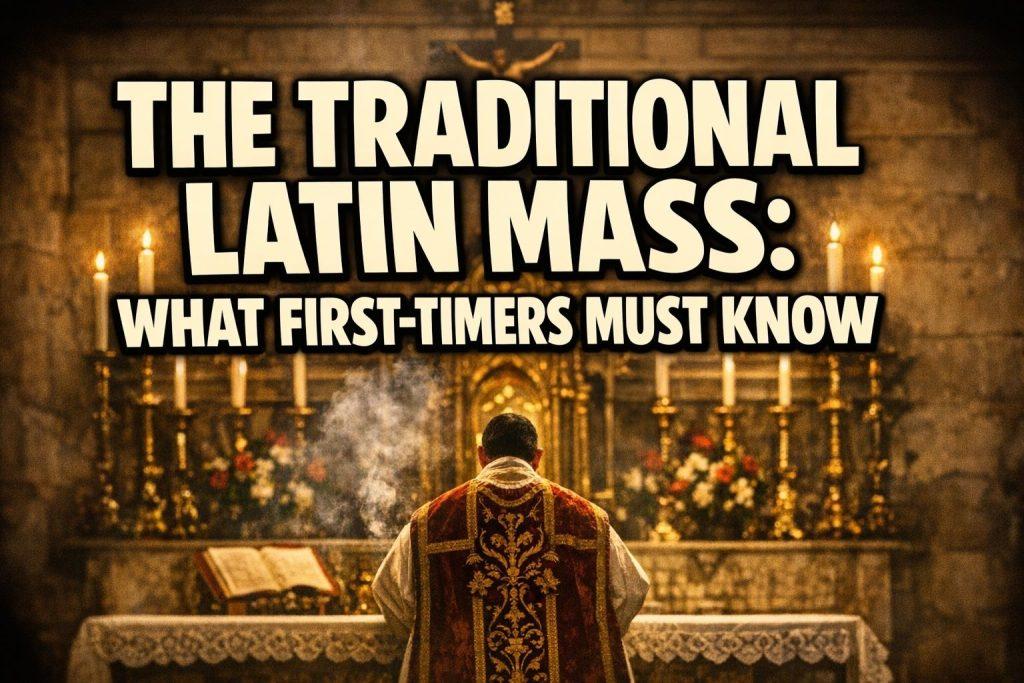
The priest celebrates the TLM ad orientem, meaning he faces the altar and the crucifix rather than the congregation. In most Low Masses, the priest will have his back to you for the majority of the liturgy. This surprises people who have only attended Mass in the ordinary form, where the priest faces the people across the altar.
The theological logic of ad orientem worship is that the priest and congregation face God together, rather than facing each other. The priest leads the people in prayer toward the Lord, not performance toward an audience. The Council of Trent did not invent this orientation; it is the ancient posture of Christian worship, as the Church Fathers consistently described. St. Augustine, writing in the fifth century, referenced the practice of turning east in prayer as universally understood among the faithful. Whether you find ad orientem immediately meaningful or initially disorienting, understanding why it exists will help you receive what the Mass is trying to give you.
The Dress Code Is Real, Even If Nobody Will Turn You Away
TLM communities take modest dress seriously. Women typically wear a chapel veil, a mantilla or simple head covering, along with skirts or dresses that cover the knees, and blouses that cover the shoulders. Men typically wear collared shirts and dress trousers, often a jacket. Nobody will physically remove you for wearing jeans, but you will stand out, and more importantly, the community’s approach to dress reflects a coherent theology of reverence before the Blessed Sacrament.
Bring or borrow a veil if you are a woman attending for the first time. St. Paul writes in 1 Corinthians 11:5 of women covering their heads in prayer, and the practice connects you to centuries of Catholic women who prayed this way. You do not need to be fully convinced of the theology to respect the custom of the community you are visiting.
You May Not Receive Communion Your First Time
At the TLM, Communion is received kneeling at the altar rail and on the tongue, administered by the priest directly. There is no option to receive in the hand. This is not a community rule but a reflection of the rite’s rubrics and the community’s theology of the Real Presence.
Before you approach the rail, you must meet the same requirements for receiving Communion at any Catholic Mass. You must be a baptized Catholic in a state of grace, have observed the one-hour Eucharistic fast, and hold the Catholic faith in its fullness. If you are not yet Catholic, or if you have unconfessed mortal sin, or if you are unsure of your standing, remain in the pew. This is not rejection. It is exactly what the Church asks at every Mass, and the TLM community takes it seriously in a way that the broader Catholic culture sometimes softens.
So, Is the Traditional Latin Mass Right for You?
Going once will likely not tell you much. Most people who attend the TLM regularly say the same thing: the first visit was confusing, the third or fourth visit something began to open up, and by the sixth or seventh visit they understood why Catholics throughout history never wanted to let it go. The Mass rewards sustained attention, prior preparation, and genuine theological curiosity. It is not the right starting point for someone in spiritual crisis who needs immediate pastoral warmth and accessible language. It is an extraordinarily good fit for a Catholic who already holds a firm sacramental faith and wants a liturgical form that carries that faith with maximum density, silence, and awe.
The Traditional Latin Mass is not better than the ordinary form in every respect, and saying so would be dishonest. But it offers something specific, a quality of sacred silence, a visual theology of sacrifice, and a connection to nineteen centuries of Catholic worship, that you cannot get anywhere else. Go prepared, go humble, and give it more than one chance. Psalm 84:1 says, “How lovely is your dwelling place, O Lord of hosts.” The TLM is one of the most serious attempts the Church has ever made to build a dwelling place worthy of that description.
Disclaimer: This article presents Catholic teaching for educational purposes. For official Church teaching, consult the Catechism and magisterial documents. For personal spiritual guidance, consult your parish priest or spiritual director. Questions? Contact editor@catholicshare.com
Sign up for our Exclusive Newsletter
- 📌 Add CatholicShare as a Preferred Source on Google
- 🎁 Join us on Patreon for Premium Content
- 🎧 Check Out These Catholic Audiobooks
- 📿 Get Your FREE Rosary Book
- 📱 Follow Us on Flipboard
-

Recommended Catholic Books
Discover hidden wisdom in Catholic books — invaluable guides enriching faith and satisfying curiosity. #CommissionsEarned
- The Early Church Was the Catholic Church
- The Case for Catholicism - Answers to Classic and Contemporary Protestant Objections
- Meeting the Protestant Challenge: How to Answer 50 Biblical Objections to Catholic Beliefs
As an Amazon Associate, I earn from qualifying purchases. Thank you for your support.