
Brief Overview
- The earliest Christians gathered around a bishop, celebrated the Eucharist as the real body and blood of Christ, and recognized a clear hierarchical structure that looks far more Catholic than anything resembling modern Protestant church life.
- The Church Fathers, including men who knew the apostles personally, wrote with unmistakable clarity about confession, the Real Presence, apostolic succession, and the authority of Rome in ways that Protestantism as a system simply cannot account for.
- Claiming the early Church was Catholic is not merely a Catholic apologetic talking point; it is a claim that requires honest engagement with the actual writings of the first three centuries, and those writings carry significant weight on the Catholic side.
- Protestant scholars of early Christianity, including those who are not Catholic and have no interest in promoting Catholicism, frequently acknowledge that the early Church practiced things that look nothing like low-church Protestantism.
- The historical argument for Catholicism is genuinely strong, but it is also more textured and complex than Catholic apologists sometimes present it, and knowing both the strength and the limits of the argument matters for intellectual honesty.
- Making a decision about which Christian tradition is true based on early Church evidence requires more than cherry-picking a few patristic quotes; it requires understanding the full historical picture, including the development of doctrine and the diversity that existed in early Christianity.
The Claim Itself and Why It Carries Real Weight
The argument that the early Church looked Catholic rather than Protestant is one of the most historically serious arguments in Christian apologetics, and it deserves serious treatment rather than a dismissive wave in either direction. When people make this claim, they are pointing to a body of evidence that spans the writings of the apostolic fathers, the apologists of the second century, the great theologians of the third and fourth centuries, and the decisions of the earliest ecumenical councils. That body of evidence is substantial. It is not the invention of Catholic polemicists; it is the record of how the earliest identifiable Christian communities actually thought about themselves, their worship, their leadership, and their authority. To engage honestly with the question of what the early Church looked like, a person needs to sit with the primary sources, not just the summaries and counterarguments that circulate in online debates and YouTube apologetics channels. The writings of men like Ignatius of Antioch, Clement of Rome, Irenaeus of Lyon, Justin Martyr, Tertullian, Origen, Cyprian of Carthage, and Ambrose of Milan are not obscure documents locked away in academic vaults. They are available in translation, and they are worth reading directly. What those writings reveal is a Christian community that celebrated the Eucharist as the literal body and blood of Christ, that organized itself around bishops in succession from the apostles, that practiced something recognizable as confession and penance, that prayed for the dead, that venerated martyrs, that looked to Rome for guidance in disputes, and that understood the Church as a visible, hierarchical, and sacramental institution. That description does not match any major Protestant denomination today. It matches, in its essential structure and belief, what the Catholic Church claims to be. That is a fact that deserves honest acknowledgment, regardless of where a person ultimately lands on the question of which Church today is the true heir of that early community.
The weight of the argument becomes clearer when you understand what Protestantism actually claims and how the historical record interacts with those claims. The core Protestant conviction, shaped decisively by Martin Luther, John Calvin, Ulrich Zwingli, and their successors, is that the medieval Catholic Church had corrupted the original Christian faith and that the Reformation was a recovery of what Christianity originally was. That narrative requires the early Church to look Protestant, or at least not Catholic, in its foundational commitments. If the early Church believed in the Real Presence of Christ in the Eucharist, in the sacramental priesthood, in the necessity of episcopal authority, in the real forgiveness of sins through confession to a priest, and in the ongoing role of Tradition alongside Scripture, then the Protestant claim to be restoring original Christianity faces a serious problem. The Protestant Reformers were aware of this problem. Luther himself engaged with the Church Fathers, and he selectively drew on patristic sources while dismissing those that did not support his positions. Calvin was similarly selective. The honest reader of the Reformation debates quickly notices that the Reformers were not simply recovering a pristine early Church that everyone agreed looked like what they were building. They were constructing something genuinely new, and they had to argue against a vast amount of early Church evidence to do it. That does not mean the Reformers were wrong about everything, and it certainly does not mean every Catholic practice has a direct early Church precedent in the form Catholics today might recognize. But it does mean that the Protestant appeal to the early Church as validation for Protestant theology is historically very difficult to sustain.
What Ignatius of Antioch Actually Said, and Why It Matters
Ignatius of Antioch is one of the most important witnesses to early Christianity that we have, and his significance cannot be overstated in this discussion. He died as a martyr in Rome around 107 AD, and on his way to martyrdom he wrote seven letters to various churches and to his colleague Polycarp of Smyrna. Polycarp himself had been a disciple of the Apostle John, which places us within one generation of the apostles themselves when we read Ignatius. These letters are not theological speculation or later developments; they are the direct pastoral writings of a man who knew people who knew Jesus. What Ignatius wrote in those letters reads like a Catholic handbook, not a Protestant one. He used the word “Catholic” for the first time in recorded Christian writing to describe the universal Church. He insisted with striking force that the Eucharist is the flesh and blood of Christ, calling those who denied this heretics and warning Christians not to receive the Eucharist from anyone outside the bishop’s authorization. He organized his entire ecclesiology, meaning his understanding of the Church’s nature and structure, around the threefold ministry of bishop, presbyter, and deacon. He told the church at Smyrna that where the bishop is, there the Catholic Church is, and that no baptism or love feast is valid without the bishop. These are not peripheral comments buried in footnotes; they are the central theological claims of his letters. A Protestant reading Ignatius without any prior agenda would find it very difficult to map his Christianity onto the kind of faith practiced in a modern evangelical or Reformed congregation.
The letters of Ignatius also tell us something important about how early Christians understood authority. Ignatius did not appeal to Scripture alone as the final arbiter of Christian truth. He appealed to the bishop, to the community of faith gathered around the bishop, and to the living Tradition handed down from the apostles. He spoke of the bishop as someone who stands in the place of God and the presbyters as standing in the place of the apostolic council. This is a sacramental and hierarchical understanding of Church order that Protestantism, particularly in its more low-church expressions, categorically rejects. When Protestants appeal to the early Church as support for their rejection of Catholic hierarchy and sacramentalism, they need to come to terms with Ignatius. Some Protestant scholars acknowledge that Ignatius represents a form of Christianity that developed quickly beyond what the New Testament alone establishes. That acknowledgment is honest, but it creates its own problems: if the Church began developing in a Catholic direction within one generation of the apostles, with the direct input of people who knew the apostles personally, what does that say about whether that development was guided and intended? The Catholic answer is that the Holy Spirit guided the Church into the fullness of truth as Christ promised in John 16:13, and that this development was not corruption but organic growth from the seeds planted by the apostles. A person engaging this question honestly has to grapple with that answer rather than simply dismissing it.
The Eucharist in the Early Church Was Not a Symbol
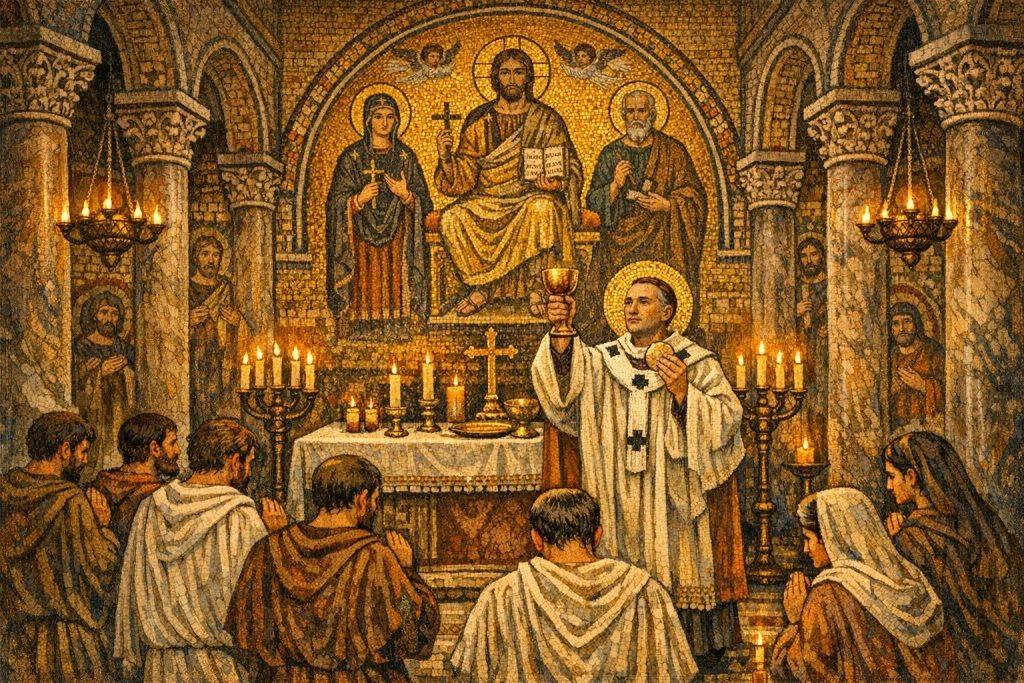
Nothing separates Catholic and Protestant Christianity more sharply today than the question of what happens in the Eucharist, and the early Church record on this question is about as clear as historical evidence gets. Modern Protestant theology, with the exception of some Lutherans who hold to a real presence position, treats the bread and wine of communion as symbols of Christ’s body and blood, as memorials of the Last Supper, or as spiritual but not physical encounters with Christ. The Catholic Church teaches that the bread and wine become the actual body and blood of Christ through the words of consecration at Mass (CCC 1376). The historical record leaves almost no room for doubt about which position the early Church held. Justin Martyr, writing around 155 AD, described the Eucharist to the Roman Emperor Antoninus Pius in terms so explicit that they embarrassed early Protestant apologists. Justin explained that Christians do not receive the bread and wine as common food and drink, but that just as Jesus Christ took flesh and blood for our salvation, so too the food over which the prayer of thanksgiving has been spoken is both the flesh and blood of the incarnate Jesus. This was not written for internal Catholic consumption; it was written as an explanation of Christianity to a pagan emperor. Justin had no reason to exaggerate or embellish in a private theological dispute. He was describing what Christians actually did and believed. Ignatius called the Eucharist “the medicine of immortality,” and warned that those who abstained from it because they denied that it was the flesh of Christ, who suffered for our sins, were not living in truth. These descriptions are not compatible with a memorialist view of communion.
The Didache, a document that many scholars date to the late first or very early second century and that may preserve traditions going back to the apostles themselves, describes the Eucharist with a reverence and a specificity that fits the Catholic understanding perfectly. It forbids anyone who has not been baptized from eating the Eucharist, citing the words of Jesus in Matthew 7:6 about not giving what is holy to dogs. The framing assumes that the Eucharist is a holy thing in a very particular sense, not merely a spiritual exercise or a shared meal with symbolic meaning. Cyril of Jerusalem, writing in the fourth century, instructed newly baptized Christians to receive communion with their hands shaped like a throne, to take the body of Christ with their eyes, and to be sure that not a particle fell. His instructions make no sense if the bread is only a symbol. Augustine of Hippo, who is sometimes claimed by Protestants as a forerunner of Reformed theology because of his strong emphasis on grace and predestination, wrote plainly about the reality of Christ’s body and blood in the Eucharist. The attempt to claim Augustine as a proto-Protestant on the Eucharist requires significant selective reading of a man who also wrote extensively about the Church, the episcopate, the sacraments, and the authority of Tradition in ways that are thoroughly Catholic. The early Church’s Eucharistic theology is one of the strongest pieces of evidence that the ancient Christian faith was Catholic in its fundamental structure.
Confession, Penance, and the Forgiveness of Sins Through the Church
One of the most common objections raised by Protestants against Catholic practice is the sacrament of Confession, formally called the Sacrament of Penance and Reconciliation, in which Catholics confess serious sins to a priest and receive absolution. The Protestant objection is that this is a medieval invention with no basis in the early Church, that Scripture teaches a person can go directly to God for forgiveness, and that no human priest has the authority to pronounce the forgiveness of sins. The Catholic Church teaches that Christ gave the apostles, and through them their successors the bishops and priests, the authority to forgive and retain sins, citing John 20:22-23 where the risen Christ breathed on the disciples and said, “Receive the Holy Spirit. If you forgive the sins of any, they are forgiven; if you retain the sins of any, they are retained” (CCC 1485). The Protestant reading of this passage is that it refers only to the proclamation of the gospel, not to a specific act of priestly absolution. But the early Church’s reading of this passage, judging from the actual practice that developed in the first centuries, was much closer to the Catholic interpretation. Origen, writing in the early third century, described the process by which a person burdened by sin should seek out a physician for the soul, meaning a bishop or experienced priest, and confess their sins to receive healing. He acknowledged that confession was painful and difficult but insisted it was necessary for serious sins. Tertullian, even before he broke from mainstream Christianity to join the Montanist sect, described a penitential discipline in which Christians who had committed grave sins underwent a public process of confession and reconciliation overseen by the Church community. His later Montanist writings, in which he argued against allowing certain sins to be forgiven at all, are sometimes used by Protestants to argue against Catholic confession, but this actually backfires on the Protestant argument: Tertullian’s controversy was not about whether the Church had authority to forgive sins, but about whether that authority had any limits. The very existence of the debate presupposes that the Church’s authority to forgive was accepted as real.
Cyprian of Carthage, one of the most significant bishops of the third century, dealt extensively with the question of how to handle Christians who had apostatized during the Decian persecution of 250 AD, and then sought readmission to the Church. His entire treatment of the question assumed that the Church, through its bishops, had real authority over who was and was not reconciled to God through reconciliation to the Church. He insisted that no one could have God as father who did not have the Church as mother, and he organized the process of readmission around the bishop’s role as the steward of God’s mercy. Pope Clement I, writing to the Corinthian church at the very end of the first century, exercised an authority over a distant community that makes no sense if early Christianity understood church governance the way most Protestant traditions do today. Clement did not merely offer advice; he corrected, admonished, and directed with a tone of real pastoral authority, and the Corinthians appear to have accepted this as legitimate. The Shepherd of Hermas, a second-century document that some early communities treated as near-canonical, addressed the question of postbaptismal sin and the possibility of forgiveness at length, in terms that assume the Church plays a real mediating role in the process of reconciliation. All of this evidence, taken together, presents a picture of early Christian life in which the forgiveness of serious sins was not simply a private matter between the individual and God, but a sacramental and ecclesial event involving the Church’s ministry.
Apostolic Succession Was Not a Later Invention
The Catholic doctrine of apostolic succession holds that the bishops of the Church today stand in an unbroken line of ordination going back to the apostles, and that this succession is the basis for the Church’s authority, the validity of its sacraments, and its identity as the one Church Christ founded (CCC 861). Protestants generally reject this doctrine, holding instead that authority in the Church derives from correct teaching of Scripture rather than from an unbroken chain of ordination. The early Church record on this question is not ambiguous. Irenaeus of Lyon, writing around 180 AD in his major work “Against Heresies,” provided the most systematic early account of apostolic succession as the criterion for distinguishing true Christianity from gnosticism and other heretical movements. He argued that the truth could be found wherever one found the genuine succession from the apostles, and he offered the succession of bishops at Rome as a particularly clear example because Rome was founded by the two most glorious apostles Peter and Paul. He listed the bishops of Rome from Peter down to his own day, presenting this succession as a living guarantee of doctrinal fidelity. His argument was not that the bishops were personally infallible or morally perfect, but that the apostolic faith was transmitted through them and that a community in communion with the apostolic sees was a community that possessed the authentic Christian tradition. This argument structures his entire refutation of gnosticism, and it is the argument that Protestantism, in its insistence on Scripture alone as the criterion of truth, fundamentally breaks with.
Clement of Rome’s letter to the Corinthians, which dates to around 96 AD, is another clear early witness to apostolic succession. Clement argued that the apostles appointed their successors and made provision for a further succession, so that the ministry would continue after the death of those they had appointed. He insisted that it was wrong to remove from office those who had been lawfully appointed, and he framed this in terms of the order established by God through Christ through the apostles through their successors. This is a fully developed theology of apostolic succession, presented within the first generation after the deaths of the apostles, by a man who himself appears in the apostolic succession lists of Rome as an early bishop. The document was not a theoretical theological treatise; it was a real intervention in a real church dispute, and it assumed that the principle of apostolic succession was accepted and authoritative. Hegesippus, a second-century Christian writer whose works survive only in fragments quoted by Eusebius of Caesarea, traveled from Palestine to Rome collecting lists of the succession of bishops in various churches, apparently because he understood that this succession was the guarantor of orthodoxy. The practice of maintaining these lists was widespread in the early Church, which suggests that apostolic succession was not a Roman innovation or a later development but a universal assumption about how the Church’s identity and authority worked.
The Primacy of Rome Was Real, Not Invented by Medieval Popes
The question of Rome’s special authority among the early churches is one of the most contested historical questions in Christian studies, and it deserves honest treatment precisely because it is contested. Catholics claim that the primacy of the Bishop of Rome, the Pope, goes back to Christ’s words to Peter in Matthew 16:18-19, where Christ said, “You are Peter, and on this rock I will build my Church, and the powers of death shall not prevail against it. I will give you the keys of the kingdom of heaven, and whatever you bind on earth shall be bound in heaven, and whatever you loose on earth shall be loosed in heaven.” The Catholic Church teaches that Peter’s successors in Rome inherit this primacy (CCC 882). The historical evidence for a special Roman authority in the early Church is genuine, even if its precise nature and extent were not defined with the precision the First Vatican Council used in 1870. Clement of Rome’s letter to the Corinthians, already mentioned above, stands as the earliest non-canonical evidence of Roman intervention in another church’s affairs. Rome was not a geographically close neighbor to Corinth. Clement wrote with a tone of authority that was accepted, not contested. Ignatius of Antioch, in his letter to the Romans, addressed the Roman church in terms unlike any of his other letters, calling it the church “that presides in the place of the region of the Romans,” “worthy of God, worthy of honor, worthy of blessing, worthy of praise, worthy of success, worthy of sanctification, and presiding over love.” The precise meaning of “presiding over love” is debated, but the fact that Ignatius reserved this unique language for Rome is historically significant.
Irenaeus, as noted above, pointed to the Roman succession as the clearest example of the apostolic tradition because of Rome’s founding by Peter and Paul and because all churches must agree with Rome. Pope Victor I, at the end of the second century, attempted to impose the Roman date for the celebration of Easter on churches in Asia Minor that followed a different tradition, and while this effort was resisted by Polycarp and others, the fact that a Roman bishop felt his authority extended to such a decision across the whole Church, and was taken seriously enough to generate real controversy, tells us something important about how Rome understood its own role. The Council of Nicaea in 325 AD and subsequent councils recognized Rome as holding a primacy of honor at minimum, and the ongoing appeals made to Rome from churches throughout the Mediterranean world throughout the fourth and fifth centuries suggest a practical primacy that went beyond mere honor. Augustine of Hippo’s famous statement, “Rome has spoken, the case is closed,” though its precise original context is sometimes debated, captures the practical reality of how the Western Church functioned. None of this means that every aspect of papal authority as defined in the nineteenth and twentieth centuries was fully explicit in the early Church. Development of doctrine is a real thing, and the Catholic Church acknowledges it. But the seed of Roman primacy was clearly present in the early centuries, and it grew in a Catholic direction rather than in a direction that supports Protestant ecclesiology.
Development of Doctrine Is Not the Same as Corruption
One of the most intellectually serious responses to the Catholic historical argument is the Protestant claim that even if early Christianity does look more Catholic than Protestant, this proves only that the early Church developed away from original apostolic Christianity very quickly, and that both Catholicism and Protestantism represent later developments from a simpler original faith. This argument has genuine force, and it deserves honest engagement. The Catholic response is the doctrine of the development of doctrine, articulated most fully by Blessed John Henry Newman in his landmark 1845 work “An Essay on the Development of Christian Doctrine,” which Newman wrote while still an Anglican and which contributed directly to his conversion to Catholicism. Newman argued that genuine doctrinal development is not the same as doctrinal corruption. A seed grows into a tree, and the tree is genuinely different in form from the seed, but it is the same organism growing according to its own nature. Newman identified criteria for distinguishing genuine development from corruption: genuine development preserves the original idea, it unfolds from within, it strengthens rather than undermines the original structure, and it is recognized by the community as continuous with what came before rather than as a replacement for it. Applying these criteria to Catholic development and Protestant revision, Newman found Catholic development to be the organic growth of the original apostolic faith and the Reformation to be a break rather than a recovery. This argument did not convince everyone, and Protestant theologians have responded to it, but it is a serious intellectual argument that cannot simply be dismissed.
The honest reality is that every Christian tradition involves some form of doctrinal development, and the question is not whether development happened but whether the development was guided by the Holy Spirit or represented a corruption of the original. Protestants who claim to follow Scripture alone still have to interpret Scripture, and their interpretations reflect centuries of theological development within their own traditions. The Westminster Confession, the Heidelberg Catechism, and the Augsburg Confession are all documents of doctrinal development within Protestantism. Baptists who reject infant baptism are engaged in a doctrinal position that most early Christians would not have recognized as the standard practice. The canon of the New Testament itself was not formally defined until the late fourth century, and the councils and bishops who defined it were the same bishops and councils that the Catholic Church points to as expressions of its authority. A Protestant who accepts the New Testament canon while rejecting the authority of the councils and bishops who defined it is in a historically awkward position. The Catholic claim is not that every doctrine appeared fully formed in the first century and can be found word for word in the writings of Justin Martyr. The Catholic claim is that the fullness of the faith that Christ gave to the apostles was entrusted to the Church, and that the Church, guided by the Holy Spirit, has unfolded that deposit of faith over time in a way that is continuous and organic rather than inventive and discontinuous.
What the Protestant Case Actually Gets Right
Intellectual honesty requires acknowledging what the Protestant historical case actually gets right, because pretending there are no legitimate Protestant historical arguments serves no one. It is true that not every Catholic practice or belief has a clear and unambiguous precedent in the first-century Church. The development of the papacy’s specifically monarchical character took centuries. The precise dogmatic formulation of transubstantiation, the philosophical term for what happens to the bread and wine at Mass, came from the medieval period, even though the underlying belief in the Real Presence was ancient. The formal definition of the canon of Scripture, as already noted, happened in the fourth century, which means Christians before that time operated without the fixed closed canon that both Catholics and Protestants accept today. Some practices that became standard in medieval Catholicism, such as mandatory celibacy for all Western-rite priests, were not universal in the early Church; married men were ordained to the priesthood and episcopate in the early centuries, and this is still the practice in Eastern Catholic Churches in communion with Rome today. The development of Marian dogmas, including the Immaculate Conception formally defined in 1854 and the Assumption formally defined in 1950, involved doctrinal development of a kind that not all historians find straightforwardly continuous with the earliest available evidence. Honest Catholic engagement with these questions does not require abandoning the historical argument for Catholicism, but it does require acknowledging that the argument is stronger in some areas than others.
The Protestant Reformers were also right to object to many of the pastoral and moral failures that afflicted the medieval Church. The selling of indulgences in the form that Luther encountered was a serious distortion of the Catholic teaching on satisfaction for sin. Clerical corruption, political manipulation of Church appointments, and the neglect of genuine pastoral care for ordinary believers were real problems that needed real reform. The Catholic Church itself acknowledged this at the Council of Trent, which was a massive reform council that corrected many of the practical abuses the Reformers had identified. The fact that genuine reform was needed does not validate every theological position the Reformers took, but it does mean that the impulse behind the Reformation was not simply theological error. Luther, Calvin, and their contemporaries were responding to real problems in the Church, and their response, even where it went theologically wrong in Catholic eyes, was fueled by a genuine love for Scripture and a genuine pastoral concern for souls. Acknowledging this does not weaken the Catholic historical case; it strengthens the credibility of the Catholic person making the argument, because it shows that the argument rests on actual historical evidence rather than on a caricature of all non-Catholic Christianity as bad faith.
What You Actually Find When You Read the Church Fathers
The single most important practical step for anyone who wants to engage seriously with the question of whether the early Church looked Catholic or Protestant is to read the Church Fathers directly rather than relying exclusively on summaries and secondary sources. The Fathers are available in English translation through sources like the Ante-Nicene Fathers and Nicene and Post-Nicene Fathers collections, and many individual texts are available free online through sites like the New Advent Catholic Encyclopedia and the Christian Classics Ethereal Library. What a person finds when they read the Fathers directly is often genuinely surprising, because the popular Protestant presentation of early Church history does not prepare a person for what is actually there. Reading Ignatius of Antioch for the first time, a person who has been taught that the early Church was a simple community of believers gathered around Scripture alone will find a man who insists on the authority of the bishop in terms so strong they sound almost monarchical, who describes the Eucharist as the flesh of Christ, and who speaks of a united visible Church with a definite hierarchical order as the non-negotiable foundation of authentic Christianity. Reading Justin Martyr’s First Apology, a person will find a detailed description of the Sunday Eucharistic assembly that includes the offertory of bread, wine, and water, the prayer of thanksgiving, the distribution of communion to those present and its being carried to the absent, and an explicit statement that this food is not common bread and wine. Reading Irenaeus against the gnostics, a person will find an argument structured entirely around the apostolic succession and the visible, hierarchical Church as the criterion of truth over against private interpretation of Scripture.
Reading Cyprian of Carthage, a person will find one of the most uncompromising statements of ecclesiology in the ancient Church. Cyprian wrote that a person cannot have God as father who does not have the Church as mother, and that outside the Church there is no salvation. He meant by this the visible, hierarchical, sacramental Church gathered around its bishop in communion with the other bishops. He did not mean an invisible assembly of true believers whose unity was purely spiritual and who could belong to any congregation that taught correctly. His understanding of the Church was structural and visible in a way that is categorically different from the invisible-church ecclesiology that underlies most of Protestant theology. Reading Jerome, a person finds a passionate defender of the virginity of Mary and of the special status of virginity and celibacy as a Christian calling. Reading Augustine, a person finds a theologian who placed enormous weight on the authority of the Church, who insisted that he would not believe the gospel unless moved to do so by the authority of the Catholic Church, and who developed the theology of original sin, grace, and predestination within a framework that was thoroughly sacramental and ecclesial, not individualistic. The Fathers are not a uniformly simple resource that proves every Catholic doctrine with crystal clarity, but the overall picture they present is far closer to Catholic Christianity than to any form of Protestantism.
How Honest Protestants Have Responded to This Evidence
The question of what the early Church looked like has not gone unexamined by Protestant scholars, and the honest ones have grappled seriously with the patristic evidence rather than pretending it does not exist. Jaroslav Pelikan, one of the most respected church historians of the twentieth century, spent his career studying the development of Christian doctrine across the centuries, and his multi-volume work “The Christian Tradition” is a landmark of careful, thorough historical scholarship. Pelikan was a Lutheran for most of his life, and he engaged the patristic evidence without any desire to promote Catholicism. His conclusion, reflected throughout his scholarly work, was that the faith of the early Church was not the faith of the Protestant Reformers and that the development of Catholic theology was a genuine development of the original Christian deposit rather than a corruption of it. Near the end of his life, in 2004, Pelikan converted to Eastern Orthodoxy, a tradition that shares with Catholicism the sacramental, hierarchical, and traditional understanding of the Church, though it differs from Rome on the question of papal authority. His conversion was informed by decades of immersion in patristic sources, and it represents a significant intellectual verdict on the question of which Christianity most closely resembles the early Church. Thomas Howard, a Protestant scholar and brother of the well-known evangelical theologian Elisabeth Elliot, wrote a book titled “Evangelical Is Not Enough” in which he traced his intellectual and spiritual movement from evangelicalism to Anglicanism and eventually to Catholicism, driven largely by his encounter with the richness of the ancient Church’s liturgical and sacramental life. His journey, and the journeys of many other Protestant scholars and pastors who have entered the Catholic Church, are not proofs that Catholicism is true, but they are evidence that the historical argument is serious enough to move careful and intellectually honest people.
Some Protestant scholars have responded to the patristic evidence by arguing for a distinction between the visible, institutional Church that developed in the early centuries and the true invisible Church of genuine believers, arguing that the institutional developments were human additions rather than divinely guided developments. This is an intellectually coherent position, but it has its own serious problems. It requires the assumption that the Holy Spirit essentially abandoned the visible Church in its earliest centuries to develop in directions contrary to what Christ intended, without any clear correction or recovery until the sixteenth century. It requires treating the men who had personally known the apostles or who had been taught by people who had known them as witnesses to a corruption rather than to a continuity. It requires accepting a very individualistic and private reading of texts like Matthew 16:18-19, John 20:22-23, and Luke 22:19 that runs against the grain of how those texts were actually read and applied in the communities that produced and preserved them. And it requires explaining why Christ’s promise that the gates of hell would not prevail against His Church apparently failed within one or two generations of His resurrection. These are not impossible positions to hold, but they are costly positions that require significant intellectual investment to sustain, and the honest Protestant willing to engage the patristic evidence knows this.
Scripture Itself Points in a Catholic Direction
The historical argument is strong, but it does not stand alone; it is reinforced by the internal evidence of the New Testament itself, which points in directions that fit the Catholic understanding of the Church better than the Protestant one. The Church in the New Testament is not a loose association of individuals who gather around a shared reading of Scripture. It is a community with real authority structures, real leaders, real disciplinary processes, and a real sacramental life. In Matthew 18:15-18, Jesus gave the Church authority to bind and loose, meaning to make authoritative decisions that carry real weight. In Luke 10:16, Jesus told His disciples that whoever hears them hears Him and whoever rejects them rejects Him, grounding the authority of the apostolic mission in the authority of Christ Himself. In Acts 15, the early Church faced a serious theological dispute about circumcision and the law, and it resolved that dispute not by each individual believer searching the Scriptures privately and reaching a personal conclusion, but by calling a council in Jerusalem, deliberating together under the guidance of the Holy Spirit, and issuing a binding decision that was sent to the churches with authority. This is precisely the structure of conciliar authority that the Catholic Church has practiced throughout its history. The New Testament also presents the Eucharist in the sixth chapter of John’s Gospel in terms so literal and concrete that they provoked a crisis among Jesus’s listeners. John 6:53-56 has Jesus saying that unless a person eats His flesh and drinks His blood they have no life in them, that His flesh is real food and His blood is real drink, and that whoever eats His flesh and drinks His blood abides in Him and He in them. When disciples found this saying hard and left Him because of it, Jesus did not clarify that He was speaking metaphorically. He let them leave and turned to the Twelve and asked whether they too wanted to go.
Paul’s treatment of the Eucharist in 1 Corinthians 11:17-34 is equally serious. He wrote that whoever eats the bread or drinks the cup of the Lord unworthily eats and drinks judgment upon themselves, not discerning the body of the Lord. He linked the sickness and deaths in the Corinthian community to their unworthy reception of the Eucharist. This is not the language of someone describing a symbolic memorial meal. This is language that treats the Eucharist as something with a real and powerful presence capable of conveying both grace and judgment. Paul also described the cup of blessing that Christians bless as a participation in the blood of Christ and the bread that they break as a participation in the body of Christ (1 Corinthians 10:16). The Greek word he used, “koinonia,” means real sharing or communion, not a symbolic act of remembrance. When the Church Fathers read these texts and wrote about the Eucharist in the terms described above, they were drawing on the plain sense of the New Testament text as their communities understood it. The Protestant move to interpret these texts symbolically or spiritually was a sixteenth-century development that contradicted fifteen centuries of nearly universal Christian reading. That does not automatically make the Protestant interpretation wrong, but it does place a serious burden of proof on the Protestant side, a burden that requires explaining why the plain reading was universally abandoned in favor of a symbolic one only after Luther and Zwingli had a famous public disagreement about the matter in 1529.
The Question of the Biblical Canon Cuts Against Sola Scriptura
One of the most effective historical arguments against the Protestant principle of “sola scriptura,” meaning Scripture alone as the final authority for Christian doctrine, is the question of who determined what Scripture is. The canon of the New Testament was not delivered from heaven wrapped in a bow. It developed over time within the Church, through a process of discernment that involved bishops, councils, and the lived experience of Christian communities using and weighing various texts. Different communities used different collections of texts in the early centuries. Some texts that were eventually excluded from the canon, like the Shepherd of Hermas and the Didache, were treated as nearly scriptural by some communities. Some texts that were eventually included, like the book of Revelation and the letter to the Hebrews, were disputed in some regions. The decisive canonical decisions came from local councils in the late fourth century, and those decisions were subsequently affirmed by broader Church authority. Pope Damasus I issued a canonical list in 382 AD that matches the Catholic canon. The Council of Hippo in 393 AD and the Councils of Carthage in 397 and 419 AD affirmed the same canon. These were Catholic councils, operating through Catholic bishops, exercising the kind of conciliar authority that Protestantism rejects in principle. If a Protestant accepts the New Testament canon, they are accepting a determination made by the very kind of Church authority they reject as the final arbiter of Christian truth. This is not merely a debating point; it is a genuine structural problem for the Protestant position that serious Protestant thinkers have acknowledged and struggled with.
The Protestant response to this problem is typically that the Church did not determine the canon but only recognized what was already canonical by its own intrinsic qualities. This is a theologically possible position, but it faces practical difficulties. The communities that eventually accepted the canon disagreed with each other about specific books for centuries, which means the intrinsic qualities of the texts were not obvious to everyone. If private judgment can recognize canonical Scripture reliably, why did so many early Christians fail to recognize it correctly? And if the Church’s corporate judgment was reliable enough to identify Scripture correctly, why should we trust that judgment while rejecting the same community’s judgment on other matters of doctrine and practice? The Catholic position is that the same Spirit-guided authority that identified the Scriptures also guarded and transmitted the full apostolic deposit of faith, and that it is theologically inconsistent to accept the Church’s authority regarding the canon while rejecting it regarding everything else. This argument was Newman’s central insight in his movement toward Rome, and it remains a genuinely compelling argument that the Protestant position struggles to answer without either granting more authority to the Church than Protestant theology can accommodate or retreating to a position about intrinsic canonical qualities that is historically difficult to sustain.
So, Does the Historical Evidence Actually Settle the Question?
The historical evidence that the early Church looked Catholic rather than Protestant is strong, genuinely strong, strong enough that engaging with it honestly is one of the most significant intellectual challenges facing any thoughtful Protestant. The convergence of evidence from the apostolic fathers, the second and third century apologists and theologians, the practice of early Christian worship, the structure of early Christian community life, and the reading of the New Testament within those early communities all points in a direction that is far more compatible with Catholic Christianity than with any major form of Protestant Christianity. A person who reads Ignatius of Antioch, Justin Martyr, Irenaeus, Cyprian, and the other Fathers with genuine openness and honesty will find it very difficult to come away saying that the early Church looked like a modern evangelical congregation, a Presbyterian denomination, or a Baptist church. That conclusion is not a matter of Catholic bias; it is the conclusion that careful historians, including non-Catholic ones, have reached when they engage the primary sources directly. The evidence for a sacramental Eucharist, for apostolic succession, for episcopal authority, for the role of Tradition alongside Scripture, for the real forgiveness of sins through the Church’s ministry, and for the special status of Rome among the churches of the first several centuries is historical, textual, and serious.
At the same time, the honest person acknowledges the limits of what historical evidence can prove. The historical argument can demonstrate that the early Church looks more Catholic than Protestant. It cannot by itself prove that the Catholic Church today is the true continuation of that early Church in every claimed detail. It cannot resolve every question about the development of doctrine, the precise nature of papal authority, or the specific form in which Marian doctrines were held in the earliest communities. History is a necessary part of the argument for Catholicism, but it is not the whole argument. The full case for Catholicism also involves the internal coherence of Catholic theology, the living witness of the saints, the ongoing vitality of the Church’s spiritual and intellectual tradition, and ultimately the kind of personal encounter with Christ that no historical argument alone can produce or replace. What the historical argument does is remove one of the most common Protestant objections, the objection that Catholicism is a medieval distortion of original Christianity. When that objection falls, the intellectual space opens for a person to consider Catholicism on its full merits, including its theological, philosophical, and spiritual claims. That is a significant contribution, and it is why the historical argument matters. If you are in the middle of this question, the best thing you can do is go to the sources yourself. Read the Fathers. Read the New Testament with fresh eyes. Read Newman and then read the Protestant responses to Newman. Take the question seriously, because it is serious. The early Church was not ambiguous about what it was; the only question is whether you are willing to look honestly at what it actually said.
Disclaimer: This article presents Catholic teaching for educational purposes. For official Church teaching, consult the Catechism and magisterial documents. For personal spiritual guidance, consult your parish priest or spiritual director. Questions? Contact editor@catholicshare.com
Sign up for our Exclusive Newsletter
- 📌 Add CatholicShare as a Preferred Source on Google
- 🎁 Join us on Patreon for Premium Content
- 🎧 Check Out These Catholic Audiobooks
- 📿 Get Your FREE Rosary Book
- 📱 Follow Us on Flipboard
-

Recommended Catholic Books
Discover hidden wisdom in Catholic books — invaluable guides enriching faith and satisfying curiosity. #CommissionsEarned
- The Early Church Was the Catholic Church
- The Case for Catholicism - Answers to Classic and Contemporary Protestant Objections
- Meeting the Protestant Challenge: How to Answer 50 Biblical Objections to Catholic Beliefs
As an Amazon Associate, I earn from qualifying purchases. Thank you for your support.